The short answer
Cane Corsos are naturally alert and protective, NOT naturally aggressive. The difference is critical. Guardian breed psychology runs on a four-stage continuum: alert (notice), assess (decide), act (respond if needed), disengage (return to baseline). Aggression problems are almost always disengagement problems, fixable with force-free training. Bite force claims of 700 PSI are internet myth; bite SEVERITY correlates with dog SIZE not breed. Never punish the growl: it removes the warning system without fixing the underlying state. Edmonton Bylaw 21244 dangerous-dog provisions apply to any breed by behaviour, not breed. Muzzle training is responsible ownership, not failure. Force-free training only. Aversive corrections (prong, e-collar) increase bite risk in guardian breeds and create Bylaw 21244 exposure.
The four-stage guardian continuum
ALERT, then ASSESS, then ACT, then DISENGAGE. The Corso's genetic substrate is built around this. Aggression problems are almost always disengagement problems.
- ALERT (notice the thing). The dog perceives the stimulus. Body stiffens slightly, ears come forward, vocal acknowledgment may follow. This is the warning the breed exists to provide.
- ASSESS (decide if it is a threat). The dog evaluates: is this person dangerous? Is this dog approaching aggressively? Is this noise meaningful? Trained Corsos take cues from the handler during this phase.
- ACT (respond if needed). If assessment concludes threat, the dog escalates: barking, body forward, possibly moving toward the threat. If assessment concludes no threat, the dog returns to baseline without acting.
- DISENGAGE (return to baseline). The trigger passes. The dog comes back down. This is the critical training skill that distinguishes safe Corsos from dangerous ones.
All true guardian breeds share this pattern: Cane Corso, Presa Canario, Bullmastiff, Boerboel, Tibetan Mastiff, Caucasian Shepherd, Anatolian Shepherd, Great Pyrenees. The genetic blueprint for centuries was guarding property, livestock, and family.
Why this matters for Edmonton owners: most “aggression” problems are disengagement problems. The dog noticed correctly, assessed correctly, may have even acted correctly, but cannot come back down to baseline. Disengagement is a TRAINING skill, not a genetic gift. Your job as the owner is to be the thermostat. You see the trigger first, you mark it for the dog (“yes, I see it, we are fine”), and you cue disengagement before the dog escalates.
The aversive-training failure mode: a Corso trained with prong collars, e-collars, or alpha rollovers learns to suppress the alert stage entirely. The result is dogs that go from zero to act with no warning. That is a dangerous dog. A Corso trained with positive methods is allowed to alert, taught to assess, and rewarded for disengaging. That is a safe dog.
The bite-force myth
Cane Corso bite force is often cited at 700 PSI online. This number comes from internet speculation, not peer-reviewed measurement. The most cited peer-reviewed bite force study (Ellis 2008, also National Geographic 2005 measurements) put domestic dog average around 320 PSI, German Shepherd around 238 PSI, Rottweiler around 328 PSI. No direct Cane Corso measurement exists in the published literature.
Even the high end of speculation puts Corsos in the same range as other large guardian breeds. The data that matters:
- Bite SEVERITY correlates with dog SIZE, not breed. A 130 lb Cane Corso bite is more dangerous than a 25 lb Beagle bite because the dog is heavier and the jaw is bigger. A 130 lb Newfoundland bite would be equally dangerous.
- Bite INCIDENTS correlate with socialisation gaps and owner experience, not breed alone. CDC and peer-reviewed bite epidemiology data is consistent.
- The American Veterinary Medical Association position is explicit: breed is not a reliable predictor of bite risk. Individual dog history, socialisation, and owner handling are.
The honest framing for Edmonton owners: yes, your Corso has the physical capability to do serious damage if a bite happens. That capability never goes away. Your job is to make sure a bite never happens through proper socialisation, force-free training, management of trigger exposure, and muzzle training for high-risk situations. Most Corsos go their entire lives without a single bite. That outcome is the norm, not the exception.
Fear-aggression vs guardian-aggression
| Signal | Fear-aggression | Guardian-aggression |
|---|---|---|
| Body posture | Tucked, low, weight back | Confident, forward, weight forward |
| Eyes | Whale eye, lip-licking, head turned | Hard direct stare |
| Vocal | Whine, then explosion | Clear vocal warning, then escalation if ignored |
| Trigger pattern | Unpredictable; close-range; quick movement | Predictable territorial or stranger-approach |
| Treatment direction | Confidence building, threshold work, counter-conditioning | Disengagement training, owner-handler clarity, trigger management |
The cost of guessing wrong is high. A fear-aggressive Corso treated with corrections will escalate. A guardian-aggressive Corso treated only with desensitisation may continue to rehearse without ever learning disengagement. An Edmonton force-free trainer with guardian-breed experience can distinguish between the two in a single assessment session. Trainer consultation cost: $150 to $250. Veterinary behaviourist consultation (DACVB telemedicine or referral to Western College of Veterinary Medicine in Saskatoon): $400 to $800. Worth it.
The never-punish-the-growl rule
If your Corso growls and you scold the dog or use a leash correction, you teach the dog that growling predicts punishment. The dog stops growling but does not stop feeling uncomfortable. You have removed the warning system without fixing the underlying problem. The next escalation is a bite with no warning.
Growling is communication, not defiance. Your Corso is saying “I am uncomfortable with this person right now.” Thank the dog for the information, then manage the situation.
The right response: calm cue to a place or crate in a separate room, high-value chew, close the door. The dog has been told their concern was heard and they have been removed from the trigger. The friend or visitor is in the house, comfortable, and the dog is not rehearsing escalation.
The long fix: gradual positive exposure. Have your friend ignore the dog entirely on visits (no eye contact, no reaching out, no talking to the dog). After several visits where nothing bad happens, the friend can drop treats on the floor while ignoring the dog. After more visits, brief calm eye contact. Months, not days. Most Corsos warm up to specific known people over time with patient exposure.
Some Corsos never want strangers in the house and that is a temperament reality, not a fixable problem. If your dog is in the “never wants strangers” category, build a lifestyle that respects it: dog goes to a quiet room when friends come over, your social life happens outside the house or at times when the dog is settled. That is responsible guardian-breed ownership. Edmonton force-free trainer involvement is strongly recommended for any Corso who growls at visitors more than occasionally.
Browse adoptable Cane Corsos in Edmonton
Adult Cane Corsos (3+ years) with documented foster history are the safest fit for first-time guardian-breed households. Edmonton rescues disclose temperament honestly during the foster phone screen.
See Available Cane Corsos →Muzzle training as baseline life skill
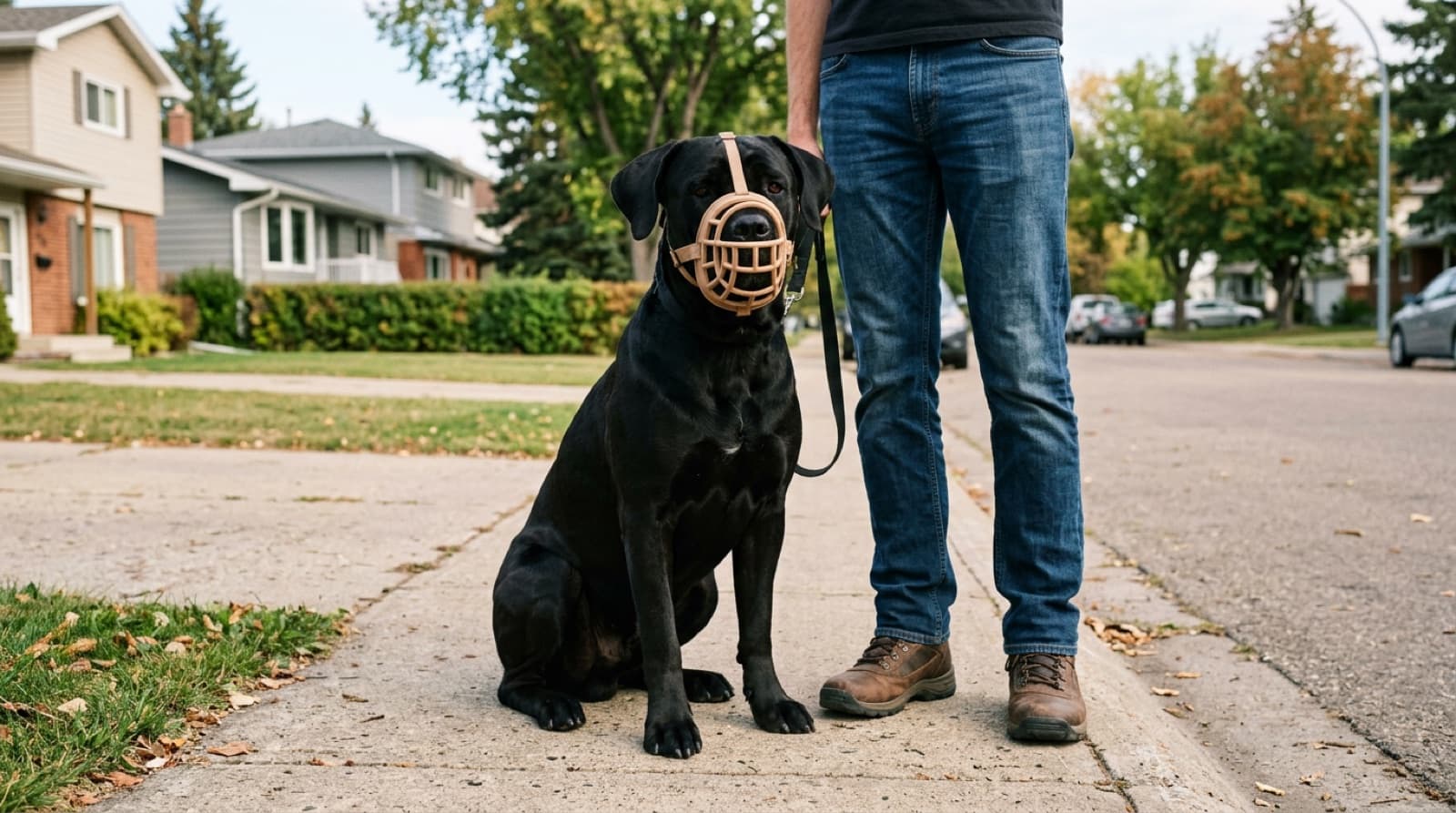
Muzzle train every Cane Corso, every time, as a baseline life skill, before you need it. The muzzle does not change your dog's temperament. It eliminates a low-probability worst-case outcome.
When you might need a muzzle:
- Vet visits (especially first visit with a new vet, dental procedures, anything involving pain).
- Grooming (nail trims, ear cleaning, ear infections that are painful).
- Introductions to children (responsible introduction at minimum the first few times).
- Emergency situations (your dog is injured and needs to be moved).
- Any situation where unpredictable things might happen around your dog.
The right muzzle: basket-style (Baskerville, Trust Your Dog, or custom-fit). The dog can pant, drink, take treats. Closed-cup vet muzzles are for short procedures only and should not be used for longer than 10 minutes.
Training timeline: 4 to 8 weeks of positive conditioning from puppy or new-rescue stage. Start by feeding treats through the muzzle without strapping, then short wears with treats, then longer wears, then wears during normal activities. By the end, your dog should think the muzzle predicts good things. Many Edmonton force-free trainers offer muzzle training workshops for $50 to $150.
The asymmetry: if you train it and never need it, no harm done. If you do not train it and need it in an emergency, you have a dog who associates the muzzle with stress in the worst moment. Muzzle training is responsible ownership, full stop.
Bylaw 21244 stakes for Cane Corso owners
Alberta has no breed-specific legislation, and the Edmonton Animal Care and Control Bylaw 21244 treats Cane Corsos the same as every other breed. The dangerous-dog provisions are behaviour-based: a dog can be declared dangerous after biting, attacking, or threatening a person or animal, regardless of breed or size.
The classification carries serious consequences: mandatory leashing, muzzle in public, secure containment requirements, and fines that can run into thousands of dollars. For Cane Corso owners specifically, an adolescent-phase bite incident that would resolve quietly with another breed can trigger a dangerous-dog designation that follows the dog for life.
The practical case for force-free training: the behaviour-modification record matters if there is ever an incident. A dog whose owner can demonstrate ongoing work with a CCPDT-credentialed or IAABC-credentialed force-free trainer is in a different position than a dog whose owner cannot. Aversive training that increases bite probability creates legal exposure on top of welfare harm.
The detailed Bylaw 21244 housing and insurance context lives in our sibling Edmonton Cane Corso housing and insurance guide.
The science on aversive training: the American Veterinary Medical Association, the International Association of Animal Behaviour Consultants, the Certification Council for Professional Dog Trainers, and the American Veterinary Society of Animal Behavior all carry position statements against aversive correction tools, citing elevated fear, aggression, and bite risk.
Frequently Asked Questions
Are Cane Corsos naturally aggressive?
No. This is the most important distinction in the breed. Cane Corsos are naturally ALERT and PROTECTIVE, not naturally aggressive. The difference is critical. A well-bred, well-socialised Corso is suspicious of strangers, watchful of their environment, and willing to act if they perceive a real threat. That is not the same as aggressive. Aggressive means seeking out conflict. Alert-protective means responding to perceived threat. Most Corsos go their entire lives without a single bite incident. Long-term owner community consensus: "my Corso is sweet at home, suspicious of strangers, will bark first and ask later." That is normal, healthy guardian temperament. It is also why this breed is not for first-time dog owners. The threshold for what a Corso considers a threat must be carefully shaped through structured socialisation in the first 18 months, or natural suspicion can drift into fear-based reactivity. Cane Corsos who become "aggressive" almost universally have one of three histories: insufficient early socialisation, aversive training methods that damaged trust, or genuine fear from a specific bad experience. Breed alone does not produce an aggressive dog. The Italian Cane Corso breed standard explicitly calls for a dog that is discriminating, not indiscriminate.
What is guardian breed psychology and why does it matter?
Guardian breed psychology runs on a four-stage continuum: ALERT (notice the thing), ASSESS (decide if it is a threat), ACT (respond if needed), DISENGAGE (return to baseline). All true guardian breeds share this pattern: Cane Corso, Presa Canario, Bullmastiff, Boerboel, Tibetan Mastiff, Caucasian Shepherd, Anatolian Shepherd, Great Pyrenees. The Corso's job for centuries was to guard property, livestock, and family. Their genetic substrate is built around this continuum. When a Corso barks at a stranger walking past your fence, that is the ALERT stage working correctly. When they then calmly return to your side when you say "thank you, that is enough," the ASSESS and DISENGAGE stages are working. When they cannot disengage and continue escalating, something has broken in the continuum. Why this matters for Edmonton owners: most "aggression" problems in Cane Corsos are actually disengagement problems. The dog noticed correctly, assessed correctly, may have even acted correctly, but cannot come back down to baseline. Disengagement is a TRAINING skill, not a genetic gift. Your job as the owner is to be the thermostat. You see the trigger first, you mark it for the dog ("yes, I see it, we are fine"), and you cue disengagement before the dog escalates. A Corso trained with aversive corrections learns to suppress the alert stage entirely, which produces dogs that go from zero to act with no warning. That is a dangerous dog. A Corso trained with positive methods is allowed to alert, taught to assess, and rewarded for disengaging. That is a safe dog.
My Cane Corso is going through adolescent reactivity at 14 months. Is this normal?
Yes, completely normal, and the most important behaviour management window of the dog's life. Cane Corsos hit a sharp behavioural shift between 12 and 24 months when the guardian instinct fully emerges. A puppy who was friendly with every stranger at 8 months may suddenly start barking at strangers at 14 months. A dog who ignored other dogs at the off-leash zone at 10 months may start staring at them at 16 months. This is not regression and not bad behaviour. The breed's genetic blueprint is switching on. Three rules: First, do not punish the alert. If your dog barks at a stranger and you correct them harshly, you teach them that strangers predict bad things from you. That builds reactivity, not reduces it. Mark the alert calmly ("yes, I see them, thank you") and reward calm following. Second, increase structured socialisation, do not decrease it. Many owners pull back from socialisation when the dog starts barking. Wrong move. Calm, positive exposure to varied people, dogs, and environments at safe distance teaches the dog that the world is largely not threatening. Third, get a force-free trainer involved now, not later. An Edmonton force-free trainer with guardian-breed experience (CCPDT, KPA, IAABC, or Fear Free certified) will help you shape the alert-assess-disengage continuum during this critical window. The window closes around 24 to 30 months. Adult Corso temperament is largely set by 30 months. Invest the work now.
What about Cane Corso bite force? Are Corsos more dangerous than other big dogs?
The bite force discussion is mostly myth, and the data is clear. Yes, a Cane Corso can bite hard. So can any 100+ pound dog. Cane Corso bite force is often cited at 700 PSI, but this number comes from internet speculation, not peer-reviewed measurement. The most cited peer-reviewed bite force study (Ellis 2008, also National Geographic 2005 measurements) put domestic dog average around 320 PSI, German Shepherd around 238 PSI, Rottweiler around 328 PSI, and no direct Cane Corso measurement exists. Even the high end of speculation puts Corsos in the same range as other large guardian breeds. CDC bite statistics and peer-reviewed bite severity studies consistently find that bite SEVERITY correlates with dog SIZE, not breed. A 130 lb Cane Corso bite is more dangerous than a 25 lb Beagle bite because the dog is heavier and the jaw is bigger. A 130 lb Newfoundland bite would be equally dangerous if it happened. The breed is not the variable. Size is. Bite INCIDENTS correlate with socialisation gaps and owner experience, not breed alone. The American Veterinary Medical Association position is explicit: breed is not a reliable predictor of bite risk. Individual dog history, socialisation, and owner handling are. The honest framing for Edmonton owners: yes, your Corso has the physical capability to do serious damage if a bite happens. That capability never goes away. Your job is to make sure a bite never happens through proper socialisation, force-free training, management of trigger exposure, and muzzle training for high-risk situations.
Fear-aggression vs guardian-aggression: what is the difference?
Different problems, different fixes. FEAR-AGGRESSION presents like this: the dog freezes, then explodes. Body language before the explosion shows fear signs (whale eye, ears back, tail tucked, lip-licking, head turned away). The trigger is often something the dog cannot predict or control: a stranger reaching toward them, a loud noise, being cornered, a quick movement. Fear-aggressive dogs are not trying to drive the threat away because they think they will win. They are trying to drive the threat away because they think they will lose. This is the more dangerous category because warning signs are often subtle. GUARDIAN-AGGRESSION presents differently: confident body, forward stance, hard eye, vocal warning, then escalation if the warning is ignored. The dog is making a clear "you, leave" statement. This is more typical of the breed at full maturity and is what guardian breed psychology produces by design. Why the distinction matters: fear-aggression requires confidence building, threshold management, and counter-conditioning over months. Aversive corrections make fear-aggression dramatically worse because they confirm the dog's belief that the trigger predicts bad things. Guardian-aggression requires teaching disengagement, building owner-handler clarity, and managing trigger exposure so the dog does not over-rehearse the guarding response. An Edmonton force-free trainer with guardian-breed experience can distinguish between the two in a single assessment session. The cost of guessing wrong is high. A fear-aggressive Corso treated with corrections will escalate. A guardian-aggressive Corso treated only with desensitisation may continue to rehearse without ever learning disengagement. Trainer consultation cost: $150 to $250. Veterinary behaviourist consultation (DACVB telemedicine or Western College of Veterinary Medicine in Saskatoon): $400 to $800. Worth it.
Should I muzzle train my Cane Corso?
Yes. Absolutely. And no, it is not admitting your dog is dangerous. It is admitting that your dog is large enough and capable enough that a safety tool is responsible ownership. Muzzle training is a SAFETY TOOL, not a punishment, and not a failure marker. Long-term owner community consensus: muzzle train every Corso, every time, as a baseline life skill, before you need it. When you might need a muzzle: vet visits (especially first visit with a new vet, dental procedures, anything involving pain), grooming (nail trims, ear cleaning, ear infections that are painful), introductions to children (responsible introduction at minimum the first few times), emergency situations (your dog is injured and needs to be moved), any situation where unpredictable things might happen around your dog. The muzzle does not change your dog's temperament. It eliminates a low-probability worst-case outcome. The right muzzle: basket-style (Baskerville, Trust Your Dog, or custom-fit). The dog can pant, drink, take treats. Closed-cup vet muzzles are for short procedures only and should not be used for longer than 10 minutes. Training timeline: 4 to 8 weeks of positive conditioning from puppy or new-rescue stage. Start by feeding treats through the muzzle without strapping, then short wears with treats, then longer wears, then wears during normal activities. By the end, your dog should think the muzzle predicts good things. Many Edmonton force-free trainers offer muzzle training workshops for $50 to $150. Worth every cent. The asymmetry: if you train it and never need it, no harm done. If you do not train it and need it in an emergency, you have a dog who associates the muzzle with stress in the worst moment.
My Cane Corso growls at my friends when they visit. What do I do?
Common and manageable, but how you handle it determines whether it gets better or worse. The WRONG response: punish the growl. Many owners hear a growl, scold the dog, send them away, or use a leash correction. This teaches the dog that growling predicts punishment. Result: the dog stops growling but does not stop feeling uncomfortable. You have removed the warning system without fixing the underlying problem. Now the dog goes from quiet to bite with no warning. This is how serious bite incidents happen with Corsos. The RIGHT response: thank the dog for the information, then manage the situation. Growling is communication, not defiance. Calm response: cue the dog to a place or crate in a separate room, give them a high-value chew, close the door. The dog has been told their concern was heard. The long fix: gradual positive exposure. Have your friend ignore the dog entirely on visits (no eye contact, no reaching out, no talking to the dog). After several visits where nothing bad happens, the friend can drop treats on the floor while ignoring the dog. After more visits, brief calm eye contact. Months, not days. Most Corsos warm up to specific known people over time with patient exposure. Some Corsos never want strangers in the house and that is a temperament reality, not a fixable problem. If your dog is in the "never wants strangers" category, build a lifestyle that respects it: dog goes to a quiet room when friends come over, your social life happens outside the house or at times when the dog is settled. That is responsible guardian-breed ownership.
Edmonton Bylaw 21244 and dangerous-dog provisions for Cane Corsos?
Alberta has no breed-specific legislation, and Edmonton Animal Care and Control Bylaw 21244 treats Cane Corsos the same as every other breed. The dangerous-dog provisions are behaviour-based: a dog can be declared dangerous after biting, attacking, or threatening a person or animal, regardless of breed or size. The classification carries serious consequences including mandatory leashing, muzzle in public, secure containment requirements, and fines that can run into thousands of dollars. For Cane Corso owners specifically, an adolescent-phase bite incident that would resolve quietly with another breed can trigger a dangerous-dog designation that follows the dog for life. The practical case for force-free training during adolescence and beyond: the behaviour-modification record matters if there is ever an incident. A dog whose owner can demonstrate ongoing work with a CCPDT-credentialed or IAABC-credentialed force-free trainer is in a different position than a dog whose owner cannot. Aversive training that increases bite probability creates legal exposure on top of welfare harm. The detailed Bylaw 21244 housing and insurance context lives in our sibling Edmonton Cane Corso housing-insurance guide.
Why are prong collars and e-collars dangerous on Cane Corsos?
You will hear "balanced trainers" in Edmonton recommend prong collars and e-collars for Cane Corsos, often pitched as the only thing that works on a "powerful guardian breed." The peer-reviewed research and breed-specific behavioural science say the opposite. Aversive corrections increase aggression and bite risk in guardian breeds in two ways. First, the dog associates the painful correction with whatever they were looking at (another dog, a stranger, a kid on a bike) and learns that thing predicts pain. The dog gets MORE reactive to the trigger, not less. Second, aversive corrections often suppress growling, which sounds like progress but is dangerous. The growl is the warning before a bite. Suppress the growl and you get bites without warning. The science is not Pawfinder editorial: the American Veterinary Medical Association, the International Association of Animal Behaviour Consultants, the Certification Council for Professional Dog Trainers, and the American Veterinary Society of Animal Behavior all carry position statements against aversive correction tools, citing elevated fear, aggression, and bite risk. The trainers worth working with describe themselves as force-free, positive reinforcement, or LIMA (Least Intrusive, Minimally Aversive). Verify CCPDT, KPA, IAABC, or Fear Free certification before booking. First sessions typically run $80 to $150 in Edmonton.
When should I escalate to a vet behaviourist?
When training plateaus or escalates, escalate fast. Criteria: bite history to a human (any bite, even a nip; must be assessed by a veterinary behaviourist before treatment plan); bite to another dog with injury; severe resource guarding with growling or biting at family members; sudden personality change in a previously stable Corso (medical workup FIRST: pain, thyroid, neurological, especially in dogs aged 4+); inability to recover from arousal (over-threshold for hours after a trigger); self-injurious behaviour; predatory aggression toward small animals or children; multiple bite incidents. Edmonton specialty behavioural referral options: virtual consultation with a DACVB (Diplomate American College of Veterinary Behaviorists) board-certified specialist ($300 to $600 initial), referral to the Western College of Veterinary Medicine in Saskatoon (the closest full veterinary teaching hospital, about 5.5 hours from Edmonton), or Edmonton force-free trainers plus general-practice vet partnership for moderate cases. Vet workup FIRST for any sudden behavioural change. Rule out pain, neurological issues, thyroid imbalance, sensory deficits. Especially in Corsos aged 4+, sudden change is medical until proven otherwise. Bite history: do not lie to your vet, trainer, or behaviourist. Honest disclosure produces honest treatment plans.
Should I rehome or euthanise my reactive Cane Corso?
The last-resort question. Almost always unnecessary with proper training, but sometimes the right answer. REHOMING should be considered when the dog's temperament is fundamentally mismatched with your specific household (you have small children and a fear-aggressive Corso, you live in an apartment building with constant trigger exposure, your work schedule cannot provide the structure the dog needs) AND the dog could thrive in a different home with the right structure. Edmonton breed-specific rescue intake exists. Edmonton Humane Society and breed-rescue networks will accept Cane Corso surrenders with full behavioural history. Do not lie about the dog's issues. Honest surrender allows the rescue to match the dog with an appropriate adopter. EUTHANASIA should only be considered when the dog has a documented bite history with serious damage AND a credentialed veterinary behaviourist (not a regular vet, not a trainer) has assessed the dog and concluded that the bite risk cannot be safely managed even with the best possible structure. This is rare. Most Corsos labeled "unmanageable" by owners or general vets respond well to a proper behavioural plan from a force-free trainer or behaviourist. Before either decision, exhaust the legitimate options: full medical workup (thyroid panel, pain assessment, neurological exam), force-free guardian-breed trainer evaluation, behaviourist consultation, 6 to 12 months of structured training following the behaviourist plan, environmental management improvements. Do not let internet doom narratives push you toward the worst outcome before you have done the work. Also do not let stubbornness keep an unsafe dog in your home if you have done the work and the answer is clear.
Bottom line for Edmonton Cane Corso owners?
Cane Corsos can be wonderful Edmonton companions with proper structure. RIGHT IF: experienced dog owner (not first-time), commit to force-free training relationship by month 8 with CCPDT/KPA/IAABC/Fear Free credentialed trainer ($1,500 to $3,000 first 2 years), muzzle train as baseline life skill, build the alert-assess-disengage continuum proactively, structured socialisation through 18 months, Edmonton suburb home with secure fencing OR very disciplined apartment plan, accept that the breed requires lifestyle structure other breeds do not. CHALLENGING BUT POSSIBLE IF: first-time large-breed owner with experienced support network and force-free trainer relationship from day one, Edmonton condo with quiet building (rare; the breed is loud), suburban home with small kids (manageable but constant supervision through Corso adolescence). WRONG IF: first-time dog owner with no support network, expectations set by social media tough-guy narratives, attracted to the breed for aversive-training "alpha" reasons, unable to commit to force-free training investment, household with constant chaotic stranger traffic, fearful that aversive training is needed for "control." The Cane Corsos surrendered to Edmonton rescues are largely from these mismatch households. Wonderful dogs in wrong situations. Senior Cane Corso adoption (5+ years from SCARS, EHS, Zoe's, AHHRB) skips adolescence entirely and often gives the calm devoted adult Corso owners hope for. The breed lifespan is 9 to 12 years, so adult adoption still gives 4 to 7 years of companionship.
Adoptable Cane Corsos in Edmonton
Live listings from SCARS, Edmonton Humane Society, Zoe's, AHHRB, and AARCS Edmonton fosters.
Cane Corso Adoption Edmonton
Rescue pipelines, costs, working-line vs show-line, family-fit framework.
Cane Corso Adolescence + Training
Force-free training through the 12-30 month adolescent window, guardian-instinct emergence, structured socialisation.
Cane Corso Housing & Insurance Edmonton
Landlord conversations, condo board pet rules, home insurance restrictions, Bylaw 21244 dangerous-dog provisions.
New dog? Start with these care guides
Everything a new adopter needs to set up a safe, happy home.