The short answer
Cavalier adoption in Edmonton is low-volume and patient. Local intake at Edmonton Humane Society, AARCS Edmonton fosters, Zoe's, SCARS, and AHHRB is the realistic working set; the national Cavalier King Charles Spaniel Club of Canada rescue is a long-shot extra, not a main route. Adult fees $360 to $650. Most Edmonton Cavalier adopters wait 6 to 18 months for a temperament-fit dog. Plan around mitral valve disease as a near-certainty in any Cavalier over age eight. Set alerts and apply same-day when a listing appears.

Why Cavaliers surrender to Edmonton rescue
Cavaliers reach Edmonton rescue at a fraction of the rate of Chihuahuas, Labradors, or Pit Bull crosses. The breed is loved, expensive at the breeder, and built to bond closely with one household. Most families plan around their Cavalier rather than surrender. When surrender does happen, four patterns dominate, and reading them helps an adopter understand the dog in front of them.
The first pattern is the mitral valve disease diagnosis. A family Cavalier is diagnosed with MVD at age seven or eight, and the family realises the ongoing cardiology checks, medication, possible echocardiograms, and end-of-life cardiac care add up to thousands of dollars over the remaining years. If the family already has financial stress, the dog ends up at rescue. These Cavaliers are usually well-adjusted, housetrained, and grieving. The rescue absorbs the cardiac management costs until placement and discloses the diagnosis clearly to applicants.
The second pattern is owner death or assisted-living downsizing. Cavaliers are devoted long-term companions for elderly owners and they often outlive them or face household dissolution when the owner moves into care. These dogs come into rescue raised properly, housetrained, and emotionally stable, but grieving the loss of their person. The foster home usually gets a settled dog who needs help adjusting to new people more than help with training. Most senior Cavaliers in Edmonton rescue are this pattern.
The third pattern is the puppy-mill seizure. When law enforcement or animal welfare scales down a backyard or commercial breeding operation, rescues absorb the breeding mothers, unsold puppies, and sometimes the stud dogs. Cavaliers are a popular target for puppy mills because the breeder price is high and demand is steady. The mothers often arrive with significant dental disease, untreated MVD, and emotional shutdown from years in a confined environment. With patient foster care most recover, but it takes months. Rescues sometimes hold these dogs for six to twelve months before they are ready to list.
The fourth pattern is the lifestyle mismatch surrender, less common with Cavaliers than other breeds because the breed is unusually adaptable. When it happens, the trigger is usually a family whose schedule changed sharply (long work hours, new baby, a move overseas) and could not give the dog the close companionship Cavaliers need. Syringomyelia diagnosis (a neurological condition described in detail in our companion health article) occasionally falls into this category when the family is unprepared for ongoing pain management.
Edmonton rescues that occasionally list Cavaliers
Local Cavalier intake is low across the board. No Edmonton rescue carries Cavaliers regularly enough that adopters can plan around it. The realistic strategy is to follow every Edmonton-area rescue, set up alerts, and apply same-day when a listing appears. Patient adopters who watch the broader Western Canadian rescue scene usually do better than adopters watching only Edmonton.
- Edmonton Humane Society: the highest-traffic Edmonton intake point for Cavaliers. EHS sees a Cavalier or Cavalier mix every several months through owner surrender, transfer, or stray intake. The centralised facility means you can meet the dog before applying. The EHS behaviour team produces detailed temperament assessments, and the medical team flags any cardiac murmurs or dental concerns clearly. More on adoptable dogs and adoption process is on the Edmonton Humane Society website.
- AARCS (Alberta Animal Rescue Crew Society): headquartered in Calgary with Edmonton-area foster homes. AARCS tags each dog with current foster location so Edmonton-foster Cavaliers surface on Edmonton listings. AARCS foster temperament write-ups are among the most detailed in the province, and they consistently flag cardiac findings, prior breeding-mother history, and behaviour notes when applicable. Volume is low but quality is high.
- Zoe's Animal Rescue: long-running Edmonton foster-based rescue. Cavalier listings are infrequent but worth watching. Foster temperament assessments are thorough and the application emphasises fit over speed.
- Alberta Homeward Hound Rescue Bureau (AHHRB): Edmonton-area foster-based rescue. AHHRB lists every dog as Mixed Breed on paper as a matter of policy, so Cavaliers and Cavalier mixes are identified by photo and description rather than breed tag. Their foster network includes experienced small-companion homes.
- GEARS (Greater Edmonton Animal Rescue Society) and Hope Lives Here Animal Rescue: both Edmonton-area rescues with smaller rotating inventory. Cavaliers appear rarely, but both prioritise senior small-breed placements and a senior Cavalier occasionally surfaces.
- SCARS (Second Chance Animal Rescue Society): the largest northern-Alberta intake rescue. SCARS volume favours working breeds and northern-community pulls; Cavaliers are uncommon but a puppy-mill seizure occasionally brings several in at once.
The national breed-club rescue: real, but tiny
The Cavalier King Charles Spaniel Club of Canada (CCKCSC) is the national breed club, and it runs the only Canadian Cavalier breed rescue we can verify. Its rescue page says it averages only one or two dogs a year, keeps a long waiting list, and charges no fixed fee. The Cavalier Club of BC is not taking adoption applications, and Cavalier Rescue Trust is a UK charity, not a Canadian route.
So it is worth getting on the CCKCSC list if you want a purebred Cavalier specifically, but it is not a faster path than the local rescues. At one or two dogs a year for the whole country, the Edmonton rescues above, plus a willingness to consider a Cavalier mix, are still where most adopters will find their dog.
Verify any breed-specific rescue the same way you would verify any pet transaction: a current adoptable-dog list, a real address or named foster network, public-facing vet references, and a Canada Revenue Agency charitable registry record. Reputable breed clubs operate transparently. If a group calling itself a Cavalier rescue cannot show those signals, treat the listing the same way you would treat a Kijiji free-Cavalier post: with real caution.
The four recognised Cavalier colours
The Canadian Kennel Club and the Cavalier King Charles Spaniel Club of Canada recognise four colour patterns. Health risk is identical across all four; mitral valve disease and syringomyelia run through the entire breed gene pool rather than tracking colour. Choose on preference.
- Blenheim. Chestnut-red and white. The most common Cavalier colour, named after Blenheim Palace where the Duke of Marlborough kept the breed's ancestors. Most Edmonton rescue Cavalier listings are Blenheim. The classic image many adopters picture when they think Cavalier.
- Tricolour. Black, white, and tan markings, typically with tan above the eyes, on the cheeks, and under the tail. Less common than Blenheim but appears regularly in rescue. Some adopters find the tricolour markings the most striking of the four.
- Ruby. Solid rich red with no white markings. Rare in rescue. The colour comes from the same gene pool as Blenheim, just without the white spotting pattern.
- Black-and-tan. Black with tan markings above the eyes, on the cheeks, on the chest, and under the tail. The least common of the four colours in rescue. Sometimes mistaken for a small Gordon Setter at a distance.
The practical rule for an Edmonton adopter is colour-neutral: a temperament-fit Cavalier of any colour is the right dog. Most rescue listings are Blenheim or tricolour, simply because those are the most common colours in the broader breed population. If a ruby or black-and-tan listing appears and the temperament fit is right, the medical and behavioural picture is no different.
Cavalier vs English Toy Spaniel: two different breeds
Adopters frequently confuse the Cavalier King Charles Spaniel with the English Toy Spaniel (sometimes called the King Charles Spaniel in the UK). The names overlap and the historical origins are linked, but they are two different breeds today with meaningfully different health profiles.
- Cavalier King Charles Spaniel. Longer muzzle, flatter skull, larger frame (13 to 18 pounds typically). No significant brachycephalic breathing issues. The breed almost every adopter means when they say Cavalier. This is the breed Edmonton rescues list.
- English Toy Spaniel (King Charles Spaniel). Smaller (8 to 14 pounds), domed skull, much shorter pushed-in muzzle. Brachycephalic breathing concerns are real. Rare in Canada generally and very rare in Alberta. If you see an English Toy Spaniel in Edmonton rescue, it would be remarkable.
The practical implication is to read the foster description and look at head shape in the listing photos. Almost every dog tagged as Cavalier or CKCS in Edmonton rescue is the longer-muzzled Cavalier King Charles Spaniel. If you see an obvious pushed-in face and a very small frame, ask the foster directly which breed they are listing.
Common Cavalier mixes in Edmonton rescue
Cavalier crosses appear in Edmonton rescue more often than purebreds, partly because the parent breeds were heavily marketed as designer mixes through the 2019 to 2022 pandemic-puppy wave. Foster temperament notes carry the real information; size, coat, energy, and grooming needs are unpredictable in first-generation crosses.
- Cavachon (Cavalier-Bichon Frise). Typically 12 to 18 pounds, fluffy white or white-and-tan coat that needs brushing two or three times a week and a professional groom every six to eight weeks ($55 to $90 in Edmonton). Temperament usually combines Cavalier affection with Bichon playfulness. Often easier with kids than pure Cavalier because the Bichon side adds resilience. Inherits some cardiac risk from the Cavalier side; ask about cardiac workup.
- Cavapoo (Cavalier-Poodle), also called Cavoodle. Typically 10 to 20 pounds, coat varies from low-shed Poodle-like fleece to silky Cavalier-like coat depending on genetic luck. Grooming needs run $55 to $100 every six to eight weeks for the Poodle-coat versions. The most-marketed Cavalier mix during the pandemic-puppy wave. Many Cavapoos in Edmonton rescue today are surrenders from buyers who expected low-shed and got Cavalier shedding. Cardiac risk from the Cavalier side remains.
- Cavachu (Cavalier-Chihuahua). Typically 8 to 14 pounds, variable coat. Less common than Cavachon or Cavapoo but appears in Edmonton small-breed rescue intake. Temperament combines Cavalier affection with Chihuahua boldness; can be more reactive than pure Cavalier.
- Cavalier-King Charles Spaniel-Maltese (Cav-A-Malt). Typically 9 to 15 pounds, silky low-shed coat that needs brushing and grooming similar to a Maltese. Rare in rescue but appears occasionally.
All Cavalier-cross dogs carry inherited risk for mitral valve disease from the Cavalier parent. Pet insurance enrolment in week one is essential. Ask the rescue specifically what cardiac workup has been done and what the foster home has observed about the dog's energy and breathing during normal activity.
The puppy-mill Cavalier reality
Cavaliers have been heavily over-bred by puppy mills, backyard breeders, and high-volume commercial operations precisely because the breed is popular and expensive. The Cavalier King Charles Spaniel breed standard, the genetic-testing protocols established by responsible breeders, and the cardiac and neurological-screening programs run by reputable breed clubs all exist because the breed's inherited health risks are real. Indiscriminate breeding short-circuits every one of those protections.
Edmonton rescues regularly intake Cavaliers from puppy-mill backgrounds. The pattern looks the same across rescues: a family bought a Cavalier puppy from a Kijiji or pet-store source at a price well below what registered breeders ask, the dog turned out chronically sick (early-onset MVD, syringomyelia symptoms, severe dental disease, behaviour shutdown), and the ongoing care costs are unsustainable. Some Cavaliers come to rescue from direct law-enforcement seizures of breeding operations. The breeding mothers in particular often arrive with significant medical needs and emotional shutdown from years in a confined environment.
What this means for an adopter: any rescue Cavalier may have undiagnosed MVD or syringomyelia, especially if the dog came through a puppy-mill pipeline. Reputable rescues invest in cardiac workup and neurological assessment before listing, and they disclose findings clearly. If a rescue cannot tell you whether the dog has had a cardiac auscultation or echocardiogram, ask for that workup as a condition of adoption and budget for it yourself if needed.
None of this should discourage adoption. Puppy-mill rescue Cavaliers are some of the most loving, devoted dogs that come through rescue. The breeding system is the problem, not the dog. Adopting a Cavalier from rescue is the most direct way to support the dogs caught in indiscriminate breeding while skipping the breeder pipeline entirely.
What an Edmonton rescue Cavalier actually costs
Edmonton adult-dog adoption fees run $360 to $650: Edmonton Humane Society $360 plus an admin fee, SCARS $425, Zoe's $425 ($500 for small dogs), and AHHRB $500 ($650 for small breeds under 30 lb). Rescues do not set a special Cavalier price; a small dog may land on a small-dog fee. The fee is a partial recovery on costs the rescue has already incurred. A typical Cavalier adoption fee covers:
- Spay or neuter surgery. Standalone, this is $300 to $500 at an Edmonton vet clinic for a small-breed dog.
- Core vaccinations. DAPP and rabies at minimum. Bordetella often included if the dog has been boarded.
- Microchip implant and registration. Required by City of Edmonton bylaw for licensed dogs.
- Deworming and flea and tick treatment. Standard intake processing.
- Cardiac baseline workup. Auscultation at minimum, often a full echocardiogram for Cavaliers because of the breed-specific MVD risk. Standalone, an echo at an Edmonton veterinary cardiology referral runs $400 to $700. This is one reason to ask exactly what cardiac work the rescue has done.
- Basic vet workup with dental assessment. Physical exam, dental check, and any imaging the intake vet recommends. Dental disease is common in adult and senior rescue Cavaliers.
- Dental work, when needed. Many puppy-mill background Cavaliers arrive with significant dental disease and need extractions before listing. A full dental with multiple extractions at retail Edmonton pricing is $900 to $1,800.
Stacked at retail Edmonton vet pricing, those services run $1,400 to $3,200 for a Cavalier intake, with the cardiac workup being the biggest single line item. The rescue fee is a partial recovery, not a profit. Senior fees are lower at several Edmonton rescues (EHS $155, SCARS $300, AHHRB $400 for dogs 9 and older), and some rescues reduce the fee for a dog with a known heart diagnosis.
Beyond the fee, plan on ongoing Cavalier costs of $2,200 to $4,000 per year for a healthy adult, rising sharply once MVD is diagnosed. Food is modest given the size. Grooming is moderate; weekly brushing at home plus a professional groom every eight to ten weeks ($55 to $85 in Edmonton) keeps the silky coat clean. Cardiac monitoring is the meaningful line item: twice-yearly veterinary checks for adults over age six, an echocardiogram every one to two years once a murmur is detected, and pimobendan or other cardiac medications when MVD progresses to that stage. Pet insurance for a young pre-MVD Cavalier in Edmonton typically runs $55 to $95 per month, and enrolling before any cardiac diagnosis is critical because MVD becomes a pre-existing condition the moment it appears on a vet record.
For comparison, CKC-registered breeders that publish prices ask $3,200 to $4,000+ for a Cavalier puppy (October 2026, small sample), usually with a wait list; show-line dogs cost more. Good breeders follow the CCKCSC heart-screening rule for the parents, which tells you about the parents, not the puppy. Cheap ads well below breeder prices are a red flag for puppy-mill dogs with no screening at all. Our Cavalier puppy price guide has the breeder-by-breeder detail. The rescue path is significantly cheaper, and the dog comes with a known foster temperament write-up.
The MVD reality at adoption
Mitral valve disease is the breed-defining health concern for Cavaliers and every adopter needs to understand it before signing the contract. The American College of Veterinary Internal Medicine, the recognised cardiology authority, has published consensus statements on canine valvular heart disease that establish the diagnostic and management framework most Canadian cardiologists follow. Adopters can read the patient-facing summaries on the ACVIM website.
The headline: a 2020 peer-reviewed study in the journal Animals notes that as many as 90% of Cavaliers develop MVD by age 10, and that it reaches almost all Cavaliers over eleven. Most cases progress slowly enough that affected Cavaliers live good-quality lives for years with monitoring and medication, but the progression is real and the cost adds up.
At adoption, three profiles are common. Pre-MVD dogs (no murmur detected) are the most common adoption profile, especially for Cavaliers under age six. These dogs usually come with a baseline auscultation and sometimes an echocardiogram. The adopter's job is twice-yearly cardiac checks starting at age six and pet insurance enrolment in week one.
Early-stage MVD dogs (Stage B1 or B2 in the ACVIM staging system, meaning a murmur is present but the dog is asymptomatic) are very adoptable. These Cavaliers usually have years of good-quality life ahead. Rescues often reduce fees and pair the dog with adopters specifically prepared for ongoing cardiology monitoring. Echocardiograms every one to two years, sometimes annually, become routine. Pimobendan may be prescribed when imaging shows certain heart-size changes.
Symptomatic MVD dogs (Stage C, meaning congestive heart failure has occurred) are less common in rescue because the medical needs are significant, but they do come through, often as senior surrenders. Rescues match these dogs carefully with adopters who can manage daily medications (pimobendan, furosemide, ACE inhibitors) and frequent vet visits. Ask the rescue about the fee; some reduce it for dogs with heavy medical needs. Quality of life remains good in many Stage C cases for months to years with proper management. See our companion Cavalier MVD management article for the daily-life detail.
Edmonton Cavalier adopter readiness check
Before applying, work through this honestly. Most failed Edmonton Cavalier placements come back to one or two of these questions not being answered before the dog moves in.
- Cardiac monitoring commitment? Twice-yearly vet checks once the dog is six or older. An echocardiogram every one to two years once a murmur is detected. Possible daily medications. Are you ready for that routine and budget for the rest of the dog's life?
- Pet insurance week one? Cavalier insurance is meaningful (typical $55 to $95 per month for a young pre-MVD dog in Edmonton) and must be in place before any cardiac diagnosis. Are you enrolling in the first week?
- Patience for the timeline? Most Edmonton Cavalier adopters wait 6 to 18 months for a temperament-fit local listing. Are you prepared to watch alerts, apply same-day when one appears, and accept that the national CCKCSC rescue list moves very slowly?
- Companion-dog schedule? Cavaliers are companion dogs first and they do badly left alone for long stretches. A 50-hour-a-week in-office schedule with no midday check is a hard fit. A retiree home, work-from-home household, or multi-adult household with overlapping schedules works well. Is your schedule honest?
- Apartment or condo fit? Cavaliers suit apartments and condos extremely well. They are quiet, low-energy, and indoor-loving. The main planning is the cardiac veterinary access; make sure your Edmonton vet is comfortable with the breed's health profile or has a cardiologist referral path.
- Other pets and kids? Cavaliers are famously gentle and get along with children, dogs, and cats when introduced well. Households with calm older kids work; toddlers who handle the dog roughly can cause real injury to a small fragile dog. Foster notes on the specific dog matter.
- Grooming routine? Weekly brushing at home plus a professional groom every eight to ten weeks. Daily ear checks (the long ears trap moisture and Cavaliers are prone to ear infections). Are you on board with that routine?
- Dental care? Daily home tooth brushing with dog-safe enzymatic toothpaste plus annual professional cleanings. Cavaliers are prone to dental disease alongside their cardiac concerns. Ready for the routine?
- Household consensus? Every adult in the household agrees on the cardiac monitoring budget, the no-rough-handling rules around kids, and the daily routine. Placements fail fastest when one person follows the plan and another lets it slide.
- End-of-life planning? Cavaliers often live ten to fourteen years, sometimes longer, but MVD typically ends life. Are you prepared for the cardiac end-of-life decisions that come with the breed?
If most of these check out, you are a strong candidate. If a few do not, the rescue may steer you toward a more settled adult dog, recommend you wait, or suggest a Cavalier mix with a different temperament or health profile. Either way, honesty in the application strengthens it.
Browse adoptable Edmonton Cavaliers and Cavalier mixes
Current Edmonton listings from EHS, AARCS Edmonton fosters, Zoe's, AHHRB, GEARS, Hope Lives Here, and SCARS in one place. Cavaliers are rare locally; set up alerts and apply same-day when a temperament-fit dog appears.
See Edmonton Adoptable Dogs →What Edmonton rescues evaluate in a Cavalier application
Cavalier applications are screened differently from working-breed applications. The rescue is focused on companion-dog fit, cardiac monitoring willingness, household stability, and small-fragile-dog safety. The screening typically covers:
- Schedule and time alone. Cavaliers form strong bonds and a household that leaves the dog alone for long stretches is a hard fit. Retiree homes, work-from-home households, and multi-adult households with overlapping schedules score highest.
- Cardiac monitoring commitment. The rescue will ask whether you understand mitral valve disease, what your plan is for twice-yearly cardiac checks, and whether your vet has a cardiology referral path. Strong signal of a prepared adopter.
- Pet insurance plan. Critical for Cavaliers. Plan to enrol in week one before any cardiac finding becomes pre-existing.
- Household structure and kid age. Cavaliers are generally great with children, but most Edmonton rescues will not place into homes with toddlers because the dog is fragile and rough handling causes injury. Calm older kids who understand small-dog rules are usually fine.
- Existing pets. Cavaliers live happily with other dogs and cats when introduced well. Households with high-prey-drive dogs or very energetic large breeds face more scrutiny.
- Living situation. Apartments, condos, and houses all work for Cavaliers. Rescues will ask about condo board rules and rental landlord approval but the breed rarely triggers restricted-breed flags.
- Veterinary access. Your current vet's name will be checked. A vet who is comfortable with Cavalier-specific health planning is a plus.
- Prior small-breed experience. Not required, but it strengthens the application. First-time Cavalier adopters who show real homework (cardiac monitoring plan, pet insurance research, vet identified) are usually fine.
The screening is not a hurdle; it is the conversation that determines whether this placement lasts. Specificity wins applications. Honest answers about your household's rhythm and your cardiac planning beat aspirational ones every time.
How to apply for an Edmonton Cavalier adoption
Edmonton rescues run their application processes online. Because Cavalier listings are rare and demand is high, prepared adopters who apply same-day usually win. The typical sequence:
- Set up listing alerts. Register for adoption alerts on every Edmonton-area rescue website and, if you want a purebred, join the CCKCSC rescue waiting list. Check listings daily during active adoption search.
- Pre-fill your application materials. Have your vet's name, two non-family references, landlord or condo board contact, and a written paragraph about why you want a Cavalier ready to paste. Same-day applications win.
- Read the entire foster write-up. Medical history (especially cardiac findings), kid tolerance, dog tolerance, cat tolerance, housetraining status, and any behavioural notes. Apply to dogs whose foster description matches your household honestly.
- Complete the online application thoroughly. Expect 45 to 60 minutes for a thorough Cavalier application.
- Phone screen with the foster or rescue coordinator. If the application clears the first review, the dog's foster home or the rescue coordinator will call you. This conversation decides most applications. Be honest about household rhythm, work schedule, cardiac planning, and prior breed experience.
- Meet-and-greet. Either at the foster's home or a neutral location. Cavaliers warm up faster in quiet environments than in busy rescue facilities, so a home visit usually shows the better version of the dog.
- Home check, sometimes. Some rescues do a brief home visit to confirm the household setup. Have your crate and bedding ready by this point.
- Reference checks. Most Edmonton rescues call two references, including your current or prior vet. Give your references a heads-up so they pick up promptly.
- Adoption contract and fee. Most rescues use a standard contract that requires the dog be returned to the rescue if you can no longer keep them, ever. Read it.
Realistic timeline from application to dog-in-your-house is two to six weeks for an Edmonton local Cavalier placement. Prepare your application materials in advance so you can move the day a listing appears.
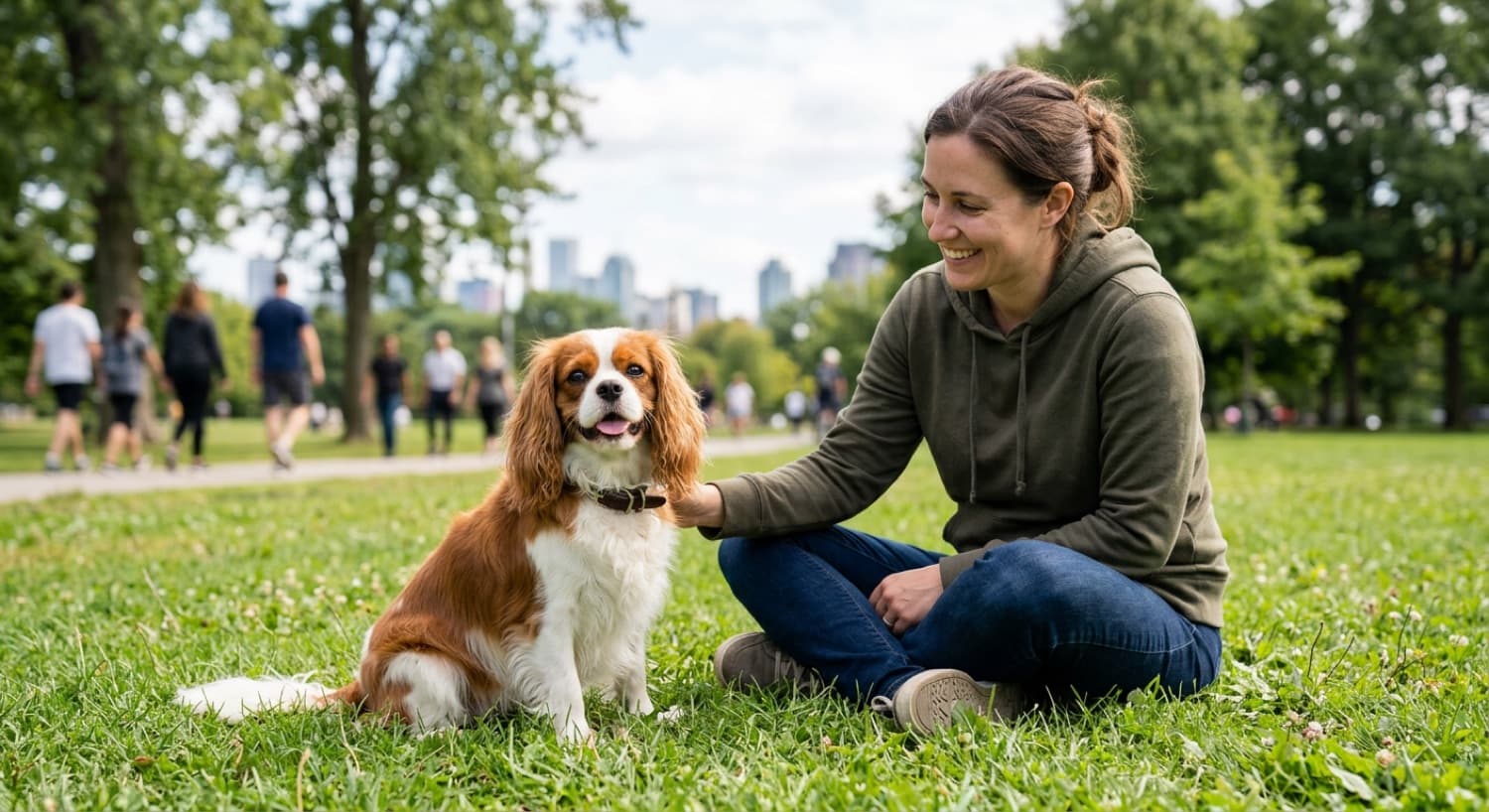
The first 30 days with an Edmonton rescue Cavalier
The 3-3-3 decompression principle applies to Cavaliers, but the rhythm is faster than for many rescue breeds. Cavaliers are unusually adaptable and the real personality usually emerges around week two or three. Practical week-one priorities for an Edmonton rescue Cavalier:
- Set up a quiet decompression space. A crate or covered bed in a low-traffic room. Cavaliers often arrive grieving the loss of their previous home and need somewhere to retreat. Let them choose when to come out for the first few days.
- Schedule a cardiac baseline vet visit in week one. Even if the rescue did an auscultation or echocardiogram, establish your own baseline with the vet who will follow the dog long-term. This becomes the reference point for every future cardiac check.
- Enrol pet insurance immediately. Before any cardiac finding becomes pre-existing. Compare two or three Canadian providers and pick a plan with strong cardiac coverage.
- Use a step-in harness, not a collar. Cavaliers are small enough that collar pressure on a delicate neck is risky, and a harness is gentler on Cavaliers with any early cardiac symptoms. Step-in harness from day one for all walks.
- License the dog with the City of Edmonton. Required for any dog over six months under City of Edmonton bylaw. Tags visible on the harness from day one.
- Establish a feeding schedule. Two small meals per day rather than free-feeding. Helps with weight management; Cavaliers are prone to weight gain that compounds cardiac strain.
- Start a dental baseline. Introduce daily tooth brushing slowly in week one with a soft finger brush and a dog-safe enzymatic toothpaste. Build the routine gradually. Schedule a vet dental assessment as part of the week-one visit.
- Start a grooming routine. Weekly brushing at home from week one. Daily ear checks (the long ears trap moisture and Cavaliers are prone to ear infections). Schedule the first professional groom for week three or four.
- Start light leashed exercise. Two short walks per day (15 to 25 minutes each, weather permitting) plus calm indoor play. Build slowly as the dog settles. Cavaliers do not need heavy exercise; gentle daily movement plus companionship is the recipe.
- Add mental work early. Snuffle mats, puzzle feeders, basic obedience refreshers. Mental work tires a Cavalier as effectively as physical exercise and prevents boredom in indoor-heavy households.
- Winter routine startup. If you adopt in winter, the cold hits Cavaliers fast. Warm coat or sweater for outings below freezing, booties on salted Edmonton sidewalks, short trips below -20C, and indoor exercise to cover the rest of the day.
- Schedule the first long-term cardiology check at six months. The week-one baseline plus a six-month follow-up establishes the cardiac monitoring rhythm. For dogs already on the MVD spectrum, twice-yearly cardiology becomes the norm.
By week three, you will start seeing the real dog. Senior Cavaliers and owner-death surrenders often warm up faster than younger dogs because they have lived in homes before and recognise the rhythm. Puppy-mill background Cavaliers take longer, sometimes two to four months, because they have to learn what life inside a home looks like. By month three the routine is established and the foster-write-up dog is the dog living in your house. For Cavaliers, this is when the gentle, devoted, lap-loving personality really emerges, and it is genuinely lovely.
Frequently asked questions
Where can I adopt a Cavalier King Charles Spaniel near me in Edmonton?
Cavaliers are rare in Edmonton rescue and the patient path usually wins. Local intake is low because the breed is loved, expensive at the breeder, and slow to surrender unless something serious has happened. The Edmonton Humane Society lists a Cavalier or Cavalier mix every several months, typically through owner death, assisted-living downsizing, or a cardiac diagnosis the family cannot manage. AARCS, headquartered in Calgary, tags Edmonton-foster dogs and a Cavalier surfaces there occasionally. Zoe's Animal Rescue, AHHRB, GEARS, Hope Lives Here, and SCARS see the breed less often. The Cavalier King Charles Spaniel Club of Canada (CCKCSC) runs a national rescue, but it averages only one or two dogs a year and keeps a long waiting list, so treat it as a long-shot application alongside the local rescues rather than a faster path. Plan a 6 to 18 month timeline. Set up alerts and apply the day a temperament-fit dog appears.
Why are Cavaliers so rare in Edmonton rescue?
Three reasons. First, Cavaliers are devoted companion dogs that rarely lose their homes for lifestyle reasons. Families plan around them rather than surrender them. Second, Alberta breeder volume is small compared to Chihuahuas, Labradors, or Pit Bull crosses, so the pool of potential surrenders is small to begin with. Third, when Cavaliers do reach rescue, the trigger is usually serious: a mitral valve disease diagnosis the family cannot afford to manage, a syringomyelia diagnosis, owner death, or a puppy-mill seizure where the breeding mothers are absorbed by rescues. Volume stays low and adopter demand is high. The breed is rare enough that adopters who want a Cavalier specifically usually apply broadly across Western Canada rather than waiting for an Edmonton-only listing.
How much does it cost to adopt a Cavalier in Edmonton?
Edmonton adult-dog adoption fees run $360 to $650: Edmonton Humane Society $360 plus an admin fee, SCARS $425, Zoe's Animal Rescue $425 ($500 for small dogs), and AHHRB $500 ($650 for small breeds under 30 lb). Cavaliers are small, so expect the small-dog fee where a rescue charges one. Senior fees are lower at several rescues (EHS $155, SCARS $300, AHHRB $400 for dogs 9 and older). The fee covers spay or neuter surgery, core vaccinations, microchip, deworming, and a basic vet workup. Ask whether a cardiac check (auscultation at minimum, sometimes an echocardiogram) has been done. For comparison, CKC-registered breeders that publish prices ask $3,200 to $4,000+ for a Cavalier puppy (October 2026, small sample); show-line dogs cost more, and cheap ads well below breeder prices are a red flag. The rescue path is significantly cheaper, and the dog comes with a known foster temperament write-up.
What is mitral valve disease and how does it affect adoption?
Mitral valve disease (MVD) is the leaking heart valve that affects most Cavaliers as they age. By age ten, the majority of Cavaliers have detectable MVD. The progression is usually slow and manageable for years with monitoring and medication, but it is the breed-defining health concern and every Cavalier adopter needs to understand it. At adoption, the rescue should disclose whether the dog has had a cardiac auscultation, whether a murmur was heard, and whether an echocardiogram was done. Pre-MVD dogs (no murmur yet) are the most common adoption profile. Dogs with early-stage MVD are still very adoptable; they often have years of good quality life ahead with twice-yearly cardiac checks and, when needed, medications like pimobendan. Pet insurance enrolment in week one is essential. See our companion article on Cavalier MVD management for the daily-life detail.
What are the four recognized Cavalier colours?
Four. Blenheim (chestnut-red and white, the most common, named after Blenheim Palace), tricolour (black, white, and tan markings), ruby (solid rich red), and black-and-tan (black with tan markings). All four are equally recognised by the Canadian Kennel Club and the Cavalier King Charles Spaniel Club of Canada. Health risk is identical across colours; MVD and syringomyelia run through the entire breed gene pool rather than tracking colour. Choose on preference. Blenheim is the colour most adopters picture when they think Cavalier; ruby and black-and-tan are slightly rarer but show up in rescue too.
Cavalier vs English Toy Spaniel: what is the difference?
Two different breeds with similar histories and similar names. The Cavalier King Charles Spaniel has a longer muzzle, a flatter skull, a slightly larger frame (13 to 18 pounds typically), and no significant brachycephalic breathing issues. The English Toy Spaniel, sometimes called the King Charles Spaniel in the UK, is smaller (8 to 14 pounds), has a domed skull, a much shorter pushed-in muzzle, and the breathing concerns that come with a brachycephalic build. Adopters frequently confuse the two because of the overlapping name. In Edmonton rescue almost every dog listed as Cavalier or CKCS is the longer-muzzled Cavalier King Charles Spaniel, not the English Toy. Read the foster description carefully and look at head shape in the photos.
Are Cavachons and Cavapoos in Edmonton rescue?
Yes, and they appear more often than pure Cavaliers. Cavachon (Cavalier-Bichon Frise), Cavapoo or Cavoodle (Cavalier-Poodle), and Cavachu (Cavalier-Chihuahua) are popular designer crosses that sold heavily through Kijiji and Facebook Marketplace from 2019 onward. Many were sold as low-shed, low-maintenance family dogs. When adolescence hits or a cardiac concern surfaces, surrenders follow. Edmonton rescue Cavalier-mix listings often outnumber purebred listings. Foster temperament notes carry the real information; size, coat, and energy are unpredictable in first-generation crosses. A Cavapoo may inherit the Poodle's low-shed coat or the Cavalier's silky shedding coat, and you may not know which until adolescence.
What is the puppy-mill Cavalier reality?
Cavaliers have been heavily over-bred by puppy mills and backyard breeders precisely because they are popular and expensive. Indiscriminate breeding has thinned the gene pool and amplified the inherited cardiac and neurological risks that responsible breeders work to manage. Edmonton rescues regularly take in Cavaliers from puppy-mill seizures or from family surrenders where a mill-bred puppy turned out chronically sick. These dogs are absolutely adoptable and often have excellent temperaments, but adopters need to plan for undiagnosed MVD, undiagnosed syringomyelia, dental disease from poor early care, and behavioural under-socialisation. Reputable rescues disclose breeding origin when known and price accordingly. The dog is not the problem; the breeding system is, and rescue adoption is the most direct way to support the dogs caught in it.
Are Cavaliers good apartment and condo dogs in Edmonton?
Yes, exceptionally well suited. Cavaliers are quiet, low-energy, indoor-loving companion dogs that adapt to apartments, condos, and small houses without difficulty. Two short walks per day plus indoor play covers their exercise needs. They are not alert barkers, which matters for shared condo walls. The main caveat is that Cavaliers are companion dogs to the core and they do badly left alone for long stretches. A household where someone is home most days, or where the dog can travel with the owner, fits the breed best. Retirees, work-from-home adults, and multi-adult households with overlapping schedules are the strongest fits.
How long do Cavaliers wait in Edmonton rescue?
When a Cavalier is listed locally it usually places within days, occasionally hours. Demand consistently outpaces supply. Senior Cavaliers and Cavaliers with confirmed MVD sometimes wait longer because they need an adopter prepared for cardiac management, but reputable rescues actively match these dogs with retiree households and the placements happen. Cavalier mixes (Cavachons, Cavapoos) place faster than the average rescue dog but slower than purebred Cavaliers. Set up alerts on every Edmonton-area rescue and on the national breed rescue. Apply the day a temperament-fit dog appears.
Do Cavaliers handle Edmonton winters?
They feel the cold. Cavaliers have a single silky coat with no insulating undercoat, and they are small enough that body heat is lost quickly. Plan on a warm winter coat or sweater for outings below freezing, booties for salted Edmonton sidewalks, short trips below -20C, and indoor exercise to cover the rest of the day during the worst of winter. The breed's low natural exercise needs make winter management easier than for high-drive breeds; most Cavalier winter exercise moves indoors without losing the dog any quality of life.
Related Edmonton Cavalier guides
Edmonton Adoptable Dogs
Current Edmonton-area Cavalier, Cavachon, Cavapoo, and Cavalier-mix listings from EHS, AARCS Edmonton fosters, Zoe's, AHHRB, GEARS, Hope Lives Here, and SCARS.
Cavalier King Charles Health Issues: Heart, SM
Cavalier King Charles Spaniel health issues to plan for: mitral valve heart disease, Chiari-like malformation and syringomyelia, episodic falling, eye disease and teeth.
Cavalier Winter Care Edmonton
Edmonton winter routine for a single-coated small companion. Warm coat thresholds, booties on salted sidewalks, indoor exercise programming through five months of cold, and the cardiac-aware winter activity adjustments for MVD dogs.
Find your Edmonton rescue Cavalier
Browse current Edmonton-area Cavalier and Cavalier-mix listings. Local intake is low; set up alerts and apply same-day when a temperament-fit dog appears.
Browse All Edmonton Dogs →New dog? Start with these care guides
Everything a new adopter needs to set up a safe, happy home.