The short answer
Dachshunds were bred to bark loudly through metres of dirt at cornered badgers. The bark is hardwired, not bad behaviour. Three barking types need different management: alert (predictable triggers like doorbells), demand (attention or food), anxiety (separation). The Duffy et al. 2008 study found Dachshunds elevated on owner-directed snapping, usually around being picked up against their will, moved off furniture, handled in pain, woken suddenly, or guarding food. Force-free training only. Aversive corrections (prong, e-collar) suppress warnings and lead to bites without warning. Edmonton Bylaw 21244 noise provisions are enforced through 311 complaints; condo Doxies need a real management plan. The breed bears IVDD-aware handling because rough handling can trigger disc episodes. Edmonton winter compounds potty-training difficulty. Most Edmonton Dachshund surrenders trace to expectations mismatch, not the breed itself.
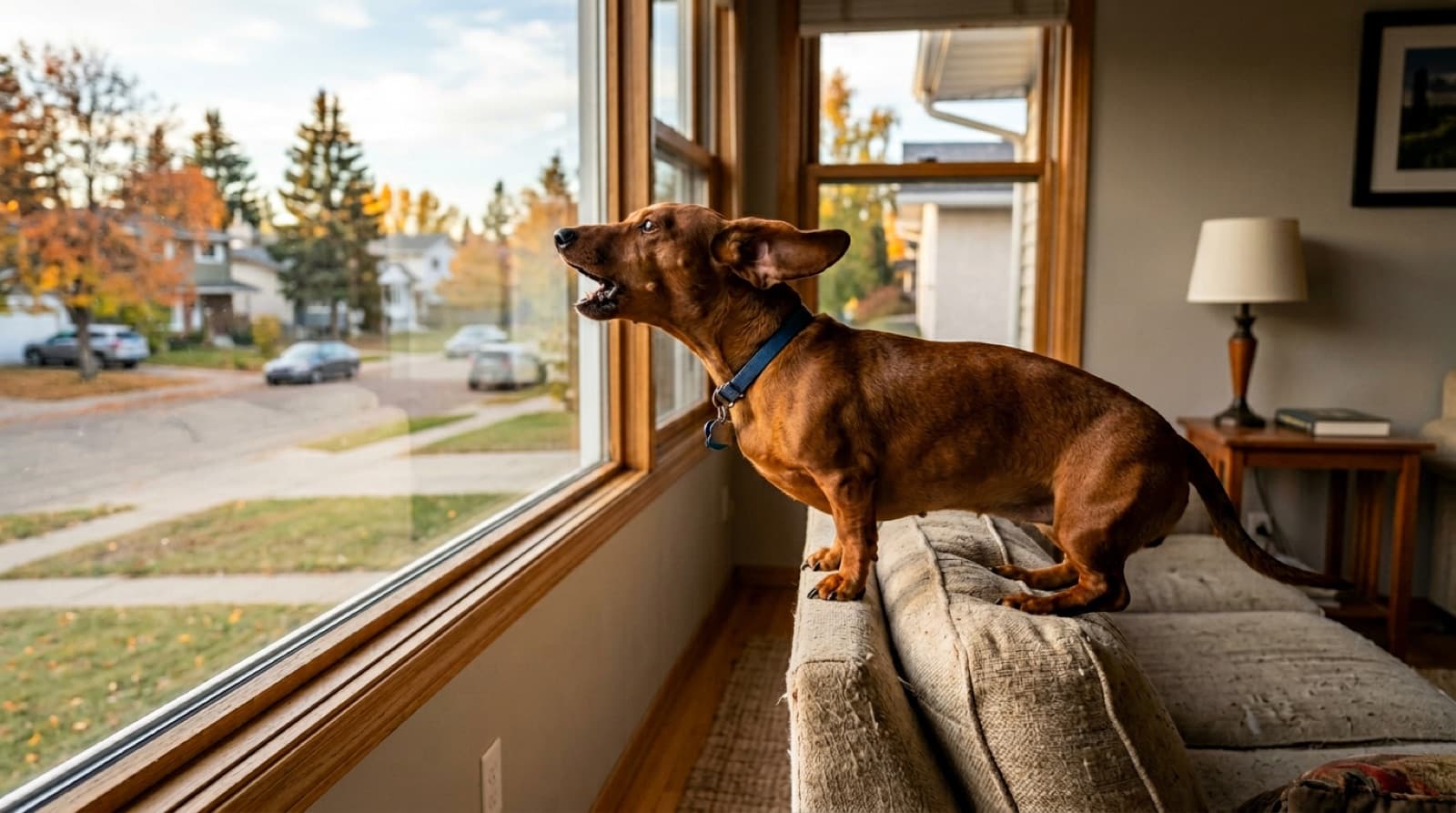
Why the bark is hardwired
Dachshunds were bred in Germany to hunt badgers underground. The job involved tracking the badger into its tunnel, cornering it, and then barking loud and continuously so the hunter above could find the dog through several feet of dirt. A vocal alert was not a side effect of the breed; it was the entire point. The deep, surprisingly loud bark you hear from a 12 lb Doxie is the same bark designed to carry through a metre of Alberta soil.
This matters because the bark is hardwired. You will not train a Dachshund to be a silent dog the way you might with a Whippet or a Basenji. What you can train is bark control: which triggers earn a response, how long the response lasts, and what behaviour the dog defaults to when the trigger passes.
The AKC Dachshund breed profile describes the breed as “spunky, curious, friendly” without foregrounding the bark intensity. The breed-club community is more honest: every Dachshund owner needs a bark-management plan from day one.
Three types of barking, three different protocols
| Type | Trigger | Protocol |
|---|---|---|
| Alert | Doorbell, mail carrier, dog past window | Environmental management (window film, blinds) + quiet cue + redirect to “place” |
| Demand | Wants food, attention, couch position | Never reward the bark. Reward calm offers instead. Ignore demand vocals. |
| Anxiety | Separation, isolation, fear | Counter-conditioning + gradual desensitisation + sometimes medication via vet behaviourist |
Trying to fix all three with one technique fails. Identify which type the bark is, then apply the matching protocol. Most Edmonton Dachshund owners can substantially reduce barking within 6 to 12 weeks of consistent force-free work, but they cannot eliminate it entirely. The breed comes with sound effects included.
The Duffy et al. owner-directed snapping data
Dachshunds are not a mean breed. But Duffy et al. 2008 found them elevated on owner-directed snapping compared to most breeds. Specific situations matter.
The 2008 University of Pennsylvania study (Duffy et al., “Breed differences in canine aggression”) ranked breeds across stranger-directed, dog-directed, and owner-directed aggression. Dachshunds ranked moderately on stranger and dog-directed but notably higher than most breeds on owner-directed.
What that elevation actually looks like:
- Picked up against their will
- Moved off furniture
- Handled when in pain (which matters a lot given Dachshund back issues)
- Woken suddenly
- Approached when guarding food, a toy, or a sleeping spot
The framing that works: a Dachshund is a small dog with strong opinions about consent and clear preferences about being handled. Treat those preferences like any other dog and the behaviour usually stays within normal range. Ignore them and you get the growl-then-snap pattern the studies pick up.
The IVDD connection matters here too: a Dachshund with subclinical back pain may snap when picked up wrong. The snap is communication about pain, not a personality defect. Vet workup for any sudden behavioural change is the first step before training intervention.
Edmonton Bylaw 21244 and apartment Doxies
Real risk for Edmonton condo and apartment Dachshund owners. Persistent vocal Doxies generate noise complaints fast. The Edmonton Animal Care and Control Bylaw 21244 noise provisions are enforced through Edmonton 311 complaints.
Pattern: neighbour reports excessive barking through 311, bylaw officer investigates, potential warning, then fines for repeated complaints. Condo board complaints separately can result in condo violation notices and, in severe cases, eviction.
Prevention: training plan over 6 to 12 weeks targeting the specific barking pattern, environmental management (frosted window film, blinds during high-trigger hours, white noise), addressing separation anxiety if it is the driver, daycare 2 to 3 days per week during peak adolescent barking phase if needed ($30 to $55/day in Edmonton).
If a complaint is received: do not ignore (work with neighbour and property manager actively), address the barking immediately, communicate with the neighbour (a friendly conversation often resolves it), document training efforts.
The honest conversation: if you are an Edmonton condo dweller without willingness to commit to behaviour modification, a Dachshund may not be the right breed for your living situation. Many Edmonton suburban Dachshund placements happen because a condo Doxie's noise issues forced rehoming.
Browse adoptable Dachshunds in Edmonton
Most Edmonton Dachshund surrenders happen because of barking, housetraining, or IVDD costs. Adult adoption from Edmonton rescue skips much of the puppy chaos.
See Available Dachshunds →Why aversive training makes it worse
You will hear “balanced trainers” in Edmonton recommend bark collars, prong collars, and e-collars for vocal Dachshunds. The science says they make the underlying behaviour worse.
Why aversive training is wrong for Dachshunds:
- Bark collars suppress the warning without changing the underlying state. A Doxie that stops alert-barking still has the same arousal level when triggers appear; the behaviour shifts to other expressions (reactivity, snapping, redirected aggression).
- Prong and e-collars on reactive Dachshunds elevate fear-based reactivity. The dog associates the painful correction with the trigger (cyclist, other dog, stranger) and learns the trigger predicts pain. Reactivity gets worse, not better.
- Aversive corrections suppress growling. The growl is the warning before a snap or bite. Suppress it and you get snaps without warning, which is the classic Dachshund bite pattern.
- The breed's elevated owner-directed snapping (per Duffy et al.) gets worse with corrections because the dog associates handling with pain.
The science is consistent across position statements from the American Veterinary Medical Association, International Association of Animal Behaviour Consultants, Certification Council for Professional Dog Trainers, and American Veterinary Society of Animal Behavior. Force-free Edmonton trainers (CCPDT, KPA, IAABC, or Fear Free certified) handle Dachshund cases consistently and effectively.
Frequently Asked Questions
Why does my Dachshund bark so much?
Because that is what the breed was designed to do. Dachshunds were bred in Germany to hunt badgers underground. The job involved tracking the badger into its tunnel, cornering it, and then barking loud and continuously so the hunter above could find the dog through several feet of dirt. A vocal alert was not a side effect of the breed; it was the entire point. The deep, surprisingly loud bark you hear from a 12-pound Doxie is the same bark designed to carry through a metre of Alberta soil. This matters because the bark is hardwired. You will not train a Dachshund to be a silent dog the way you might with a Whippet or a Basenji. What you can train is bark control: which triggers earn a response, how long the response lasts, and what behaviour the dog defaults to when the trigger passes. Three types of barking show up in Edmonton Doxie households: alert barking (someone at the door, the mail carrier, a dog walking past the window); demand barking (wants food, attention, off the couch, on the couch); anxiety barking (separation, isolation, fear). Each type needs a different management approach. Trying to fix all three with one technique fails. Most Edmonton Dachshund owners can substantially reduce barking within 6 to 12 weeks of consistent force-free work, but they cannot eliminate it entirely. The breed comes with sound effects included.
Are Dachshunds actually aggressive?
Mostly no, but with real caveats. The Duffy et al. 2008 study on breed-specific aggression at the University of Pennsylvania found that Dachshunds ranked moderately on stranger-directed and dog-directed aggression, but notably higher than most breeds on owner-directed aggression. That last number is the one that surprises people. It does not mean Dachshunds are mean. It means they are more likely than average to growl or snap at their own owner during specific situations: being picked up against their will, being moved off furniture, being handled when in pain (which matters a lot given Dachshund back issues), being woken suddenly, or being approached when guarding food, a toy, or a sleeping spot. The label "aggressive" is overstated. Most Dachshunds are wonderful with proper handling, training, and respect for their preferences. The breed is opinionated, vocal, and not always patient with rough handling, but those traits are manageable. The framing that works: a Dachshund is a small dog with strong opinions about consent and clear preferences about being handled. Treat those preferences like any other dog and the behaviour usually stays within normal range. Ignore them and you get the growl-then-snap pattern the studies pick up. Edmonton force-free trainers (CCPDT, KPA, IAABC, or Fear Free certified) treat Dachshund cases regularly. Most rehab within 8 to 16 weeks of consistent counter-conditioning.
How do I stop my Dachshund from alert-barking at the door?
Alert barking is the easiest type to manage because the trigger is predictable. The protocol has four parts. First, manage the environment: frosted window film on the lower half of front windows, blinds drawn during peak mail-delivery hours, a white noise machine running in the main living space. Removing the visual and auditory triggers reduces practice opportunities. Second, teach a quiet cue using positive reinforcement: when the dog barks, wait for a natural pause (even half a second), mark it with a clicker or verbal "yes," and feed a high-value treat (chicken, freeze-dried liver). Over weeks the dog learns that brief barking earns reinforcement when paired with quiet. Add the verbal cue "quiet" to the pause once the pattern is established. Third, redirect: the moment the doorbell rings, cue the dog to go to a place (mat or bed) in another room and feed there. Over time the doorbell becomes a cue to leave, not a cue to bark. Fourth, accept some baseline barking. A Dachshund that never alert-barks is a Dachshund whose breed instinct has been broken, not trained. The goal is a controlled three to five seconds of bark, not zero seconds. Edmonton apartment dwellers do best with a dedicated training plan over 8 to 12 weeks plus environmental management. A force-free Edmonton trainer can build a custom plan for $150 to $250 in a single private session.
My Dachshund lunges at every dog on Edmonton walks. Why?
Almost always defensive leash reactivity, not offensive aggression. The dog feels small and exposed, sees an approaching dog (especially a larger one), and uses noise and forward lunging to make the threat go away. It works (the other dog usually passes), so the behaviour gets reinforced. Most reactive Dachshunds are friendly off-leash with the same dogs they bark at on-leash. Poor early socialisation is the most common root cause. Many Dachshunds are kept close, carried in arms, and rarely exposed to other dogs as puppies because owners worry about back injury or size mismatch. The dog reaches adulthood without ever having learned to read other dogs at normal distances. The fix is the standard force-free reactivity protocol: increase distance from triggers (if your dog reacts at 10 feet, walk at 30 feet), keep the dog under threshold (calm enough to take treats), mark with a clicker or "yes" when the dog sees another dog at calm distance and feed a high-value treat, repeat dozens of times per walk. The dog learns that other dogs predict treats. Gradually reduce distance over weeks. Walk in quiet places at off-peak times: residential side streets early morning, industrial-zone Sunday mornings, river-valley pathways pre-7 AM. Most Edmonton reactive Dachshunds show real improvement in 6 to 12 weeks. Avoid prong and e-collars. They suppress the warning without fixing the fear and often make snapping worse.
My Dachshund growls when I touch his food bowl. Is this normal?
Yes, and it is more common in Dachshunds than in many other breeds. Resource guarding is not dominance. It is anxiety about losing a valued resource, often learned over time when food, toys, or sleeping spots have been taken away without warning. Dachshunds were bred to corner badgers and hold them. The same trait that made the breed useful underground shows up as strong attachment to high-value items at home. Punishing the growl teaches the dog to skip the warning and go straight to the snap. Do not do that. The fix is counter-conditioning. At meals, walk past the bowl from a distance and drop a high-value treat in (chicken, cheese, freeze-dried liver). Your approach predicts gain, not loss. Reduce distance over weeks until you can stand next to the bowl while the dog eats calmly. Never reach into the bowl. Never take food away. Never stand over the dog while he eats. Feed in a quiet space away from kids and other pets. For toys and chews, trade up: offer a higher-value item in exchange for the lower-value one. The dog learns that giving up an item leads to a better item. Severe resource guarding (lunging, biting, guarding spaces or people) needs a force-free Edmonton trainer.
Can I trust my Dachshund off-leash around small animals?
No, not reliably. Dachshunds were bred for prey drive. They were sent into tunnels to flush, corner, and confront badgers and rabbits weighing more than themselves. That drive does not turn off because you call. A Dachshund chasing a squirrel, rabbit, cat, or any small fast-moving animal is in prey mode, and the recall cue is competing with a hardwired behaviour selected for over centuries. Most experienced Dachshund owners treat off-leash time as conditional: securely fenced yards only, never in open spaces near cats or wildlife, never in off-leash zones where small animals might appear, never near city pathways during gopher or rabbit seasons. Edmonton has substantial wildlife (squirrels everywhere, jackrabbits in many residential neighbourhoods including Riverbend and Strathcona, coyotes on the river-valley corridors and city edges) that a Doxie will absolutely chase. Off-leash recall training is still worth doing for emergencies, but the working assumption should be: my Dachshund will chase small animals if given the chance. Manage the environment. Use a long line (10 to 15 metres, biothane preferred for winter) for off-leash feel with safety. Trust earned through 1,000 successful recalls in low-distraction settings does not transfer to a squirrel six feet away. The prey drive is breed design, not a training failure, and the responsible approach is environmental management, not optimistic recall practice.
Are Dachshunds good with kids?
With caveats. Dachshunds are not a kid-aggressive breed, but they are a kid-fragile breed, and that fragility plus their reactive tendencies creates a real risk profile. Two issues combine. First, the back. Dachshunds have a 25 percent lifetime risk of intervertebral disc disease, and rough handling by a child (picking up wrong, dropping, squeezing, lifting under the front legs) can directly trigger a disc episode. A child who hugs a Doxie around the middle can injure the dog. Second, the temperament. Dachshunds tend to be opinionated about handling and not always patient with sudden grabs, hugs, or face-approaches. A toddler grabbing a Doxie has a higher than average chance of being snapped at, not because the dog is mean, but because the dog is small, fragile, and defending against contact that hurts. The rules are similar to other small breeds, but stricter. Kids must learn: no picking up the dog, no hugging, no chasing, no approach during eating or sleeping. The dog needs a safe space the kids cannot enter (crate, baby-gated room). Never leave a Dachshund alone with a child under 8. Teach kids to invite the dog over rather than approach. With families of older kids (10+) who can follow rules, Dachshunds do well. With toddlers and active young kids, the breed is a higher-risk match unless adults can fully manage interactions. Most Edmonton Dachshund rescues ask about kid ages during the application process for this reason.
How does Edmonton Bylaw 21244 noise apply to a vocal Dachshund?
Real risk for Edmonton condo and apartment Dachshund owners. Persistent vocal Doxies generate noise complaints fast. The Edmonton Animal Care and Control Bylaw 21244 noise provisions are enforced through 311 complaints. Pattern: neighbour reports excessive barking through Edmonton 311, bylaw officer investigates, potential warning, then fines for repeated complaints. Condo board complaints separately can result in condo violation notices, and in severe cases eviction. Prevention: training plan over 6 to 12 weeks targeting the specific barking pattern (alert, demand, or anxiety), environmental management (frosted window film, blinds during high-trigger hours, white noise), addressing separation anxiety if it is the driver, daycare 2 to 3 days a week during peak adolescent barking phase if needed ($30 to $55/day in Edmonton). If a complaint is received: do not ignore (work with neighbour and property manager actively), address the barking immediately, communicate with the neighbour (a friendly conversation often resolves it), document training efforts (photos, trainer receipts, behaviourist consultation if needed). The honest conversation: if you are an Edmonton condo dweller without willingness to commit to behaviour modification, a Dachshund may not be the right breed for your living situation. Many Edmonton suburban Dachshund placements happen because a condo Doxie's noise issues forced rehoming.
Why are so many Dachshunds surrendered to Edmonton rescues?
Three reasons dominate Edmonton rescue intake forms. First, barking. Owners underestimate how loud and persistent the breed is until they live with it. Edmonton apartment neighbours complain. Doorbell-triggered episodes wake babies. Demand barking for attention or food becomes constant. Owners who expected a quiet small dog discover they got the most vocal breed in the toy and small size range. Bylaw 21244 noise complaints accumulate. Second, housetraining difficulty. Dachshunds are notoriously slow to potty-train. The combination of small bladder, low ground clearance, sensitivity to cold and wet (a real factor for Edmonton winters where -25C wind chill makes outdoor potty trips genuinely painful for the breed), and stubborn temperament means many Doxies are not reliably housetrained until 9 to 12 months, sometimes longer. Owners who expected the standard 4 to 6 month timeline get frustrated. Third, IVDD costs. Intervertebral disc disease is a breed-specific risk with roughly 25 percent lifetime incidence. A bad episode means surgery in the $7,000 to $12,000 range at Edmonton specialty clinics, plus 6 to 12 weeks of strict crate rest. Many owners surrender after an episode because they cannot manage the recovery or afford the surgery. The fix for the high surrender rate is honest expectations before adoption. Anyone considering a Dachshund should know: the breed barks more than most small dogs, takes longer to housetrain (Edmonton winter compounds this), and carries a real risk of expensive back issues. Owners who go in informed almost always keep their Doxies.
How does Edmonton winter affect Dachshund behaviour?
Significantly. Edmonton winter (5 to 6 months of sub-zero) creates breed-specific challenges. (1) Potty training regression. A 12 lb Dachshund with low ground clearance refuses outdoor potty in deep snow and cold. Indoor accidents increase. The fix: indoor potty pads as a winter accommodation rather than a training failure, shovelled small outdoor potty zone (12-square-foot area cleared and salt-free), insulated coat plus booties for outdoor potty trips. (2) Cold-aggravated IVDD. Cold weather can stiffen disc material and increase IVDD episode risk. Edmonton owners of IVDD-history Doxies report flares more common in deep January cold. (3) Cabin fever vocal escalation. A Doxie that gets less outdoor stimulation through winter often increases indoor barking. Mental enrichment (puzzle feeders, snuffle mats, training sessions) becomes more important. (4) Heating-season skin and coat issues. Dry indoor air aggravates the breed's tendency toward atopic dermatitis. Humidifier (35 to 45% RH) helps. (5) Adoption timing. Many Edmonton families adopt Dachshunds in fall, then hit winter unprepared. Spring or early summer adoption gives the dog and family time to establish routine before the first deep cold. None of this means Dachshunds cannot thrive in Edmonton. They can, with realistic winter accommodation.
When should I escalate to a force-free trainer or vet behaviourist?
Earlier than most owners do. Force-free Edmonton trainer relationship by month 6 to 8 of adoption is the standard recommendation. Initial assessment ($150 to $250) sets a baseline and gives you a trainer relationship before problems emerge. Escalate immediately if: bite history to a human (any bite, even a snap that broke skin), severe resource guarding (around food, toys, sleeping spots), reactive lunging that does not respond to standard counter-conditioning within 8 to 12 weeks, escalating barking that risks Bylaw 21244 complaints, sudden personality change in a previously stable Doxie (medical workup FIRST, rule out pain especially given the breed's back issues), inability to recover from arousal (over-threshold for hours after a trigger). Veterinary behaviourist consultation if training is not improving within 8 to 12 weeks of consistent professional work, severe reactivity beyond what general trainers can manage, suspected pain or medical issues affecting behaviour, or conversation about behavioural medication. Edmonton specialty behavioural referral options: DACVB telemedicine ($300 to $600 initial), referral to Western College of Veterinary Medicine in Saskatoon for complex cases. Cost: trainer $80 to $150/session over 6 to 10 sessions totals $480 to $1,500. Worth it for a breed where the alternative is often surrender.
Bottom line for Edmonton Dachshund owners?
Right for you if: realistic about the breed (loud, opinionated, prey-driven, IVDD-prone), willing to commit to force-free training relationship by month 6 to 8, comfortable with 8 to 12 month potty-training timeline that Edmonton winter extends, Edmonton suburb home OR condo with serious noise-management commitment, willing to manage the kid-and-handling rules (no rough handling, no toddler hugs, no waking by touch), accept that off-leash freedom in unfenced areas is unsafe (prey drive), commit to pet insurance from day one for the IVDD reality. Challenging if: Edmonton condo without willingness to invest in noise management, first-time small-breed owner with no support network, families with toddlers and no plan for managed interactions, owners who expected "easy small apartment dog." Wrong if: limited budget for training plus pet insurance, expectation of quiet apartment companion (the breed is the loudest small dog), unable to commit to long potty-training timeline. Adult Dachshund adoption (3+ years) from SCARS, Edmonton Humane Society, Zoe's Animal Rescue, AHHRB, AARCS Edmonton fosters skips much of the puppy chaos. Senior Dachshunds (8+ years) often have established housetraining, calmer baseline, and known medical history. The breed is opinionated and loud but devoted, brave, and entertaining. Edmonton Dachshund households that go in informed almost always keep their dogs for life.
Adoptable Dachshunds in Edmonton
Live listings from SCARS, Edmonton Humane Society, Zoe's, AHHRB, and AARCS Edmonton fosters.
Dachshund Adoption Edmonton
Rescue pipelines, costs, mini vs standard, coat varieties (smooth, longhaired, wirehaired), family-fit reality.
Dachshund IVDD Prevention
Back-injury prevention, ramps and stairs, weight management, daily handling rules, pet insurance timing.
Dachshund Winter Care Edmonton
Cold sensitivity, salt protection, low-clearance snow management, indoor potty alternatives, IVDD cold-aggravation.
New dog? Start with these care guides
Everything a new adopter needs to set up a safe, happy home.