The short answer
Dobermans are arguably the most velcro breed of any common dog. Bred in 1890s Germany for close-quarters personal protection and companionship, the modern Doberman was selected to glue itself to one handler for 8+ hours daily. The typical adult tolerates 2 to 4 hours alone before stress accumulates. Healthy velcro behaviour is NOT separation anxiety, and the puppy-cam test sorts the two in 30 minutes. The dominant Edmonton Doberman surrender pattern in 2024 to 2026 is the WFH-to-office return: pandemic-adopted dogs hitting sudden 9 to 11 hour isolation when their owner returns to a downtown commute. Mitigation works (daycare 3 to 4 days a week, midday walker, gradual exposure, sometimes medication) but costs roughly $500 to $1,200/month. Force-free protocol only. Aversive crate training breaks the dog further.
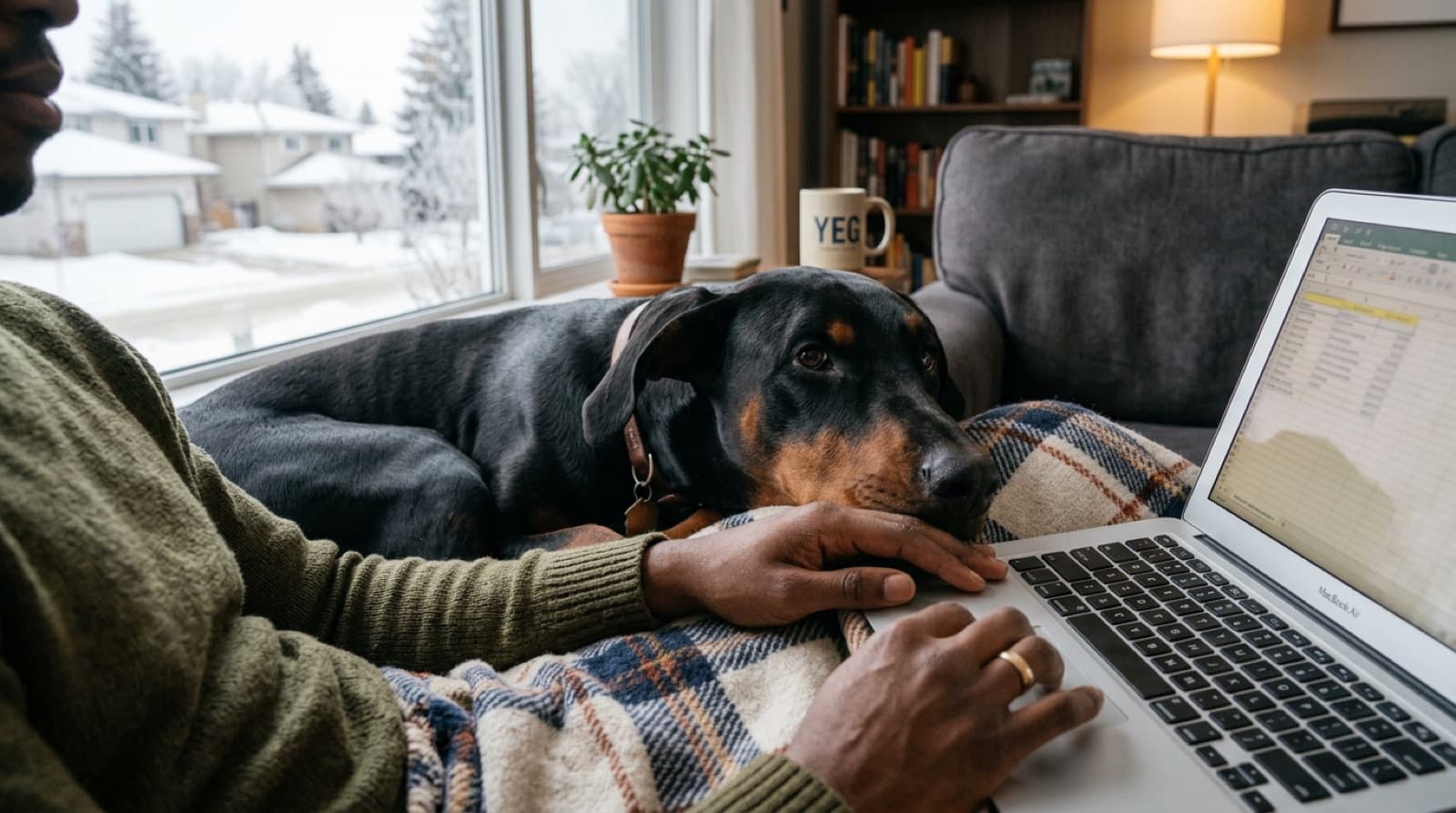
Why Dobermans are so velcro
Bred in 1890s Germany by tax collector Karl Friedrich Louis Dobermann for close-quarters personal protection and companionship. The breed was selected for constant handler attention, intense single-handler bonding, 8+ hour shoulder-to-shoulder work, and reading handler body language and emotional cues. Modern Dobermans retain the trait in full intensity.
Adult Dobermans typically:
- Follow the primary handler room-to-room intensely
- Want physical contact (touching, leaning, sleeping at feet)
- Watch family activities with intense focus
- Greet enthusiastically after even brief separations
- Get actively distressed by closed bathroom doors
- Seek out the primary handler over food, treats, or toys when given a choice
This is breed-typical healthy behaviour. Velcro behaviour alone is NOT separation anxiety. The critical distinction: healthy velcro Dobermans CAN be calmly alone for moderate periods (2 to 4 hours typical with training, more with structured lifestyle). Clinical separation anxiety is panic when alone regardless of duration. The AKC Doberman Pinscher breed profile describes the breed as deeply bonded and devoted, which is the same trait writers euphemistically call “velcro” in the rescue community.
Many Edmonton Doberman owners initially worry about velcro behaviour. The healthy approach is to enjoy and work with the velcro nature while building independence skills gradually. Dobermans thrive in households where they can be near family AND learn to be calmly alone for needed periods.
Velcro vs clinical SA: the puppy-cam test
Many Edmonton Doberman owners assume their dog “is fine” alone, but a 30-minute puppy-cam recording reveals chronic stress. The diagnostic removes guesswork.
Set up a phone or pet camera (Wyze, Ring, Furbo, or any home security camera you already own) to record the dog alone. Watch the first 30 minutes after departure. The pattern divides cleanly into two pictures:
Some of the product links in this section are Amazon affiliate links — we may earn a small commission at no extra cost to you. It never changes which products we recommend.
NORMAL VELCRO presentation:
- Dog watches you leave with mild attention
- Finds a spot, lays down, sleeps or rests calmly
- Brief whining or protest at the door, settles within 5 to 15 minutes
- No destruction, no soiling indoors despite being house-trained
- Calm waiting behaviour after settling
- Normally enthusiastic greeting when you return
CLINICAL SEPARATION ANXIETY presentation:
- Panic-level distress when you prepare to leave (often visible from key or coat pickup)
- Destruction (especially exit doors, windows, crate damage)
- Self-injury (broken nails, raw paws from scratching, mouth wounds)
- Soiling indoors despite house-training
- Refusing food or water alone (some Dobermans will not eat without the handler)
- Continuous vocalising 30+ minutes (howling, barking, screaming)
- Salivation puddles, hyperventilating
- Escape attempts (jumping fences, breaking windows, ripping crates)
- Trembling and hiding when you grab keys or coat
Doberman-specific clinical SA presentation is often more severe than other breeds. Self-injury during episodes is more common. Pattern includes scratching at exits, broken teeth from chewing crates, paw injuries from running in distress. If puppy-cam shows clinical SA, do NOT continue the current alone-time pattern. Continued exposure equals worsening cortisol cycle + lasting trauma + potential self-injury during separation. Implement the protocol below and consult a veterinary behaviourist.
The Edmonton WFH-to-office return crisis
The dominant Edmonton Doberman surrender pattern in 2024 to 2026. Pandemic-adopted Dobermans, used to a person home all day, hitting sudden 9 to 11 hour isolation when their owner returns to a downtown commute.
The pattern:
- Doberman adopted during WFH (often 8 weeks to 2 years old, common 2020 to 2024)
- Spent 2 to 4 years with owner home most or all day
- Owner returns to office 5 days weekly
- Doberman experiences sudden 8 to 10 hour daily isolation
- Within 1 to 4 weeks: destruction, vocalisation, soiling, severe distress, possible self-injury
- Within 2 to 6 months: many of these Dobermans surrendered to SCARS, Edmonton Humane Society, Zoe's Animal Rescue, and AHHRB
Why Dobermans are particularly vulnerable: extreme velcro breed + intense single-handler bonding + separation distress propensity equals the highest-risk breed for return-to-office crisis. Edmonton Doberman rescue networks have seen the surrender volume tied to this pattern increase significantly since 2024.
Prevention (during WFH ownership): structured alone-time training even while WFH. Leave the dog in another room for periods. Take walks without the dog. Build the “alone muscle” gradually. WFH-trained Dobermans handle return-to-office with adjustment, not crisis.
Intervention (if facing return-to-office now):
- Gradual exposure 6 to 12 weeks before return: increase alone time slowly. Start with 1-hour absences, build to 8 to 9 hours over weeks.
- Daycare 3 to 4 days weekly minimum (Dobermans need MORE daycare than most breeds).
- Dog walker midday on non-daycare days.
- Hybrid schedule if possible: 3 office + 2 WFH preserves the dog's wellbeing.
- Puppy-cam monitoring during initial return.
- Behaviourist consultation early if clinical SA signs emerge.
- Medication often appropriate during transition. Do not hesitate.
- Second dog companion sometimes beneficial.
Edmonton downtown commute reality: 30 to 45 minute commute + 9-hour office equals effectively 9 to 11 hour alone time. Most Dobermans cannot handle this. Investment in mitigation ($500 to $1,200+/month) is significantly less than rehoming + emotional toll.
The crate protocol (and when to skip the crate entirely)
Many Doberman owners report crate training “nightmares”: dog screaming, breaking teeth, self-injury attempting escape. The Doberman-specific protocol:
- Never force. Gradual desensitisation is the protocol. Forcing the crate creates lasting trauma.
- Foundation days 1 to 7: crate present and open in the main living area. Treats inside randomly throughout the day. NO confinement. Just positive crate-area associations.
- Feeding in crate. Meals served inside the crate, door open initially. Dog enters voluntarily.
- Close door briefly. When the dog is calmly inside eating, close the door for 30 seconds, then 1 minute, building gradually. Keep eyes on the dog.
- Watch for distress. If the dog shows panic (hyperventilating, frenzied digging, vocalising), open immediately. Do NOT wait for “they'll calm down.” Dobermans do not. They escalate.
- Reward calmness. Only release the crate when the dog is calm. Never release when actively distressed (reinforces distress).
- Build duration. 5 minutes, 10 minutes, 30 minutes over weeks while you are home. Then brief departures.
- Departure-cue desensitisation. Separate process. Pick up keys and coat without leaving 100+ times to normalise the cues.
- Medication sometimes required. For severe cases, trazodone or clomipramine before crating sessions can help break the panic cycle. Vet consultation.
When crate training does not work: some Dobermans never tolerate crating despite proper training. Alternatives include exercise pen with safe-room setup, single-room confinement (bedroom or laundry room with baby gate), free-roam with dog-proofed home, or two-dog household. NOT ALL Dobermans need crate training for life. Many adult Dobermans free-roam comfortably.
Warning signs that crate is the wrong tool: persistent self-injury attempts, broken teeth from chewing bars, urinary or fecal accidents in the crate, severe panic that does not reduce after 4 to 6 weeks of training. Switch to alternatives. Some Dobermans are crate-negative for life. That is OK. Manage with other tools.
When to involve a vet behaviourist (and what medications do)
Doberman SA often requires medication intervention. Do not hesitate. Criteria to escalate:
- Self-injury during alone time (broken teeth, raw paws, mouth wounds)
- Continuous distress without calming for 30+ minutes
- Escape attempts (jumping fences, breaking windows, destroying crates)
- Refusing food alone for 24+ hours
- Cannot be left even 15 to 30 minutes without panic
- Behaviour worsening despite 6 to 12 weeks of consistent training
Edmonton vet behaviourist access: limited locally. Options include virtual consultation with a DACVB (Diplomate American College of Veterinary Behaviorists) board-certified specialist (Edmonton-friendly via telemedicine, $300 to $600 initial), referral to the Western College of Veterinary Medicine in Saskatoon (the closest full veterinary teaching hospital, about 5.5 hours from Edmonton), and Edmonton force-free trainers + Edmonton GP vet partnership for moderate cases.
Medications commonly used for Doberman SA (prescribed and dosed by your vet, never self-administered):
- Fluoxetine (Reconcile, generic Prozac). Daily SSRI, 4 to 6 weeks to reach effect. $30 to $70/month. Long-term medication. Common for Dobermans.
- Trazodone. Situational anti-anxiety plus sedative. Used for predictable triggers (departure). $30 to $60/month.
- Clomipramine (Clomicalm). TCA antidepressant for SA specifically. $40 to $80/month. Often first-line for Doberman SA.
- Gabapentin. Sometimes added for nighttime or storm-related anxiety. $20 to $60/month.
Cardiac considerations: many SA medications are safe in cardiac patients, but verify with a cardiologist if your Doberman has a DCM (dilated cardiomyopathy) diagnosis. Some anti-anxiety medications have cardiac effects. Always coordinate behaviourist and cardiologist for DCM-affected Dobermans. The detailed cardiac monitoring picture is covered in our sibling Doberman health-issues guide.
Medication framework: medication is not a fix, it is a tool. Used WITH behaviour modification, it allows the dog to learn new patterns by reducing baseline anxiety. Dogs are typically maintained on medication 6 to 18 months while behaviour modification builds new responses, then weaned slowly. Stigma around SA medication is undeserved: severe SA in Dobermans is a medical condition like diabetes. There is no shame in treating with appropriate medical tools.
The American Veterinary Society of Animal Behavior publishes position statements on separation anxiety and humane training that are useful background reading for Doberman owners weighing medication.
Browse adoptable Dobermans in Edmonton
Adult Dobermans (3 years and up) often arrive in Edmonton rescue with documented foster behaviour notes covering velcro intensity and any SA history. The honest disclosure helps adopters match the right dog to the right schedule.
See Available Dobermans →The Edmonton daycare and walker math
Essential infrastructure for full-time-working Edmonton Doberman owners. The investment ($500 to $1,200+/month) is significantly less than rehoming costs plus emotional toll.
Edmonton daycare typical pricing:
- Structured group daycare: $30 to $55/day depending on neighbourhood, sport-focused vs general play, group size
- Independent neighbourhood daycares: $25 to $40/day, vary widely on handling philosophy
- Sport-style daycares with structured active play tend to fit Dobermans best
What to look for:
- Group size (max 8 to 12 dogs per handler ideal)
- Active play structure
- Force-free handling (no shock collars, no aversive methods)
- Temperament evaluation before enrolment
- Doberman-friendly intake (some daycares hesitant about guard breeds; find ones that accept)
- Camera monitoring (some Edmonton daycares offer apps showing live feed)
- Health requirements with verification
- Aggressive-dog screening
Edmonton dog walker options:
- Rover: widely available, $20 to $35 per visit, 30 to 45 min walks. Read reviews carefully for Doberman experience.
- Wag: $20 to $30 per visit
- Local independents: often best quality, $25 to $40 per visit, build a personal relationship
- Pack walking services: some offer pack walks with multiple dogs on group walks, $15 to $25 per dog
Investment math for a working Edmonton Doberman owner: 3 days daycare ($120 to $165) + 2 midday walks ($40 to $80) equals $160 to $245/week, $640 to $980/month, $7,680 to $11,760 annual. Significant, but dramatically less than rehoming + restart with another dog + emotional cost.
Prioritisation: if budget is tight, prioritise 2 to 3 daycare days weekly (provides exhaustion + socialisation) over daily walks. Daycare-wiped Dobermans handle alone time better.
Edmonton Bylaw 21244 noise provisions and 311 complaints
Real risk for Edmonton condo and apartment Doberman owners with separation anxiety. Anxious-vocalising Dobermans generate quick neighbour complaints and Edmonton 311 reports under the noise provisions of City of Edmonton Animal Care and Control Bylaw 21244.
What 311 complaints look like: neighbour reports excessive barking through Edmonton 311, bylaw officer investigates, potential fines apply. Repeated complaints can escalate to dog-removal orders in extreme cases. Condo board complaints separately can result in condo violation notices, and eviction in severe cases.
Prevention: soundproof when possible (close windows, sound-absorbing curtains, reduce outdoor stimulus visibility), calming background sound (TV or radio reduces the dog's perception of building noises that trigger barking), white noise machines, crate or pen placement away from front door and windows where building activity triggers reactivity.
If a complaint is received: do not ignore (work with the neighbour and property manager actively), address the barking immediately (puppy cam to identify trigger, behaviour modification, sometimes medication), communicate with the neighbour (a friendly conversation and commitment to action often resolves quickly), document training efforts (photos, trainer receipts, behaviourist consultation — shows good-faith intervention).
The honest conversation: if you are an Edmonton condo dweller with full-time office work, no daycare or walker budget, and unable to commit to behaviour modification, a Doberman may not be the right breed for your living situation. Many Edmonton suburban Doberman placements happen because a condo Doberman's noise issues forced rehoming.
Frequently Asked Questions
Why are Dobermans so velcro?
Dobermans are arguably the MOST velcro breed of any common dog. Bred in 1890s Germany by tax collector Karl Friedrich Louis Dobermann specifically for personal protection plus companionship, the breed was selected to bond intensely with one handler and remain glued to that person 8+ hours daily. Modern Dobermans retain this extreme bonding trait. Adult Dobermans typically follow the primary handler room-to-room, want physical contact (touching, leaning, sleeping at feet), watch family activities with intense focus, greet enthusiastically after even brief separations, get actively distressed by closed bathroom doors, and seek out the primary handler over food, treats, or toys when given a choice. THIS IS BREED-TYPICAL HEALTHY behaviour. Velcro behaviour alone is NOT separation anxiety. The critical distinction: healthy velcro Dobermans CAN be calmly alone for moderate periods (2 to 4 hours typical with training, more with structured lifestyle). Clinical separation anxiety is panic when alone regardless of duration. Many Edmonton Doberman owners initially worry about velcro behaviour; the healthy approach is to enjoy and work with the velcro nature while building independence skills gradually.
How long can I leave my Doberman alone in Edmonton?
2 to 4 hours is the typical alone-time ceiling for adult Dobermans before stress accumulates. Adult Dobermans (3+ years, well-conditioned): 4 to 6 hours occasionally with training. Most uncomfortable beyond 4 hours daily. Adolescent Dobermans (8 months to 3 years): 2 to 4 hours maximum. The most challenging age. Puppies under 8 months: 1 to 3 hours maximum based on age. Bladder and emotional immaturity. Rescue Dobermans first 30 to 60 days: start with 30 minutes to 2 hours and build slowly. Many rescue Dobermans arrive with prior separation anxiety from previous home transitions. Senior Dobermans (8+ years): often slightly longer tolerance (calmer baseline) but cardiac and medical considerations. Edmonton commute reality: an Edmonton downtown professional with a 30 to 45 minute commute each way effectively faces 9 to 10 hours of alone-time without intervention. Most Dobermans cannot handle this without daycare, dog walker, or schedule modification. SCARS, Edmonton Humane Society, Zoe's Animal Rescue, and AHHRB all see surrendered Dobermans tied to office-return scenarios.
Velcro vs clinical separation anxiety in Dobermans?
Critical distinction. Two very different conditions requiring very different responses. VELCRO (NORMAL Doberman behaviour): follows you room-to-room when home, prefers same-room presence and physical contact, mild whining or protest at brief separations, settles within 5 to 15 minutes once alone with training, no destruction and no soiling indoors despite being house-trained, calm waiting behaviour after settling, normally enthusiastic greeting when you return. CLINICAL SEPARATION ANXIETY (medical condition): panic-level distress when you prepare to leave (often visible from key or coat pickup), destruction (especially exit doors, windows, crate damage), self-injury (broken nails, raw paws from scratching, mouth wounds, sometimes severe), soiling indoors despite house-training, refusing food or water alone (some Dobermans literally will not eat without the handler), continuous vocalising 30+ minutes (continuous howling, barking, screaming), salivation puddles, escape attempts (jumping fences, breaking windows, ripping crates), trembling and hiding when you grab keys or coat, sometimes desperate hyperventilating greeting when you return. THE PUPPY CAM TEST: set up a phone or pet camera (Wyze, Ring, Furbo) to record the dog alone. Watch the first 30 minutes after departure. Normal velcro: dog watches briefly, finds a spot, lays down, sleeps or rests calmly. Clinical SA: dog panics, paces continuously, destroys items, vocalises endlessly, cannot settle. The diagnostic removes guesswork. Many Edmonton Doberman owners assume their dog "is fine" alone, but a puppy cam reveals chronic stress.
The WFH-to-office return: the dominant Edmonton Doberman surrender pattern
Critical Edmonton Doberman pattern 2024 to 2026. The pattern: Doberman adopted during WFH (often 8 weeks to 2 years old, common 2020 to 2024), spent 2 to 4 years with owner home most or all day, owner returns to office 5 days weekly, Doberman experiences sudden 8 to 10 hour daily isolation, within 1 to 4 weeks destruction and vocalisation and soiling and severe distress emerge (possible self-injury), within 2 to 6 months many of these Dobermans are surrendered to Edmonton rescues. Why Dobermans are particularly vulnerable: extreme velcro breed + intense single-handler bonding + separation distress propensity equals the highest-risk breed for return-to-office crisis. SCARS, Edmonton Humane Society, Zoe's Animal Rescue, and AHHRB have all seen Doberman surrender volume tied to this pattern. Prevention (during WFH ownership): structured alone-time training even while WFH. Leave the dog in another room for periods. Take walks without the dog. Build the "alone muscle" gradually. WFH-trained Dobermans handle return-to-office with adjustment, not crisis. Intervention (if facing return-to-office now): gradual exposure 6 to 12 weeks before return (increase alone time slowly, start with 1-hour absences, build to 8 to 9 hours over weeks), daycare 3 to 4 days weekly minimum, dog walker midday on non-daycare days, hybrid schedule if possible (3 office + 2 WFH preserves the dog), puppy cam monitoring during initial return, behaviourist consultation early if clinical SA signs appear, medication often appropriate during transition.
Why does Edmonton winter amplify Doberman velcro behaviour?
Edmonton winter creates a perfect storm for velcro Doberman households. Five compounding factors: daylight contraction means shorter walks and less external stimulation, sub-zero cold means more indoor confinement and tighter quarters (which a velcro Doberman actually loves but which amplifies separation distress when the owner DOES leave), reduced outdoor socialisation means fewer chances to build the alone-time muscle, holiday season (December through January) brings family visits and schedule disruption that breaks any progress on alone-time training, and the WFH thaw effect (some Edmonton offices loosen WFH policies in winter, which sets up an even harder return-to-office in spring). The management plan: maintain structured alone-time training year-round, do NOT use winter as an excuse to be home constantly with the dog, continue daycare 3+ days weekly even in deep cold (daycare staff handle the cold-weather transitions), and watch for early signs of velcro becoming clinical (puppy-cam check monthly through the season).
Crate training nightmare with a Doberman: how to handle it?
Common Doberman issue. Many owners report crate training "nightmares": dog screaming, breaking teeth, self-injury attempting escape. The Doberman-specific protocol. (1) NEVER force. Gradual desensitisation is the protocol. Forcing crate creates lasting trauma. (2) Foundation days 1 to 7: crate present and open in main living area, treats inside randomly throughout the day, NO confinement, just positive crate-area associations. (3) Feeding in crate: meals served inside crate, door open initially, dog enters voluntarily. (4) Close door briefly: when dog is calmly inside eating, close the door for 30 seconds, then 1 minute, building gradually. Keep eyes on the dog. (5) Watch for distress: if the dog shows panic (hyperventilating, frenzied digging, vocalising), open immediately. Do NOT wait for "they'll calm down." Dobermans do not. They escalate. (6) Reward calmness: only release the crate when the dog is calm. Never release when actively distressed (this reinforces distress). (7) Build duration: 5 minutes, 10 minutes, 30 minutes over weeks while you're home. Then brief departures. (8) Departure-cue desensitisation: separate process. Pick up keys and coat without leaving 100+ times to normalise the cues. (9) Medication sometimes required: for severe cases, trazodone or clomipramine before crating sessions can help break the panic cycle. Vet consultation. When crate training does not work: some Dobermans never tolerate crating despite proper training. Alternatives include exercise pen with safe-room setup, single-room confinement (bedroom or laundry room with baby gate), free-roam with a dog-proofed home, or two-dog household (companion dog reduces isolation). NOT ALL Dobermans need crate training for life.
Should I get a second Doberman as a companion?
Common solution but with important caveats. NOT a guaranteed fix. When a second dog helps: primary dog enjoys other dogs (confirmed through current socialisation with friend's dogs, daycare reports, or playdates), first Doberman has worked through alone-time training (the companion supplements solid foundation, not replaces it), household can absorb costs (two Dobermans equals double food, vet care, insurance, daycare; $4,000 to $8,000+ annual additional), sufficient space, and handler capacity (two Dobermans require MORE training time, not less). When a second dog worsens things: first dog has resource guarding with dogs, first dog has dog reactivity, domestic situation is unstable (divorce, move, lifestyle change planned), first dog's SA is primarily handler-focused (a second dog does not resolve handler-attachment anxiety), or financial strain. Same-sex vs opposite-sex: opposite-sex pairs typically harmonise better than same-sex, especially female-female (some same-sex aggression patterns documented in Dobermans). Male-female pair is the most common Edmonton success pattern. Doberman-Doberman vs Doberman-other: Doberman-Doberman pairs work but increase complexity. Doberman + calmer breed (Lab, Golden) is often an easier addition. Doberman + small dog is risky (predatory drift potential). Professional consultation: an Edmonton force-free trainer or behaviourist can assess whether a second dog is appropriate. $90 to $150 consultation is worth the investment before committing.
When to involve a veterinary behaviourist and medication?
Doberman SA often requires medication intervention. Do not hesitate. Criteria to escalate: self-injury during alone time (broken teeth, raw paws, mouth wounds), continuous distress without calming for 30+ minutes, escape attempts (jumping fences, breaking windows, destroying crates), refusing food alone for 24+ hours, cannot be left even 15 to 30 minutes without panic, or behaviour worsening despite 6 to 12 weeks of consistent training. Edmonton veterinary behaviourist access is limited locally. Options include virtual consultation with a DACVB (Diplomate American College of Veterinary Behaviorists) board-certified specialist (Edmonton-friendly via telemedicine, $300 to $600 initial), referral to the Western College of Veterinary Medicine in Saskatoon (the closest full veterinary teaching hospital, about 5.5 hours from Edmonton), Edmonton force-free trainers plus GP vet partnership for moderate cases. Medications commonly used for Doberman separation anxiety: fluoxetine (Reconcile, generic Prozac), a daily SSRI taking 4 to 6 weeks to reach effect, $30 to $70/month, long-term medication; trazodone, situational anti-anxiety plus sedative for predictable triggers (departure), $30 to $60/month; clomipramine (Clomicalm), a TCA antidepressant for SA specifically, $40 to $80/month, often first-line for Doberman SA; gabapentin, sometimes added for nighttime or storm-related anxiety, $20 to $60/month. Cardiac considerations: many SA medications are safe in cardiac patients, but verify with a cardiologist if the Doberman has a DCM (dilated cardiomyopathy) diagnosis. Some anti-anxiety medications have cardiac effects. Coordinate behaviourist and cardiologist for DCM-affected Dobermans. Medication framework: medication is not a fix, it is a tool. Used WITH behaviour modification, it allows the dog to learn new patterns by reducing baseline anxiety. Dogs are typically maintained on medication 6 to 18 months while behaviour modification builds new responses, then weaned slowly.
Edmonton daycare and walker network for working Doberman owners?
Essential infrastructure for full-time-working Edmonton Doberman owners. The investment ($500 to $1,200+/month) is significantly less than rehoming costs plus emotional toll. Structured group daycare in Edmonton typically runs $30 to $55/day depending on neighbourhood, sport-focused vs general play, and group size. Sport-style daycares with structured active play tend to fit Dobermans best. Independent neighbourhood daycares can be cheaper ($25 to $40/day) but vary widely on handling philosophy. What to look for: group size (max 8 to 12 dogs per handler ideal), active play structure, force-free handling (no shock collars, no aversive methods), temperament evaluation before enrolment, Doberman-friendly intake (some daycares hesitant about the breed because of guard-breed perception — find ones that accept), camera monitoring (some Edmonton daycares offer apps showing live feed), health requirements with verification, and aggressive-dog screening. Edmonton dog walker options: Rover (widely available, $20 to $35 per visit, 30 to 45 min walks; read reviews carefully for Doberman experience), Wag ($20 to $30 per visit), local independents (often best quality, $25 to $40 per visit, build a personal relationship), pack walking services (some offer pack walks with multiple dogs on group walks, $15 to $25 per dog). Investment math for a working Edmonton Doberman owner: 3 days daycare ($120 to $165) + 2 midday walks ($40 to $80) equals $160 to $245/week, $640 to $980/month, $7,680 to $11,760 annual. Significant, but dramatically less than rehoming + restart with another dog + emotional cost.
Edmonton condo and apartment 311 noise complaints?
Real risk for Edmonton condo Doberman owners with separation anxiety. Anxious-vocalising Dobermans generate quick neighbour complaints and Edmonton 311 reports. Prevention: soundproof when possible (close windows, sound-absorbing curtains, reduce outdoor stimulus visibility), calming background sound (TV or radio reduces the dog's perception of building noises that trigger barking), white noise machines, crate or pen placement away from front door and windows where building activity triggers reactivity. What 311 complaints look like: a neighbour reports excessive barking through Edmonton 311, a bylaw officer investigates, and potential fines apply under the noise provisions of Edmonton Bylaw 21244. Repeated complaints can escalate to dog-removal orders in extreme cases. Condo board complaints separately can result in condo violation notices, and eviction in severe cases. What to do if a complaint is received: don't ignore it (work with the neighbour and property manager actively), address the barking immediately (puppy cam to identify the trigger, behaviour modification, sometimes medication), communicate with the neighbour (sometimes a friendly conversation and commitment to action resolves it quickly), document training efforts (photos, trainer receipts, behaviourist consultation — shows good-faith intervention), consider Edmonton Animal Care and Control mediation services. The honest conversation: if you are an Edmonton condo dweller with full-time office work, no daycare and walker budget, and unable to commit to behaviour modification, a Doberman may not be the right breed for your living situation. Many Edmonton suburban Doberman placements happen because a condo Doberman's noise issues forced rehoming.
How long does it take to fix Doberman separation anxiety?
4 to 12+ months of structured work is typical. Each Doberman is individual. Stage 1: stabilisation (weeks 1 to 4) establishes baseline, reduces trigger exposure, builds trust and bond with the new owner, practises impulse control cues, and sometimes starts medication. Goal: dog can navigate Edmonton daily life without crisis. Stage 2: foundation training (weeks 4 to 12) introduces gradual desensitisation protocol (departure-cue desensitisation — picking up keys and coat without leaving 100+ times), practises micro-separations (30 seconds, then 2 minutes, building up), calm departures and arrivals, and pre-departure exercise routine. Goal: dog tolerates short separations calmly. Stage 3: progressive separation (months 3 to 6) builds to 1 to 3 hour absences with continuous puppy-cam monitoring. Some setbacks are expected and normal. Identify what works for THIS dog. Goal: dog handles work-day-shaped absences. Stage 4: real-world work (months 6 to 12) handles full work-day absences with daycare and walker support, continued behaviour modification, and medication consideration if not already prescribed. Goal: dog enjoys Edmonton life with sustainable alone-time arrangement. Stage 5: maintenance (year 1+) involves continued reinforcement, accepting some ongoing management, and possibly continued medication. Realistic outcome distribution: 60 to 80% of structured cases improve significantly, 15 to 25% remain manageable but require ongoing accommodation, 5 to 15% require permanent extensive management or rehoming to a better-suited situation.
Adopting a rescue Doberman with existing separation anxiety?
Many Edmonton rescue Dobermans have SA history from previous home transitions. Recovery is possible with a structured approach. Rescue Doberman SA presentations: mild (velcro behaviour, brief settling time, no destruction — most common, easily managed), moderate (vocalisation, minor destruction, 2 to 4 hour ceiling difficulty — manageable with structured training), severe (panic, self-injury, escape attempts, cannot be left even briefly — requires intensive intervention with behaviourist and medication). What to ask Edmonton Doberman rescues: "What's the alone-time history?" "Has the dog had medication for anxiety?" "Has the dog been crated?" "Foster home schedule patterns observed?" "Any documented self-injury during separation?" "Best alone-time setup recommended?" Edmonton rescue networks (SCARS, EHS, Zoe's, AHHRB, plus AARCS Edmonton fosters for Doberman placements) typically provide detailed disclosure. Adoption protocol for rescue Doberman with known SA: take time off work the first 2 to 4 weeks (not optional for severe SA dogs), build slow alone-time foundation 4 to 8 weeks before any extended absence, camera monitoring essential, enrol an Edmonton force-free trainer immediately (do not wait for crisis), vet evaluation including consideration of medication (ask about clomipramine and fluoxetine), daycare and walker plan in place BEFORE adoption, and realistic expectations (recovery may take 6 to 12 months). The best fit for severe-SA rescue Doberman: WFH owner, retired person, or multi-adult household where someone is usually home. Worst fit: full-time office single person with no daycare budget. Edmonton rescues sometimes specifically place SA-affected Dobermans with appropriate households.
Bottom line for Edmonton working Doberman owners?
Dobermans CAN be wonderful Edmonton companions for working owners, with realistic infrastructure investment. RIGHT FOR YOU IF: hybrid work schedule (3 office + 2 WFH or similar) OR full WFH, willing to commit $500 to $1,200+/month to daycare plus walker network, willing to invest 6 to 16 weeks initial training in alone-time tolerance building, realistic expectations (Doberman is extreme velcro, not a couch breed), Edmonton suburban house (easier) or condo with a serious SA management plan AND Bylaw 21244 noise awareness, considering adult rescue Doberman (3+ years, past adolescent activation, with foster temperament evaluation) for first Doberman, have a backup plan (family, pet sitter) for sick days and work travel, accept Edmonton winter accommodation reality (5 to 6 months) on top of SA management. CHALLENGING BUT POSSIBLE IF: Edmonton downtown professional with 9-hour daily commute and work, condo or apartment dweller, first-time guardian-breed owner, or limited budget for daycare and walker. These households CAN succeed but need Edmonton suburban placement, daycare 3 to 4 days weekly, hybrid schedule negotiation if possible, and realistic acknowledgment that Doberman ownership is more demanding than most breeds. WRONG FOR YOU IF: full-time office without daycare or walker plan, apartment plus frequent travel, expectation that the Doberman will "adapt to my lifestyle" without effort, first-time dog owner unfamiliar with extreme velcro breeds, severely limited budget that cannot accommodate $500 to $1,000+/month dog-care infrastructure, or desire for a "calm guard dog" that does not need attention. The Dobermans surrendered to Edmonton rescues are largely from these households: wonderful dogs in wrong situations.
Adoptable Dobermans in Edmonton
Live listings from SCARS, Edmonton Humane Society, Zoe's, AHHRB, and the rest of the Edmonton rescue network.
Doberman Adoption Edmonton
Rescue pipelines, costs, European vs American lines, working-line vs show-line, family-fit reality.
Doberman Training & Adolescence Edmonton
Force-free training for the 8 to 24 month adolescent phase, working-breed energy management, Edmonton trainer credentials.
Doberman Health Issues: DCM, vWD, Wobbler
Doberman health issues to plan for: dilated cardiomyopathy and yearly heart screening, von Willebrand bleeding disorder, wobbler syndrome, bloat, bone cancer and coat loss.
New dog? Start with these care guides
Everything a new adopter needs to set up a safe, happy home.