The short answer
LGD instinct is selection bred, not trained in or out. The Pyrenees package includes perimeter patrol, alarm-bark at perceived threats, nocturnal alertness, independent decision-making, escape-artist roaming, and slow 3 to 4 year emotional maturity. The right approach is to manage the instinct with fenced structure, accept the nocturnal alarm-bark pattern that the breed was built for, work with a force-free trainer credentialed through CCPDT or IAABC who understands independent breeds, and choose a home that fits: acreage first, suburban detached with tolerant neighbours sometimes, condo or attached townhome almost never. For specifics on the alarm-bark issue, see our barking and noise management guide.
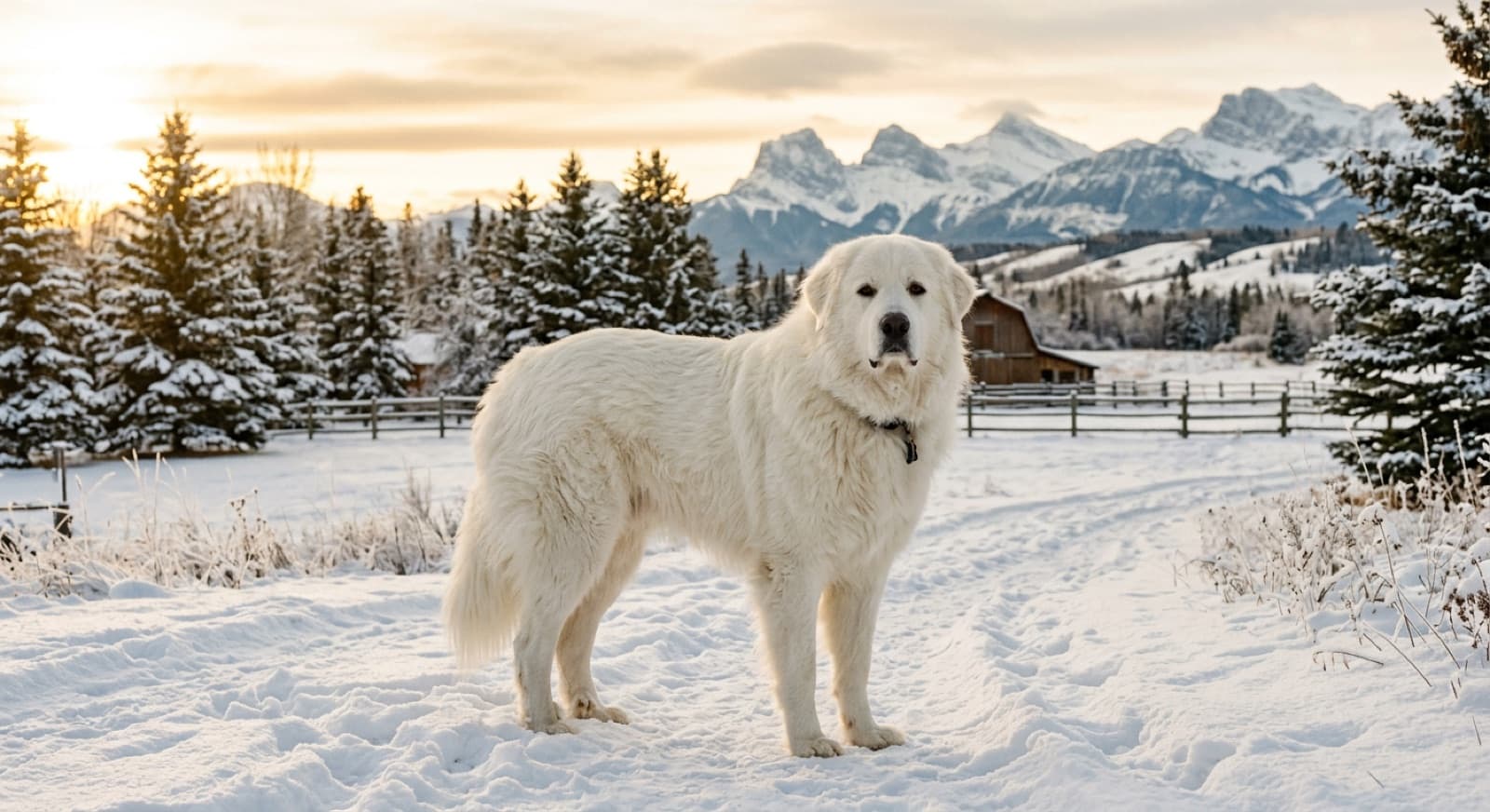
The LGD instinct package
The Great Pyrenees is a livestock guardian dog, not a herding dog. LGDs do not move stock. They live with the flock, watch over it, patrol the perimeter, and protect it from predators. The Pyrenees was developed in the French and Spanish Pyrenees over centuries to do exactly this work against wolves and bears, and the selection pressure shaped a coherent behavioural package. Most rescue Pyrenees in Edmonton homes still show the package even though they have never seen a sheep.
The package includes six core traits, each of which a new Pyrenees owner notices in the first weeks at home.
- Perimeter patrol. The dog walks the boundary of the property repeatedly, mapping the perimeter and checking for changes. In a yard, this looks like the dog tracing the fence line on a regular loop. In the house, it can look like the dog checking each room before settling.
- Alarm-bark at perceived threats. The dog vocalises at anything that registers as a potential threat: an unfamiliar sound, a wildlife scent, a person moving past the property, another dog on the street. The bark is loud, deep, and intended to carry across pasture.
- Nocturnal activity. The dog is most alert in the evening and through the night, when predators historically moved on flocks. Daytime is the rest period. Evening is the start of work.
- Independent decision-making. The dog evaluates situations and decides on a response without consulting the handler. Recall is processed rather than reflexive. Cues are weighed against the dog's own read of the situation.
- Territorial bonding. The dog forms a strong attachment to a defined territory and treats the territory as part of the job. In an Edmonton home, the territory becomes the property line, the household, and sometimes the regular walking route.
- Slow emotional maturation. Full adult temperament typically arrives at 3 to 4 years rather than the 18 to 24 months of most other breeds. The dog is adolescent longer, tests longer, and only settles into the famously calm adult after the extended developmental window closes.
Owners who understand the package and choose a home that accommodates it have steady, deeply rewarding companions. Owners who expect a Pyrenees to behave like a Lab end up with a frustrated dog and frustrated neighbours. The mismatch is the single biggest predictor of Pyrenees surrender in Edmonton.
LGD vs herding vs sporting vs working
Group categories matter for training. A force-free methodology applies across every group, but the response patterns differ enough that a trainer who matches their plan to the breed group does better work. The Canadian Kennel Club places the Great Pyrenees in the Working Group, but functionally the LGD subcategory operates differently from other working breeds.
Herding breeds (Border Collie, Australian Shepherd, Cattle Dog)
Selection bred to move stock at distance under handler direction. Highly biddable, fast response, strong handler orientation, reward-motivated, food and play driven. A Border Collie reads a recall cue as a clear instruction and responds immediately. The training partnership is collaborative.
Sporting breeds (Labrador, Golden, Spaniels)
Selection bred to work cooperatively with hunters at close range. Strongly handler-oriented, biddable, food and play motivated, social with people and dogs by default. The Lab is the prototype: easy reward-based training, predictable response patterns, fast recall.
Working breeds (Doberman, Boxer, Bullmastiff)
Selection bred for guardian work in close partnership with a handler. Biddable but with stronger arousal patterns than sporting breeds, more deliberate response, often higher reactivity in adolescence. Reward-based training works well; the partnership is closer to herding than to LGD.
LGD breeds (Pyrenees, Anatolian, Maremma, Kuvasz)
Selection bred for autonomous guardian work without a handler present. Independent decision-making is the defining selection trait. Response to cues is processed rather than reflexive. Reward motivation works but is less reliable than in other groups. The training partnership is closer to a long negotiation than a clear instruction set.
The practical implication: a force-free trainer who has worked with sporting and herding breeds and assumes the same response speed from a Pyrenees will be frustrated. A trainer who understands LGD selection adjusts expectations on response speed, reinforcement schedules, and the priority list of skills to layer first. Ask any prospective trainer whether they have worked with LGDs specifically; the answer matters.
The “failed LGD” reality
In working LGD circles, a Pyrenees who bonds to people rather than livestock is sometimes called a failed LGD. This is shorthand for a working context, not a judgment of the dog. A Pyrenees who fails as a livestock guardian because the dog wants to be with humans is exactly the dog who succeeds as a companion in an Edmonton home. Most rescue Pyrenees fit this profile.
The surrender pipeline runs both directions. Some Pyrs come from rural Alberta farms where the dog could not commit to the flock and ended up sleeping at the door instead. Others come from urban or suburban homes where the LGD instinct turned out to be too much for the setting and the dog ended up with a noise complaint history. Both ends of the pipeline produce companion-suited Pyrs. The shelter spotlight on the Great Pyrenees adoption page covers the local intake pattern in more detail.
The shift owners need to make is to understand that the Pyrenees bonded to the family treats the family as the flock. The patrol pattern, the alarm-bark, the nocturnal alertness, the protective territorial behaviour: all of it applies to the household instead of sheep. The dog is still doing the LGD job. The flock just looks different now.
Perimeter patrol in urban Edmonton
The Pyrenees in an Edmonton backyard still patrols a perimeter. The perimeter is now the property line. The dog walks the fence on a regular rotation, pauses at the corners, checks the gates, and resumes. This is calm working behaviour, not anxiety. The owner who tries to interrupt the patrol every time it happens is fighting the dog's baseline.
The structure that works in suburban detached Edmonton homes has three layers.
Fenced yard structure
A 6-foot fence with buried fence skirts or a dig-resistant base. The dog gets a real perimeter to walk during daytime sessions. Double-gated entries prevent door-dashing. The yard becomes the dog's legitimate patrol zone, which channels the instinct rather than suppressing it.
Structured on-leash neighbourhood walks
One or two leashed walks per day cover physical exercise, exposure to the broader environment, and a kind of extended patrol of the neighbourhood. Most rescue Pyrenees walk calmly on a loose leash once foundation work is established. The walks become part of the routine the dog expects.
Indoor settle routine
A designated bed or place where the dog rests during daytime hours when the family is busy. LGDs settle well indoors when the routine is predictable. The settle routine is the off-switch that balances the patrol drive.
For Pyrenees owners in acreage settings around Sherwood Park, Spruce Grove, Stony Plain, St. Albert rural, Beaumont, or Devon, the perimeter is real pasture or property edge. The dog patrols a few acres rather than a backyard, and the instinct gets a closer match to what selection produced. This is why rescues consistently steer Pyrs toward acreage homes when intake conversations allow it.
Alarm-bark at perceived threats
Alarm-barking is genetic and is the single most common neighbour-complaint trigger for Pyrenees in Edmonton suburbs. The dog hears a coyote yip from the river valley, a deer at the property line, a raccoon in the alley, or a neighbour cat moving, and barks. Daytime bark sessions tend to be short. Evening and nighttime sessions can be longer.
Trying to extinguish the alarm-bark with punishment or correction collars is contraindicated. The American Veterinary Society of Animal Behavior position statement on humane training is clear that aversive tools increase fear and aggression rather than solving the underlying behaviour. For an LGD breed alarm-barking at perceived threats, punishment teaches the dog that the trigger predicts pain, which can intensify the response rather than reduce it.
The full management protocol for alarm-bark, including sunset routines, indoor positioning, neighbour communication, sound-masking options, and the realistic limits of what training can change, lives in the dedicated barking and noise management article. This article defers there for the specifics so the two pages do not contradict each other.
Nocturnal activity
LGDs were bred to work through the night because that is when predators move on flocks. Most rescue Pyrenees in Edmonton homes still show this pattern. The dog sleeps longer through the daytime, becomes more alert as the sun sets, does a perimeter check before settling for the early evening, gets up two or three times overnight for short patrol rotations, and is fully alert by the early morning hours.
Owners who expect a normal pet sleep cycle find this disorienting. The right adaptation is to plan the routine around the dog's natural cycle rather than fight it.
- Bring the dog indoors at sunset. An outdoor LGD at night will alarm-bark on every sound. Indoors, the trigger density drops significantly.
- Evening enrichment routine. Puzzle feeders, scent games, a long chew. Channels the evening alertness into a contained activity.
- Calm bedtime structure. A designated sleep spot near family, low-light environment, predictable timing. Pyrenees do well with structure and settle once the routine is set.
- Accept brief overnight patrol rotations. The dog may get up two or three times in the night for short checks. This is the breed working as designed, not a behaviour problem.
- Daytime rest is normal. The Pyrenees that sleeps four hours through the early afternoon is not a lazy dog. The dog is on the evening shift.
Households with family members who work night shifts or who keep flexible schedules often find Pyrs easier than households with strict 10 PM lights-out routines. The dog is going to be active at night either way; the question is whether the family routine has any flexibility around it.
Independent decision-making
The most distinctive trait of the LGD group is independent decision-making at distance. A working Pyrenees on a Pyrenean mountain pasture had to evaluate threats and respond without consulting a shepherd who might be a kilometre away. The selection pressure produced a dog that processes cues rather than reflex-responds to them.
For the Edmonton companion owner, this shows up as recall that is real but slow. The dog hears the cue, looks at the handler, evaluates the situation, and may decide to finish the patrol check first. From the outside this can look like disobedience. It is closer to the dog making a working decision based on the information available.
Force-free recall training adapts to this in three ways.
- Very high-value reinforcement. The food has to genuinely compete with whatever the dog is evaluating. Kibble does not work. Cooked chicken, cheese, or freeze-dried liver does.
- Long-line work as the default. A 10 to 15 metre biothane long-line gives the dog distance to feel autonomous while keeping the safety margin. The recall is built on the long-line for years before any off-leash work is considered.
- Acceptance of partial reliability. Even a well-trained adult Pyrenees may not have a Lab-grade recall. Most experienced LGD owners run lifetime long-line setups in unfenced areas. This is not training failure. It is the breed's genetic profile.
The trainer relationship matters here. A trainer credentialed through CCPDT or IAABC who has worked with LGDs understands that the response speed is structurally different from a Lab or Golden. A trainer who has only worked with sporting and herding breeds may interpret the Pyrenees response as stubbornness and push for faster compliance with higher pressure. That direction does not work with this breed.
Browse adoptable Edmonton Pyrs
Current Edmonton-area Pyrenees and Pyr-mix listings from SCARS, the Edmonton Humane Society, and Zoe's Animal Rescue. Foster temperament notes describe the actual LGD profile of the individual dog and the type of home that fits.
See Edmonton Adoptable Dogs →
Force-free LGD training methodology
The force-free methodology that applies across all behaviour science also applies to LGDs, with adjustments for the breed group. Aversive tools (prong collars, choke chains, e-collars, alpha rolls) are contraindicated for any breed on the AVSAB position. For an independent breed already prone to processing cues at a distance, aversive corrections degrade the partnership in ways that are particularly hard to recover from.
The adapted plan for a Pyrenees looks like this.
Foundation skills, not a long trick list
Layer six to eight reliable skills rather than 40 mediocre ones. Name response, loose-leash walking, settle on a mat, recall on a long-line, trade-up for resource items, and a default check-in cover most household needs. Trick training is fine after the foundations are solid, but it is not the priority during the first 12 months.
High-value, variable reinforcement
An independent breed needs richer reinforcement than a biddable one. Cooked meat, cheese, freeze-dried treats. A variable schedule (sometimes high-value, sometimes lower, occasionally a jackpot) keeps the motivation steady. Predictable kibble-only reinforcement runs out of value fast.
Realistic timelines
A Lab might have a usable recall at 6 months and a reliable one at 18 months. A Pyrenees often takes to age 3 or 4 to reach the same point, and even then the recall is processed rather than instant. Owners who set expectations against the LGD timeline rather than the sporting-breed timeline are less frustrated and more consistent.
Trainer credentials that matter
Dog training is unregulated in Alberta. The credentials that mean something are independent: CCPDT for trainers and IAABC for behaviour consultants. Ask any prospective trainer whether they have worked with LGDs and what they would adjust in their approach for this breed group. A thoughtful answer is the right signal.
Slow maturation (3 to 4 year window)
The Pyrenees emotional maturity curve is notably longer than most other breeds. Most dogs reach adult temperament by 18 to 24 months. The Pyrenees often takes to 3 or 4 years. The extended adolescence shows up across several domains.
- Longer reactive phases. Adolescent reactivity that resolves in a typical breed at 24 months may continue in a Pyrenees through 30 or 36 months.
- Extended testing patterns. The dog re-tests household rules, recall reliability, and perimeter boundaries periodically through the third year.
- Slower settling into the adult routine. The famously calm Pyrenees adult often arrives suddenly at year 4, after a longer-than-expected adolescent stretch.
- Foster note translation. When an Edmonton rescue describes a 2-year-old Pyrenees as “still adolescent,” the note is accurate to the breed, not coded language for problem dog.
The implication for adopters: expect the work to take longer than with most breeds, and resist the conclusion at 18 months that the dog has a permanent problem. The adolescent Pyrenees at 16 months is not the adult Pyrenees at 4 years. The owners who push through year three see the dog the breed was selected to become.
Escape artist reality
The Pyrenees was developed to roam large pastoral areas and the wandering tendency is in the genetic profile. A 6-foot fence is the starting standard. Pyrs can clear lower fences with intent, dig under inadequately buried fence lines, and learn how gate latches work. Most lost-Pyrenees calls into Edmonton rescues are escape situations, not abandonment.
The fence setup that holds up across Edmonton homes has four components.
- 6-foot perimeter fencing. Solid panel or chain-link. The fence has to be physically tall enough that a determined adult Pyrenees cannot clear it standing on hind legs.
- Dig-resistant base. Either a concrete footing along the fence line, a buried fence skirt extending 30 cm into the ground, or large flat stones along the inside base. Pyrs dig as a default. A fence with a clean grass-to-fence transition will fail.
- Double-gated entries. A small airlock between the outer gate and the yard so the dog cannot rush through a single open gate. Critical at gates that family members use frequently.
- Latches above dog height. Pyrs learn to operate horizontal latches with their nose. Vertical-pull latches at the top of the gate hold up better.
For acreage homes, full perimeter fencing of several acres is often not realistic, and a smaller fenced dog yard combined with on-leash patrol of the broader property usually works. The dog gets the fenced zone for off-leash time and the long-line patrol time for the wider property. Pure free-roaming on unfenced acreage rarely holds; the dog will eventually follow a scent off the property.
Microchipping is essential, ID tags should be on at all times, and the City of Edmonton dog licence required under Animal Care and Control Bylaw 21244 should be current. Even with all of this, an escape recovery is much easier if the dog is registered with one of the lost-pet networks that Edmonton rescues monitor. See the City of Edmonton dog licensing page for the local requirements.
Edmonton wildlife triggers
Edmonton has an unusually dense urban-wildlife interface for a Canadian city of its size. The river-valley corridor runs continuous green space through the centre of the city, suburban edges back onto natural areas, and acreage properties on the outskirts share boundaries with active wildlife habitat. For a Pyrenees, this means more alarm-bark triggers per day than in most cities of comparable size.
The four most common triggers for Edmonton Pyrs are:
- Coyotes. The river valley supports a resident coyote population, and individual coyotes range through suburban neighbourhoods at night. Pyrenees historically guarded against canid predators, and coyote scent or sound is a strong alarm trigger. The City of Edmonton coyote management page has the local context.
- Deer. White-tail and mule deer cross suburban edges, sometimes moving through neighbourhood yards. A Pyrenees seeing or smelling deer at the property line will alarm.
- Raccoons. Active overnight in alleys, garbage bins, and yards. The sound of raccoons climbing fences is a reliable nighttime alarm trigger.
- Other dogs and humans at the perimeter. The dog reads the property line as the boundary. Anyone passing on the sidewalk, anyone in an adjacent yard, anyone approaching the door registers as a perimeter event.
For acreage owners around Sherwood Park, Spruce Grove, Stony Plain, St. Albert rural, Beaumont, and Devon, the wildlife triggers extend to coyote packs, deer herds, occasional cougars in foothill-adjacent areas, and large bird movement. The acreage Pyrenees is doing closer to the original LGD job, and the alarm-bark frequency is often higher than the suburban dog. Acreage neighbours are usually further away, so the noise impact is lower even though the bark frequency is higher.
Edmonton dog park calculus
Edmonton off-leash dog parks are not automatically unsafe for a Pyrenees, but the calculus differs from most breeds. Three considerations shape the right approach.
LGD threat-evaluation
A Pyrenees in a busy off-leash park is evaluating other dogs as either part of the flock or as potential threats. Most calm interactions are fine. High-arousal play between other dogs can be misread as a threat, and the Pyrenees may step in. Small fast-moving dogs are sometimes briefly misread when the movement pattern is unfamiliar. The individual dog's history matters: some rescue Pyrs are social with all dogs, others are reserved but tolerant, a smaller subset should not be in busy off-leash zones at all.
Unfenced river-valley off-leash zones
Edmonton's main river-valley off-leash zones (Hawrelak, Mill Creek, Whitemud, Terwillegar, Capilano) are unfenced and border coyote corridors. For a Pyrenees with the breed's baseline recall profile, this is high-risk: a wildlife trigger plus an unfenced perimeter plus an unreliable recall is the exact set of conditions for a long search. The Edmonton off-leash parks guide covers which zones suit which dog stages.
The realistic alternative
For most Edmonton Pyrenees owners, the right pattern is long-line walks on quieter river-valley trail segments, occasional short visits to less crowded off-leash zones at off-peak times, and (when budget allows) hourly fenced-rental sessions at private facilities. The dog gets real off-leash exercise in a controlled setting without the threat-evaluation pressure of a crowded off-leash park.
Condo and apartment reality
Condos and attached townhouses are almost always the wrong setting for a Pyrenees. The breed's alarm-bark profile is loud, frequent, and worst at night, which is exactly when shared-wall neighbours are most affected. Most rescue Pyrenees in Edmonton condo or attached homes generate noise complaints within the first few weeks, often before the family has finished settling.
The minimum setting that has any chance of working for a Pyrenees is a detached single-family home with reasonable yard space and tolerant neighbours on both sides. Even there, sensitive neighbours can become a problem. Acreage is the safer fit. Rescues that ask about housing type during the application process are not being inflexible; they are trying to avoid setting up a surrender within 90 days.
For adopters who currently live in a condo and are committed to a Pyrenees, the realistic path is to move first and adopt second. A Pyrenees in a condo creates a noise problem and a stressed dog and a surrendered-back-to-rescue outcome more often than not. The breed deserves better, and so does the household.
Multi-Pyrenees households
LGD-LGD pairs can work well, particularly for acreage homes where the dogs share patrol work. Two Pyrenees often coordinate, rotate rest periods, and develop a workable hierarchy. The risk pattern is mostly about same-sex pairs of mature dogs and resource boundaries.
- Opposite-sex pairs work most reliably. Most behaviourists recommend male-female pairings for multi-LGD households, with both dogs spayed and neutered.
- Same-sex pairs need careful selection. Two adult intact males can produce serious conflicts. Two adult females sometimes work, sometimes not, depending on the individual dogs.
- Resource boundaries matter. Separate feeding stations, separate sleep spots, and supervision around high-value chews reduce conflict triggers.
- Foster-to-adopt with the rescue. Most Edmonton rescues will facilitate a meet-and-greet between the existing dog and the prospective adoptee, and many will support a foster-to-adopt trial period for multi-dog homes.
Pyrenees-with-other-breed combinations are often easier than Pyrenees-with-Pyrenees. A Pyrenees with a Lab or Golden, where the breeds work differently and resources are easy to separate, tends to be lower-conflict than a Pyr-Pyr pair where both dogs are claiming the same perimeter.
Children and Pyrenees
The Pyrenees is famously gentle with children in the household, with two caveats worth naming directly. First, the breed bonds to the family as the flock, which includes children, and the protective instinct extends to them. Second, the dog is slow to warm to unfamiliar humans, which can mean unfamiliar children at the door or in the yard.
Household children with a Pyrenees typically experience a calm watchful adult dog who is patient and gentle. Visiting children may experience a more reserved dog who needs supervised introductions rather than direct contact in the first minutes. The family routine should account for both: the children at home are part of the flock and the dog adjusts to their movement and noise, but visiting children get supervised, brief, low-pressure introductions rather than encouragement to hug or climb on the dog.
For households with very young children (under 5), the size of the breed (85 to 120 lbs is typical) creates accidental-knock-over risk even with gentle dogs. Most Edmonton rescues will discuss this directly during the application process and may steer families with toddlers toward a smaller breed or an older calm Pyrenees with documented family history.
When to escalate to a veterinary behaviourist
A force-free trainer handles foundation skills and most normal LGD-instinct management. An IAABC behaviour consultant handles entrenched reactivity or resource guarding that has not responded to standard protocols. A veterinary behaviourist credentialed through the American College of Veterinary Behaviorists (DACVB) handles cases that need diagnosis of a behavioural disorder and often medication alongside training.
Escalate to a DACVB for any of these triggers, which apply to Pyrs the same way they apply to any breed.
- Any actual bite to a human that breaks skin or holds.
- Resource guarding that escalates over weeks rather than settling under a trade-up protocol.
- Sustained generalised anxiety that prevents the dog from settling anywhere, including at home with no triggers present.
- Severe noise phobia producing self-injury or full panic.
- Predatory drift on cats or small dogs that includes bite-and-shake.
- Sudden behaviour change in an adult dog after thyroid and pain have been ruled out.
The closest DACVB-staffed program for Edmonton is the Western College of Veterinary Medicine at the University of Saskatchewan in Saskatoon. Consultations run by referral from your primary vet, sometimes by telehealth, and expect $400 to $800 for an initial workup plus medication and follow-up costs. For genuinely dangerous behaviour or for cases where training is plateauing, this is the right tier.
Day-to-day LGD-Pyrenees routine
The structured day for an Edmonton Pyrenees blends typical companion-dog routines with adjustments for the LGD profile. The structure below works across suburban detached and acreage homes with minor modifications.
- Morning patrol of the property. A short backyard or acreage check before breakfast. The dog gets a legitimate perimeter rotation to start the day.
- Breakfast as enrichment. Slow feeder or scattered in a snuffle mat. Not free-fed from a bowl.
- Morning leashed walk, 30 to 45 minutes. Loose-leash work, name response drills, environmental exposure.
- Mid-morning training session, 5 to 10 minutes. Foundation skills, high reinforcement rate, end before the dog disengages.
- Daytime indoor rest. The Pyrenees settles for several hours through the daytime. A designated bed or place near family activity.
- Midday potty break. Brief, structured.
- Afternoon yard time or supervised patrol. The dog gets to do legitimate perimeter work in the fenced yard or on a long-line in unfenced acreage.
- Late afternoon leashed walk, 30 to 45 minutes. Often the highest-value slot of the day for shared activity.
- Dinner as enrichment. Same pattern as breakfast.
- Evening indoor settle. The dog comes indoors at sunset, settles near family, with a long-lasting chew or puzzle feeder to channel evening alertness.
- Last potty break, 10 to 11 PM. Short and structured.
- Overnight indoor sleep. The dog sleeps near family with brief overnight patrol rotations. Outdoor overnight sleep produces alarm-bark sessions and is not recommended for any urban or suburban Edmonton home.
Total handler-engaged time runs about 90 to 120 minutes, which overlaps with normal household routine. Owners who hold this structure through the first 12 to 18 months find the routine becomes automatic, and the dog settles into the calm watchful adult pattern as the 3 to 4 year maturity window closes.
Red flags: when to call for help today
Most Pyrenees behaviour is normal LGD behaviour managed with structure and patience. A smaller subset is genuine crisis behaviour that warrants a same-week call to a force-free trainer, an IAABC behaviour consultant, or a veterinary behaviourist.
- Any actual bite to a human that breaks skin or holds, regardless of context.
- Resource guarding that escalates over weeks rather than settling under a trade-up protocol.
- Predatory bite-and-shake on a cat, small dog, or wildlife.
- Generalised inability to settle for more than a few minutes at a time in a quiet home.
- Severe noise phobia producing self-injury or full panic.
- Sudden behaviour change in an adult dog with no environmental cause, after thyroid and pain have been ruled out.
- Repeated escape attempts with intent to leave the property, beyond normal LGD perimeter testing.
Calling early is always cheaper than calling late, and reputable Edmonton rescues are usually willing to consult informally with adopters in the first months. The conversation that ends with a referral to a credentialed trainer at week six is a much better outcome than the conversation at month eight where the family is exhausted and the dog is being surrendered. For medical contributors that mimic behaviour change, the cluster sibling on Great Pyrenees health issues covers the rule-out protocol.
Frequently asked questions
How do I manage Great Pyrenees LGD instinct in Edmonton?
The honest answer is that you manage the instinct rather than eliminate it. The Pyrenees was selection bred over centuries in the Pyrenean mountains to patrol a perimeter, alarm-bark at perceived threats, work through the night, and make independent decisions without consulting the shepherd. None of that turns off because the dog now lives in Sherwood Park or Spruce Grove. The playbook is fenced-yard structure that gives the dog a real perimeter to walk, checked on-leash walks through the neighbourhood, an indoor settle routine for the daytime hours, force-free training adapted for an independent breed, and patience with a dog that does not fully emotionally mature until 3 to 4 years old. The right Edmonton home for this dog is acreage. Detached suburban with tolerant neighbours can work. Condo and attached townhouse almost never works.
Are Great Pyrenees nocturnal?
Yes, by selection. LGDs were bred to work through the evening and night when predators are most active and the flock is most vulnerable. Most rescue Pyrenees in Edmonton homes still show this pattern: a quieter day with longer rest periods, then increased alertness in the evening, perimeter checks late at night, and intermittent alarm-bark sessions through the small hours. Owners who expect a normal pet sleep schedule are usually surprised. The right adaptation is to bring the dog indoors at sunset, structure an evening enrichment routine, and accept that the dog will get up several times overnight to do a quick perimeter check. Trying to suppress this with crate isolation through the night creates frustration without changing the underlying instinct.
Why does my Great Pyrenees bark so much at night?
Alarm-barking at perceived threats is the core LGD job and is genetically driven. In Edmonton, the most common triggers are coyotes moving through river-valley corridors, deer on suburban edges, raccoons in alleys, and neighbour movement in townhouse rows. The Pyrenees evaluates each sound, decides whether it warrants alarm, and reports. This is not a behaviour problem to extinguish. It is the breed working as designed. Management for the specific noise issue is covered separately in our barking-noise article. The short version: bring the dog indoors at sunset, reduce the patrol perimeter the dog can hear from after dark, and accept that some intermittent night alarm-bark is part of life with the breed.
Is a Great Pyrenees safe at Edmonton off-leash dog parks?
It depends on the individual dog and the park. The LGD instinct can engage with high-arousal play that the dog reads as a threat to a smaller dog, and it can engage with small fast-moving dogs that the dog briefly misreads. Most rescue Pyrenees in Edmonton are stable and gentle around other dogs, but the breed reserves the right to step in if it perceives a threat. The realistic position is to start at the quietest end of the river-valley off-leash trails with one calm dog the Pyr already knows, supervise every interaction directly, and accept that crowded off-leash zones may never be the right environment for this dog. Long-line river-valley walks deliver the exercise without the social pressure.
Do Great Pyrenees actually need acreage in Edmonton?
For most dogs, yes, and rescues will say so honestly. The right Edmonton home is acreage: Sherwood Park outskirts, Spruce Grove, Stony Plain, St. Albert rural, Beaumont, or Devon, where the dog has a real perimeter to patrol and nocturnal barking is not a neighbour issue. Detached suburban homes with tolerant neighbours can work for a quieter individual Pyrenees or a Pyr mix with a lower barking drive. Attached townhomes and condos almost never work because the alarm-bark profile generates noise complaints within weeks. The shelter spotlight on our Pyrenees adoption page lists the rescues most willing to have an honest conversation about which homes are appropriate for which dogs.
Can I train a Great Pyrenees off-leash recall?
Sometimes, partially, and only after years of consistent work. The breed was selected for independent decision-making at distance, which is the opposite of the Lab or Golden Retriever recall profile. A Pyrenees evaluates the recall cue, considers whether returning makes sense, and may decide to finish the perimeter check first. Force-free recall training with very high-value reinforcement, started in adolescence and layered through to age 4, gets most Pyrs to a usable but not bulletproof recall. The realistic plan for Edmonton owners is fenced perimeters at home, long-line work everywhere else, and acceptance that off-leash freedom in unfenced areas is a high-risk choice with this breed.
How long does it take a Pyrenees to emotionally mature?
Roughly 3 to 4 years, which is longer than almost any other breed. Many owners describe their Pyrenees as adolescent in body and temperament well into the third year. The slow maturity pattern shows up as extended reactive phases, longer-lasting resource testing, prolonged perimeter testing, and a slower transition into the calm watchful adult the breed is known for. The trade is real. An adolescent Pyrenees can be more work for longer than an adolescent Lab. The adult that emerges around year four is one of the steadiest companion dogs in any breed, calm with family, watchful without being reactive, gentle with children.
Are Great Pyrenees escape artists?
Yes, the breed was developed to roam large pastoral areas and the wandering tendency is genetic. A 6-foot fence is the starting point, not the ceiling. Pyrs can clear lower fences with deliberate intent, dig under inadequately buried fence lines, and learn gate latches. The acreage setup that works includes 6-foot perimeter fencing with buried fence skirts or dig-resistant base, double-gated entries to prevent door dashing, and supervision during the early weeks when the dog is learning the property. For suburban detached homes, the same fence standard applies, plus on-leash supervision for any yard time during the first months. Most lost-Pyrenees calls to Edmonton rescues are escape, not deliberate abandonment.
What does a force-free trainer do differently with a Pyrenees?
A trainer credentialed through CCPDT or IAABC who understands LGD selection adjusts the training plan in three ways. First, expectations on response speed: the Pyrenees evaluates rather than reflex-responds, and the trainer builds reinforcement around the dog completing the response rather than the speed of compliance. Second, reinforcement value: an independent breed needs higher-value reinforcement and a less predictable schedule to maintain motivation than a biddable breed. Third, the priority list: foundation skills like name response, settle on a mat, recall under low distraction, and loose-leash walking matter more than a long obedience-trick repertoire. A trainer who calls a Pyrenees stubborn or stupid for not responding like a Lab is not the right partner for this breed.
When should I escalate to a veterinary behaviourist for my Pyrenees?
Most Pyrenees behaviour is normal LGD behaviour managed with structure, fencing, and patience. A smaller subset warrants escalation to a DACVB credentialed veterinary behaviourist. The triggers are the same as for any breed: an actual bite that breaks skin, resource guarding that escalates over weeks rather than settling under a trade-up protocol, sustained generalised anxiety that prevents the dog from settling anywhere, severe noise phobia producing self-injury, or sudden behaviour change in an adult dog after thyroid and pain have been ruled out. The closest DACVB-staffed program for Edmonton is the Western College of Veterinary Medicine in Saskatoon, accessed by referral from your primary vet. Force-free trainers and IAABC behaviour consultants handle most cases; the DACVB tier is for diagnosis and prescribing when training alone is not enough.
What if I adopted a Pyrenees and the home is wrong?
Talk to the rescue early rather than late. Reputable Edmonton rescues including SCARS, Zoe's Animal Rescue, and the Edmonton Humane Society would rather hear at week four that a home is not working than at month four when the family is exhausted and the dog has built up patterns. Many will help rehome to a better-suited acreage home through their network. The adoption fee is often refundable or transferable depending on the contract. The conversation is harder than the silence, but it ends better for the dog. The cluster sibling on Great Pyrenees adoption in Edmonton covers the surrender pipeline and the alternatives in more detail.
Related Edmonton Great Pyrenees guides
Edmonton Adoptable Dogs
Current Edmonton-area Pyrenees and Pyr-mix listings from SCARS, EHS, Zoe's, and other Edmonton rescues. Foster temperament notes describe LGD profile and home fit.
Great Pyrenees Adoption Edmonton
The rescue-first Pyrenees adoption guide: local intake patterns, surrender pipeline, common mixes, real fees, and acreage-vs-suburban housing reality.
Great Pyrenees Health Issues: Joints, Bloat
Great Pyrenees health issues to plan for: hip dysplasia and slipping kneecaps, bloat, bone cancer and giant-breed growth, plus what to ask your vet after adoption.
Great Pyrenees Barking & Noise Edmonton
Alarm-bark management protocol, sunset routine, neighbour communication, sound-masking options, and the realistic limits of what training can change with LGD vocalisation.
Find your Edmonton rescue Pyrenees
Browse current Edmonton-area Pyrenees and Pyr-mix listings. Foster temperament notes describe real LGD profile and the housing match the dog will need.
Browse All Edmonton Dogs →New dog? Start with these care guides
Everything a new adopter needs to set up a safe, happy home.