The short answer
Maltese are a long-lived toy breed (often 12 to 15 years) with a distinctive set of concerns. The most common is patellar luxation (slipping kneecaps). The most breed-distinctive is a portosystemic liver shunt, a congenital vessel abnormality the Maltese is notably overrepresented for, worth knowing in a young dog with poor growth or post-meal neurological signs. Dental disease is close to universal in the crowded toy mouth. Add a collapsing-trachea cough (always use a harness, never a neck collar), later-life mitral valve heart disease, and the treatable tremor disorder white shaker syndrome. Keep the dog lean, protect it from Edmonton cold (a tiny single coat), and enrol in pet insurance week one, since every Canadian provider excludes pre-existing conditions.
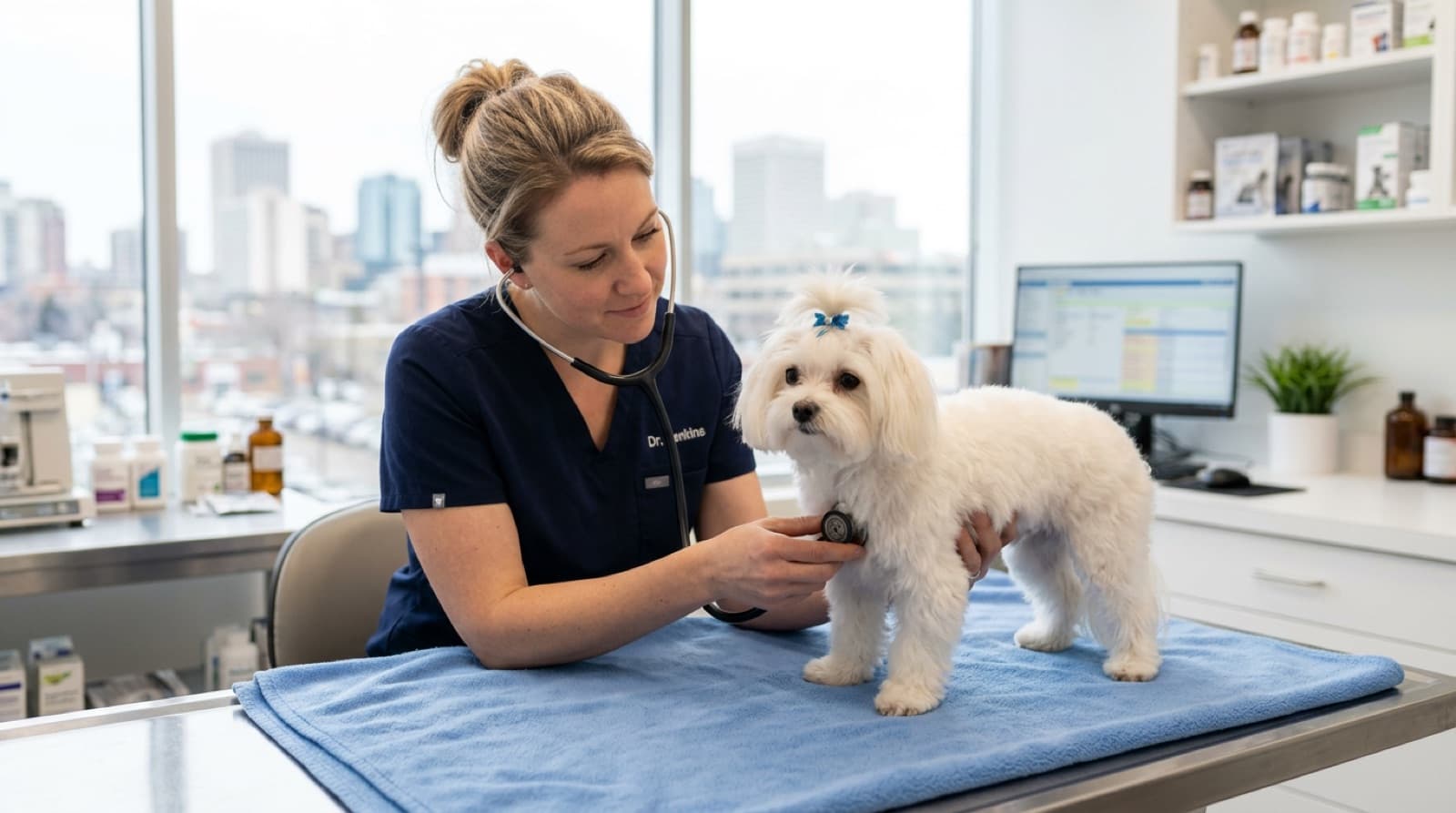
The Maltese breed health picture, briefly
The Maltese is an ancient toy companion: a tiny, single-coated lap dog bred for centuries to be a gentle housemate. It is generally long-lived, commonly reaching 12 to 15 years, so the goal is managing a distinctive set of mostly non-catastrophic conditions well across a long life, while protecting a very small body that has little margin for error.
The prioritisation list is led by the knees and the liver. Patellar luxation is the most common orthopaedic issue. The portosystemic liver shunt is the most breed-distinctive concern and the one most worth recognising early in a young dog. Dental disease is close to universal in the crowded toy mouth and needs lifelong care. After those: collapsing trachea (a honking-cough windpipe weakness), degenerative mitral valve disease (the common toy-breed heart condition of later life), white shaker dog syndrome (a treatable tremor disorder), puppy and small-dog hypoglycemia, eye disease with heavy tear staining on the white coat, and occasional hydrocephalus or other neurological issues.
The practical theme for an Edmonton Maltese owner is attentive routine care for a fragile-sized dog: keep it lean, use a harness, protect it from the cold, brush the teeth, and keep up annual exams that listen to the heart and check the knees. Pet insurance enrolled in week one is the financial backstop. The American Animal Hospital Association publishes preventive-care guidelines that frame the routine.
Patellar luxation and the toy joints
Patellar luxation, where the kneecap slips out of its groove, is one of the most common health issues in the Maltese as in toy breeds generally. The classic sign is an intermittent skip or hop in a back leg, or the dog briefly holding a leg up mid-stride before carrying on as normal. Your vet grades the severity, from mild and occasional to a kneecap that is dislocated most of the time.
Mild cases are often managed conservatively with weight control, sensible exercise, and joint support, and many dogs live comfortably for years without surgery. More severe or painful cases, or ones causing persistent lameness and driving arthritis, may need surgical correction. The single most protective everyday measure is keeping the dog lean, which spares the knees, the joints, and the small frame generally. The Orthopedic Foundation for Animals maintains the patellar evaluation scheme vets use. Legg-Calvé-Perthes disease, a hip condition of small breeds, appears occasionally and causes hind-leg lameness in a young dog needing veterinary assessment.
Portosystemic liver shunt: the breed-distinctive concern
A portosystemic shunt is a congenital abnormal blood vessel that lets blood bypass the liver instead of being filtered through it, so toxins the liver should clear build up in the bloodstream. The Maltese is one of the breeds notably overrepresented for this condition, which makes it worth every owner understanding, even though most individual Maltese will not have it.
Signs typically show in a young dog and can include stunted growth or failure to thrive, neurological signs that worsen after meals (disorientation, circling, staring into space, head pressing, or seizures), excessive drinking and urination, and digestive upset. The post-meal pattern is a classic clue, because eating increases the toxin load the bypassed liver cannot handle. Diagnosis starts with bloodwork and a bile acid test that assesses liver function, followed by imaging to locate the shunt.
Treatment depends on the shunt. Some are managed medically with a special diet and medication; many are best treated with surgery to close the abnormal vessel, which is specialist-level surgery often done on referral to internal medicine and surgery teams. The encouraging part is that outcomes are frequently good with appropriate treatment. The key message for adopters: any young Maltese with poor growth or post-meal neurological signs deserves a prompt vet workup, because a liver shunt is very treatable but has to be found first.
Browse adoptable Edmonton Maltese
Current Edmonton Maltese and Maltese-mix listings from SCARS, Zoe's, EHS, GEARS, Hope Lives Here, AHHRB, and AARCS Edmonton fosters. Foster notes flag any documented knee, heart, or growth history. Plan a first-month vet workup that checks the knees, listens to the heart, and sets a dental and weight plan.
See Available Maltese →Dental disease in the toy mouth
Like other toy breeds, the Maltese crowds a full set of teeth into a small jaw, which traps plaque and accelerates periodontal disease, and retained baby teeth are common and worsen the crowding. Left alone, dental disease causes pain, tooth loss, and a bacterial load that affects overall health, so it is one of the most consistent and most preventable Maltese health issues.
Management is lifelong and routine: daily toothbrushing with pet-safe paste is the single most effective home step and is worth building in from day one, supported by dental chews and professional cleanings under anaesthesia on the schedule your vet recommends, often more often than for a larger dog. An Edmonton dental cleaning with anaesthesia and any extractions commonly runs from several hundred to over a thousand dollars depending on the work involved, and the small-dog anaesthesia precautions below apply. The daily brushing habit saves teeth, money, and discomfort across the dog's life.
Collapsing trachea and heart disease
Collapsing trachea
Collapsing trachea is a weakening of the windpipe cartilage that lets the airway flatten, producing a distinctive dry, honking cough, often triggered by excitement, exertion, or pressure on the neck. It is managed rather than cured in most cases: always walk a Maltese on a harness instead of a neck collar so the leash never presses the windpipe, keep the dog lean (excess weight worsens it), reduce coughing triggers, and use medication for flare-ups on your vet's advice, with surgery reserved for severe cases. The harness habit is simple, cheap, and genuinely protective.
Mitral valve disease
Degenerative mitral valve disease is the common toy-breed heart condition, in which a heart valve gradually leaks. It is usually a concern of middle age and beyond, is first picked up as a heart murmur on a routine vet exam, and is monitored over time and then managed with medication as it progresses, frequently giving years of good quality life after diagnosis. This is one reason an annual exam that listens carefully to the heart matters for the breed. A board-certified veterinary cardiologist, credentialed through the American College of Veterinary Internal Medicine, manages advanced cases on referral.
Shaker syndrome, tiny-dog risks, and anaesthesia
White shaker dog syndrome
White shaker dog syndrome is a disorder seen in small white breeds including the Maltese, in which a young adult develops generalised, full-body tremors. It looks frightening, but it typically responds well to the treatment your vet prescribes, and many dogs recover fully or are well controlled. Because tremors can have other causes, some serious, any Maltese that develops body tremors needs a prompt veterinary assessment to pin down the cause rather than an assumption.
Hypoglycemia and other tiny-dog risks
Very small dogs, especially puppies, are prone to hypoglycemia (low blood sugar), which can cause weakness, wobbliness, or collapse and needs prompt action and veterinary advice. Toy breeds can also have an open fontanelle or, less commonly, hydrocephalus. Heavy tear staining is common and mostly cosmetic on the white coat, but persistent eye redness, squinting, or cloudiness is a medical sign, and progressive retinal atrophy and other eye conditions appear in the breed.
Anaesthesia in a tiny dog
A Maltese's small size means anaesthesia needs care, with attention to maintaining body temperature and blood sugar and precise drug dosing, all of which experienced clinics manage routinely. Since dental cleanings (a regular need in the breed) require anaesthesia, use a vet comfortable with toy-breed protocols and discuss the plan. Sharing any known history helps your vet build the safest approach for your individual dog.

The first-month Edmonton vet workup
A rescue adoption fee typically covers the basics: spay or neuter, core vaccines, deworming, a microchip, and treatment of any acute issue found at intake. What it usually does not cover is the breed-specific baseline that makes the years ahead easier to manage.
Plan a first-month visit with your chosen Edmonton vet that establishes the Maltese baseline:
- A careful cardiac auscultation to baseline the heart and catch any murmur
- A patellar (knee) check and an orthopaedic exam
- A thorough dental assessment and a plan for home brushing and the first cleaning
- A question about coughing (collapsing trachea) and confirmation you are using a harness
- Baseline bloodwork, including liver values, with a bile acid test if a shunt is suspected
- An eye exam, noting tear staining versus any medical eye sign
- A frank talk about pet insurance and enrolling now, before anything is documented
For senior Maltese (roughly ten and up), add full senior bloodwork and urinalysis, closer cardiac monitoring with a low threshold to refer for echocardiogram, dental care, and an eye exam. Budget $400 to $1,000 for a senior intake workup at an Edmonton clinic, and bring any vet notes the rescue can share.
Frequently asked questions
Where can I find specialty care for a Maltese near me in Edmonton?
Start with your general-practice Edmonton vet, who handles most Maltese health needs and refers to specialists when required: a board-certified internal medicine specialist for a suspected liver shunt, a cardiologist for heart murmurs and mitral valve disease, a neurologist for shaker syndrome or seizures, and a surgeon for patellar or shunt surgery. Edmonton has a smaller specialty network than Calgary, so some owners travel to Calgary specialty centres or the Western College of Veterinary Medicine (WCVM) in Saskatoon for advanced diagnostics and surgery. The American College of Veterinary Internal Medicine credentials the internal medicine, cardiology, and neurology boards. Establish a primary vet in month one, ask which specialists they refer toy breeds to, and keep an after-hours emergency plan handy, since a tiny dog can destabilise quickly.
What are the main Maltese health issues to know before adopting?
The Maltese is a long-lived toy breed (often 12 to 15 years) with a distinctive health profile. In rough order of practical importance: patellar luxation (slipping kneecaps, very common in the breed); portosystemic liver shunt (a congenital blood-vessel abnormality the Maltese is notably overrepresented for); dental disease (close to universal in the crowded toy mouth); collapsing trachea (a windpipe weakness causing a honking cough); degenerative mitral valve disease (the common toy-breed heart condition, usually later in life); white shaker dog syndrome (a treatable full-body tremor disorder seen in the breed); puppy and small-dog hypoglycemia; eye disease and heavy tear staining on the white coat; and occasional hydrocephalus or other neurological issues. Anaesthesia needs small-dog precautions. Week-one pet insurance is well worth it given the breed's range of potentially expensive concerns.
What is a liver shunt in a Maltese?
A portosystemic shunt is a congenital abnormal blood vessel that lets blood bypass the liver instead of being filtered by it, so toxins normally cleared by the liver build up in the bloodstream. The Maltese is one of the breeds notably overrepresented for it. Signs often appear in a young dog and can include stunted growth or failure to thrive, neurological signs that worsen after meals (disorientation, circling, staring, head pressing, seizures), excessive drinking and urination, and digestive upset. Diagnosis starts with bloodwork and a bile acid test that measures liver function, followed by imaging to locate the shunt. Some shunts are managed medically with diet and medication; many are best treated surgically to close the abnormal vessel, which is specialist surgery. Outcomes are often good with appropriate treatment. Any young Maltese with poor growth or post-meal neurological signs needs a prompt vet workup, because a shunt is very treatable but needs to be found.
How common is patellar luxation in Maltese, and how is it treated?
Patellar luxation, where the kneecap slips out of its normal groove, is one of the most common orthopaedic issues in the Maltese and in toy breeds generally. The classic sign is an intermittent skip or hop in a back leg, or the dog briefly holding a leg up mid-stride and then carrying on normally. Severity is graded by your vet from mild and intermittent to a kneecap that is out most of the time. Mild cases are managed conservatively with weight control, appropriate exercise, and joint support, and many dogs do well for life without surgery. More severe or painful cases, or those causing lameness and accelerating arthritis, may need surgical correction. The Orthopedic Foundation for Animals maintains the patellar evaluation scheme vets use. Keeping a Maltese lean is protective here, as it is for the joints and the back generally.
Do Maltese have heart and trachea problems?
Both are worth knowing about. Degenerative mitral valve disease is the common toy-breed heart condition, where a heart valve gradually leaks; it is usually a concern of middle age and beyond, is first detected as a heart murmur on a vet exam, and is monitored and then managed with medication as it progresses, often over years of good quality life. Collapsing trachea is a weakening of the windpipe cartilage that lets the airway flatten, producing a distinctive dry, honking cough, often triggered by excitement, pressure on the neck, or exertion. It is managed by avoiding neck pressure (always walk a Maltese on a harness, never a neck collar), keeping the dog lean, controlling coughing triggers, and medication for flare-ups, with surgery reserved for severe cases. Neither condition is a reason to avoid the breed, but both mean an annual vet exam that listens to the heart and asks about coughing is valuable.
What is white shaker dog syndrome?
White shaker dog syndrome (also called idiopathic cerebellitis or little white shaker syndrome) is a disorder seen in small white breeds including the Maltese, where a young adult dog develops generalised, full-body tremors. It looks alarming, but the important and reassuring fact is that it typically responds well to treatment that your vet prescribes, and many dogs recover fully or are well controlled. The tremors usually come on over a short period in a dog that is otherwise alert and eating. Because tremors and shaking can also have other causes, some serious, any Maltese that develops body tremors needs a prompt veterinary assessment to diagnose the cause rather than an assumption. With the right diagnosis and treatment, the outlook for true shaker syndrome is generally good.
Should I get pet insurance for an Edmonton rescue Maltese?
Yes, and enrol in week one. The Maltese case rests on the breadth of potentially expensive concerns rather than one single risk: liver shunt diagnosis and surgery is specialist-level cost, patellar surgery, dental cleanings and extractions over a lifetime, cardiology monitoring and heart medication in older age, and the workup for neurological signs all add up. Any one is manageable; the possibility of several over a 12-to-15-year life is what makes insurance sensible. Every Canadian provider excludes pre-existing conditions, and the clock starts the day you adopt, so a heart murmur, a luxating patella, or a dental issue documented before enrolment becomes a permanent exclusion. Premiums for a small breed are usually moderate. Look for explicit hereditary and congenital coverage (important given the liver shunt and patellar concerns), a reasonable annual cap, and acceptable wait times.
Do Maltese handle Edmonton winter?
They need real cold protection. The Maltese is a tiny, single-coated breed with no dense undercoat and very little body mass, which makes it genuinely cold-sensitive in an Edmonton winter. Plan a warm coat or sweater for walks below freezing, booties on salted and icy paths if the dog tolerates them, shorter outings in deep cold, and indoor activity to make up the exercise. Watch for shivering, lifted paws, and reluctance to walk as signs the dog is too cold. The small size also means a Maltese loses heat fast and can chill quickly, so do not leave one outside in winter weather. Inside, a Maltese is a cozy lap companion well suited to apartment life. With sensible winter gear and common sense, the breed lives happily in Edmonton, but the cold sensitivity is real and worth planning for.
Related Edmonton Maltese guides
Edmonton Adoptable Dogs
Current Edmonton-area Maltese and Maltese-mix listings from SCARS, Zoe's, EHS, GEARS, Hope Lives Here, AHHRB, and AARCS Edmonton fosters.
Maltese Adoption Edmonton
Rescue sources, real adoption costs, the companion-breed reality, common Maltese mixes, and the grooming commitment.
Shih Tzu Health Issues Edmonton
Another small companion breed, with the toy-mouth dental and eye-care themes that overlap closely with the Maltese.
Spay & Neuter Edmonton
Low-cost clinics, timing, and the small-dog anaesthesia precautions to raise with your vet before a Maltese's surgery.
Find your Edmonton rescue Maltese
Browse current Edmonton-area Maltese and Maltese-mix listings. Foster temperament notes help you flag any documented knee, heart, or growth history before you apply, and your first-month vet workup baselines the heart, knees, and teeth that shape the breed's care.
Browse All Edmonton Dogs →New dog? Start with these care guides
Everything a new adopter needs to set up a safe, happy home.