The short answer
Tracheal collapse is one of the highest-risk conditions for Pomeranians. Genetic cartilage weakness causes the windpipe to flatten and collapse during breathing, producing the signature dry goose-honking cough. Harness only, NEVER collar, from day one of ownership (collar pressure damages the trachea and triggers collapse). Most Poms develop symptoms between ages 4 and 10. Weight management is the single biggest modifiable severity factor: obesity dramatically worsens collapse mechanics. Medical management first: cough suppressants, bronchodilators, anti-inflammatories ($30 to $150/month). Severe cases (grade III-IV) may need surgical intervention ($5K-$10K+ stents or rings) at Edmonton specialty referral. Edmonton dry winter compounds the condition; humidifier 35-45% RH essential Nov-Mar. Smoke-free home, low-stress environment, calm excitement levels. Pet insurance within 14 days of adoption: tracheal collapse becomes pre-existing fast and is a lifetime expense. Most Poms live full 12-16 year lifespans with proper management.
Why Pomeranians are at high risk
The Pomeranian (along with Yorkshire Terrier, Maltese, Toy Poodle, Chihuahua, Shih Tzu, and other toy breeds) carries elevated lifetime risk for tracheal collapse. The condition is typically genetic and progressive: cartilage rings supporting the trachea weaken and flatten over time, causing the airway to partially or fully collapse during breathing.
The AKC Pomeranian breed profile describes the breed as “inquisitive, bold, lively” without foregrounding the respiratory commitment. The breed-club community and peer-reviewed veterinary literature consistently identify tracheal collapse as a defining breed health concern.
Onset timeline: most affected Poms develop symptoms between ages 4 and 10, with severity increasing over time. Some Poms remain asymptomatic for life; others develop severe symptoms requiring intervention. The progression is typically gradual over months to years.
Severity grades (used to determine treatment):
- Grade I: 25% airway collapse during breathing
- Grade II: 50% collapse
- Grade III: 75% collapse
- Grade IV: Greater than 75% collapse (severe; surgical candidate)
The honking cough: what to recognise
A dry, harsh, goose-like honking cough in a Pomeranian is tracheal collapse until proven otherwise. Immediate vet visit when first noticed; early-stage medical management has best outcomes.
Cough trigger patterns:
- Excitement (guests arriving, walks, food preparation)
- Drinking water
- Eating
- Pulling on leash (especially with a collar)
- Exposure to cold air
- Pressure on the throat (collar tug, lifting under the chin)
- Lying down or changing positions
Other signs:
- Exercise intolerance (the dog tires faster than expected during walks)
- Wheezing or gagging
- Blue-tinged gums (cyanosis) during severe episodes
- Fainting or collapse during severe episodes
- Increased respiratory effort
- Difficulty breathing when stressed or excited
Severity progression typically worsens during summer heat (panting puts more stress on collapsed airway), winter cold (cold air triggers cough), and with weight gain (excess weight in the chest area worsens collapse mechanics).
The harness-only rule
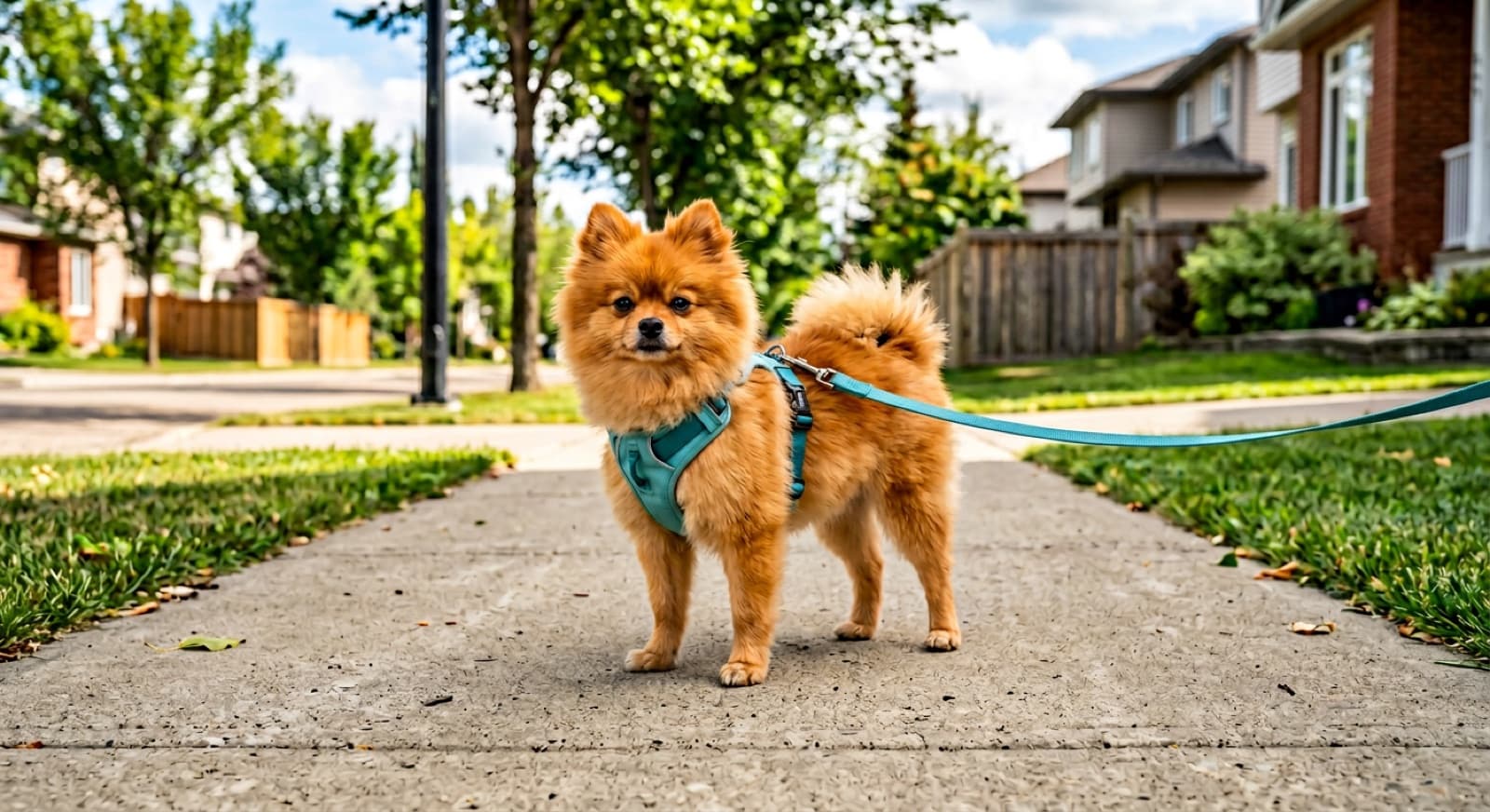
Every Pomeranian should wear a harness, not a collar, for leash walking from day one. A collar puts direct pressure on the trachea. For a dog with weakened cartilage, this pressure can trigger immediate collapse, cause coughing fits, or accelerate cartilage damage over time.
This rule applies even before any tracheal collapse symptoms appear because the condition is progressive and largely preventable from cartilage-damage acceleration with proper equipment.
Recommended harness types for Poms: H-style or vest-style harness that distributes pressure across the chest and shoulders. Brands: Ruffwear Front Range, Puppia Soft Harness, Voyager Step-in Harness (sized for tiny dogs).
Avoid:
- Any collar for leash walking (slip collars, prong collars, choke chains are especially dangerous)
- Retractable leashes (sudden jerks transmit force to whatever is at the dog's neck)
- Neck-only harnesses
The collar can still be worn for ID tag purposes but should not be the attachment point for the leash. This single equipment change is the most impactful prevention strategy.
Edmonton Pom owners who walked their dog on a collar for years before learning about tracheal collapse often see symptoms emerge in middle age that might have been delayed with harness-only practice from day one.
Browse adoptable Pomeranians in Edmonton
Adult Poms (5+ years) from Edmonton rescue often arrive with documented respiratory baseline including any tracheal collapse history. Ask the rescue during foster phone screen.
See Available Pomeranians →Weight management: the biggest modifiable factor
Obesity dramatically worsens tracheal collapse mechanics. Excess weight in the chest area increases pressure on the trachea, making collapse more severe and more frequent. Many mild-to-moderate cases improve significantly with weight loss of 10 to 20% of body weight.
Pomeranian breed standard is 3 to 7 lbs. Most adult Poms target 4 to 7 lbs at ideal body condition. Body Condition Score (BCS) 4 to 5 of 9 is the target. Ribs should be palpable with light fat cover; waist visible from above; slight tuck behind ribs from side.
Weight loss protocol for an overweight tracheal-collapse Pom (vet-supervised):
- Vet consult to rule out medical causes (hypothyroidism elevates risk and is common in older Poms)
- Measure food precisely with measuring cup (most owners over-feed by 20 to 40%)
- Reduce 10 to 20% from current intake
- Eliminate table food and treats during weight loss
- Use small piece of regular kibble as treats if needed for training
- Gentle exercise within tolerance (walks must not trigger coughing fits)
- Weekly weigh-ins
- Target 1 to 2% body weight loss per week
- Prescription weight-loss formulas sometimes appropriate (Hill's Metabolic, Royal Canin Satiety; vet-prescribed)
Weight management is lifelong, not just during a weight-loss phase. Maintaining ideal body condition is the single biggest thing you can do to manage tracheal collapse severity.
Medical treatment options
Medical management is the first-line approach for most Pomeranians with mild to moderate tracheal collapse. Multi-pronged approach (all medications vet-prescribed and dosed):
- Cough suppressants: hydrocodone, butorphanol, dextromethorphan derivatives. Reduce the cough cycle that further irritates the airway.
- Bronchodilators: theophylline, terbutaline. Help open the airway.
- Anti-inflammatory medications: sometimes oral steroids, NSAIDs as appropriate. Reduce airway inflammation.
- Sedatives for severe episodes: trazodone, acepromazine. When stress-triggered coughing fits are problematic.
Environmental management alongside medication:
- Harness-only walking (covered above)
- Reduced excitement triggers
- Humidifier during dry Edmonton winter (35 to 45% RH; dry air worsens cough)
- Avoiding cold-air exposure during severe cold snaps
- Smoke-free home (cigarette smoke is a major airway irritant)
- Calm low-stress environment
Cost: $30 to $150/month medications. Vet recheck visits $150 to $300 every 3 to 6 months for stable cases.
When surgery is considered
Surgery is reserved for severe cases (grade III or IV) that have failed medical management or are causing life-threatening respiratory distress. Two main surgical options exist:
Extraluminal prosthetic ring placement: rigid plastic rings placed around the outside of the trachea to support the cartilage. Older technique, requires referral to specialty surgeon. Edmonton cost: $4,000 to $8,000 through specialty veterinary referral.
Intraluminal stent placement: self-expanding metal mesh stent placed inside the trachea via bronchoscopy. Minimally invasive, requires specialty internal medicine practice with stent placement experience. Edmonton cost: $5,000 to $10,000+ specialty referral.
Both procedures carry risks (stent fracture, granulation tissue, ongoing cough management still needed in many cases). Most Edmonton Pomeranians never need surgery; medical management plus weight control plus harness-only equipment manages the majority of cases successfully for life.
Edmonton specialty veterinary internal medicine referral for severe cases routes through your GP vet; complex referrals route to the Western College of Veterinary Medicine in Saskatoon for advanced cases.
Frequently Asked Questions
What is tracheal collapse in Pomeranians?
Tracheal collapse is a progressive condition where the cartilage rings supporting the trachea (windpipe) weaken and flatten, causing the airway to partially or fully collapse during breathing. The Pomeranian (along with Yorkshire Terrier, Maltese, Toy Poodle, and other toy breeds) carries one of the highest lifetime risks of any breed. The condition is typically genetic and progressive: most affected Poms develop symptoms between ages 4 and 10, with severity increasing over time. The hallmark symptom is the "goose honking" cough that gives the condition its informal name. Tracheal collapse is one of the leading reasons Edmonton Pom owners seek emergency vet care, and it is the most common chronic condition managed by Edmonton specialty veterinary internal medicine practices for the breed.
What are the symptoms of tracheal collapse?
The hallmark symptom is a dry, harsh, goose-like honking cough, typically triggered by excitement, drinking water, eating, pulling on leash, exposure to cold air, or pressure on the throat. Other signs: exercise intolerance (the dog tires faster than expected during walks), wheezing or gagging, blue-tinged gums (cyanosis) during severe episodes, fainting or collapse during severe episodes, increased respiratory effort, difficulty breathing when stressed or excited. Mild cases may only produce occasional honking coughs that resolve quickly. Severe cases can include life-threatening respiratory distress requiring emergency vet intervention. The progression is typically gradual over months to years; symptoms may worsen during summer heat (panting puts more stress on collapsed airway), winter cold (cold air triggers cough), and with weight gain (excess weight in the chest area worsens collapse mechanics). Many Edmonton Pom owners report the first honking cough at age 4 to 6, with severity slowly increasing into the senior years.
Why is harness-only the rule for Pomeranians?
A collar puts direct pressure on the trachea. For a dog with weakened cartilage, this pressure can trigger immediate collapse, cause coughing fits, or accelerate cartilage damage over time. Every Pomeranian should wear a harness, not a collar, for leash walking from day one. This rule applies even before any tracheal collapse symptoms appear because the condition is progressive and largely preventable from cartilage-damage acceleration with proper equipment. Recommended harness types for Poms: H-style or vest-style harness that distributes pressure across the chest and shoulders (Ruffwear Front Range, Puppia Soft Harness, Voyager Step-in Harness, sized for tiny dogs). Avoid: any collar for leash walking (slip collars, prong collars, choke chains are especially dangerous), retractable leashes (sudden jerks transmit force to whatever is at the dog's neck), neck-only harnesses. The collar can still be worn for ID tag purposes but should not be the attachment point for the leash. This single equipment change is the most impactful prevention strategy. Edmonton Pom owners who walked their dog on a collar for years before learning about tracheal collapse often see symptoms emerge in middle age that might have been delayed with harness-only practice.
How is tracheal collapse diagnosed in Edmonton?
Diagnosis combines clinical history (the honking cough pattern), physical examination, and imaging. Chest x-rays during inspiration and expiration can sometimes show collapse but often miss intermittent collapse. Fluoroscopy (real-time x-ray during breathing) is the gold standard diagnostic and shows the trachea collapsing in real time; this requires referral to an Edmonton specialty veterinary practice with fluoroscopy capability. Sometimes bronchoscopy (camera into the airway under anaesthesia) is performed for severity grading and to rule out other airway conditions. Tracheal collapse is graded I to IV based on the percentage of airway lumen lost during collapse, with grade I being mildest and grade IV being severe (greater than 75% collapse). Grade determines treatment approach. Edmonton diagnostic costs: chest x-rays $300 to $700, fluoroscopy $500 to $1,000+ at specialty referral, bronchoscopy $800 to $1,500. Many Edmonton Pom owners get a presumptive diagnosis from clinical history plus chest x-rays without fluoroscopy unless the case is severe or treatment is not responding to standard management.
How is tracheal collapse treated medically?
Medical management is the first-line approach for most Pomeranians with mild to moderate tracheal collapse. Multi-pronged approach: cough suppressants (hydrocodone, butorphanol, dextromethorphan derivatives, all vet-prescribed) reduce the cough cycle that further irritates the airway; bronchodilators (theophylline, terbutaline) help open the airway; anti-inflammatory medications (sometimes oral steroids, NSAIDs as appropriate) reduce airway inflammation; sedatives for severe episodes (trazodone, acepromazine) when stress-triggered coughing fits are problematic. Weight management is critical: obesity dramatically worsens tracheal collapse mechanics; many mild-to-moderate cases improve significantly with weight loss of 10 to 20%. Environmental management includes harness-only walking, reduced excitement triggers, humidifier during dry Edmonton winter (35 to 45% RH; dry air worsens cough), avoiding cold-air exposure when possible during severe cold snaps, smoke-free home (cigarette smoke is a major airway irritant). Cost: $30 to $150/month medications, vet recheck visits $150 to $300 every 3 to 6 months for stable cases. The detailed weight management framework lives in our sibling Edmonton Pomeranian health-issues guide.
When is surgery considered for tracheal collapse?
Surgery is reserved for severe cases (grade III or IV) that have failed medical management or are causing life-threatening respiratory distress. Two main surgical options exist. Extraluminal prosthetic ring placement: rigid plastic rings placed around the outside of the trachea to support the cartilage; older technique, requires referral to specialty surgeon, $4,000 to $8,000 in Edmonton through specialty veterinary referral. Intraluminal stent placement: self-expanding metal mesh stent placed inside the trachea; minimally invasive, performed via bronchoscopy, requires specialty internal medicine practice with stent placement experience; $5,000 to $10,000+ in Edmonton specialty referral. Both procedures carry risks (stent fracture, granulation tissue, ongoing cough management still needed in many cases). Most Edmonton Pomeranians never need surgery; medical management plus weight control plus harness-only equipment manages the majority of cases successfully for life. Edmonton specialty veterinary internal medicine referral for severe cases routes through your GP vet; complex referrals route to the Western College of Veterinary Medicine in Saskatoon for advanced cases.
Does Edmonton dry winter make tracheal collapse worse?
Yes. Edmonton dry winter air (5 to 6 months of furnace-heated low humidity) irritates the airway and triggers more frequent cough episodes in Pomeranians with tracheal collapse. The cough cycle (cough irritates airway, irritated airway triggers more cough) is harder to break in dry conditions. Edmonton winter management for affected Poms: humidifier 35 to 45% relative humidity (whole-home or single-room covering the dog's primary spaces); avoid prolonged outdoor exposure in deep cold (-25C and below), as cold air triggers cough; consider a face muff or breathable scarf for outdoor potty trips in extreme cold (some Poms tolerate, most do not); short potty-only outdoor trips below -15C, longer warm-day walks above -10C; warm humid bathroom (run hot shower for 5 minutes, bring Pom in to breathe the moist air) for severe coughing episodes; cool down hot dogs gradually to prevent panting (panting worsens collapse); avoid cigarette smoke, candles, strong cleaning products, and aerosol sprays in the home year-round. The detailed Edmonton winter Pom care framework lives in our sibling Edmonton Pomeranian winter-care guide.
What is the long-term prognosis for a Pomeranian with tracheal collapse?
Most Pomeranians with mild to moderate tracheal collapse live full normal-lifespan lives (12 to 16 years) with appropriate medical management, weight control, and harness-only equipment. Cough episodes may continue but are manageable. The breed's typical lifespan is not significantly shortened in most cases. Severe cases (grade III or IV without surgical intervention) may have reduced quality of life and sometimes shortened lifespan due to recurrent respiratory crises. Surgical intervention (stents or rings) can dramatically improve quality of life in severe cases but does not always fully eliminate symptoms. Prognosis factors that improve outcomes: early diagnosis (before grade III collapse develops), harness-only equipment from day one, lifelong weight management at ideal body condition, calm low-stress home environment, smoke-free home, humidifier through Edmonton winter, regular vet monitoring every 3 to 6 months, prompt treatment of respiratory infections that can worsen baseline cough. Prognosis factors that worsen outcomes: delayed diagnosis, obesity, collar use, multi-dog household with excitement triggers, smoking household, repeated respiratory infections. Edmonton senior Pom adoption (8+ years) from rescue often arrives with established tracheal collapse documented in foster medical records; ask the rescue.
Pet insurance timing for Pomeranian tracheal collapse?
Critical. Tracheal collapse becomes a pre-existing condition the moment a vet notes a cough that suggests airway compromise. Many Edmonton Pom owners discover their dog has tracheal collapse during a routine wellness exam in middle age; if insurance was not in place before that visit, tracheal collapse becomes a lifetime exclusion. Get insurance within 14 days of adoption, before the first wellness visit if possible. Edmonton-active carriers (Trupanion, Pets Plus Us, OVMA Pet Health Insurance, Fetch) have different coverage philosophies on chronic respiratory conditions; read each policy specifically for tracheal collapse, respiratory condition, and pre-existing exclusions before signing. Premiums for an adult Pomeranian: $40 to $90/month for young adults, climbing to $80 to $180/month by age 8 to 10. Lifetime premium total: $6,000 to $18,000. Tracheal collapse lifetime medical management cost: $5,000 to $20,000+ over the dog's lifespan ($30 to $150/month medications + quarterly vet visits + occasional emergencies). The math favours insurance heavily for this breed. Adult rescue Pom strategy: schedule baseline vet exam BEFORE starting insurance if you want any pre-existing tracheal collapse documented in records before policy start; understand any noted condition will be excluded.
Are there other breeds at risk for tracheal collapse?
Yes. Tracheal collapse follows toy-breed anatomy. Highest-risk breeds: Pomeranian, Yorkshire Terrier, Maltese, Toy Poodle, Chihuahua, Shih Tzu, Lhasa Apso, Pug (also brachycephalic compounding), Italian Greyhound. Mixed breeds with toy-breed lineage carry the same risk. If your rescue dog has the small body, short neck, and toy-breed build typical of these breeds, treat as elevated tracheal collapse risk: harness-only from day one, weight management, vigilance for honking cough symptoms. The genetic cartilage-weakness component is anatomical, not paperwork-based. Edmonton rescue intake (SCARS, Edmonton Humane Society, Zoe's Animal Rescue, AHHRB, AARCS Edmonton fosters) regularly includes toy-breed mixes; foster home observation of body build matters more than breed label for risk assessment. Sibling Edmonton Yorkie feeding-and-dental guide covers Yorkie-specific tracheal collapse context briefly; the principles transfer.
Can I prevent tracheal collapse?
You cannot prevent the genetic predisposition (cartilage weakness is anatomical). You CAN delay or reduce severity through environmental factors. Lifelong prevention strategies: harness-only walking from day one (eliminate collar pressure on trachea); maintain ideal body weight (obesity is the single biggest modifiable risk factor for severity); calm low-stress home environment (chronic stress and excitement triggers worsen progression); smoke-free home (cigarette smoke is a major airway irritant for affected dogs); humidifier through Edmonton dry winter (35 to 45% RH); avoid neck pressure of any kind (never lift Pom by scruff or under chin; lift from chest/under-armpits); prompt treatment of any respiratory infections (kennel cough, viral upper respiratory infections can damage already-weakened cartilage); regular dental care (chronic dental infections affect overall airway health). None of these guarantee the dog will not develop symptomatic tracheal collapse, but they reduce severity and delay onset for genetically-predisposed individuals.
Bottom line for Edmonton Pomeranian owners?
Harness-only from day one (the single most impactful prevention practice). Weight management lifelong (obesity is the biggest severity factor). Pet insurance within 14 days of adoption (tracheal collapse becomes pre-existing fast and is a lifetime expense). Watch for honking cough symptoms starting around age 4 to 6; immediate vet visit when first noticed (early-stage medical management has best outcomes). Edmonton dry winter compounds the condition; humidifier essential through November to March. Smoke-free home, low-stress environment, calm excitement levels. Right for you if: realistic about the breed's elevated medical-management commitment, willing to commit harness-only and weight management, comfortable with $30 to $150/month medications for life if symptoms emerge, Edmonton home with humidifier capacity, pet insurance budget. Wrong for you if: smoker without willingness to smoke outside, limited budget for chronic medication, household with frequent excitement triggers (toddlers, multi-dog chaos), expectation of "easy small dog" with no medical commitment. Adult Pom adoption (5+ years from SCARS, EHS, Zoe's, AHHRB, AARCS Edmonton fosters) often arrives with documented respiratory baseline; ask the rescue. The breed lives 12 to 16 years; the medical commitment is real but the companionship return is meaningful for the right household.
Adoptable Pomeranians in Edmonton
Live listings from SCARS, Edmonton Humane Society, Zoe's, AHHRB, and AARCS Edmonton fosters.
Pomeranian Adoption Edmonton
Rescue pipelines, costs, teacup warning, coat colour varieties, family-fit framework.
Pomeranian Health Issues: Trachea, Knees, Coat
Pomeranian health issues to plan for: collapsing trachea, knees and hips, alopecia X coat loss, dental disease, puppy low blood sugar and heart valve disease.
Pomeranian Winter Care Edmonton
Cold tolerance limits, gear standards, indoor potty, humidifier needs, tracheal collapse winter management.
New dog? Start with these care guides
Everything a new adopter needs to set up a safe, happy home.