The short answer
Rottweiler adolescence runs 8 to 24 months with peak chaos at 12 to 18. Recall fails. Counter-surfing emerges. A second fear period drops in around 12 to 14 months that looks dramatic and is temporary. The dog reaches adult strength (80 to 130 lbs) by 18 months but mental maturity does not arrive until 2 to 3 years, sometimes 3 to 4 for large males. Edmonton rescue intake peaks at 12 to 20 months for exactly this reason. The training did not fail. The dog is teenagering. Force-free management plus environmental controls plus patience equals the calm confident adult Rottweiler the breed is famous for. Aversive training (prong, e-collar, alpha rolls) elevates bite risk in guardian breeds and creates Bylaw 21244 exposure the family cannot undo.
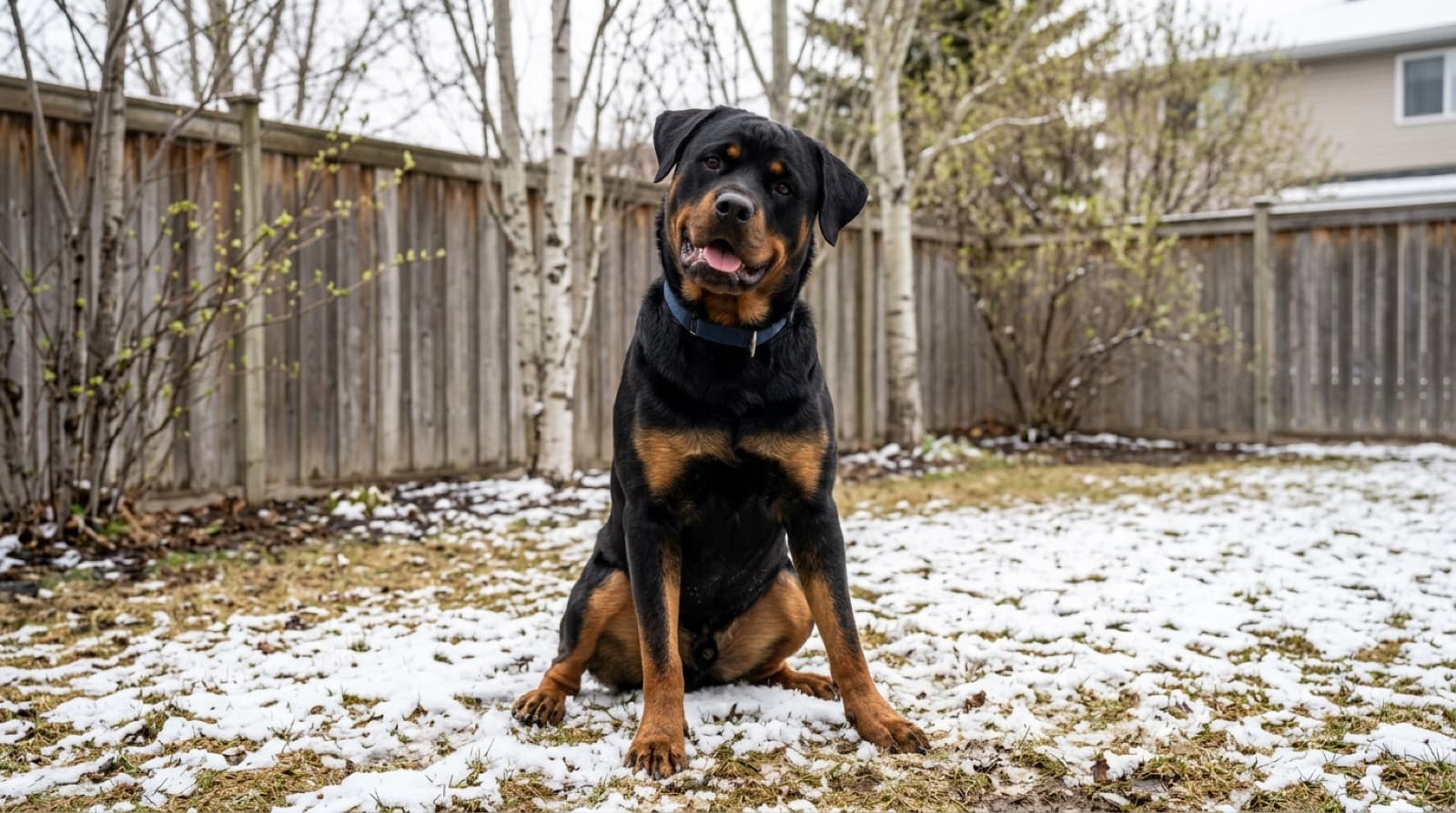
The pattern Edmonton rescues see every month
SCARS, the Edmonton Humane Society, Zoe's Animal Rescue, and AHHRB all see Rottweiler surrenders most weeks, and the surrendered dogs are overwhelmingly 12 to 20 months old. The story is consistent. The family did everything right with their puppy. The dog was responding beautifully at six months. Then something changed around the first birthday. The recall fell apart. The mouthing came back. The dog started counter-surfing and ignoring cues they used to know cold. By 14 months the family is exhausted and convinced something is wrong with their dog.
Nothing is wrong. The dog is in adolescence. Same phase a human teenager goes through, but with the body of a 110 lb adult and the impulse control of a six-month-old. If you can get through the next year with consistency and the right help, the dog you imagined when you adopted shows up on the other side. The calm confident deeply bonded Rottweiler the breed is famous for is the post-adolescent version, not the 14-month-old eating your sectional.
This is also the phase when the aversive training industry markets hardest to Rottweiler owners. The promised quick fixes through prong, e-collar, or alpha rollover do not solve adolescent regression in a guardian breed; they elevate reactivity and create Bylaw 21244 dangerous-dog exposure the family cannot easily undo.
What is actually happening between 8 and 24 months
- Onset (8 to 10 months). Sexual maturity hormones begin (even in dogs already spayed or neutered, the adolescent neurological window is still active). Subtle training slips you might miss. The 6-month-old who held a sit now breaks it occasionally.
- Peak chaos (10 to 18 months). Recall fails in distraction. Hard mouthing during play. Counter-surfing emerges. Selective hearing. Boundary testing. Second fear period (12 to 14 months) drops in with sudden new fears that look dramatic. The dog reaches near-adult body weight while still making adolescent decisions.
- Gradual settling (18 to 24 months). Consistent owners see training re-integration. Skills return faster than they did the first time because the foundation is still there underneath. Impulse control improves. Reactivity moderates if it was generalised rather than specific.
- Mental maturity (24 to 36 months, sometimes 48). The calm adult Rottweiler emerges. Large males and working-line dogs sometimes take until 3 to 4 years to fully settle.
The reason this feels brutal is the timing mismatch. A Rottweiler reaches adult strength (80 to 130 lbs) by about 18 months, but the brain is still teenage for another year. You end up with a fully grown dog making puppy-quality decisions. Edmonton bylaw consequences and bite-risk exposure are real even though the dog is “just being a teenager.”
Why Edmonton Bylaw 21244 raises the stakes
Alberta has no breed-specific legislation, and the Edmonton Animal Care and Control Bylaw 21244 treats Rottweilers the same as every other breed. The dangerous-dog provisions are behaviour-based: a dog can be declared dangerous after biting, attacking, or threatening a person or animal, regardless of breed or size.
The classification carries serious consequences including mandatory leashing, muzzle in public, secure containment requirements, and fines that can run into thousands of dollars. For Rottweiler owners specifically, an adolescent-phase bite incident that would resolve quietly with another breed can trigger a dangerous-dog designation that follows the dog for life. The City of Edmonton dogs services page is the canonical reference.
The practical case for force-free training during adolescence: the behaviour-modification record matters if there is ever an incident. A dog whose owner can demonstrate ongoing work with a CCPDT-credentialed or IAABC-credentialed force-free trainer is in a different position than a dog whose owner cannot. Aversive training that increases bite probability (which the peer-reviewed evidence consistently shows it does, particularly in guardian breeds) creates legal exposure on top of welfare harm. The math is simple: $80 to $150 per force-free training session times 8 to 12 sessions across the adolescent window costs $640 to $1,800 total. A single bite incident in a Rottweiler can cost five to ten times that in vet bills, civil liability, and dangerous-dog hearing costs.
The detailed Bylaw 21244 housing, insurance, and landlord context lives in our Edmonton Rottweiler housing and insurance guide. The short version is that responsible adolescent management is the foundation everything else builds on.
The second fear period: what it looks like and how to handle it
The second fear period usually shows up between 6 and 14 months, and for Rottweilers it often lands around 12 to 14 months. It looks different from general adolescent regression. Regression is your dog ignoring known cues across many situations. A fear period is sudden, specific, and often dramatic.
A dog who was completely fine with the vacuum, the mailman, or another dog at the off-leash park suddenly is not. The fear is new, not preexisting, and usually lasts two to four weeks. Body language is the giveaway: tail tucked, weight shifted backward, ears back, even when the dog is lunging forward. That posture means defensive, not aggressive. The dog is scared, not dominant.
The right response:
- Keep distance from whatever scared them. Distance is the cheapest behaviour-modification tool.
- Pair the trigger with high-value food at a distance the dog can handle. Counter-conditioning works on this principle.
- Avoid forcing exposure. “Flooding” a fearful dog into the scary thing usually makes the fear worse, not better.
- Do NOT punish growling or lunging. The growl is your warning system. Suppressing it teaches the dog to skip straight to a bite next time.
If the fear period is dragging past four weeks or generalising to lots of triggers, work with a force-free trainer credentialed through CCPDT, IAABC, KPA, or Fear Free. Edmonton-specific triggers worth knowing: sudden weather changes, summer fireworks around Canada Day, Halloween costumes, unfamiliar workers in the yard, and dogs encountered on narrow river-valley trails where distance management is harder than in open parks.
Why aversive trainers are dangerous on adolescent Rottweilers
You will hear “balanced trainers” in Edmonton recommend prong collars and e-collars for Rottweilers, often pitched as the only thing that works on a “stubborn” guard breed. The peer-reviewed research and breed-specific behavioural science both say the opposite.
Aversive corrections increase aggression and bite risk in guardian breeds in two ways.
- Trigger association. The dog associates the painful correction with whatever they were looking at (another dog, a stranger, a kid on a bike) and learns that thing predicts pain. The dog gets MORE reactive to the trigger, not less. This is documented across multiple peer-reviewed studies on shock collar and prong collar use in guardian and herding breeds.
- Growl suppression. Aversive corrections often suppress growling, which sounds like progress but is dangerous. The growl is the warning before a bite. Suppress the growl and you get bites without warning. This is the mechanism that turns a manageable reactive dog into a dangerous-dog-classified dog.
The science is not Pawfinder editorial. The American Veterinary Medical Association, the International Association of Animal Behaviour Consultants, and the Certification Council for Professional Dog Trainers all carry position statements against aversive correction tools, citing elevated fear, aggression, and bite risk. The American Veterinary Society of Animal Behavior position statement on humane training is unambiguous on the point.
What to look for instead: trainers who describe themselves as force-free, positive reinforcement, or LIMA (Least Intrusive, Minimally Aversive). Verify CCPDT, KPA, IAABC, or Fear Free certification before booking. First sessions typically run $80 to $150 in Edmonton. A few hundred dollars of force-free training is a fraction of what a single bite incident costs in vet bills, civil liability, and Bylaw 21244 dangerous-dog hearing costs.
The Edmonton adolescent Rottweiler management playbook
Rely on environmental management more than you think you should. A house-leash, baby gates, a front-clip harness, and a long-line at the off-leash park are what every experienced Rottweiler owner uses through this phase.
The daily structure that works:
- Morning exercise before training. 30 to 45 minute walk first, then a 5 to 15 minute training session. Tired dog learns better than fresh wired dog.
- House-leash inside. A light leash dragging behind the dog when home gives you a handle for redirection without confrontation. Take it off when crated or at night.
- Baby gates blocking high-value rooms. Kitchen during cooking, dining room during meals, bedroom if needed. The dog physically cannot rehearse the unwanted behaviour.
- Long-line in off-leash zones. 10 to 15 metres of biothane. Keeps the recall practice happening without recall failure rehearsal.
- Real food rewards. Cooked chicken, cheese, freeze-dried liver. Kibble is insufficient for adolescent Rottweiler training in distraction.
- Short training sessions. 5 to 15 minutes, several times per day, rather than one long session.
- Impulse-control games. Wait at doors, wait before meals, “leave it” with high-value items.
- Family consistency. Every adult in the household uses the same cues and the same rules. Mixed messages slow training by months.
- Daily mental enrichment. Food puzzles, snuffle mats, scent games, frozen Kong. A mentally tired Rottweiler destroys far less than a physically half-tired one.
- Force-free trainer relationship. By month 10 or earlier. CCPDT, IAABC, KPA, or Fear Free certification only. $80 to $150 per session times 6 to 10 sessions across the adolescent window.
Browse adoptable Rottweilers in Edmonton
Adult Rottweilers (3 years and up) skip the adolescent chaos entirely. Live Edmonton listings from SCARS, EHS, Zoe's, AHHRB, and the rest of the Edmonton rescue network update regularly.
See Available Rottweilers →What does NOT outgrow on its own
Mouthing during play, lunging from over-arousal, selective hearing, and most counter-surfing fade between 18 and 24 months as the dog matures. What does NOT fade on its own:
- Reactivity. Specific or generalised reactions to triggers (dogs, strangers, kids, bikes, vehicles). If your dog is showing this at 12 to 18 months, the pattern locks in without intervention. Force-free trainer immediately.
- Resource guarding. Stiffening, growling, or snapping over food, toys, or owner attention. Common in adolescent Rottweilers and entirely manageable with the right protocol, but it does not resolve by waiting it out.
- Same-sex aggression. Often emerges in adolescence between intact or older Rottweiler pairs. Needs its own management plan and sometimes lifestyle changes for multi-dog Edmonton households.
- Severe fear that does not resolve in 4 weeks. A second fear period that drags past a month and generalises to many triggers is no longer a developmental phase. It is a clinical pattern. Veterinary behaviourist referral through the Western College of Veterinary Medicine in Saskatoon is the right tier.
The adolescent phase is the worst time to hope these will grow out on their own. They lock in. A force-free trainer can work through reactivity and resource guarding while the dog is still young and the patterns are not cemented. Owners who report the best outcomes track behaviour week by week in a journal. Day to day it can feel like nothing is improving, but six weeks of notes usually show measurable change.
Frequently Asked Questions
When does Rottweiler adolescence start, and how long does it last?
Most Rottweilers start showing changes around 8 or 9 months. Peak teenage chaos generally lands between 10 and 18 months. Things start settling between 18 and 24 months. Mental maturity comes later than people expect, usually 2 to 3 years, sometimes 3 to 4 years for larger males. The AKC breed standard and the American Rottweiler Club both flag this slow-maturing pattern. The reason it feels brutal is the timing mismatch. A Rottweiler reaches adult strength (80 to 130 lbs) by about 18 months, but the brain is still teenage for another year. You end up with a fully grown dog making puppy-quality decisions. The good news: this is a phase, not who your dog is becoming. The Rottweiler everyone admires (calm, confident, deeply bonded) shows up after this phase ends, not during it.
Why is my one-year-old Rottweiler ignoring training they knew at four months?
Classic adolescent regression. The dog you trained at 4 months is going through a brain reorganisation that temporarily makes those trained behaviours harder to access. Hormones are changing (even in spayed and neutered dogs), confidence is exploding, and your dog is figuring out what they can get away with using a body that now weighs 90+ lbs. The training did not fail. It went underground. What helps: keep training, but use higher-value treats than you used as a puppy. Kibble worked at 4 months; at 14 months you usually need cooked chicken, hot dogs, freeze-dried liver, or cheese. Keep sessions short (5 to 15 minutes, several times a day). Lean on environmental management: a house-leash, baby gates, and a long-line at the off-leash park are not cheating, they are what gets you through the months when your dog can outrun their own training. Most Edmonton owners see the trained dog return between 18 and 24 months when they stay consistent.
What is the second fear period, and how is it different from regression?
The second fear period usually shows up between 6 and 14 months, and for Rottweilers it often lands around 12 to 14 months. It looks different from general adolescent regression. Regression is your dog ignoring known cues across many situations. A fear period is sudden, specific, and often dramatic. A dog who was completely fine with the vacuum, the mailman, or another dog at the off-leash park suddenly is not. The fear is new, not preexisting, and it usually lasts two to four weeks. Body language is the giveaway: tail tucked, weight shifted backward, ears back, even when the dog is lunging forward. That posture means defensive, not aggressive. The right response: keep distance from whatever scared them, pair the trigger with high-value food at a distance the dog can handle, and avoid forcing exposure. Punishing the growling or lunging is the worst thing you can do. The growl is your warning system. Suppressing it teaches the dog to skip straight to a bite next time. Edmonton-specific triggers worth knowing about: sudden weather changes, summer fireworks around Canada Day, Halloween costumes, unfamiliar workers in the yard, and dogs encountered on the narrow river-valley trails where distance management is harder.
Will my Rottweiler outgrow the lunging, mouthing, and counter-surfing?
For the most part, yes, if you keep training and managing the environment. Mouthing during play, lunging from over-arousal, selective hearing, and most counter-surfing fade between 18 and 24 months as the dog matures. What does not fade on its own: reactivity, resource guarding, and same-sex aggression. If your dog is showing those, the adolescent phase is the worst time to hope they will grow out of it. They usually do not. They lock in. A force-free trainer (look for CCPDT, IAABC, KPA, or Fear Free certifications) can work through reactivity and resource guarding while the dog is still young and the patterns are not cemented. Same-sex aggression often emerges in adolescence and needs its own management plan. Owners who report the best outcomes track behaviour week by week in a journal. Day to day it can feel like nothing is improving, but six weeks of notes usually show measurable change.
How do I stay consistent when a 100 lb teenager is testing me daily?
The shortest answer: rely on environmental management more than you think you should. A house-leash, baby gates, a front-clip harness for walks, and a long-line at the off-leash park are not a sign you failed at training. They are what every experienced Rottweiler owner uses through this phase. Tire the dog out before training sessions, not after. A 30 to 45 minute walk first, then a short training session, works better than the reverse. Use real food rewards (cooked chicken, cheese, freeze-dried liver) not kibble. Keep sessions short. Build impulse control through small daily exercises like waiting at doors, waiting before meals, and "leave it" with high-value items. Get all family members on the same rules so the dog is not getting different feedback from different people. And do not try to do this alone. An Edmonton force-free trainer experienced with large guardian breeds typically runs $80 to $150 per session, and is the most cost-effective insurance you can buy against ending up at the emergency vet, the rescue, or a Bylaw 21244 hearing. Verify CCPDT, IAABC, KPA, or Fear Free certification before booking.
Why are prong collars and e-collars dangerous on adolescent Rottweilers?
You will hear "balanced trainers" in Edmonton recommend prong collars and e-collars for Rottweilers, often pitched as the only thing that works on a "stubborn" guard breed. The peer-reviewed research and breed-specific behavioural science both say the opposite. Aversive corrections increase aggression and bite risk in guardian breeds, and they do it in two ways. First, the dog associates the painful correction with whatever they were looking at (another dog, a stranger, a kid on a bike) and learns that thing predicts pain. The dog gets more reactive to the trigger, not less. Second, aversive corrections often suppress growling, which sounds like progress but is dangerous. The growl is the warning before a bite. Suppress the growl and you get bites without warning. The American Veterinary Medical Association, the International Association of Animal Behaviour Consultants, and the Certification Council for Professional Dog Trainers all carry position statements aligned on this point. The trainers worth working with describe themselves as force-free, positive reinforcement, or LIMA (Least Intrusive, Minimally Aversive). Look for CCPDT, KPA, IAABC, or Fear Free certifications. First sessions typically run $80 to $150, and a few hundred dollars of force-free training is a fraction of what a single bite incident costs in vet bills, lawsuit risk, and Bylaw 21244 dangerous-dog classification.
Is daycare a good idea during my Rottweiler's adolescent phase?
For most Edmonton owners, yes. Two or three days a week of daycare during the 8 to 18 month phase often makes the rest of the week noticeably easier. Your dog comes home tired in a satisfying way instead of bored and looking for trouble. The trick is finding the right daycare. You want one with experienced staff, smaller groups (8 to 15 dogs), structured rest breaks, and either no small dogs in the same play group or clear separation. Daycares with too many small dogs and an over-aroused adolescent Rottweiler can drift into predatory play, which is bad news for everyone. Edmonton daycares generally charge $30 to $55 per single visit, with monthly packages around $400 to $800 for four or five visits a week. Warning signs the daycare is not the right fit: your dog comes home with puncture wounds, refuses to walk in, comes home wired instead of tired, or loses recall the day after. If daycare does not suit your dog, alternatives include nose work classes, Sniffspots (rented private outdoor spaces), and structured hikes with a calm adult dog friend.
When can my adolescent Rottweiler be off-leash in Edmonton?
Honest answer: later than you think. A reliable recall at 6 months very often fails at 14 months, and Edmonton off-leash culture creates pressure to ignore that. The safer progression is to keep your dog on a long-line (10 to 15 metres of biothane works well) through the worst of the adolescent phase, then start short off-leash sessions in low-distraction places (early morning Mill Creek Ravine, quiet weekday Whitemud) once recall is rebuilding. Most Rottweilers are reliably off-leash again somewhere between 18 and 24 months. Some never quite get there with high-value distractions like other dogs or wildlife, which is normal, not a failure. Practical points: coyote sightings on the river-valley corridors are common, and an adolescent Rottweiler chasing one can end badly for both animals. Edmonton Bylaw 21244 requires dogs to be under voice or visual control even in designated off-leash zones; the fine for failing to control is $250. Bylaw officers patrol the river-valley parks. An adolescent Rottweiler ignoring recall in a busy off-leash zone is both a ticket risk and a bite-incident risk.
How do I deal with destructive chewing and counter-surfing?
Most adolescent destruction comes from one of three places: not enough exercise, not enough mental work, or stress. The fix is rarely just more training. It is usually more environmental management plus more enrichment. For destruction, give your dog appropriate things to chew (Benebones, beef tendons, frozen Kongs stuffed with peanut butter or yogurt), rotate them so they stay novel, and limit access to off-limits zones with baby gates or a crate during alone time. A tired dog chews less, so build in 60 to 90 minutes of structured activity daily plus mental work like food puzzles, snuffle mats, or scent games. For counter-surfing, the rule is simple: do not let it happen even once. One successful theft creates a habit that takes months to break. Store everything in cabinets or the fridge, dog-proof your garbage and dishwasher, and use a baby gate to block the kitchen during cooking. Counter-surfing has real medical risk for Rottweilers: pancreatitis from rich food, GDV (bloat) from eating too fast, and toxic ingestion if your dog gets into chocolate, xylitol, grapes, or onions. Edmonton 24-hour emergency vet visits spike around holidays and summer barbecues for exactly this reason.
How does Edmonton winter change adolescent Rottweiler management?
Less than it changes management for small breeds, but more than most owners plan for. Rottweilers handle Edmonton cold well thanks to their double coat and large body mass; healthy adult Rotts are comfortable down to roughly -20C with normal walks, and many tolerate brief exposure to -30C wind chill without distress. The Edmonton winter challenge for adolescents is not cold tolerance, it is the under-exercise that happens when daylight contracts and owners shorten walks. An under-exercised 90 lb adolescent Rottweiler in a small house through January is the destructive-chewing perfect storm. The winter management plan that works: maintain the 60 to 90 minute daily exercise target year-round (river-valley walks at -15 to -20C are still possible with paw protection and shorter sessions in deep cold), prioritise indoor mental enrichment (food puzzles, scent games, training sessions) on the deepest cold days, and consider daycare 2 to 3 days a week through the worst stretches. Booties become useful below -15C for salt protection on Edmonton sidewalks, not for cold protection.
I just adopted an adolescent rescue Rottweiler. How do I handle the overlap?
You are dealing with two timelines stacking on top of each other: the 3-3-3 adjustment rule (3 days to settle, 3 weeks to learn the routine, 3 months to feel at home) and adolescent regression that may run another year. That is a hard combination. What helps in the first few weeks: structure (predictable daily routine, a quiet space the dog can retreat to, baby gates and a leash inside the house to manage interactions) and very low expectations about what your dog "knows." A rescue Rottweiler who was perfectly trained in a foster home will often act like they have forgotten everything in a new house. They have not. They are overwhelmed. Give them three or four weeks before drawing conclusions about their personality. Get a vet exam early to rule out pain or medical causes for behaviour. Reach out to a force-free trainer who has worked with rescue Rottweilers before, ideally within the first few weeks rather than waiting for a problem. Edmonton rescues (SCARS, Edmonton Humane Society, Zoe's Animal Rescue, AHHRB) offer ongoing post-adoption support. Use it. If you find yourself genuinely unable to manage the dog after honest effort, talk to the rescue about a return. Returning a dog is not a failure. Forcing a mismatched placement is harder on the dog than an honest second adoption attempt.
Bottom line, can I survive Edmonton Rottweiler adolescence?
Yes, with realistic expectations and the right support. The dogs that thrive through this phase have owners who accept that 8 to 24 months is a stage rather than a personality, manage the environment proactively (house-leash, baby gates, long-line, secure fencing), maintain training consistency through the regression, use force-free methods only, build a real Edmonton-winter exercise plan that holds up through January and February, and bring in a force-free trainer by month 10 or earlier. The owners who struggle: first-time large-breed owners without experienced support, owners with tight schedules and long work hours, families who interpret the regression as breed defect rather than developmental phase, and owners who fall for the aversive-training quick-fix marketing. If any of those describe you and you are still pre-adoption, consider an adult Rottweiler (3 years and up) from SCARS, Edmonton Humane Society, or Zoe's. Adult Rotts skip the adolescent chaos entirely and arrive with established household manners. The breed lifespan of 9 to 12 years means a meaningful 6 to 9 year companionship with the calm, confident, deeply bonded adult Rottweiler the breed is famous for.
Adoptable Rottweilers in Edmonton
Live listings from SCARS, Edmonton Humane Society, Zoe's, AHHRB, and the rest of the Edmonton rescue network.
Rottweiler Adoption Edmonton
Rescue pipelines, costs, working-line vs show-line, family-fit reality, adult adoption alternative.
Rottweiler Housing & Insurance Edmonton
Landlord conversations, condo board pet rules, home insurance restrictions, Bylaw 21244 dangerous-dog provisions.
Rottweiler Health Issues Edmonton
Cancer (osteosarcoma, lymphoma), subaortic stenosis, hip and elbow dysplasia, specialty vet access.
New dog? Start with these care guides
Everything a new adopter needs to set up a safe, happy home.