The short answer
Whitemud Ravine is the connected off-leash corridor that runs along Whitemud Creek through west Edmonton, from the Rainbow Valley area in the north down through Snow Valley and Fox Drive into the broader Whitemud Park system. The designated off-leash sections are on the granular creek-bottom trail, not the upper rim paths and not the Nature Reserve's ecologically sensitive zones. Park hours are 5 AM to 11 PM. It is wooded, multi-entry, harder than Hawrelak for first-timers, and one of the most active wildlife corridors in the city. Pair it with Mill Creek Ravine on the east for the full ravine mesh.
What makes Whitemud Ravine different
Most Edmonton off-leash parks have a vibe you can summarize in one word. Hawrelak is the manicured lawn park. Terwillegar is the open river field. Mill Creek is the south-side commuter ravine. Whitemud Ravine is the wild one.
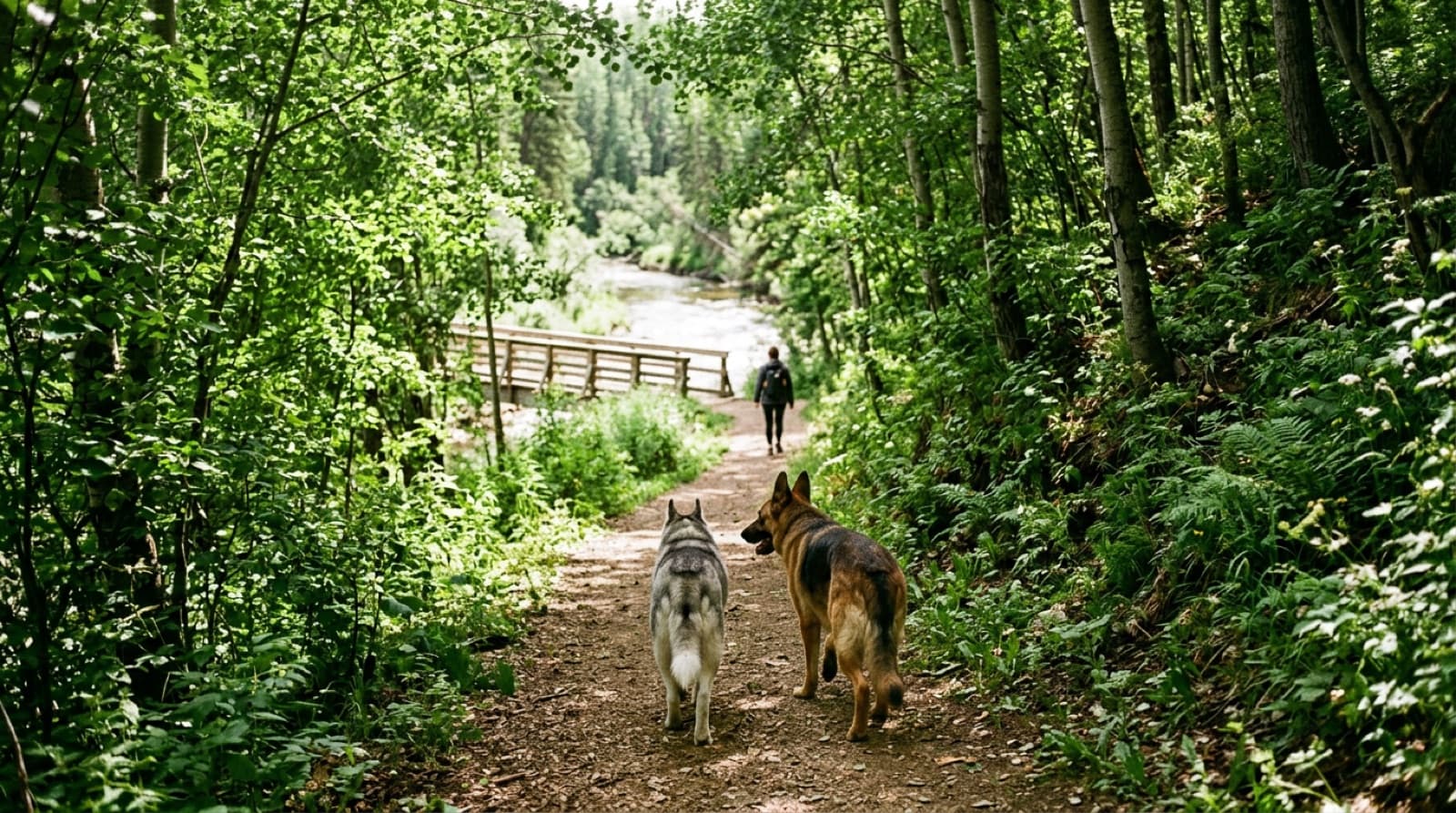
The practical effect: a visit feels more like a hike than a park stop. The corridor is long, the trail braids in several places, the tree cover is dense, and the creek runs beside you for most of the walk. You will pass deer tracks in fresh snow. You may see a coyote at dusk. The Nature Reserve designation on much of the corridor signals that this is not a manicured park space, and the trail conditions match that: gravel, packed dirt, root steps, and steep grades at some descents.
This shape also means the corridor is multi-use. Whitemud's upper paved rim path is a real commuter cycling route and the broader Edmonton river valley trail network connects into the ravine at several points. The granular trail in the ravine bottom (where the off-leash designation sits) is quieter than the rim path but still gets passes from cyclists, runners, cross-country skiers in winter, and the occasional fat-bike rider. Your dog needs to be neutral about bikes passing close, or you need to keep them leashed on the busier stretches.
Where exactly is Whitemud Ravine
The ravine runs roughly north-south through west Edmonton, following Whitemud Creek as the creek drains north into the North Saskatchewan River. The corridor stretches from the area around Snow Valley and Rainbow Valley in the north down through the broader Whitemud Park and Whitemud Ravine Nature Reserve south of Fox Drive. Whitemud Creek itself joins the North Saskatchewan in the river valley west of downtown.
Neighbourhoods the corridor passes through or borders: Rainbow Valley, Brookside, Aspen Gardens, Westbrook Estate, the Riverbend communities to the south, and the Lewis Estates and West Jasper Place areas to the west. West-side Edmonton dog owners in these areas use Whitemud as their default off-leash, often skipping Hawrelak entirely.
There is no single park address most owners punch into GPS. Whitemud is a multi-entry corridor, and you arrive at the access point closest to where you live. The Rainbow Valley Campground area on the east side is the most-used first-visit entry.
Off-leash zones explained
Important and easy to get wrong: the whole ravine is not off-leash. The designation applies to specific marked stretches of the granular creek-bottom trail. The pattern matches every other Edmonton ravine off-leash zone, and it is laid out in the City of Edmonton Animal Care and Control Bylaw 21244.
- Off-leash permitted: the designated stretches of the granular creek-bottom trail through the central corridor. Signage at access points confirms when you have entered or left the zone.
- Always leashed: the upper paved rim paths (commuter cyclist routes), the Nature Reserve's ecologically sensitive sub-zones (signed), most trail connections that link Whitemud into the broader river valley system, and any spur trails that exit the corridor into surrounding neighbourhoods.
- Bridges and creek crossings are leashed. Wooden footbridges are pinch points where dogs and cyclists or runners meet at close range.
The on-the-ground signs are not on every corner. The most reliable check is the City of Edmonton interactive off-leash map at edmonton.ca; enter your address and the map highlights nearby off-leash boundaries.
The fine for an off-leash dog outside a designated zone is $250 under the current Edmonton Animal Care and Control Bylaw (effective May 2026). Bylaw officers do patrol Whitemud, mostly on summer weekends and during city focus campaigns.
The main access points
Because Whitemud is a long, connected corridor, there is no single main entrance. You pick the access point closest to where you live or are driving from. Three common ones:
1. Rainbow Valley access (east side, the easy first visit)
Park at the Rainbow Valley Campground or picnic area off 119 Street and Whitemud Drive. Walk south on the trail descent into the ravine; you reach the creek-bottom trail within five minutes and the off-leash signage shortly after. This is the cleanest first visit because the descent is gentle, the parking is signed and obvious, and the trail spine south is the most direct walk into the off-leash zone.
2. Snow Valley access (west side)
Park near the Snow Valley Ski Club lot off Whitemud Drive. The descent into the ravine from this side is steeper, the trail braids more confusingly your first time, and the connection into the central off-leash zone is a longer walk. Use this entry once you know the corridor, or when Rainbow Valley parking is full.
3. Fox Drive access (south end)
The southern entry into the broader Whitemud Park and Nature Reserve area, off Fox Drive. Street and small-lot parking. This is the entry most Riverbend-area south-side owners use to approach Whitemud from the bottom of the corridor. The off-leash zone is north of this access; you walk in from the south.
None of these access points has a large dedicated dog-park lot. Plan for shared parking with picnic and ski-area users, and on weekend mornings expect to arrive a few minutes earlier than feels necessary.
Park rules and bylaw context
Whitemud Ravine sits under the same Edmonton bylaw umbrella as every other off-leash area in the city: the City of Edmonton Animal Care and Control Bylaw 21244. The dog-licensing and off-leash specifics live on the City's dogs page. The headline rules for Whitemud:
- Off-leash is allowed only in signed designated stretches. The whole corridor is not off-leash. $250 fine for off-leash anywhere else, including the upper rim paths, bridges, and Nature Reserve sub-zones.
- Dogs must be under verbal or visual control at all times, even inside the off-leash stretch. Off-leash is never the same as out of control.
- Pick up after your dog every time. The Nature Reserve designation makes this more important here than in a manicured park; dog waste off-trail damages the ecology the reserve exists to protect.
- Dogs must be licensed under Edmonton bylaw if over six months old. Tags on the collar.
- No dogs in heat in off-leash areas.
- Standard three-dogs-per-handler limit in off-leash zones.
- Restricted vicious dogs are never permitted in off-leash areas and carry a $1,000 fine if found in one.
The Nature Reserve sub-zones get a stricter on-the-ground read. Signage flags ecologically sensitive areas where dogs must be leashed even within the broader off-leash corridor; ground-nesting birds in May and June, riparian zones along the creek, and rare-plant locations are the usual triggers. Respect the signs.
Best times to visit
Quieter windows
- Weekday mornings before 8 AM. Some cyclists on the rim path, almost no dog walkers in the off-leash zone. The corridor feels like your own.
- Weekday mid-afternoons. The 1 to 3 PM window is usually nearly empty.
- Cold winter weekday afternoons. Below -20 C, the ravine empties out.
Busiest times
- Saturday and Sunday 9 to 11 AM. Weekend morning walk peak, especially at the Rainbow Valley entry.
- Summer evenings after a hot day. Tree cover keeps the ravine cooler than the rim or open parks. People specifically choose Whitemud to escape July heat.
- Snow Valley ski season weekends. Winter weekends bring Snow Valley ski traffic that competes for the west-side parking.
Even at its busiest, Whitemud has lower dog density than Hawrelak or Terwillegar. The corridor shape spreads owners out instead of pooling them in a single field. You might pass five to fifteen dogs over a 45-minute walk rather than meeting them all at once. That low density is the single biggest reason reactive-dog owners pick Whitemud.
One seasonal caveat: spring melt (late March through May) is the muddy season. The granular trail holds up better than dirt trails do, but the side trails turn to soup and the creek crossings can become impassable. Check the City of Edmonton trail closures page after a heavy melt or rain event.
Seasonal considerations specific to Whitemud Ravine
Spring runoff and creek levels
Whitemud Creek runs low and quiet most of the year, but late April and May can change the corridor in a week. Snowmelt from the upper watershed plus a few warm days plus a spring rain pushes the creek up fast. Low trail sections flood, the creek crossings can become impassable on foot, and the bank approaches turn to mud. Check the City of Edmonton trail closures page before driving out during spring melt. If you arrive and the bottom trail is flooded, the ethical move is to turn around, not to detour off-trail and damage the bank.
Coyote presence year-round
Coyote presence in Whitemud is real and active year-round, with the highest concentration April through July when parent coyotes are protecting pups. Sightings spike at dawn, dusk, and after dark. The standard rule from Alberta government coyote safety guidance: keep your dog within sight, recall and re-leash at the first sight of a coyote, do not run, do not let your dog chase. Dogs under 25 lbs should stay leashed at dawn and dusk hours regardless of off-leash status; the size differential between a small dog and a coyote is the highest-risk demographic in the city. Larger dogs need solid voice control at all times.
Winter ice on the creek
The most underrated Whitemud risk. Whitemud Creek runs through winter under ice, and the ice is unreliable. Dogs can fall through, and the rescue window in fast-moving cold water is small (often less than a minute before a small dog goes under). Never let your dog walk on the frozen creek, even in deep cold. Use the wooden footbridges for every crossing. The bridges themselves develop hard ice patches that are easy to miss, especially after a thaw-freeze cycle. Slow down crossing them in winter, particularly with a dog pulling on a leash.
Cougar sightings (rare but real)
Cougar sightings in the west-edge Edmonton ravines, including Whitemud, are reported occasionally, usually in early morning or late evening and more often in spring and late fall. The same dog-management rule as for coyotes applies: keep your dog within sight, recall at the first sign of any wildlife. The encounter protocol is different: do not run, pick up small dogs, make yourself big, back away slowly while facing the cougar, never turn your back. Report sightings to Alberta Fish and Wildlife on 1-800-642-3800.
West-facing trails and shoulder seasons
A Whitemud-specific detail: the west-facing trails on the deep east bank stay cooler in summer (welcome) but ice longer in spring (less welcome). The south-facing slopes thaw first; the north and west-facing ones hold ice into late April. If you visit on a borderline melt day, the south side of the corridor is usually safer for senior dogs than the shaded west bank.
Trail surfaces and dog welfare
The creek-bottom trail is gravel and packed dirt with stretches of root steps and steep grades at some access descents. This matters more here than at most Edmonton off-leash parks because the elevation change between the upper rim and the creek bottom is significant.
Whitemud is not great for:
- Senior dogs with hip or back issues. The descent and ascent at most access points are real climbs. Pick the gentlest entry (Rainbow Valley) and keep visits shorter.
- Recently-spayed or neutered dogs. The standard post-surgery rule applies: no off-leash, no running, no climbs for 10 to 14 days. Wait until the vet clears.
- Dogs recovering from any orthopedic surgery. The steep grades and root steps are an injury risk for a dog still healing.
- Very small dogs in deep winter. A 10 lb dog stepping off the packed trail into a deep drift can struggle and chill fast.
Whitemud is great for:
- High-drive working breeds. Border Collies, Huskies, German Shepherds, Australian Shepherds, working-line Labs. The varied terrain and longer corridor satisfy a kind of dog that finds Hawrelak boring.
- Sniff-driven dogs. Beagles, Bassets, scenthound mixes. The wildlife smell layer in the corridor is rich; a sniffing walk here delivers more mental enrichment than a fenced park ever will.
- Hiking-trained dogs. If your dog already does Kananaskis or Banff trail walks, Whitemud is the in-city version.
- Reactive dogs (with care). See the dedicated section below.
What to bring
Mandatory:
- Leash on hand at all times. For transit through leashed sections, for re-leashing at the first sight of wildlife, for the bridges, for the access trails. Even when your dog is off-leash, the leash is on your belt or in your hand.
- Poop bags, more than you think you need. The corridor has fewer mid-trail bins than urban parks. Carry out what your dog leaves.
- Water in summer. No fountains anywhere in the corridor. A liter bottle and a portable bowl per dog.
- Treats in a sealed pouch. Recall practice on every visit. Wildlife-rich corridors are where recall pays for itself.
Recommended:
- Long-line (10 to 15 metres). For dogs still building recall in unfenced spaces. Drag it so you can grab if needed.
- Towel and mat for the drive home. Creek wading, mud, melted snow on paws.
- Bear spray for early-morning solo visits in cougar season. Not for the dog; for a human-cougar encounter contingency, the same way Kananaskis hikers carry it.
- Paw wax in winter. Musher's Secret is the standard Edmonton recommendation. Apply before the visit, rinse paws with lukewarm water when you get home.
- Coat for short-coated breeds in deep winter. Greyhounds, Pit mixes, Vizslas, Whippets need a coat below -5 C and bootees below -15 C.
- Headlamp for late-fall and winter evenings. The corridor is dark by 5 PM in December. No path lighting.
Browse adoptable dogs in Edmonton
Adopting an Edmonton rescue who'd thrive on a ravine hike with wildlife smells and varied terrain? Browse adoptable dogs from Edmonton Humane Society, SCARS, Zoe's, GEARS, Hope Lives Here, and AHHRB. Many are foster-tested for recall, so the rescue can tell you which dogs are ready for an unfenced corridor.
See Edmonton Adoptable Dogs →The reactive-dog calculus
Whitemud is one of the better Edmonton off-leash options for reactive dogs, but it comes with a caveat that owners need to think through honestly.
The reason it works: dog density is lower than Hawrelak or Terwillegar. The corridor shape spreads owners out instead of pooling them at a beach or in a single field. You can usually see another dog coming from 30 metres away through the trees, which is enough warning to step off the trail, leash up, and let them pass.
The caveat: wildlife adds complexity. A reactive dog who sees a coyote at 20 metres is going to react. So is a deer-chasing dog who has been managing dog-reactivity. The unfenced corridor means a dog who breaks recall to chase wildlife can disappear into kilometres of ravine. For reactive dogs specifically:
- Use a long-line for the first ten visits. Even with a reliable-recall dog, the wildlife factor changes the calculus.
- Pick weekday-morning slots. Lowest dog density, lowest cyclist density.
- Avoid dawn and dusk hours. Coyote activity peaks.
- Work with an Edmonton force-free trainer first if your dog has a clear bite history or fear-based reactivity. A trainer assessment of whether Whitemud is workable at all for your specific dog is worth more than a thousand articles.
- Have an exit plan for every visit. Which entry is closest, which direction is the shortest route out, where you would re-leash if a coyote appeared.
For reactive dogs without a wildlife-chasing instinct, Whitemud's low dog density makes it a real upgrade over Hawrelak. For reactive dogs with a wildlife-chasing instinct, the calculus tilts the other way and a fenced Edmonton option may be the safer pick until prey drive is managed.
Whitemud vs Mill Creek vs Terwillegar: when to pick which
Edmonton's three big west, south, and southwest off-leash options each serve a different use case. A short cheat sheet:
Pick Whitemud Ravine when
You live in west Edmonton or Riverbend. Your dog likes varied terrain and sniffing more than open running. You want a hike-feeling walk with low dog density and don't mind the wildlife management. Reactive dog owners (with the caveats above) often default here.
Pick Mill Creek Ravine when
You live in Strathcona, Bonnie Doon, Hazeldean, King Edward Park, or Argyll. You want a shorter, more urban-feeling ravine walk close to home. Your dog is neutral about steady cyclist traffic. Mid-week after-work walks are the use case.
Pick Terwillegar Park when
Your dog needs open-field running or a real swim in the North Saskatchewan. Your dog has reliable recall. You want to meet many dogs in one visit. Hot summer weekends, off-peak windows on the river beach. High-energy working and sporting breeds thrive there in a way they cannot in the ravines.
Most regular west-side Edmonton dog owners cycle between all three depending on energy needs, weather, and how much driving feels worth it that day. The Edmonton off-leash parks guide ranks every major option side by side.
Pair Whitemud with a morning loop
A common west-side Edmonton dog-owner pattern: longer drive west, hit-and-run morning off-leash at Whitemud, coffee on the way home, total trip 1.5 to 2 hours. The Lewis Estates and Riverbend areas both have coffee options within five minutes of the Rainbow Valley access, so the loop works as a weekend morning ritual without burning a full half-day.
A typical Saturday version: 7:00 AM out the door, 7:30 AM at Rainbow Valley, off-leash on the creek-bottom trail by 7:45, walk south for 30 to 40 minutes, turn around, back at the car by 9:00, coffee by 9:15, home by 9:45. The dog is tired enough to nap until lunch, the corridor was quiet before the 10 AM peak, and you avoided the parking competition with Snow Valley ski-day traffic in winter.
Frequently asked questions
Is all of Whitemud Ravine Nature Reserve off-leash?
No. Whitemud Ravine has designated off-leash stretches along sections of the creek-bottom trail, not the entire reserve. Most of the upper paved rim paths, the ecologically sensitive areas in the Nature Reserve portion, and the trail connections that link Whitemud to the broader river valley are leashed. The off-leash stretch sits in the central part of the corridor along Whitemud Creek. The City of Edmonton interactive off-leash map at edmonton.ca shows the exact boundaries; signage at access points is the on-the-ground confirmation.
Where is the best access point for first-time visitors?
The Rainbow Valley access on the east side is the cleanest first visit. Park at the Rainbow Valley Campground / picnic area lot off 119 Street, walk down the trail descent into the ravine, and you are on the creek-bottom trail in a few minutes. Snow Valley access on the west side is the alternative if you are coming from Riverbend or Lewis Estates, but the descent is steeper and the trail braids more confusingly the first time. Save the Fox Drive access for after you know the corridor.
Are coyotes a real concern at Whitemud Ravine?
Yes. Whitemud Ravine is one of the most active coyote corridors in the Edmonton river valley system. Sightings happen year-round, with the highest concentration at dawn, dusk, and in April through July when parent coyotes are protecting pups. Dogs under 25 lbs should stay leashed during dawn and dusk hours; larger dogs need solid voice control. Recall and re-leash at the first sign of any coyote. Never let a dog chase one into cover, ever. Alberta government coyote safety guidance is the canonical reference.
What about cougars at Whitemud Ravine?
Rare but real. Cougar sightings in the west-edge Edmonton ravines, including Whitemud, are reported occasionally, most often in early morning or late evening and more often in spring and late fall. A cougar encounter is a different animal from a coyote encounter: do not run, pick up small dogs, make yourself big, back away slowly while facing the cougar. The same dog-management rule applies as for coyotes: keep your dog within sight and under voice control at all times. Sightings should be reported to Alberta Fish and Wildlife on 1-800-642-3800.
Can my dog swim in Whitemud Creek?
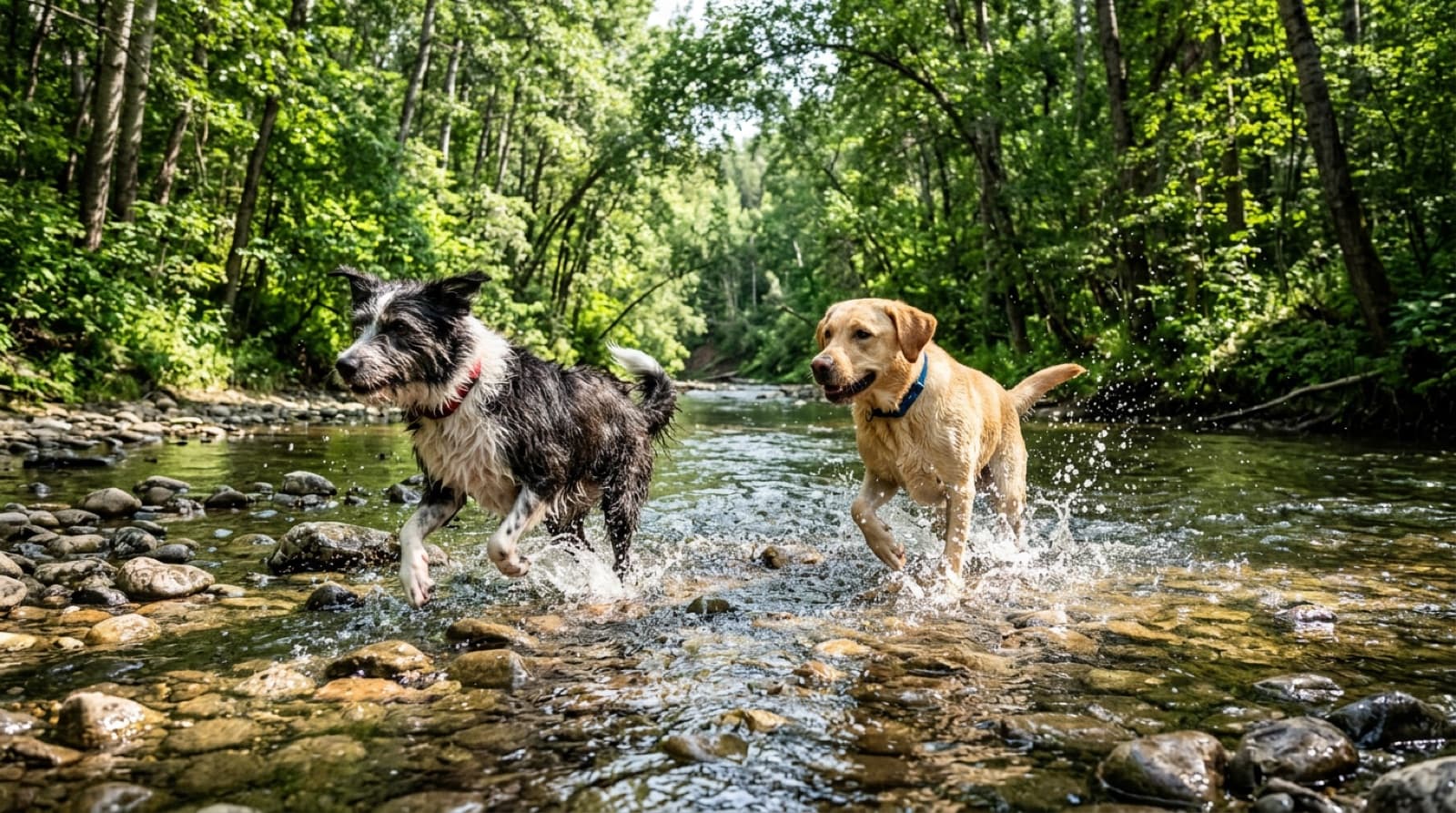
Sort of. Whitemud Creek is shallow most of the year, not a swimming creek. Dogs can wade, splash, and cool off at the bank approaches and at the creek crossings. The creek runs much higher and faster during spring runoff (typically late April through May) and after heavy summer storms, when even wading becomes risky. There is no deep swim pool in this corridor. For real swimming, drive to Terwillegar Park on the river.
Is Whitemud Ravine safe in winter?
Walkable, with caveats. The creek-bottom trail packs down into a hard snow surface through Edmonton's -25 C months, and the tree cover blocks the worst prairie wind. The bigger risk is the creek itself: Whitemud Creek runs through winter under ice and the ice is unreliable. Dogs can break through, and the rescue window is small in fast-moving cold water. Use the wooden footbridges; never let your dog walk on the frozen creek. Bridges develop hard ice patches that are easy to miss.
How does Whitemud Ravine compare to Mill Creek Ravine?
They are the east-west pair of Edmonton's ravine off-leash corridors. Mill Creek runs north-south through south-central Edmonton (Strathcona, Bonnie Doon, Argyll); Whitemud runs north-south through west-central Edmonton (Rainbow Valley, Riverbend, Lewis Estates). Mill Creek is shorter and more urban-feeling, with steady cyclist traffic and easier access points. Whitemud is longer, wilder, with more wildlife and quieter trails. Most west Edmonton owners use Whitemud as their default; most south-side owners use Mill Creek. The two together form the ravine mesh that gives Edmonton its off-leash variety.
How does Whitemud Ravine compare to Terwillegar Park?
Different park types entirely. Terwillegar is an open river-valley off-leash area on the North Saskatchewan, built for hard running, river swimming, and meeting many dogs at once. Whitemud is a wooded ravine corridor along a small creek, built for trail walks, sniffing, and quieter exploration. Pick Whitemud when you want a hike-feeling visit with low dog density. Pick Terwillegar when you want open running and a real swim. Both are 15 to 25 minutes from most of west Edmonton.
Is Whitemud Ravine good for a recently adopted rescue dog?
Not in the first three weeks. The 3-3-3 decompression principle applies. An unfenced wooded ravine with active wildlife, creek crossings, and steep grades is too much stimulation for a brand new rescue. Start with leashed walks in your own neighbourhood, then graduate to leashed Whitemud visits on the upper rim path, and only attempt off-leash in the designated zone once recall is solid in lower-stimulation settings. Most Edmonton rescues we work with suggest 4 to 6 weeks before a first Whitemud off-leash visit, longer for nervous or under-socialized dogs.
What are the park hours?
Whitemud Ravine Nature Reserve and Whitemud Park follow standard City of Edmonton park hours: 5 AM to 11 PM daily. There are no gates, but bylaw applies during posted hours. Bylaw officers patrol the corridor more on summer weekends than weekday mornings.
Are bikes allowed on the off-leash trail?
Cyclists use the upper paved rim path heavily as a commuter and recreation route. The granular creek-bottom trail (where the off-leash designation sits) is slower and quieter but still gets occasional cyclist and runner traffic. Your dog needs to be neutral about bikes passing. Recall off the trail when you hear a bike approaching, step aside on narrow stretches, and re-leash for bridges where two parties meeting can crowd the deck.
Related Edmonton dog guides
Edmonton Off-Leash Parks Guide
Every major Edmonton off-leash park ranked side by side, with the “best for X” matrix.
Mill Creek Ravine Off-Leash
The east-side ravine pair to Whitemud: south Edmonton's 8 km ribbon corridor, sections and access.
Terwillegar Park Off-Leash
Edmonton's biggest open-field off-leash park: sandbars, river flats, what to expect.
Best Dog Rescues Edmonton
All Edmonton rescue organisations compared by cost, wait time, and best fit.
Find your Edmonton trail dog
Browse adoptable dogs from Edmonton-area rescues. Filter by energy and size to find one who'd thrive on a Whitemud ravine hike.
Browse All Edmonton Dogs →New dog? Start with these care guides
Everything a new adopter needs to set up a safe, happy home.