The short answer
Severe periodontal disease is breed-defining for Yorkies. Without daily brushing, tooth loss by age 5 to 7 is the predictable outcome. Daily 1 to 2 minute brushing with dog toothpaste (NEVER human; xylitol is fatal) is non-negotiable. VOHC-approved dental chews + water additives supplement brushing (look for the VOHC seal). Annual professional cleaning under anaesthesia $500 to $1,000 in Edmonton. Feeding: adult Yorkie 1/4 to 1/2 cup daily, divided into 2 meals, scheduled (not free-fed), measured precisely. 37% of Yorkies are overweight; 8+ lbs likely too heavy for the 4 to 7 lb breed standard. Treats less than 10% daily calories. Edmonton dry winter compounds dental risk through reduced hydration. Pet insurance within 14 days of adoption before any dental disease becomes pre-existing.
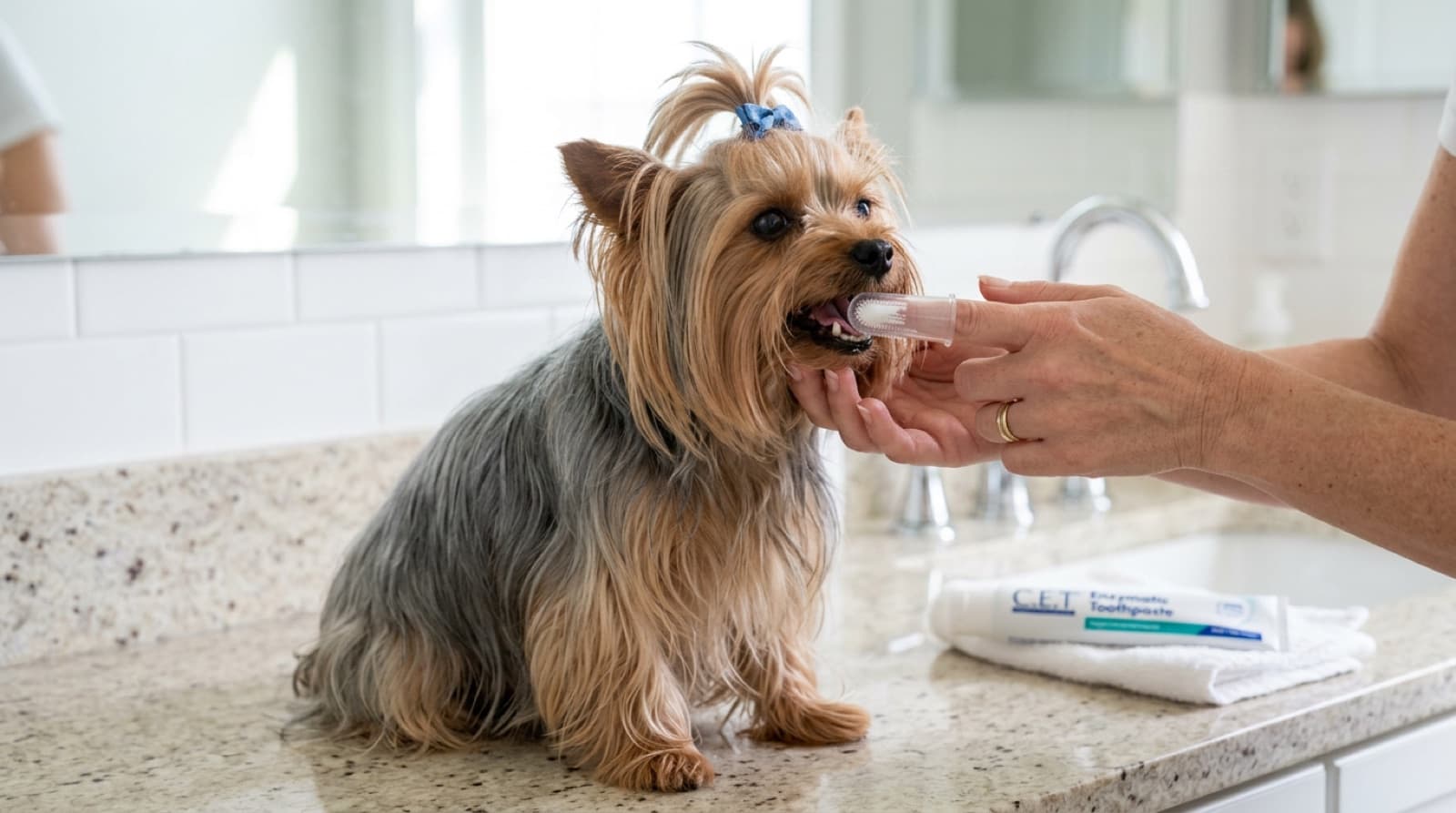
Why Yorkie dental disease is breed-defining
Small jaw plus crowded teeth plus plaque-prone genetics equals the highest periodontal disease prevalence of any common toy breed. Yorkies lose teeth by age 5 to 7 without daily brushing. The science: tartar builds within days, calculus within weeks. Untreated periodontal disease equals tooth loss plus systemic infection (heart, kidney, liver).
The AKC Yorkshire Terrier breed profile describes the breed as “sprightly, tomboyish, affectionate” without foregrounding the dental commitment. The breed-club community is more direct: every Yorkie owner needs a daily brushing routine from day one of adoption.
Edmonton-specific compound: dry winter air reduces saliva flow (saliva is a natural plaque fighter), which accelerates plaque accumulation. Yorkies drink less in winter without prompting, which worsens this. Adjustment: humidifier (35 to 45% RH), fresh water always available, possibly a small pet water fountain to encourage drinking.
The 5-week desensitisation protocol
Most Yorkies resist tooth brushing initially. Force-restraining a stressed Yorkie creates lifelong fear. The 5-week desensitisation protocol builds tolerance gradually.
- Week 1: handle Yorkie's mouth gently with finger. Reward calm with treats. 30 seconds daily.
- Week 2: lift lips, touch teeth with finger. Reward. 1 minute daily.
- Week 3: use finger brush or soft cloth with water on teeth. Reward. 1 to 2 minutes daily.
- Week 4: introduce dog toothpaste (NEVER human toothpaste; xylitol is toxic). Reward.
- Week 5: full brushing with finger brush or small dog toothbrush.
- Ongoing: 1 to 2 minutes daily.
Recommended tools:
- Finger brush (soft rubber, slips over finger, $5 to $15). Most Yorkies tolerate better than toothbrush.
- Soft-bristle dog toothbrush sized for tiny breeds ($5 to $15).
- Dog toothpaste (chicken, beef, peanut butter flavours; $10 to $20/tube). Brands: Petsmile (VOHC-accepted), Virbac C.E.T., Nylabone Advanced Oral.
- Dental wipes as backup if brushing is too stressful ($10 to $20/pack).
NEVER use human toothpaste. Xylitol can be fatal even in small amounts.
VOHC-approved products vs marketing scams
The dental product market is saturated with scams. The gold standard is the VOHC (Veterinary Oral Health Council) seal. VOHC-tested and approved products actually work.
What works:
- Daily brushing (#1 most effective; nothing replaces it).
- VOHC-approved dental chews: Greenies (small or teenie size for tiny dogs), OraVet Dental Hygiene Chews, Virbac C.E.T. VeggieDent. $20 to $40/month. These actually reduce plaque.
- VOHC-approved water additives: Healthy Mouth, TropiClean Oral Care Water Additive. Modest plaque reduction.
- VOHC-approved dental diets: Hill's Prescription Diet t/d, Royal Canin Dental, Eukanuba Dental. Specially designed kibble for plaque control. Sometimes prescription only.
- Professional cleanings annually with anaesthesia. $500 to $1,000 in Edmonton.
What is scam or ineffective:
- “Dental treats” without VOHC seal (mostly marketing).
- Dental sprays without research backing.
- Dental gels without VOHC verification.
- “Plaque off” supplements (mixed evidence).
- Bones (tiny Yorkie teeth are fragile; fracture risk).
- Hard chews like antlers (tooth fracture risk).
- Regular treats marketed as “dental.”
- Some “anaesthesia-free” dental cleaning by non-veterinarians: cannot fully clean below gumline.
The Veterinary Oral Health Council publishes the current list of accepted products. Check the seal before purchase.
Feeding portions and meal frequency
| Age | Meals/day | Notes |
|---|---|---|
| Puppy 8-16 weeks | 4 meals | Hypoglycaemia-prone; frequent feeding prevents blood sugar drops |
| Puppy 4-12 months | 3 meals | Transition gradually from 4 to 3; monitor for hypoglycaemia |
| Adolescent 12-18 months | 2 to 3 meals | Most transition to adult schedule; some hypoglycaemic Yorkies stay on 3 |
| Adult 1+ years | 2 meals | Morning + evening, 12 hours apart; total 1/4 to 1/2 cup daily divided |
| Senior 10+ years | 2 to 3 meals | Depends on metabolism + dental status; smaller more frequent often better |
Scheduled feeding (NOT free-feeding) is strongly recommended. Easier housetraining, easier monitoring of appetite changes, prevents picky eating cycle. Measure food with an actual measuring cup, not estimation. Most owners overestimate portions.
Weight management: 37% of Yorkies are overweight
Breed standard is 4 to 7 lbs adult. 8 lbs is often 15 to 30% over ideal. 9 to 10 lbs is significantly overweight. 11+ lbs is obese. Roughly 37% of Yorkies are overweight in US studies; likely similar in Canada.
Body Condition Score (BCS 1 to 9) is more accurate than weight alone:
- BCS 4 to 5 ideal
- BCS 6 overweight
- BCS 7+ obese
- Rib palpation: should feel ribs easily without pressing through fat layer
- Waist view (from above): slight hourglass shape behind ribs
- Profile view: slight tuck-up behind ribcage from side
Why obesity is serious for Yorkies specifically:
- Tracheal collapse worsens (already common in the breed)
- Joint stress (luxating patella, arthritis)
- Diabetes risk
- Heart disease
- Liver issues
- Reduced lifespan by 6 to 12 months
- Increased anaesthesia risk for dental and other procedures
Weight loss protocol (vet-supervised): rule out medical causes (hypothyroidism), measure food precisely, reduce 10 to 20% from current intake, eliminate table food and treats during weight loss, use small piece of regular kibble as treats, increase exercise gradually within Yorkie tolerance, weekly weigh-ins, target 1 to 2% body weight loss per week. Prescription weight-loss formulas sometimes appropriate (Hill's Metabolic, Royal Canin Satiety; vet-prescribed).
Browse adoptable Yorkies in Edmonton
Adult Yorkies often arrive in Edmonton rescue with established dental disease. Foster notes document the baseline so you can plan the cleaning routine and insurance timing.
See Available Yorkies →Edmonton dry winter dental considerations
Edmonton dry winter air (5 to 6 months of furnace-heated low humidity) creates breed-specific challenges for Yorkie dental and feeding management:
- Reduced saliva flow. Yorkies drink less in winter without prompting; the reduced ambient moisture reduces saliva production, which reduces natural plaque-fighting. Adjustment: fresh water always available, multiple water stations, consider a small pet water fountain.
- Skin and coat dryness. Dry indoor air aggravates Yorkie skin sensitivities; omega-3 supplementation in diet supports skin barrier (vet-recommended dose).
- Hypoglycaemia risk. Tiny Yorkies in deep cold burn more calories for thermoregulation; the metabolic demand combined with potentially missed meals (if a winter walk is skipped and the Yorkie naps through normal mealtime) can trigger hypoglycaemia. Keep corn syrup or honey accessible during winter.
- Outdoor potty timing. Cold sensitivity reduces willingness to potty outside; indoor potty pads as winter accommodation are common for Edmonton Yorkies November through March.
- Adoption timing. Spring or early summer adoption gives time for routine establishment before deep cold hits.
Humidifier (35 to 45% relative humidity) helps with all of these. None of these mean Yorkies cannot thrive in Edmonton; they require specific seasonal accommodation.
Pet insurance timing for Yorkie dental
Most pet insurance carriers cover dental injuries (broken teeth, dental trauma) but exclude routine cleanings as preventive care. Some carriers offer wellness add-ons that include routine cleanings; these add $10 to $25/month to the base premium.
Edmonton-active carriers with different dental coverage policies:
- Trupanion (90% coverage after deductible, no per-condition caps; dental trauma covered, routine cleaning typically not)
- Pets Plus Us (80% reimbursement, multiple plan tiers including wellness add-ons)
- OVMA Pet Health Insurance (some wellness coverage options)
- Fetch (formerly Petplan Canada; 90% reimbursement available, varying dental coverage)
Critical timing rule: get insurance within 14 days of adoption, before the first wellness visit if possible. Any dental disease noted in vet records becomes pre-existing and is excluded from coverage. Pre-existing periodontal disease is one of the most common Yorkie insurance exclusions because so many Yorkies arrive in rescue with established dental disease.
Adult rescue Yorkie strategy: schedule baseline dental exam BEFORE starting insurance if possible (so any pre-existing condition is documented before policy starts), but understand any disease noted will be excluded. Some adopters skip insurance for dental specifically because of pre-existing exclusions, focusing instead on accident and illness coverage. Read each policy carefully for dental exclusions, wellness add-on options, and coverage caps before signing.
Frequently Asked Questions
How do I brush my Yorkie's teeth daily without a fight?
Critical Edmonton Yorkie owner skill. At-home dental care is ESSENTIAL because Yorkies lose teeth by 5 to 7 if neglected. Small jaw plus crowded teeth equals rapid plaque accumulation. Tartar builds within days, calculus within weeks. Untreated periodontal disease equals tooth loss plus systemic infection (heart, kidney, liver). Desensitisation protocol: Week 1, handle the Yorkie's mouth gently with finger, reward calm with treats, 30 seconds daily. Week 2, lift lips, touch teeth with finger, reward, 1 minute daily. Week 3, use finger brush or soft cloth with water on teeth, reward, 1 to 2 minutes daily. Week 4, introduce dog toothpaste (NEVER human toothpaste, xylitol is toxic), reward. Week 5, full brushing with finger brush or small dog toothbrush. Ongoing: 1 to 2 minutes daily. Recommended tools: finger brush (soft rubber, slips over finger, $5 to $15), soft-bristle dog toothbrush sized for tiny breeds ($5 to $15), dog toothpaste (chicken, beef, peanut butter flavours, $10 to $20/tube; brands Petsmile (VOHC-accepted), Virbac C.E.T., Nylabone Advanced Oral), dental wipes as a backup ($10 to $20/pack). NEVER use human toothpaste. Xylitol can be fatal even in small amounts.
What dental products actually work for Yorkies, and which are scams?
The dental product market is saturated with scams. The gold standard is the VOHC (Veterinary Oral Health Council) seal. VOHC-tested and approved products actually work. What works: daily brushing (#1 most effective; nothing replaces it). VOHC-approved dental chews (Greenies in small or teenie size for tiny dogs, OraVet Dental Hygiene Chews, Virbac C.E.T. VeggieDent; $20 to $40/month). VOHC-approved water additives (Healthy Mouth, TropiClean Oral Care Water Additive; modest plaque reduction). VOHC-approved dental diets (Hill's Prescription Diet t/d, Royal Canin Dental, Eukanuba Dental; specially designed kibble for plaque control; sometimes prescription only). Professional cleanings annually with anaesthesia ($500 to $1,000 in Edmonton). What is scam or ineffective: dental treats without VOHC seal (mostly marketing), dental sprays without research backing, "plaque off" supplements (mixed evidence), bones (tiny Yorkie teeth are fragile, fracture risk), hard chews like antlers (tooth fracture risk), some "anaesthesia-free" dental cleaning by non-veterinarians (cannot clean fully below gumline).
How often should my Yorkie eat? Meal frequency by age?
Yorkie meal frequency by age and health. Puppy (8 to 16 weeks): 4 meals daily. Tiny puppies are hypoglycaemia-prone; frequent feeding prevents blood sugar drops. Puppy (4 to 12 months): 3 meals daily, transitioning gradually. Continue monitoring for hypoglycaemia signs (lethargy, weakness, trembling). Adolescent (12 to 18 months): 2 to 3 meals daily. Most adolescents transition to adult schedule. Some Yorkies remain on 3 meals if tendency to hypoglycaemia persists. Adult (1+ years): 2 meals daily ideal, morning and evening, 12 hours apart. Avoid single large meal (GI upset, hypoglycaemia risk). Senior (10+ years): 2 to 3 meals daily depending on metabolism and dental status. Watch for weight changes. Hypoglycaemic Yorkies: multiple small meals plus treats throughout day; corn syrup or honey on hand for emergencies; vet protocol consultation. Portion division for adults: total daily food 1/4 to 1/2 cup, divided evenly across meals. Meal timing: same times daily, NOT immediately before or after exercise, NOT within 1 to 2 hours of bedtime (potty needs). Scheduled feeding (not free-feeding) is strongly recommended for Yorkies: easier housetraining, easier monitoring of appetite changes, prevents picky eating cycle.
Is my Yorkie overweight at 8 lbs?
Likely yes. Breed standard is 4 to 7 lbs adult. 8 lbs is often 15 to 30% over ideal. 9 to 10 lbs is significantly overweight. 11+ lbs is obese. Roughly 37% of Yorkies are overweight in US studies; likely similar in Canada. Body Condition Score (BCS 1 to 9) is more accurate than weight alone: BCS 4 to 5 ideal, BCS 6 overweight, BCS 7+ obese. Rib palpation: should feel ribs easily without pressing through fat layer. Waist view from above: slight hourglass shape behind ribs. Profile view: slight tuck-up behind ribcage from side. Why obesity is serious: tracheal collapse worsens (already common in Yorkies), joint stress (luxating patella, arthritis), diabetes risk, heart disease, liver issues, reduced lifespan by 6 to 12 months, increased anaesthesia risk. Weight loss protocol: vet consult first to rule out medical (hypothyroidism), measure food precisely, reduce 10 to 20% from current intake, eliminate table food and treats during weight loss, use small piece of regular kibble as treats, increase exercise gradually within Yorkie tolerance, weekly weigh-ins, goal 1 to 2% body weight loss per week. Prescription weight-loss formulas sometimes appropriate (Hill's Metabolic, Royal Canin Satiety). Measure food with an actual measuring cup, not estimation.
Professional dental cleaning frequency and Edmonton costs?
Annual professional cleaning typically recommended for Yorkies. Some require more frequent. Edmonton vet dental cleaning costs: standard cleaning under anaesthesia $500 to $1,000 typical, with extractions if needed $800 to $3,000+, specialty veterinary dental $1,500 to $5,000+ for complex cases, pre-cleaning bloodwork $150 to $300. What is included: general anaesthesia (essential for thorough cleaning), comprehensive oral examination, tartar removal (scaling), polishing, dental x-rays (some clinics, recommended), sometimes fluoride treatment, recovery monitoring. When more frequent needed: Yorkies with no daily home brushing sometimes need cleanings every 6 to 12 months, Yorkies with existing periodontal disease, senior Yorkies with deteriorating dental status, Yorkies eating soft food only (less natural cleaning). When annual sufficient: daily home brushing maintained, VOHC-approved dental products used, regular monitoring shows minimal tartar, healthy gums. Extraction costs in Edmonton: single tooth extraction $200 to $600 added to cleaning, multiple extractions $800 to $3,000+, surgical extractions (broken roots, impacted) $1,500 to $5,000+. Edmonton has specialty veterinary dental practices for complex cases; the Western College of Veterinary Medicine in Saskatoon handles the most complex referrals. Annual cleaning is preventive ($500 to $1,000); without prevention, lifetime treatment costs run $5,000 to $15,000+ in extractions plus treatments.
Pet insurance coverage for Yorkie dental?
Pet insurance landscape: most carriers cover dental injuries (broken teeth, dental trauma) but exclude routine cleanings as preventive care. Some carriers offer wellness add-ons that include routine cleanings; these add $10 to $25/month to the base premium. Edmonton-active carriers (Trupanion, Pets Plus Us, OVMA Pet Health Insurance, Fetch) have different policies on dental coverage. The critical rule: get insurance within 14 days of adoption, before the first wellness visit if possible. Any dental disease noted in vet records becomes pre-existing and is excluded from coverage. Pre-existing periodontal disease is one of the most common Yorkie insurance exclusions because so many Yorkies arrive in rescue with established dental disease. Adult rescue Yorkie strategy: schedule a baseline dental exam BEFORE starting insurance if possible, but understand any disease noted will be excluded; some adopters skip insurance for dental specifically because of pre-existing exclusions, focusing instead on accident and illness coverage. Read each policy carefully for dental exclusions, wellness add-on options, and coverage caps.
How does Edmonton dry winter affect Yorkie dental and feeding?
Several ways. (1) Hydration. Edmonton dry winter air (5 to 6 months of furnace-heated low humidity) reduces ambient moisture; Yorkies drink less in winter without prompting, which reduces saliva flow (saliva is a natural plaque-fighter), which accelerates plaque accumulation. Adjustment: fresh water always available, possibly multiple water stations, consider a small pet water fountain to encourage drinking. (2) Skin and coat. Dry indoor air aggravates Yorkie skin sensitivities; omega-3 supplementation in diet supports skin barrier. (3) Hypoglycaemia risk. Tiny Yorkies in deep cold burn more calories for thermoregulation; the metabolic demand combined with potentially missed meals (if a winter walk is skipped and the Yorkie naps through normal mealtime) can trigger hypoglycaemia. Keep corn syrup or honey accessible during winter. (4) Outdoor potty timing. Cold sensitivity reduces willingness to potty outside; indoor potty pads as winter accommodation are common for Edmonton Yorkies November through March. (5) Adoption timing. Most Edmonton Yorkie owners report better outcomes adopting spring or early summer rather than fall, giving time for routine establishment before deep cold. None of these mean Yorkies cannot thrive in Edmonton; they require specific seasonal accommodation.
Yorkie food sensitivities and GI issues?
Yorkies sometimes have sensitive stomachs. Common GI issues: pancreatitis (Yorkies are prone; sometimes from rich foods, table scraps, garbage; vet ER visit; treatment $1,500 to $5,000+); food allergies (environmental and food allergies common; Apoquel or Cytopoint $40 to $200/month, vet-prescribed); sensitive stomachs (some Yorkies do better on limited-ingredient or novel-protein formulations); diet transition issues (gradual changes over 7 to 10 days minimum); IBD (inflammatory bowel disease) sometimes; hepatic lipidosis in obese Yorkies who suddenly stop eating. Warning signs of GI issue: vomiting (occasional one-time often normal, repeated concerning), diarrhoea (especially with blood or mucus), constipation, loss of appetite, lethargy, excessive thirst, weight loss, bloated abdomen, pawing at mouth, whining or restlessness suggesting discomfort. Pancreatitis signs (24-hour ER vet immediately): severe vomiting, diarrhoea, abdominal pain (hunched posture), lethargy, loss of appetite, fever sometimes. Sensitive stomach protocols: limited ingredient diets (Natural Balance L.I.D., Royal Canin Hypoallergenic), novel protein sources (duck, venison, rabbit), probiotics (Vetri-Science Mega Probiotic, Purina FortiFlora), plain canned pumpkin for digestive issues, bland diet (boiled chicken plus rice) for acute issues short-term, gradual diet transitions. Preventing GI emergencies: NO table scraps (especially fatty foods, pancreatitis trigger), NO bones (tiny Yorkie GI tract is sensitive), NO toxic foods (chocolate, xylitol, grapes, raisins, onions, garlic, macadamia nuts, alcohol), NO human medications without vet approval.
Treat allowance and healthy treat options?
Treats often sabotage weight management plus housetraining in Yorkies. Treats should be less than 10% of daily caloric intake. For a 5 lb Yorkie eating 200 calories/day, that means treats can total max 20 calories: 1 to 2 small training treats. Most owners dramatically exceed this. Why treats are problematic: caloric load is disproportionate to a tiny body, sometimes sugar or fat causes pancreatitis, reinforces demand behaviours, reduces appetite for kibble (picky eating cycle), often nutritionally empty calories. Healthy treat options: frozen blueberries (~1 calorie each, antioxidants, Yorkies often love), raw carrot pieces (low calorie, dental benefit), green beans (plain, cooked, volume without calories), cucumber slices, apple pieces (no seeds or core), small pieces of cooked chicken (bland, no seasoning, high-value training treat), single piece of regular kibble as calorie-counted treat, freeze-dried liver training treats (high-value, low-volume). Avoid: table food, bones (tiny dog GI risk plus tooth fracture), rawhide (digestive blockage risk plus chemical processing), grapes/raisins (toxic), chocolate (toxic), xylitol (in many sugar-free products: FATAL), onions and garlic (toxic), macadamia nuts (toxic), high-fat treats, salty treats. Training treat strategy: use highest-value reward for training; tiny portions (split treat into multiple pieces); reserve special treats for training (not random snacking); subtract treat calories from daily food (reduce kibble accordingly); use mental enrichment treats (food puzzles, snuffle mats) instead of free-feeding.
Calgary vs Edmonton: any differences in Yorkie food sourcing?
Largely similar. Edmonton has the same pet store chains (PetSmart, Pet Valu, Tail Blazers, Bone & Biscuit) plus Edmonton independents. Pricing is comparable. Online options (Amazon Canada, Chewy.ca, brand websites) work identically. Recommended Edmonton Yorkie brands: Royal Canin Yorkshire Terrier Adult ($40 to $60/3 lb), Hill's Science Diet Small Paws Adult, Purina Pro Plan Small Breed, Wellness Complete Health Small Breed, Orijen Small Breed (premium, grain-free DCM concerns; vet consult), Nutro Ultra Small Breed, sometimes prescription dental formulas (Hill's t/d) for severe dental. 3 lb bag $40 to $80 typical, lasts 1 to 2 months for adult Yorkie. Monthly food cost $30 to $60. Annual food cost $400 to $700. Subscription savings often 5 to 10%. Edmonton-specific note: some boutique Edmonton pet stores carry locally-sourced raw food (verify pasteurisation and safety standards if going raw with a tiny dog; bacterial contamination risks are elevated for small breeds). Veterinary nutritionist consultation strongly recommended for homemade diets ($300 to $600 in Edmonton). The risk of nutritional deficiency in homemade tiny-dog diets is real.
Senior Yorkie feeding and dental adjustments?
Senior Yorkies (10+ years) need feeding and dental adjustments. Senior Yorkie feeding changes: metabolic slowdown means usually fewer calories needed, weight management critical, dental issues sometimes require softer food, sometimes health conditions require prescription diets (kidney disease, heart disease, diabetes), smaller more frequent meals sometimes better for digestion. Senior diet recommendations: senior-specific formulas with lower calories plus appropriate protein (Royal Canin Yorkshire Terrier Aging 8+, Hill's Science Diet Small Paws Senior), sometimes wet food softer for dental issues, sometimes prescription kidney or heart formulas. Joint support additions (vet-recommended): glucosamine plus chondroitin supplements, omega-3 fatty acids. Senior dental care: more frequent cleanings sometimes (every 6 to 9 months), anaesthesia risk consideration with pre-cleaning bloodwork plus cardiac eval, sometimes extractions needed, continued daily home brushing essential, VOHC-approved dental chews plus water additives. Edmonton senior wellness exam every 6 months recommended. Senior health screening: annual bloodwork plus urinalysis, thyroid panel (hypothyroidism common), cardiac evaluation (heart disease common), kidney function, liver function. Senior care more expensive than adult care: $2,000 to $5,000+ annually typical. Lifespan 13 to 16 years means meaningful senior chapter. Quality of life adjustments plus medical management equals wonderful senior years.
Bottom line for Edmonton Yorkie owners on feeding and dental?
Successful if: realistic feeding portions (1/4 to 1/2 cup adult daily TOTAL, divided 2 meals), measure food precisely (not estimate), strict 10 to 15 minute meal window (no free-feeding), quality small breed formula, daily tooth brushing (1 to 2 minutes), VOHC-approved dental products (chews, water additives), annual professional cleaning ($500 to $1,000), Body Condition Score monitoring (4 to 7 lbs ideal, 8+ lbs likely overweight), treats less than 10% daily calories (1 to 2 small training treats), healthy treat options, Edmonton vet relationship plus biannual senior exams, pet insurance pre-adoption enrollment. Challenging if: owner overfeeds (most common; the tiny portion looks like nothing), picky eating cycle established (food upgrades reinforce pickiness), skipping daily brushing (rapid plaque accumulation), free-feeding (creates obesity plus picky eaters), treat-heavy diet, table scrap feeding (pancreatitis risk), skipping annual professional cleaning. Wrong if: refusing daily brushing commitment, skipping VOHC products for marketing-only "dental" treats, table scraps plus rich foods (pancreatitis emergencies $1.5K to $5K+), tight budget for dental investment. Annual care investment: food $400 to $700, dental products plus annual cleaning $740 to $1,480, treats $240 to $480, vet wellness $300 to $600, insurance $480 to $960. Total $2,160 to $4,220 annually typical. Lifetime 13 to 16 years equals $28K to $67K+ investment. Daily 1 to 2 minute brushing investment alone prevents thousands in lifetime dental costs.
Adoptable Yorkies in Edmonton
Live listings from SCARS, Edmonton Humane Society, Zoe's, AHHRB, and AARCS Edmonton fosters.
Yorkie Adoption Edmonton
Rescue pipelines, costs, teacup-Yorkie warning, breed-mix patterns, family-fit reality.
Yorkie Health Issues: Teeth, Trachea, Liver
Yorkshire Terrier health issues to plan for: dental disease, collapsing trachea, liver shunt, puppy low blood sugar, hip and knee problems, and heart valve disease.
Yorkie Winter Care Edmonton
Cold tolerance limits, gear standards, indoor potty alternatives, hypoglycaemia winter risk.
New dog? Start with these care guides
Everything a new adopter needs to set up a safe, happy home.