The short answer
Brush daily, plan on a groom every four to six weeks. A Yorkie has a silky single coat that grows continuously like human hair, with no shedding seasons and no undercoat. It matts within two to three days without a brush. A short puppy cut is the practical choice for most Edmonton pet Yorkies. Full professional grooming runs $60 to $100 every four to six weeks for bath, blow-dry, body trim, face, sanitary, paws, ears, and nails. Daily face-wipe routine controls tear staining. Edmonton dry winter heat creates static and matting, so a humidifier and daily brushing matter most from November to March.
How the Yorkie coat actually works
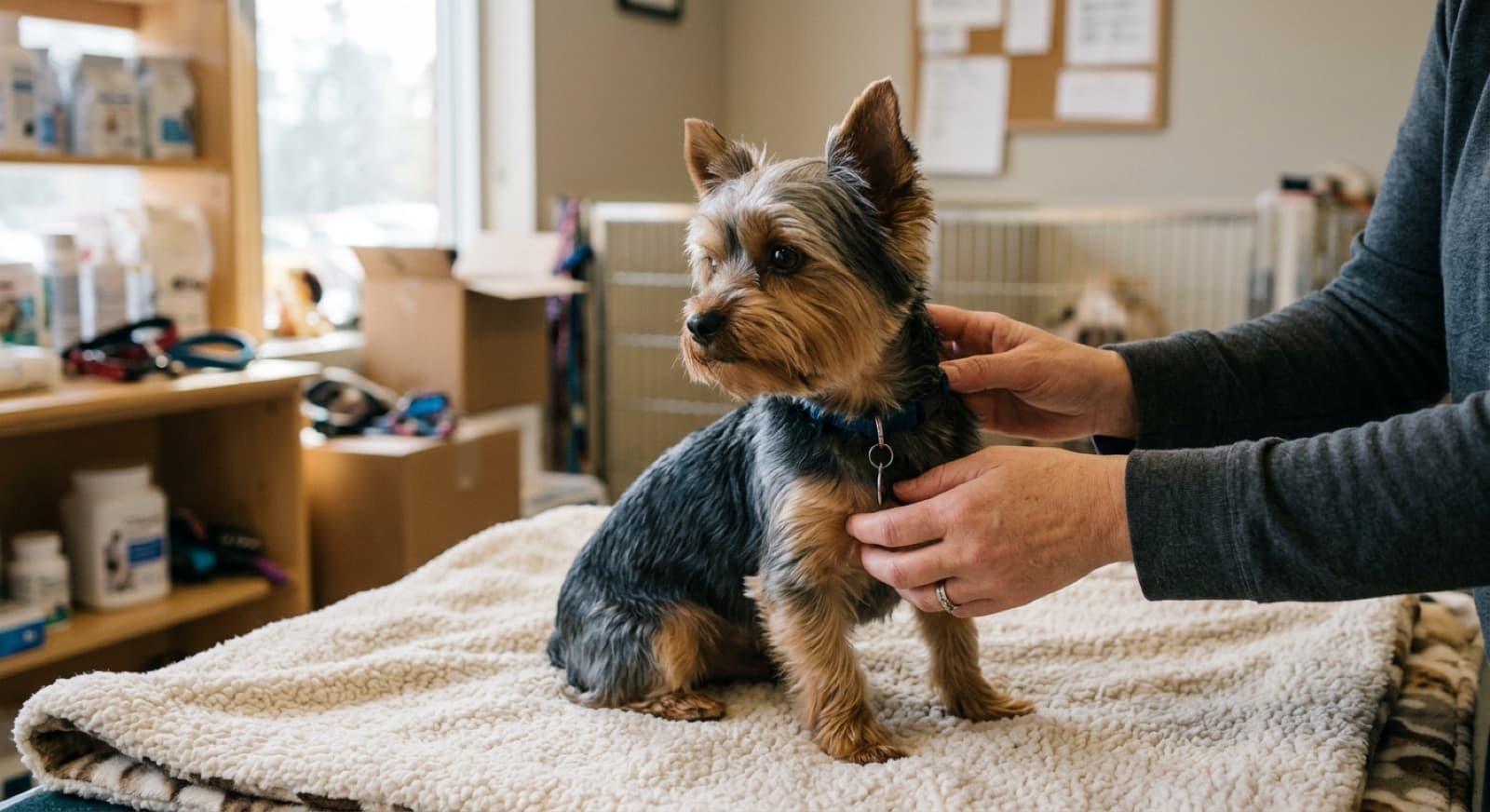
A Yorkie coat is not fur in the usual dog sense. It is a single layer of fine, silky hair that grows continuously and behaves more like human hair than like a typical dog coat. There is no dense insulating undercoat. There is no seasonal coat blow. The strands are smooth and lie flat when brushed, and the texture should feel cool and slippery between your fingers when the dog is in healthy coat.
The Canadian Kennel Club Yorkshire Terrier breed standard describes the coat as glossy, fine, and silky in texture, parted on the muzzle and from the base of the skull to the end of the tail, hanging quite straight and evenly down each side of the body. In the classic show version, the coat reaches the floor. That description matters because it tells you what the coat is built to do (be smooth and long) and what it is not built to do (shed bulk, insulate against cold, or self-clean).
Because there is no undercoat, two practical things follow. First, Yorkies shed very little, which is part of why people with mild dog allergies often tolerate them. They are not fully hypoallergenic, but the dander load is genuinely lower than most breeds. Second, without a protective topcoat keeping strands aligned, the hair tangles into mats fast. Two to three days without brushing is usually enough to start a matted patch behind the ears, in the armpits, or around the rear.
Show coat vs puppy cut: the practical decision
The first grooming decision for a new Yorkie owner is the cut. The classic show coat (floor-length silky hair, tied up in a topknot, wrapped between events to prevent breakage) takes one to two hours of daily grooming and weekly bath-and-wrap sessions. It is a real commitment and is appropriate for active conformation showing or owners who genuinely enjoy that level of coat work. For everyone else, a short clipped style is the right answer.
The five most-requested clipped styles at Edmonton groomers are the puppy cut (uniform one to two inches all over, easiest maintenance, most popular for rescue adopters), the teddy bear cut (slightly rounded face with a one to two inch body), the Schnauzer cut (short body with longer beard and eyebrows for a distinguished look), the kennel cut (very short clip, lowest maintenance, often chosen by senior-Yorkie owners), and the Westie cut (short body with a fuller head and skirt).
Tell your groomer the cut name plus a body-length number in inches and your daily-brushing willingness. A line like “I want a teddy bear cut, body about one and a half inches, and I am brushing every other day” gives the groomer enough to make the right call on length. Without that guidance, groomers default to shorter than most owners want because shorter lasts longer between visits.
The daily brushing routine
Yorkie matts form fast and brush out slowly, so the math always favours prevention over rescue. Five to ten minutes a day with the right tools keeps the coat smooth and the skin healthy. Skip a week and you will spend an hour with a groomer paying a dematting fee, or you will end up with a shave-down because the matts are too tight to brush through humanely.
Three tools cover most of the work. A pin brush is the daily through-coat tool. A slicker brush with fine bent wires lifts loose hair two or three times a week. A metal greyhound-style comb passes through last to verify no tangles remain (if the comb snags, the brushwork was not finished). For a long show coat, add a small spray bottle of leave-in conditioner before brushing to reduce static and breakage. Skip Furminator-style deshedding tools entirely because they cut hair shafts and damage texture on this coat type.
Technique. Sit the dog on a non-slip surface at a comfortable height. Start at the head and work backward. For each section, brush from the skin outward in short strokes rather than dragging the brush along the length. Pay special attention to the four matting hotspots: behind the ears, the armpits, the rear-end skirt, and the chest under the collar. A daily five-minute scan of these four areas catches mats early when they still brush out.
For face hair around the eyes, use a small soft comb daily to keep the area free of debris and to clear any tear residue. The face is one of the highest-touch areas for tear staining and ear-canal hair issues, so daily attention pays off in both health and cosmetic terms.
Edmonton groomer pricing and waitlists
A full professional Yorkie groom in Edmonton typically runs $60 to $100 every four to six weeks. The price covers a bath, blow-dry, full brush-out, body clip or scissor to your chosen length, face trim, sanitary trim around the rear, paw-pad trim, ear cleaning, and nail trim. Mobile groomers and higher-end salons can charge $110 to $150 for the same service. Quick puppy intro grooms (a gentler short session for under-six-month puppies) often run $40 to $60.
Why every four to six weeks and not every six to eight like most breeds. The silky single coat grows continuously and reaches messy length faster than a double coat. A puppy cut at one inch grows to nearly two inches in four weeks, which is when most owners notice the coat looking shaggy around the face and feet. Stretching to eight weeks means the cut is fully grown out and matting risk climbs because the hair is long enough to tangle but not long enough to lie flat.
Edmonton waitlists are a real factor. Established groomers run three to six weeks for new clients during normal months. Small-breed-only salons (often the better option for a four to seven pound Yorkie) can run longer because they limit how many small dogs they take per day for safety. Two strategies. First, book your next appointment when you check out of the current one rather than waiting. Second, when trying a new groomer, ask whether they have small-breed and Yorkie-specific experience before you book.
What a good groomer should ask you, and what to ask them. Ask them whether they use scissors for face finishing (clipper-only face work on a Yorkie often looks rough), how they handle a wiggly small dog (calm desensitisation, not restraint), and what they would do if they found a mat (call you and ask before cutting it out). They should ask you about vaccination status, any health conditions, previous grooming history, your preferred cut and length, and behaviour around handling. A groomer who skips these questions is rushing.
Browse adoptable Edmonton Yorkies
Yorkies come up in Edmonton rescue intake regularly, often seniors surrendered because grooming felt overwhelming for the previous owner. A rescue Yorkie typically arrives with foster notes on coat condition, current cut, and grooming tolerance, which makes the first few visits to a new groomer much smoother.
See Available Yorkies →Bath frequency and at-home washing
Yorkies need bathing more often than most breeds. Every three to four weeks is normal for a pet Yorkie. The silky single coat tends to look stringy and feel oily faster than a double coat because the strands lie flat against the skin and absorb skin oils directly. Bathing is the reset that restores the smooth glossy texture the coat is meant to have.
Use a gentle dog shampoo formulated for sensitive skin. Avoid human shampoo (wrong pH for canine skin) and avoid medicated shampoos unless prescribed. After shampoo, a quick conditioner pass adds slip to the strands and reduces breakage during brush-out. Rinse thoroughly because shampoo residue causes itching and dull coat.
The drying step is where most home-grooming mistakes happen. Always blow-dry on a low heat setting while brushing in sections. Air-drying a Yorkie coat is the fastest route to matting because the hair tangles as it dries unsupervised. A handheld pet dryer or a regular hairdryer on cool-warm with a vented hood works. Senior Yorkies with thinner skin can stretch the bath interval to every five to six weeks.
Weekly bathing is generally too often unless there is a medical reason like a skin condition. It dries out the skin and accelerates coat breakage. The right cadence is three to four weeks paired with daily brushing, not weekly bathing in place of brushing.
Tear staining management
Tear staining is the reddish-brown discolouration that appears under the eyes on Yorkies with lighter face hair. The cause is porphyrins, iron-based pigments naturally present in tears and saliva, reacting with bacteria and yeast on damp facial hair. The staining itself is cosmetic and not painful, but the routine matters because the underlying causes range from minor to clinically important.
The daily routine. Trim face hair short so tears cannot pool against fur (alone, this fixes a majority of cosmetic cases). Wipe gently under each eye with a damp cotton pad and then dry the area. Use a separate pad for each eye to avoid moving bacteria from one side to the other. Skip hydrogen peroxide near the eye because it can cause serious eye injury. Avoid tear-stain supplements containing tylosin (a low-dose antibiotic), which is not approved for this use in Canada and creates antibiotic-resistance risks with long-term use.
Environmental tweaks that help. Switch from plastic to ceramic or stainless steel water bowls because plastic harbours bacteria in scratches. If Edmonton tap water leaves heavy mineral residue, try filtered water. Check whether your food contains artificial colours or excessive iron, both of which can intensify staining. The American College of Veterinary Dermatology treats persistent tear staining as a presenting sign worth working up rather than a purely cosmetic complaint, because allergic skin disease and chronic ocular discharge often present this way first.
When to see a vet. Sudden onset of staining, worsening that does not respond to a daily wipe routine, eye redness, squinting, or visible discharge are all signals that something underlying needs attention. Possibilities include blocked nasolacrimal ducts, entropion (eyelids that roll inward), allergies, conjunctivitis, dental disease (a common silent cause in small breeds, especially Yorkies), or a foreign body. These need a vet visit, not a cosmetic fix. The American Animal Hospital Association guidance for chronic ocular discharge points to a structured workup including a fluorescein eye stain and an oral exam before treating tear staining cosmetically.
Topknots for show-coat Yorkies
The classic Yorkie topknot is functional first and cute second. It keeps face hair out of the eyes, preventing corneal irritation and chronic eye discharge that are otherwise common in long-faced-coat Yorkies. Bows and barrettes are aesthetic; the topknot itself is the part that matters for the dog.
Process. Brush all face and head hair backward toward a point on top of the skull. Gather a bundle of hair from above each eyebrow (about half an inch wide on each side). Secure with a small soft latex-free elastic designed for hair. Do not use a rubber band because rubber breaks hair shafts. Add a bow or small barrette if you want. Redo daily because the topknot loosens through normal head movement.
Most Edmonton pet owners skip the topknot entirely by keeping face hair short with a puppy cut. That is the lower-maintenance choice and looks tidy. If you want a long show-coat face, the topknot is essential. Yorkie eye irritation from drooping face hair is one of the more common groom-related vet visits, and it is fully preventable.
Sanitary trims and clipper-appropriate areas
Even on a long-coat show Yorkie, several areas always get clipped short for hygiene and comfort. A skilled groomer handles all of these in a way that is invisible from a normal viewing distance.
- Rear sanitary area. The coat under the tail and around the rear gets soiled during bathroom breaks and stays cleaner trimmed short. A short clipper trim here is standard at every groom.
- Paw pads and between toes. Long hair between the pads picks up Edmonton snow, ice balls, and de-icing salt in winter and grit in summer. Short trims keep paws clean and grippy.
- Around the eyes. Hair near the inner corners is trimmed back so it cannot scratch the cornea. This is scissor work, not clipper.
- Inside the ear flaps. The hair on the inside of a Yorkie ear flap is trimmed back so air can move and ear canals stay drier. This reduces ear-infection risk.
- Belly and underarm. Lightly tidied for comfort and to reduce matting in friction-heavy areas.
None of this affects the protective coat. A Yorkie has no insulating undercoat to protect anyway, so the Pomeranian and Husky never-shave rules do not apply here. A clipped body length of one to two inches is appropriate and healthy for the breed. Going much shorter than half an inch on the body exposes skin to sun and Edmonton cold and should be reserved for medical reasons.
Winter coat care in Edmonton
Edmonton winters are harder on Yorkie coats than summers, which is the same story you hear from Pomeranian and Maltese owners. The damage is not from the cold itself, although Yorkies do chill faster than larger breeds because the single coat offers minimal insulation. The bigger problem is the indoor environment. Forced-air heating drops indoor humidity into the teens or twenties in January, creating static that matts the fine silky hair and drying the skin out. Repeated transitions between cold outdoor air and dry indoor heat compress the coat further.
The winter routine. Brush daily without exception, even more important in winter than summer. Run a humidifier in the rooms your dog spends the most time in (aim for 40 to 50 percent indoor humidity, measured with a $15 hygrometer). Rinse paws with lukewarm water after walks on salted sidewalks, then towel dry. De-icing salt is genuinely hard on fur, skin, and paw pads, and Yorkies lick their paws which adds an ingestion risk on top. Use a leave-in conditioning spray sparingly if static is severe (a few sprays on the brush, not directly on the coat).
Outdoor sessions stay short. A healthy adult Yorkie can handle -15 to -20 C for five to ten minutes of walking, but they will start lifting paws and shivering before they damage themselves. A well-fitted sweater or coat is sensible for any Yorkie outdoors in deep cold, and a tiny pair of boots solves the salt-paw problem if your dog tolerates them. Trust the dog's signals. Indoor exercise (fetch in a hallway, training sessions, stair work) fills the gap during -25 C stretches.
Senior Yorkies and very small individuals under five pounds need shorter outdoor sessions and earlier sweater use. A senior Yorkie in deep cold can become hypothermic in fifteen minutes, so plan walks accordingly and watch for early signs (slowing, shivering, paw-lifting, reluctance to continue).
Ear care and weekly cleaning
Yorkies have semi-erect ears with a small canal, which is a step better than full drop ears for airflow but still creates conditions where moisture and debris accumulate. Chronic ear infections are common in Yorkies (allergic skin disease is one underlying driver), so a weekly ear-cleaning routine pays off.
Weekly cleaning routine. Use a vet-approved ear cleaning solution (your vet will recommend a brand suited to your dog). Fill the ear canal with cleaner, gently massage the base of the ear for ten to fifteen seconds, let the dog shake their head (this brings debris up out of the canal), then wipe the visible ear with a cotton pad. Do not use cotton swabs deep in the canal because they push wax further in and risk eardrum damage.
Signs that need a vet, not a cleaning. Strong odour, dark waxy discharge, redness inside the ear flap, head shaking or scratching, head tilting, or sensitivity when the ear is touched all point to infection (bacterial, yeast, or both) that needs medication. Chronic recurrent ear infections almost always have an underlying allergic component, which a vet can work up with a food trial or referral to a veterinary dermatologist.
Nail trim every 3 to 4 weeks
Yorkies do not wear nails down naturally because their tiny weight and indoor lifestyle means almost no abrasion against pavement. Nails grow continuously and need trimming every three to four weeks, and at every professional groom. Overlong nails change foot mechanics, contribute to splayed toes and joint stress over time, and on a small breed can curl into the paw pad.
At-home trim options. Small dog nail clippers or a small rotary grinder (often quieter and safer for owners who fear cutting the quick) both work. Trim a small amount weekly rather than a big amount monthly because the quick gradually recedes when nails stay short. If your Yorkie hates nail trims (most do), build the tolerance with daily handling of the paws paired with treats over weeks, not a single forced session.
If nail trims are a battle, let the groomer do them every four weeks rather than fighting it at home. The cost is small and the relationship with your dog matters more than the savings. Some Edmonton vet clinics also offer drop-in nail trims for $15 to $25 if the groomer is fully booked.
Senior Yorkie coat changes
From around ten years of age, the Yorkie coat changes. The strands thin and feel softer, growth slows, and the overall coat density decreases. Pigment can fade or turn silvery in spots, especially on the face. This is normal aging, not a problem to fix.
What changes about the routine. Brushing stays daily but becomes gentler because thinning skin is more sensitive. Bath frequency stretches to every five to six weeks because senior skin dries out faster. Switch to a senior-appropriate oatmeal-based shampoo. Many senior Yorkies do better with shorter clipped coats (one inch or shorter) because longer hair gets harder for them to keep clean and they tolerate shorter sessions on the grooming table better.
Watch for sudden changes. Patchy thinning, bilateral symmetrical hair loss, dull coat, or new dandruff can signal hypothyroidism (common in seniors), Cushing's disease, or skin allergies that are flaring with age. These need a vet workup including bloodwork, not a grooming change. Some Edmonton groomers offer senior-friendly appointments with shorter sessions, more breaks, and seated work for dogs that struggle to stand the full visit.
Frequently asked questions
How much does Yorkie grooming cost in Edmonton?
A full professional Yorkie groom in Edmonton typically runs $60 to $100 every four to six weeks. That covers a bath, blow-dry, brush-out, body trim to your chosen length, face trim, sanitary trim, paw trim, ear cleaning, and nail trim. Mobile groomers and higher-end salons can charge $110 to $150. Yorkies are cheaper than Pomeranians or Goldendoodles because they are smaller and have less coat volume to process, but the visit interval is shorter (every four to six weeks instead of six to eight) because the silky single coat grows continuously and matts quickly.
How do I get rid of Yorkie tear stains?
Yorkie tear staining (the reddish-brown discolouration under the eyes) comes from porphyrins, iron-based pigments naturally present in tears, reacting with bacteria and yeast on damp face fur. Daily routine: trim face hair short so tears cannot pool against fur, wipe gently under each eye with a damp cotton pad and then dry, use ceramic or stainless steel water bowls (plastic harbours bacteria in scratches), and consider filtered water if your tap water leaves heavy mineral residue. Avoid hydrogen peroxide near the eye and avoid tear-stain supplements containing tylosin (an antibiotic not approved for this use in Canada). Sudden onset of staining, eye redness, squinting, or visible discharge needs a vet visit, not a cosmetic fix. Possible causes include blocked tear ducts, entropion, allergies, or dental disease, all of which are treatable but need diagnosis first.
Is a Yorkie coat hair or fur?
Hair. Yorkies have a single coat of silky hair that grows continuously, more like human hair than typical dog fur. There is no dense undercoat and no seasonal coat blow. The practical implications: Yorkies shed minimally, do not need an undercoat rake or high-velocity dryer, and matt within two to three days without brushing because there is no protective topcoat to keep the strands aligned. Furminator-style deshedding tools are wrong for this coat type because they cut hair shafts and damage texture. The coat reaches the floor in classic show length, which is impractical for most pet homes.
Should I keep a show coat or a puppy cut?
For most Edmonton pet Yorkies, a short puppy cut is the right call. The show coat (floor-length silky hair brushed daily, wrapped between events, topknot tied up) is for active conformation showing and demands one to two hours of grooming a day plus weekly bath-and-wrap. A puppy cut keeps the body at one to two inches all over, takes five minutes of daily brushing, and looks tidy between groomer visits. Edmonton dry indoor winter heat is hard on a long Yorkie coat (static and matting), which is one more reason most local owners settle into a short cut by the second winter.
How often should I brush my Yorkie?
Daily, even in a short puppy cut. A Yorkie coat matts within two to three days without brushing, and once matted the only humane fix is shaving down because brushing through pulls the skin painfully. Five to ten minutes a day with a pin brush plus a metal comb is enough for a clipped coat. A long show coat needs twenty to thirty minutes daily with pin brush, slicker brush, and comb, working in sections. The face, behind the ears, the armpits, and the rear are the spots that matt first; check them every day.
How long is the Edmonton Yorkie groomer waitlist?
Established Edmonton groomers run three to six weeks for new clients during normal months. Small-breed-only groomers (popular for Yorkies because handling a delicate four-pound dog needs experience) sometimes run longer. The practical strategy is to book your next appointment when you check out of the current one rather than waiting. When trying a new groomer, ask whether they have small-breed experience, what their handling approach is for a wiggly Yorkie face, and whether they scissor-finish or only clipper.
How do I do a Yorkie topknot?
The classic topknot keeps face hair out of the eyes and prevents corneal irritation. Process: brush all face and head hair backward toward a point on top of the skull, gather a bundle of hair from above each eyebrow, and secure with a small soft latex-free elastic designed for hair (not a rubber band, which breaks hair). Add a bow or barrette if you want. Redo daily. Most Edmonton owners skip the topknot by keeping face hair short with a puppy cut, which is the easier maintenance route. If you keep face hair long, the topknot is essential because Yorkie eye irritation from drooping hair is one of the more common groom-related vet visits.
How often should I bathe my Yorkie?
Every three to four weeks for most Yorkies, which is more frequent than most breeds. The silky single coat tends to look oily and stringy faster than a double coat, and bathing is the only reset. Use a gentle dog shampoo and always blow-dry on low heat while brushing. Air-drying a Yorkie coat is the fastest route to matting because the hair tangles as it dries. Over-bathing (weekly or more) can dry the skin out, so weekly is too often unless there is a medical reason. Senior Yorkies with thinner skin can stretch to every five to six weeks.
Are Yorkies hypoallergenic?
Often tolerated by people with mild dog allergies, but no dog is fully hypoallergenic. Yorkies have hair instead of fur and shed minimally, both of which reduce dander and saliva-protein exposure. People with mild dog allergies frequently tolerate Yorkies well. People with severe allergies, asthma triggered by dogs, or a specific protein allergy (Can f 1) may still react. Before adopting, do a two to three hour visit with the specific dog and wait 48 hours for delayed allergic response. Weekly bathing reduces dander further. HEPA filtration in the bedroom helps. Edmonton rescues can sometimes arrange trial fosters specifically for allergy compatibility; ask.
How do I care for a Yorkie coat in Edmonton winter?
Edmonton dry indoor heat is harder on a Yorkie coat than the cold itself. Forced-air heating drops indoor humidity into the teens or twenties in January, creating static that matts the fine hair and drying the skin. The winter routine: brush daily without exception, run a humidifier in the rooms your dog spends the most time in (aim for 40 to 50 percent indoor humidity), rinse and dry paws after walks on salted sidewalks, and use a leave-in conditioning spray sparingly if static is severe. A sweater or coat is sensible for any Yorkie outdoors in deep cold because the single coat offers minimal insulation. Stick to short outdoor sessions and supplement with indoor play during -25 C stretches.
Related Edmonton Yorkie guides
Edmonton Adoptable Dogs
Current Edmonton-area listings from SCARS, Zoe's, EHS, GEARS, Hope Lives Here, AHHRB, and AARCS Edmonton fosters, including Yorkies and Yorkie mixes when available.
Yorkie Adoption Edmonton
Where Edmonton rescue Yorkies come from, real adoption fees, the senior-Yorkie surrender pattern, Morkie and Yorkipoo mix patterns, and what foster notes reveal about a dog before you apply.
Yorkie Health Issues Edmonton
Dental disease, tracheal collapse, luxating patella, portosystemic shunt, hypoglycemia in tiny puppies, and the Edmonton specialty vet ecosystem for small-breed care.
Yorkie Winter Care Edmonton
Cold-weather limits for a four to seven pound dog, sweaters and boots, indoor humidity, paw care on de-icing salt, and how to keep a Yorkie exercised through deep winter.
Find your Edmonton rescue Yorkie
Browse current Edmonton-area Yorkie and Yorkie-mix listings. Foster notes on coat condition, current cut, and grooming tolerance help you set up the first groomer visit smoothly.
Browse Edmonton Yorkies →New dog? Start with these care guides
Everything a new adopter needs to set up a safe, happy home.