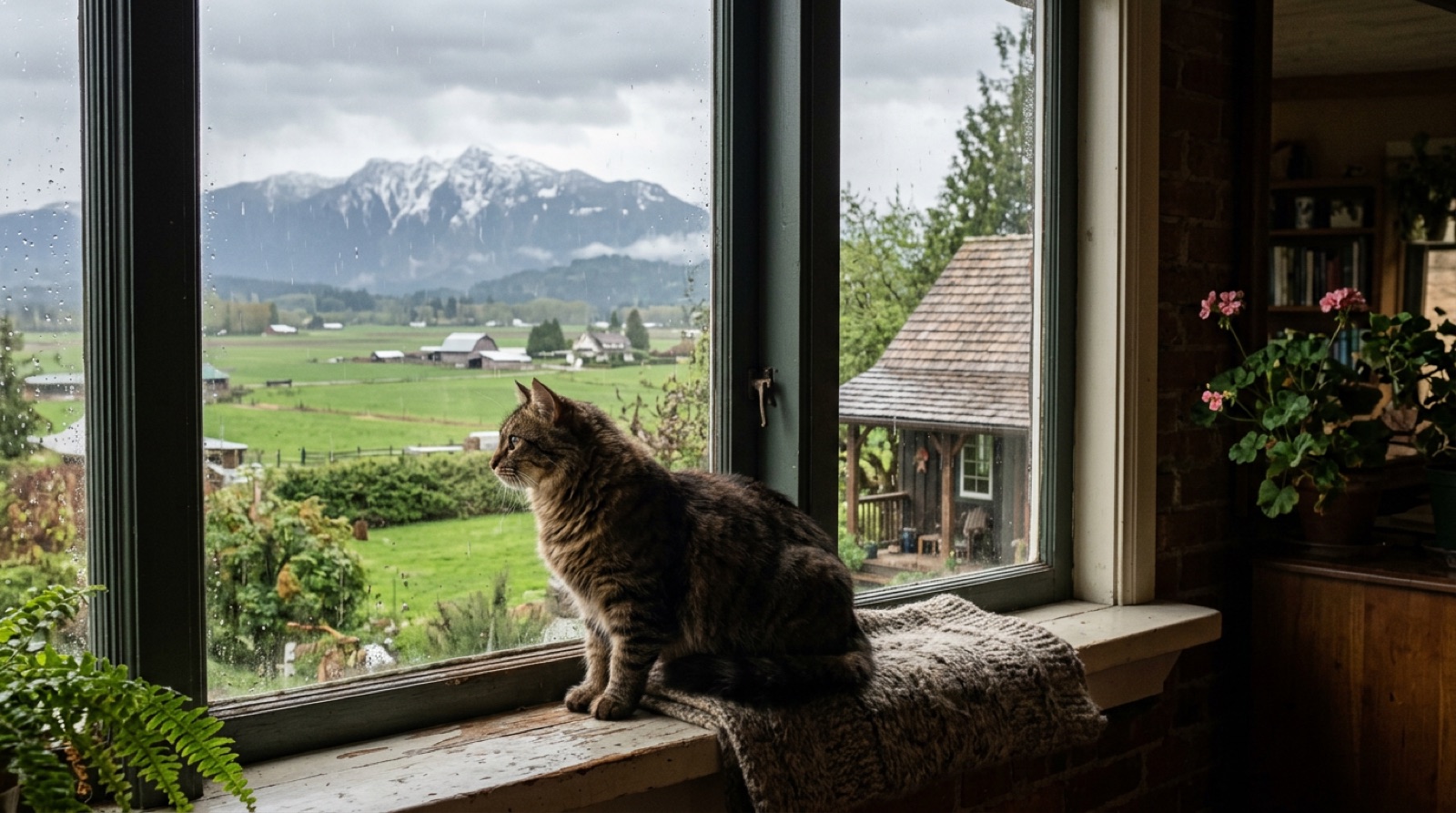
The short answer
Keep the cat indoors. Abbotsford has no cat bylaw, so nothing bans roaming but nothing recovers a lost cat either. Coyotes work the Sumas Prairie field edges, farm roads and Highway 1 move fast, and outdoor cats trade FIV and feline leukemia through fights. Microchip your cat and keep the registration current, and use a screened catio or supervised yard time as the safe middle ground.
Abbotsford handles cats differently from most Canadian cities. There is no rule at all.
The city does not license cats, and the Fraser Valley Regional District, which runs animal control, deals only with dogs. No cat tag, no registration, no impound process, no at-large rule. That sounds relaxed until a cat goes missing, because it also means there is no municipal system anywhere working to get it back.
So the Abbotsford debate is not about whether roaming is allowed. It is about what a cat can safely do instead, in a farmland landscape that is harder on outdoor cats than a tidy suburb would be.
Why There Is No Safety Net
In a city that licenses cats, a lost pet that gets picked up enters a system: a tag, a registry, an impound with a holding period and a duty to contact the owner. Abbotsford has none of that for cats. The Fraser Valley Regional District confirms its animal control is not equipped to impound cats and refers cat matters to the BC SPCA.
The practical result is that recovery depends entirely on you and on community networks. A microchip registered to your current phone number is the one thing a vet or rescue can scan and trace. An indoor cat that never gets out is safer still, because it never tests any of this.
The Real Risks Around Abbotsford
This is farm country on the edge of the Lower Mainland, and the hazards reflect that. None of these is hypothetical.
The Sumas Prairie farmland, hedgerows and greenbelts around Abbotsford hold a healthy coyote population that moves into neighbourhoods, especially at dawn and dusk. A cat is prey-sized.
Rural roads across the prairie carry fast farm and commuter traffic, and Highway 1 cuts through the city. Cats do not survive the encounter.
Abbotsford does not license cats, and the Fraser Valley Regional District does not impound them. A roaming cat that goes missing has no municipal registry working to get it home.
A busy outdoor and farm cat population trades FIV and feline leukemia through bites, and fight wounds abscess quickly.
Machinery, chemicals, rodenticides and livestock buildings on agricultural land add risks a city cat never meets. Secondary rodenticide poisoning is a real one.
Damp Lower Mainland winters offer little shelter, and birds of prey work the open farmland. Small cats stay warmer and safer inside.
The Safe Middle Ground
Indoor does not have to mean bored. Most of what a cat wants from outside is stimulation, and you can bring almost all of it indoors. Abbotsford mild climate makes a catio especially worthwhile here.
Cat trees, shelves and a windowsill perch. Cats measure territory in height as much as floor area, so a tall room feels bigger to them.
A perch facing a bird feeder or the farmland beyond is the cheapest entertainment you will buy, and it works year round in the Fraser Valley.
Two short wand-toy sessions beat one long one. Ten minutes each, ending with a food reward, mimics the hunt and settles a restless cat.
Feeding from a puzzle feeder rather than a bowl turns two minutes of eating into twenty minutes of work.
One tall sturdy vertical post plus one horizontal cardboard scratcher covers most preferences.
A screened patio run gives outdoor air and bird watching with no coyote or traffic exposure. Abbotsford mild climate means it is usable most of the year, with a covered section for the rain.
A microchip is not optional here. With no municipal cat system, the chip is the only identification anyone can trace back to you. Get it done, register it, and update the phone number every time you move. A collar tag falls off in a hedgerow. The chip does not.
Browse adoptable cats in Abbotsford
Local rescues place most cats as indoor-only, and many arrive already microchipped. Listings refreshed regularly.
See Available Abbotsford Cats →Frequently Asked Questions
Is it legal to let my cat outside in Abbotsford?
There is no bylaw stopping you, but that is not the same as it being safe. Abbotsford does not license cats and the Fraser Valley Regional District, which handles animal control, deals only with dogs. So no rule bans a cat from roaming, and no rule protects it either. The absence of a bylaw actually makes roaming riskier here than in a city with a cat system, because if your cat goes missing there is no municipal registry or impound process working to reunite you.
What actually kills outdoor cats in Abbotsford?
Coyotes and traffic lead, with disease close behind. Coyotes hunt the field edges and hedgerows around the Sumas Prairie and come into neighbourhoods at dawn and dusk. Rural roads and Highway 1 do the rest year round. Then there is disease, since a busy outdoor and farm cat population passes FIV and feline leukemia through bites. Add farm hazards like machinery and rodenticides on agricultural land, and the outdoors around Abbotsford is a genuinely rough place for a cat.
Does Abbotsford have a cat bylaw or licence?
No. The city does not license cats, and the Fraser Valley Regional District animal control service covers dogs only, not cats. There is no cat tag, no registration, no impound process, and no at-large rule for cats. That sounds relaxed, but the practical effect is that a lost cat has no safety net. The one piece of identification that still works is a microchip registered to your current phone number, so a chip matters more in Abbotsford than in a city that licenses cats.
My cat has always gone outside. Can I switch it to indoors?
Yes, and most cats manage it far better than their owners expect. The trick is replacing what the outdoors provided rather than simply removing it. Add height, add a window perch, add two short play sessions a day and feed from a puzzle feeder instead of a bowl. Expect a couple of weeks of complaining at the door. Do not open it during the complaining, because a cat that gets let out on the twelfth attempt has learned that twelve attempts works.
Is a catio worth building in Abbotsford?
For most of the year, yes. Abbotsford mild Lower Mainland climate means a screened patio run is usable across far more of the calendar than one in the interior would be. It gives a cat real outdoor air, birdsong and a view of the farmland with none of the coyote and traffic exposure. Build in a covered section so the cat can sit out during the region frequent rain, position it to catch some morning sun, and it solves most of the behaviour problems people blame on indoor confinement.
Are there coyotes in Abbotsford neighbourhoods?
Yes, regularly. The mix of farmland, greenbelts and residential streets across Abbotsford gives coyotes cover and easy movement, and they follow the field edges right into subdivisions at dawn and dusk. They take cats. This is one of the clearest local arguments for keeping cats indoors, and it applies just as much to the newer subdivisions backing onto agricultural land as it does to the rural properties out on the prairie.
Will an indoor cat get bored or fat?
It can, and both are avoidable with a bit of structure. Boredom shows up as overgrooming, night yowling, or ambushing your ankles at 6am. Weight gain comes from free-feeding a cat that no longer hunts. Fix both with measured meals, a puzzle feeder, and daily play that actually ends in a catch. A cat that plays hard for ten minutes twice a day sleeps properly and stays a sensible weight without much else changing.
Do rescues here adopt cats out as indoor-only?
Usually, and Fraser Valley Humane Society adopts strictly as indoor-only. Others treat it as a strong expectation and raise it in conversation. Either way, answer honestly. A rescue that knows you have a screened patio and want supervised outdoor time can match you with a cat that suits, and can tell you which of their cats has already lived that way. Former community cats often adapt to a safe indoor life surprisingly well once they trust the home.
What if my indoor cat escapes?
Start close and start immediately. Most escaped indoor cats hide within a short distance of home rather than travelling, often under a deck, in a shed, or beneath a parked vehicle. Search at dawn and dusk when it is quiet, call in your normal voice, and put the litter box and a piece of unwashed bedding outside the door. Post to Abbotsford lost-pet groups and contact local rescues. Because there is no municipal cat pound here, community networks and your microchip registration do the recovery work.
Should I get a GPS tracker for my cat?
A tracker is a reasonable addition for a cat with supervised outdoor access, but it is not a substitute for identification. Trackers rely on batteries and breakaway collars, both of which fail exactly when you need them. A registered microchip works forever and does not fall off in a hedgerow. Get the microchip first, keep the registration current when you move house, and treat a tracker as a convenience on top rather than the main plan.
Are there feral cat colonies around Abbotsford?
Yes, around barns and rural properties across the Fraser Valley, and The Abby Cat Daddy is the local charity that traps, alters and rehabilitates them using trap-neuter-return. If you are feeding a colony or seeing unaltered cats on your acreage, that is who to contact, because feeding without altering just grows the colony. Removal alone never solves it, since untouched cats breed back to fill the space, which is a familiar pattern on prairie farms.
Related Abbotsford Guides
One search, every Abbotsford rescue
Shelter cats and foster cats serving Abbotsford and the Fraser Valley, in a single list.
Browse Available Abbotsford Cats →New cat? Start with these care guides
Everything a new adopter needs to set up a safe, happy home.