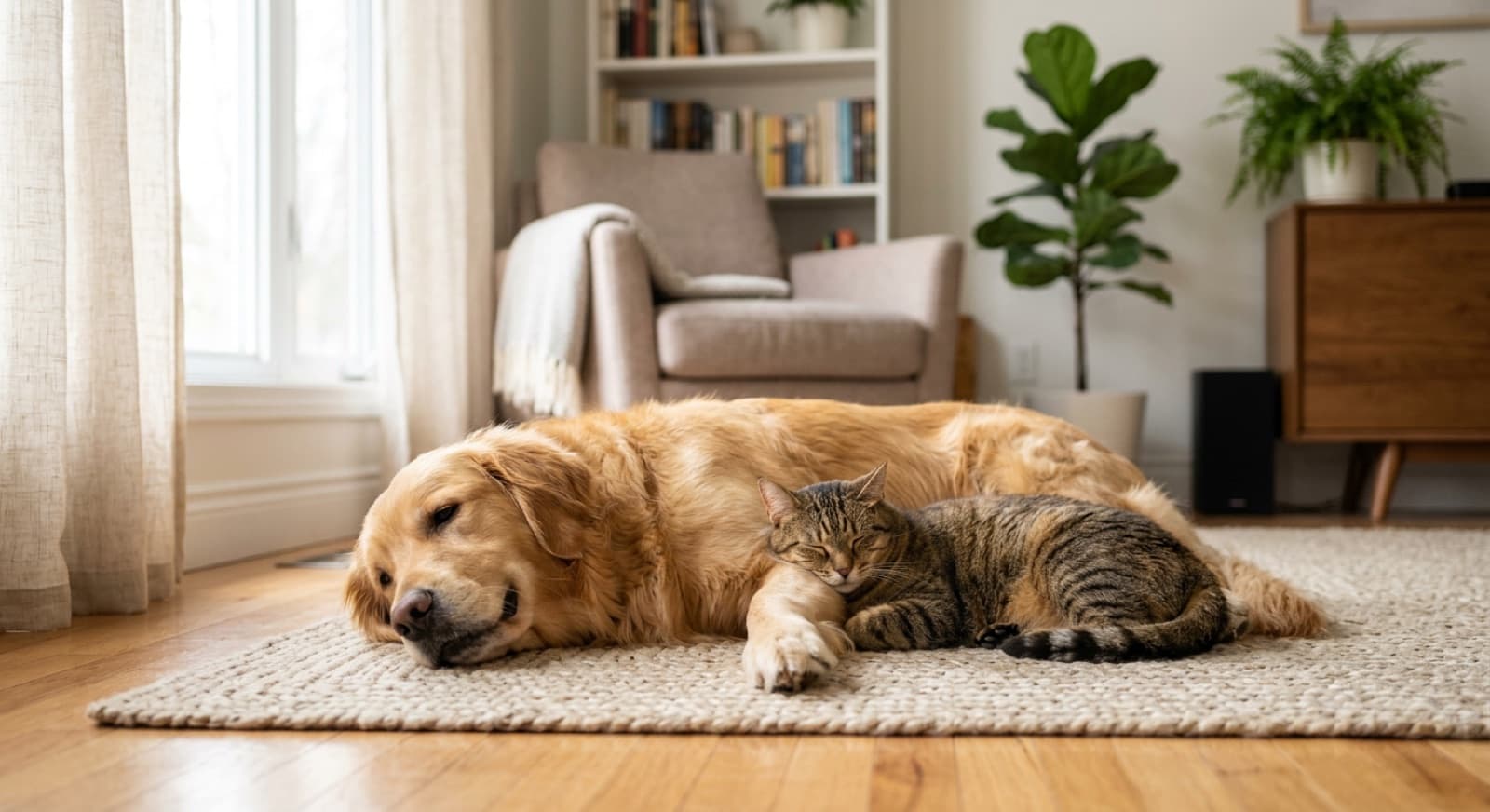
The short answer
Separate the cat and dog at first and swap scents until both are calm. Set up cat escape routes and high perches, plus a dog-free zone for the litter box, food, and water. Do first meetings with the dog leashed and the cat free to approach or leave, never allowing a chase, rewarding the dog for calm. Progress to supervised loose time only as both stay relaxed. Never leave them unsupervised until you are fully confident, and get a trainer's help early if the dog fixates on the cat.
The five steps
Separate first and swap scents
Keep the cat and dog fully apart at first, ideally with the newcomer in its own room, and let them get used to each other's smell before they ever meet. Swap bedding, and feed both animals on opposite sides of a closed door so each links the other's scent with something good. The cat needs a safe base it controls. This scent stage lowers the tension before any face-to-face, which is exactly what you want with a predator-and-prey-sized pairing.
Set up cat escape routes and safe zones
Before any meeting, make sure the cat can always get away and up. Tall cat trees, shelves, and a baby gate the cat can slip under or jump over but the dog cannot give the cat control and confidence. Keep the litter box, food, and water somewhere the dog can never reach them, since a cat that feels cornered or guarded will not relax. In a Vancouver apartment, vertical space matters even more when floor space is limited.
Do the first meetings with the dog leashed
For the first face-to-face, keep the dog on a leash and calm, and let the cat move freely and approach (or not) on its own terms. Never let the dog chase, even in play, and never hold the cat or force them together. Reward the dog for calm, quiet behaviour and for ignoring the cat. Keep sessions short and positive, and end before either animal gets worked up. Repeat over many short sessions rather than one long one.
Read both animals honestly
Watch for trouble signs: a dog that fixates, whines, lunges, or cannot look away, and a cat that is frozen, puffed up, growling, or constantly fleeing. A relaxed dog that can be redirected and a cat that moves normally and eats and uses the litter box are good signs. Progress only as both stay calm. Some dogs have a strong prey drive that makes cat cohabitation genuinely hard; be honest about it and get professional help early rather than hoping it fades.
Build to unsupervised time slowly
Only after many calm, leashed meetings do you move to dragging-leash and then off-leash time in the same room, always supervised at first. Keep the cat safe zones permanent. Do not leave a new cat and dog loose together unsupervised until you are fully confident, which can take weeks. If you adopted from a Vancouver rescue, tell them you have a dog (or cat); a foster-based rescue often knows whether a specific animal has lived successfully with the other species.
The safety rule that never bends: never allow a chase, and never leave them loose together until you are certain. A cat that always has an escape route and a dog that is rewarded for calm is the winning combination. If either animal is newly adopted, it is settling into a new home at the same time, so pair this with our first-week guide. Adopting a dog too? The Vancouver dog listings often flag cat-friendly dogs.
Adopting into a multi-pet home?
Foster-based Vancouver rescues often know whether a cat is dog-friendly (or a dog is cat-safe) from firsthand experience. Ask, and tell them about your resident pet.
Browse Vancouver Cats →Frequently Asked Questions
How long does it take for a cat and dog to get along?
Anywhere from a couple of weeks to a couple of months, depending on both animals. A calm, cat-experienced dog and a confident cat can settle quickly, while a high-prey-drive dog or a fearful cat needs much longer and more careful management. The pace is set by keeping both animals under their stress threshold: separation and scent first, then short leashed meetings, then supervised loose time, advancing only when both stay relaxed. Rushing a nervous cat or an over-excited dog sets you back.
What if my dog wants to chase the cat?
Chasing, even if it looks playful, must not be allowed to happen, because each chase makes the cat more fearful and the dog more fixated. Keep the dog leashed for all early meetings, reward calm and ignoring the cat, and give the cat escape routes and high spaces so it is never trapped. A dog with a strong prey drive that fixates, will not settle, or cannot be redirected needs the help of a qualified Vancouver trainer or behaviour professional. Do not leave them loose together until the chasing impulse is genuinely gone.
How do I keep the cat safe from the dog?
Give the cat control of the situation. Provide vertical escape (cat trees, shelves), a room or baby-gated area the dog cannot enter, and keep the litter box, food, and water somewhere the dog can never reach so the cat can eat and toilet without being cornered or bothered. Keep the dog leashed early on, supervise all contact, and never force interactions. A cat that always has a safe exit is a cat that can stay calm enough to eventually relax around the dog.
Can any dog live with a cat?
Many can, but not all, and it depends far more on the individual dog than the breed. Some dogs are naturally gentle with cats, while others have a strong prey drive that makes cohabitation difficult and, in some cases, unsafe. Individual temperament and early training matter most. If you are adopting, this is exactly what to ask a foster-based rescue: they often know whether a specific dog has lived calmly with cats, which is far more useful than guessing from breed.
Should I adopt a dog or cat that has lived with the other species before?
If you already have one, yes, it helps a lot. A cat known to be dog-friendly, or a dog known to be cat-safe, removes much of the uncertainty, and foster-based Vancouver rescues frequently note this in an animal's profile because the foster home has seen it firsthand. Tell the rescue about your resident pet and ask directly. A good match on this one trait makes the whole introduction dramatically easier and safer for everyone.
Introducing a Second Cat
The cat-to-cat version of this playbook.
First Week With a Rescue Cat
The safe room, the 3-3-3 rule, and a calm start.
How to Adopt a Cat in Vancouver
The full step-by-step adoption process.
Dog Adoption in Vancouver
Browse adoptable Vancouver dogs, including cat-friendly ones.
New dog? Start with these care guides
Everything a new adopter needs to set up a safe, happy home.