The short answer
Boxers are excellent family dogs, affectionate, playful, and typically patient and gentle with children. The catch is not temperament but energy and exuberance: a young Boxer is strong, bouncy, and stays mentally puppy-like for two to three years, so it needs an hour or more of real daily exercise and consistent, positive training (especially to curb jumping). They are generally good with other dogs and often with cats, though it varies by dog, so ask the rescue. Take heat seriously in summer (they are moderately brachycephalic). Condo life works with committed exercise. For most first-time or family adopters, an adult Boxer is the easiest, most rewarding pick.
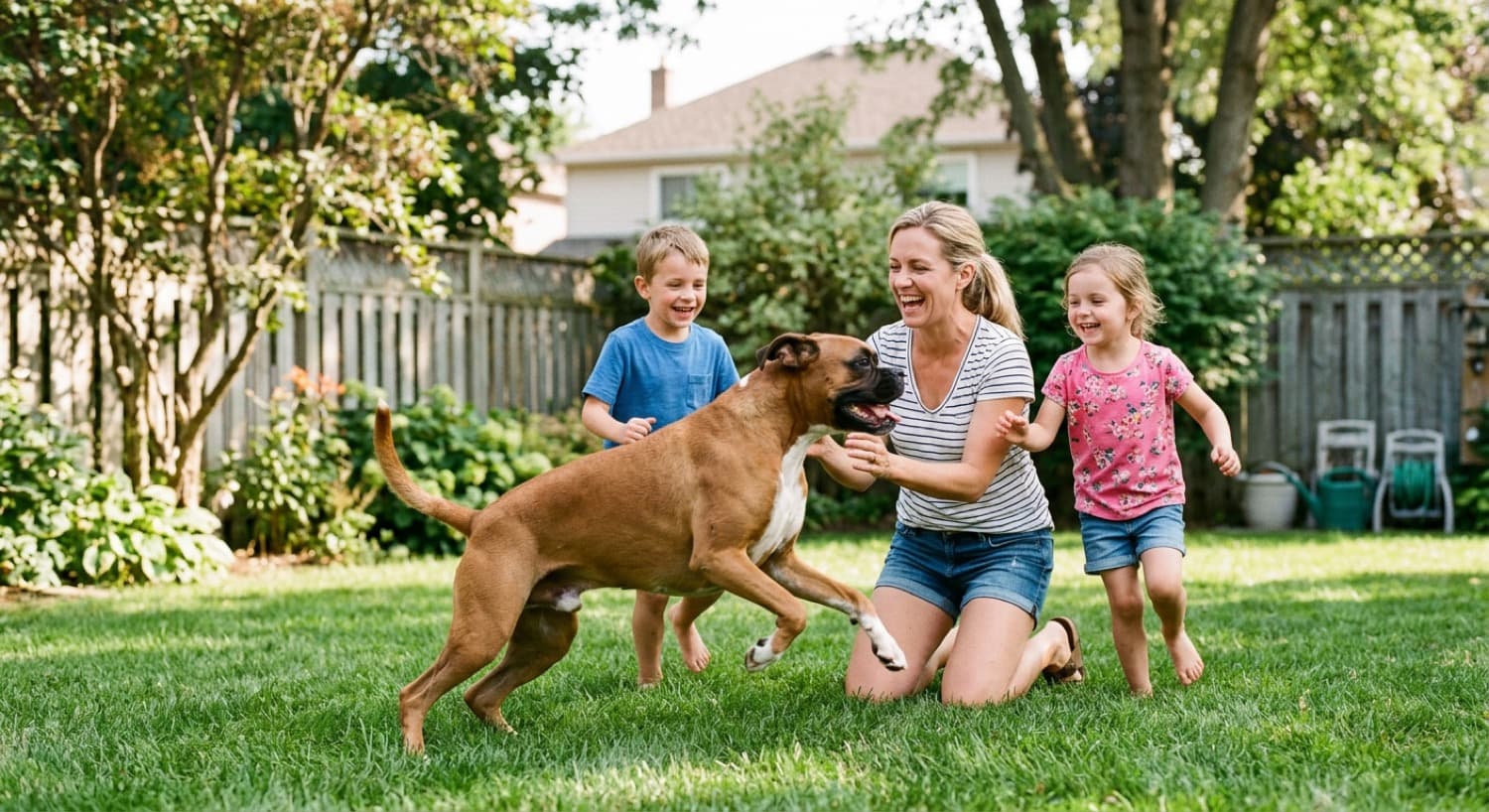
Are Boxers good with kids?
Yes, Boxers are a classic family dog and typically wonderful with children, affectionate, patient, and playful, often bonding strongly with the kids in the home. The honest caveat is size and energy, not temperament: a young, bouncy Boxer can knock over a toddler out of sheer enthusiasm, so this is a supervision-and-training matter, not an aggression one.
As with any dog, supervise interactions with small children, teach kids to be gentle and to respect the dog's space, and train the Boxer early to keep four paws on the floor around people. Match the dog to your household, too: a calmer adult Boxer is often a better fit for a home with very young children than a bouncy one-year-old. A foster-based rescue can tell you how a specific Boxer has been around kids.
The energy reality
Boxers are a high-energy working breed, and this is the single most important thing to plan for. Expect to provide an hour or more of real exercise a day, plus play and mental stimulation. An under-exercised Boxer is where most behaviour complaints (jumping, mouthing, mischief, restlessness) come from.
Vancouver is a great city for a Boxer. The seawall, Pacific Spirit Regional Park, the local off-leash areas, and a solid game of fetch all burn energy, and Boxers generally love a good run and a play session. Because they are moderately brachycephalic, take the heat seriously in summer: walk in the cool of the morning or evening, carry water, and skip strenuous midday exercise on hot days. In our wetter, cooler months, a short-coated Boxer appreciates a winter coat and drying off after rainy walks. Plan the exercise into your day before you adopt, and most Boxer challenges never appear.
The long adolescence
Boxers are famously slow to mature and often stay mentally puppy-like for two to three years. Combined with their exuberance, that means you live with a large, strong, bouncy adolescent for a good while, charming and exhausting in equal measure.
The upside is a genuinely fun, clownish companion that stays playful for life. The downside is that the jumping, mouthing, and goofiness need consistent training through that whole period, not just the first few months. Patience and a sense of humour go a long way. If the idea of a two-year adolescence sounds like a lot, adopting an adult Boxer (four years and up) is a great way to get all the affection with a bit less of the bounce, and the rescue can tell you the dog's energy level upfront.
Training a Boxer, and curbing the jump
Boxers are intelligent and eager to please but also sensitive and a little goofy, so positive, reward-based training suits them far better than harsh corrections, which tend to make a sensitive Boxer shut down or grow anxious. Keep sessions short, upbeat, and rewarding, and stay consistent across everyone in the home.
Jumping is the number one Boxer management issue, and it is pure enthusiasm, not dominance. Reward four-on-the-floor and calm greetings, give jumping no payoff (no attention, no eye contact, no pushing, which reads as play), and teach a rewarded alternative like sit-to-greet. Ask visitors to follow the same rules so the dog is never rewarded for jumping intermittently. A tired Boxer is a calmer Boxer, so exercise before high-arousal moments helps enormously.
Start training and socialisation early and keep it positive, exposing your Boxer to lots of people, dogs, and situations. A good positive-reinforcement trainer can fast-track jumping and impulse control if you are struggling. For settling a newly adopted Boxer in, our first-week guide helps.
Other pets, and apartment life
Other dogs and cats. Many Boxers are friendly and playful with other dogs, though some show same-sex tension and their exuberant play style can overwhelm a quieter dog. With cats, a Boxer raised with them or with low prey drive can do fine, while a higher-drive Boxer may chase, so gradual introductions matter. This varies by individual dog, so ask a foster-based rescue that has seen the dog around other animals, and tell them about any resident pets.
Apartment and condo life. It can work, but it takes commitment. A Boxer is a medium-to-large, high-energy dog, so condo living only succeeds if you fully meet the exercise needs outdoors rather than relying on the space. The good news is Boxers are generally not big barkers, which helps with neighbours. Check your building and strata pet rules and any size limits first, and know that a calmer adult Boxer is a better condo fit than a bouncy youngster. If you can commit to the daily exercise, plenty of Boxers live happily in Vancouver apartments.
Ready to meet a Boxer?
Browse adoptable Boxers and Boxer mixes from Lower Mainland rescues. A foster-based rescue can tell you a specific dog's energy level and how it does with kids, dogs, and cats, which is exactly what makes a great match. Refreshed regularly.
See Available Boxers →Frequently Asked Questions
Are Boxers good family dogs?
Yes, Boxers are one of the classic family breeds, and it is well earned. They are affectionate, deeply people-oriented, playful, and typically patient and gentle with children, often forming strong bonds with the kids in the home. The honest caveat is energy, not temperament: a young Boxer is big, bouncy, and enthusiastic, so it can knock over a toddler by accident simply out of joy. That is a management issue, not an aggression one. With sensible supervision around small children, early training to curb jumping, and enough daily exercise to take the edge off, a Boxer is a wonderful family dog. Match the dog's age and energy to your household and it works beautifully.
How much energy and exercise does a Boxer need?
A lot, especially as a young adult. Boxers are a high-energy working breed and generally need a solid hour or more of real exercise a day, plus mental stimulation and play, or the energy comes out as jumping, mouthing, and mischief. Vancouver suits them well: the seawall, Pacific Spirit Regional Park, the local off-leash areas, and a good game of fetch all burn energy. Because Boxers are moderately brachycephalic, take heat seriously in summer (walk in the cool hours, carry water). An under-exercised Boxer is where most of the behaviour complaints come from, so plan for the exercise before you adopt, not after.
Why do Boxers stay puppy-like for so long?
Boxers are famously slow to mature and often stay mentally puppy-like for two to three years, longer than many breeds. Combined with their natural exuberance, this means you are living with a large, strong, bouncy adolescent for a good while, which is charming and exhausting in equal measure. The upside is a genuinely fun, clownish companion that stays playful for life. The downside is that the jumping, mouthing, and general goofiness need consistent training through that whole period, not just puppyhood. Patience and a sense of humour help. Adopting an adult Boxer (four years and up) is a great way to get the affection with a bit less of the bounce.
Are Boxers good with other dogs and cats?
It depends on the individual dog and its socialisation, so this is exactly what to ask a rescue about a specific Boxer. Many Boxers are friendly and playful with other dogs, though some can show same-sex tension, and their exuberant play style can be a lot for a quieter dog. With cats, a Boxer raised with them or with low prey drive can do fine, while a high-drive Boxer may chase, so careful, gradual introductions matter. A foster-based rescue that has seen the dog around other animals is the best source of honest information. If you have a resident pet, tell the rescue and ask directly.
How do I stop a Boxer jumping on people?
Jumping is the number one Boxer management issue, and it is enthusiasm, not dominance. The fix is consistency: reward four-on-the-floor and calm greetings, and give the jumping no payoff, no attention, no eye contact, no pushing (which reads as play), simply turn away and only engage when the paws are down. Teach and heavily reward an alternative like sit-to-greet, and ask visitors to follow the same rules so the dog is not rewarded intermittently. Plenty of exercise before high-arousal moments helps enormously, because a tired Boxer is a calmer Boxer. A positive-reinforcement trainer can fast-track this if you are struggling.
How do I train a Boxer?
Boxers are intelligent and eager to please but also sensitive and a bit goofy, so positive, reward-based training suits them far better than harsh corrections, which tend to make a sensitive Boxer shut down or grow anxious. Keep sessions short, upbeat, and rewarding, because a bored Boxer loses interest fast. Consistency across everyone in the home matters, since Boxers will happily exploit a rule that only some people enforce. Start early, socialise widely and positively, and channel that energy into training games and structured play. The combination of a smart, willing dog and a lot of energy means training is not optional; it is what turns a boisterous Boxer into a brilliant companion.
Can a Boxer live in a Vancouver apartment or condo?
It can work, but it takes commitment, and it is not the easy option. A Boxer is a medium-to-large, high-energy dog, so condo life only succeeds if you fully meet the exercise needs with daily outdoor time, off-leash runs, and play, rather than relying on the space itself. Boxers are generally not big barkers, which helps with neighbours, but the bouncy energy needs a real outlet or it turns into restlessness indoors. Check your building and strata pet rules and any size limits first. An adult Boxer with a calmer energy level is a better condo fit than a bouncy youngster. If you can commit to the exercise, plenty of Boxers live happily in Vancouver apartments.
Is a Boxer a good first dog?
A Boxer can be a good first dog for an active household that goes in with realistic expectations, but it is not a low-effort starter breed. The affection and playfulness are wonderful for a family, but the size, strength, high energy, long adolescence, and need for consistent training are real commitments a first-time owner should understand upfront. For a first-time Vancouver owner, an adult Boxer (four years and up) with a known temperament from a foster-based rescue is the easiest entry point, since the energy has usually settled and the rescue can tell you exactly what the dog is like. If you want a bouncy puppy, be ready to invest heavily in training and exercise for the first couple of years.
The full Boxer cluster
Boxer Adoption in Vancouver
Where to adopt, real costs vs breeders, Boxer mixes, and the breed reality before you apply.
Boxer Health Issues
The breed heart conditions and cancer risk explained, plus heat care, bloat, and insurance.
Adoptable Boxers in Vancouver
All currently available Boxers and Boxer mixes. Updates regularly.
First Week With a Rescue Dog
The decompression routine that helps a bouncy new Boxer settle into your home.
New dog? Start with these care guides
Everything a new adopter needs to set up a safe, happy home.