The short answer
Two breed-defining concerns: hip and elbow dysplasia (joint disease that drives arthritis) and a genetic tendency toward obesity, which makes weight control the single most important thing a Lab owner does. The wet-coast wildcard is ear infections: a water-loving breed with heavy floppy ears, plus year-round Vancouver damp, means ear care is routine. Also worth knowing: exercise-induced collapse (EIC), a Lab-associated genetic condition that is DNA-testable; bloat (GDV), a deep-chest emergency; progressive retinal atrophy; and arthritis in seniors. Pet insurance tends to pay off for Labs given the joint, ear, and cancer combination. Every treatment, medication, or diet plan in this guide is a conversation with your vet, not a self-prescription.
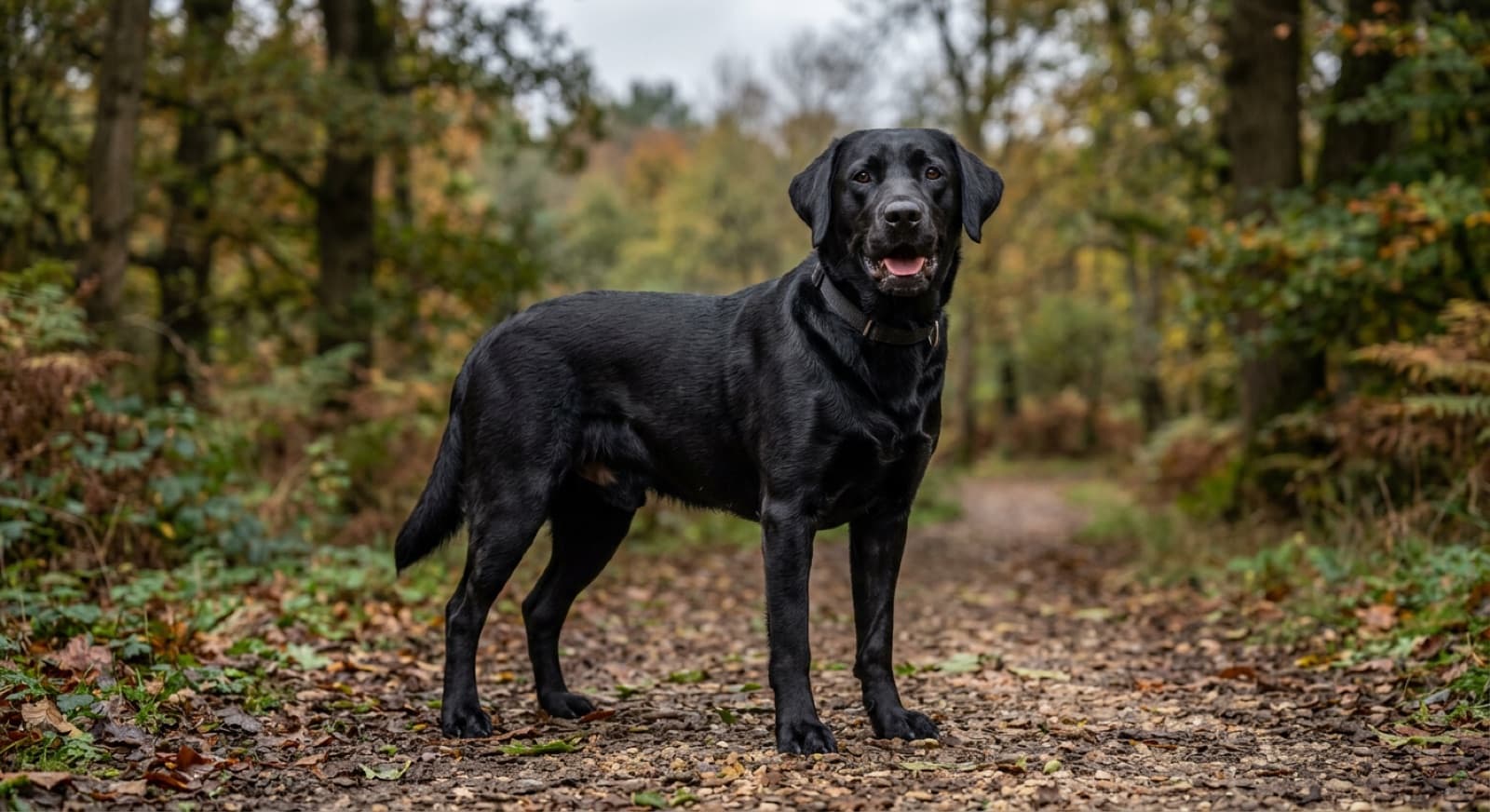
This guide is informational and is not veterinary advice. Diagnosis, medication, and treatment decisions belong with a licensed veterinarian who has examined your dog.
Why ear infections are the wet-coast Lab problem
For a Lab on the Pacific coast, recurrent ear infections (otitis) are a constant management item, not a one-off. Heavy floppy ears trap moisture, the breed loves water, and the year-round Lower Mainland damp keeps the ear canal humid. The American Kennel Club breed profile flags ear care as a routine part of owning the breed.
Three factors stack up against a Lab here. First, the floppy ear shape limits airflow and traps moisture inside the canal. Second, Labs genuinely love water, so every swim in the ocean, a lake, or a rainy-day puddle gets water where it should not stay. Third, the breed has a real tendency toward allergies, and allergic inflammation is the underlying driver of many chronic ear infections. Layer Vancouver damp on top and you get a dog that needs ear care built into the weekly routine.
Signs to watch for and discuss with your vet:
- Head shaking and scratching or pawing at the ears
- Redness inside the ear, or dark waxy or pus-like discharge
- A yeasty or foul smell
- Head tilt or balance changes in worse cases
A sensible home routine:
- Dry the ears thoroughly after every swim and every bath
- Check weekly for redness, discharge, or odour
- Use a vet-recommended ear cleaner rather than improvising with anything from the cupboard
- If infections keep coming back, ask your vet about controlling the underlying allergies, because that is usually the real fix
When a Lab gets ear infections two or three times a year, the question stops being “which drops” and becomes “what is driving this.” That root-cause work, and any medication, belongs with your vet. For the seasonal coast-damp picture that drives skin and ear care year-round, see our Pacific coast winter dog care guide. A Lab who swims often also needs a sober look at water safety, which we cover in the Lab swimming safety guide.
How common is hip dysplasia in Labrador Retrievers?
Hip dysplasia is one of the two breed-defining health concerns for Labs, alongside obesity. It is a malformation of the ball-and-socket hip joint that leads to arthritis, pain, and reduced mobility. The OFA hip dysplasia statistics by breed track screening results across thousands of evaluated Labs.
Signs to watch for: a bunny-hopping gait, reluctance to jump or climb stairs, stiffness after rest, lower exercise tolerance, weight shifting off an affected hip, and lameness that comes and goes. Severe cases can show by age 1 to 2 years; milder cases may not appear until middle age.
Diagnosis is an orthopedic exam plus hip X-rays read by your vet, scored through PennHIP or OFA.
Conservative care for milder cases combines several things your vet selects:
- Weight management, which matters most, because overweight Labs do dramatically worse
- Joint supplements and controlled low-impact exercise
- Physiotherapy or hydrotherapy, which suits Labs because they love water
- Vet-prescribed pain control when needed
Severe cases may be referred to a Vancouver veterinary specialist centre for surgery such as femoral head ostectomy or total hip replacement. Cost depends on the procedure and the centre, so have that conversation with the surgical team.
The strongest lever an owner controls is keeping the Lab lean and avoiding forced, high-impact exercise on a still-growing puppy. Screening, conservative care, and surgical decisions all belong with your vet.
How common is elbow dysplasia in Labradors?
Elbow dysplasia is reported in Labs and can be more debilitating per case than hip dysplasia, because the front legs of a front-heavy breed carry more weight. It is an umbrella term for several developmental joint problems in the elbow.
The common forms your vet may name:
- Fragmented coronoid process, where a fragment of cartilage breaks off in the joint
- Osteochondritis dissecans, a cartilage abnormality
- Ununited anconeal process, where a piece of bone fails to fuse during development
Signs to discuss with your vet: front-leg lameness that is often worse after exercise or rest, reluctance to use one front leg, swelling at the elbow, and gait changes. Severe cases often show in the first year.
Diagnosis is an orthopedic exam and elbow X-rays, sometimes a CT scan, read by your vet.
Milder cases are managed with weight control, supplements, controlled exercise, and vet-selected pain relief. More severe cases may be referred for arthroscopic surgery at a Vancouver veterinary specialist centre.
As with hips, the prevention an owner controls is keeping a growing Lab lean and avoiding forced, repetitive exercise before the growth plates close. Treatment decisions belong with your vet.
Why are Labs the most obesity-prone dog breed?
Part of it is genetic. Researchers have identified a deletion in the POMC gene in many Labradors that affects appetite regulation, so affected dogs feel hungrier and beg more even after eating enough calories. The Texas A&M College of Veterinary Medicine explains the appetite-gene link in plain terms.
Combine that gene with the strong food motivation that makes Labs such good guide and service dogs, and you have a breed that overeats easily. A large share of pet Labs in North America carry extra weight, the highest rate of any breed in most surveys.
Why it matters so much: extra weight is not cosmetic for a Lab. It worsens hip and elbow dysplasia, raises the risk of arthritis, diabetes, and cardiac disease, and shortens lifespan. Carrying a Lab lean is one of the few breed health levers almost entirely in the owner hands.
The Vancouver angle: rainy stretches cut walks short, and cozy indoor winters tempt extra treats. Both push the wrong way on a breed already wired to overeat.
What works:
- Measure food in actual cups instead of eyeballing the bowl
- Keep treats under roughly ten percent of daily calories
- Weigh monthly and use body condition score, not just the scale
- Keep exercise consistent even on wet days, with indoor games when the rain wins
If your Lab is gaining weight despite normal feeding, ask your vet to rule out a thyroid problem before assuming it is just calories. Weight is the single single most important thing a Lab owner manages, and we go deep on the Vancouver routine in our Lab weight management guide.
What is Exercise-Induced Collapse (EIC)?
EIC is a Lab-associated genetic condition in which affected dogs become weak and may collapse after intense, excited exercise, then recover after several minutes of rest. It is linked to a mutation in the DNM1 gene. The AKC Canine Health Foundation has funded research into the condition.
Many Labs carry one copy of the mutation and stay symptom-free. A smaller share carry two copies and are affected. Rates run higher in field and working lines than in show lines.
What an episode looks like: several minutes into hard, exciting exercise such as repeated retrieving or fast play, the hindquarters go wobbly, the dog may collapse, and recovery usually follows within several minutes of rest. Most affected dogs are normal at lower exercise intensity.
Why a diagnosis matters: EIC can be mistaken for heatstroke or a cardiac problem, and the management is different. A DNA test confirms status, and your vet can advise on testing. There is no medication that cures EIC. Affected dogs can live full lives with permanent moderate-intensity exercise and by stopping activity at the first sign of weakness.
For Vancouver adopters: a Lab whose collapse history or DNA status is unknown is worth testing, and most Lower Mainland rescues note any collapse episodes in a dog file. Diagnosis and management belong with your vet.
Are Labradors at risk for bloat (GDV)?
Yes, at a moderate level. Gastric dilatation-volvulus, or bloat, is a true emergency in which the stomach fills with gas and twists. It can be fatal within hours without surgery. As a deep-chested breed, Labs carry more risk than small breeds, though less than the deepest-chested giants such as Great Danes.
Warning signs that need an emergency Vancouver vet immediately:
- Unproductive retching, where the dog tries to vomit but nothing comes up. This is the key early sign
- A distended or swollen abdomen
- Restlessness and an inability to settle
- Drooling, pale gums, weakness, and collapse
This is one of the few problems where minutes matter. The window from onset to collapse can be just a few hours, so drive to the emergency clinic rather than waiting to see if it passes.
Reasonable prevention practices reported in veterinary literature:
- Feed two to three smaller meals rather than one large meal
- Use a slow-feeder bowl to slow down a fast eater
- Avoid hard exercise for an hour or so around meals
Whether a preventive gastropexy (a procedure that tacks the stomach to prevent twisting, sometimes done during spay or neuter) makes sense for an individual dog is a vet-by-vet conversation rather than a breed-wide rule. Discuss your Lab risk profile with your vet.
What is progressive retinal atrophy (PRA)?
PRA is a group of inherited eye diseases that gradually degrade the retina and can lead to blindness. The form most associated with Labs typically shows night blindness first, then a slow progression over months to years.
Signs to discuss with your vet: difficulty seeing in dim light, bumping into objects in low light, dilated pupils, and an unusually bright eye shine.
Diagnosis combines an exam by a veterinary ophthalmologist with a DNA test that identifies carriers and affected dogs. For adult adoptions, documentation through the OFA Eye Certification Registry (formerly CERF) is a useful signal.
There is no cure, but the reassuring part is that most dogs adapt remarkably well to gradual vision loss, leaning on smell and hearing to navigate familiar spaces.
Living with a vision-impaired Lab: keep furniture layouts consistent, use verbal cues, keep the dog on-leash in unfamiliar areas, and secure stairs and water. Annual eye exams are a sensible habit for adult Labs, and for an adult adoption it is worth asking the rescue what eye work a dog has had. All diagnostics and care belong with your vet.
Do Labs get arthritis, and what helps?
Arthritis is common in older Labs, often as the long-term consequence of hip or elbow dysplasia, old injuries, or years of carrying extra weight. Cool, damp Lower Mainland mornings can make a stiff senior look worse.
Signs build slowly: stiffness after rest that eases with movement, slowing on walks, hesitation on stairs or jumping into the car, and a stiff or altered gait.
There is no cure, but a lot can be managed. A typical plan your vet builds combines:
- Weight control, the biggest single factor for a heavy breed
- Joint supplements and controlled low-impact exercise
- Physiotherapy or hydrotherapy
- Traction rugs on slippery floors, orthopedic bedding, and ramps
- Vet-selected pain relief when needed
Do not give human anti-inflammatory medication. Several common ones are toxic to dogs, and pain control must be vet-prescribed. If your senior Lab is slowing down, an exam can sort out arthritis from other causes and set up a plan that keeps the dog comfortable and moving.
What is the Labrador anaesthesia profile?
Healthy adult Labs are generally considered standard-risk for anaesthesia, with no breed-specific restriction like brachycephalic breeds or sighthounds carry. Your Vancouver vet will choose the protocol for your individual dog.
Reasonable pre-operative considerations to discuss with your vet:
- Bloodwork, especially for seniors
- A cardiac check if a murmur is detected, more relevant in older Labs
- An honest body condition assessment, because overweight Labs have higher anaesthetic risk and drug dosing should be based on lean body weight, not the scale
Two Lab-specific notes worth flagging to the surgical team:
- If the dog is EIC-affected, post-op recovery activity needs care
- Older Labs have an above-average rate of laryngeal paralysis, which can affect breathing under anaesthesia
For major procedures, especially in seniors, a Vancouver veterinary specialist centre is the place to be. Final anaesthesia and surgical decisions belong with your vet.
Should I get pet insurance for my Labrador Retriever?
For Labs, insurance is one of the more reliable bets, because the hip and elbow dysplasia, obesity-driven joint disease, chronic ear infections, and cancer combination adds up over a lifetime. A single orthopedic surgery or a cancer course can cost into the thousands at a Vancouver veterinary specialist practice.
Vancouver premiums vary by provider, breed risk, and the dog age, so request real quotes from several Canadian insurers and compare deductible, reimbursement percentage, and per-condition versus annual limits side by side. A few Lab-specific things to check in the fine print: that hip and elbow dysplasia is covered, because some policies carry an orthopedic waiting period; that chronic and recurring conditions like ear infections are not excluded; and that cancer coverage has a meaningful annual limit. Enrol while your Lab is young and symptom-free, because every Canadian provider excludes pre-existing conditions.
For where to find rescue Labs and what adoption actually costs in the Lower Mainland, see our Labrador adoption Vancouver guide.
Browse adoptable Labradors in Vancouver
A foster home that has lived with the dog can often tell you more about joints, ear history, weight, and energy than any single vet record. Start with the Labs and Lab mixes available right now.
See Available Labradors →Frequently Asked Questions
Why do Labs get so many ear infections in Vancouver?
Heavy floppy ears trap moisture, the breed loves water, and the breed leans toward allergies that inflame the ear lining. Add year-round Lower Mainland damp and ear care becomes routine. Dry the ears after every swim and bath, check weekly for redness or odour, and use a vet-recommended cleaner. When infections keep returning, ask your vet about the underlying allergies, because that is usually the real fix.
Hip dysplasia in Labs?
One of the two breed-defining concerns. Watch for a bunny-hopping gait, stair reluctance, and stiffness after rest. Diagnosis is X-rays scored through PennHIP or OFA. Milder cases are managed with weight control, supplements, physiotherapy, and vet-selected pain relief; severe cases may be referred to a Vancouver specialist centre for surgery. Keeping the Lab lean is the biggest lever an owner controls.
Elbow dysplasia?
Reported in Labs and often more debilitating per case than hips, because the front legs carry more weight. Signs include front-leg lameness that worsens after exercise or rest and swelling at the elbow. Milder cases are managed conservatively; more severe cases may be referred for arthroscopic surgery. Keeping a growing Lab lean and avoiding forced exercise before the growth plates close is the prevention an owner controls.
Why are Labs so prone to obesity?
Partly genetic: many Labs carry a POMC gene deletion that makes them feel hungrier even after eating enough. Paired with strong food motivation, that makes them overeat easily. Extra weight worsens joints, raises diabetes and cardiac risk, and shortens lifespan. Measure food, keep treats modest, weigh monthly, and use body condition score. If weight climbs despite normal feeding, ask your vet to rule out a thyroid issue.
What is exercise-induced collapse (EIC)?
A Lab-associated genetic condition in which affected dogs go weak or collapse after intense, excited exercise, then recover after several minutes of rest. It is DNA-testable, and there is no cure; affected dogs do well with permanent moderate-intensity exercise. Because it can be mistaken for heatstroke or a cardiac problem, a proper diagnosis matters. Testing and management belong with your vet.
Bloat/GDV risk?
Moderate, because Labs are deep-chested. Bloat is a true emergency where the stomach fills with gas and twists. Watch for unproductive retching and a swelling abdomen, and drive to a Vancouver emergency vet immediately. Prevention practices include two to three smaller meals, a slow-feeder bowl, and no hard exercise around meals. Whether a preventive gastropexy fits an individual dog is a vet conversation.
Progressive retinal atrophy (PRA)?
An inherited eye disease that usually shows night blindness first and slowly progresses. Diagnosis combines an ophthalmologist exam with a DNA test; OFA Eye Certification is a useful adoption signal. There is no cure, but most dogs adapt well to gradual vision loss with consistent home routines and on-leash outings in new places.
Arthritis in senior Labs?
Common, often as the long-term result of joint disease or extra weight, and cool damp coast mornings can make it look worse. Manage it with weight control, supplements, low-impact exercise, hydrotherapy, traction on slippery floors, and vet-prescribed pain relief. Never give human anti-inflammatories, since several are toxic to dogs.
Anaesthesia profile?
Standard-risk for a healthy adult Lab, with no breed-specific restriction. Reasonable pre-op steps are bloodwork for seniors, a cardiac check if a murmur is found, and dosing on lean body weight for overweight dogs. Flag EIC status and the breed tendency toward laryngeal paralysis in older dogs to the surgical team. Decisions belong with your vet.
Pet insurance for Labs?
One of the more reliable breeds for it, given the joint, ear, and cancer combination. Premiums vary, so request quotes from several Canadian providers and compare limits and waiting periods. Check that hip and elbow dysplasia, chronic ear infections, and cancer are all covered, and enrol while the dog is young, because pre-existing conditions are excluded everywhere.
What should I keep on hand for a Lab emergency?
The bloat warning signs written somewhere visible, vet-recommended ear cleaner, a general first-aid kit, programmed numbers for your vet and a 24-hour Vancouver emergency clinic plus the Pet Poison Helpline (1-855-764-7661), a current photo with weight and microchip number, a strong harness, vet financing or insurance info, and any EIC test documentation. See our Vancouver low-cost vet guide for care options.
Labrador Adoption Vancouver
Where to find Labs, real costs, scam warnings, and Lab mixes.
Lab Weight Management
The breed-defining obesity problem and the Vancouver routine that fixes it.
Lab Swimming Safety
Coast and lake water safety for a breed that lives to swim.
Adoptable Labradors in Vancouver
All currently available Labradors and Lab mixes.
New dog? Start with these care guides
Everything a new adopter needs to set up a safe, happy home.