The short answer
Pit-bull-type dogs are not nanny dogs and they are not monsters. They are dogs, and the range of temperament within the type is enormous. The individual dog in front of you matters more than the breed label. Many pit-types live beautifully with kids and a resident cat. Others are best in a home with no small animals. The way to tell the difference is a foster assessment plus a slow, supervised introduction, not a guess. This guide gives you the supervision rules, the cat introduction, and the multi-dog cautions so a Vancouver family can set everyone up to succeed.
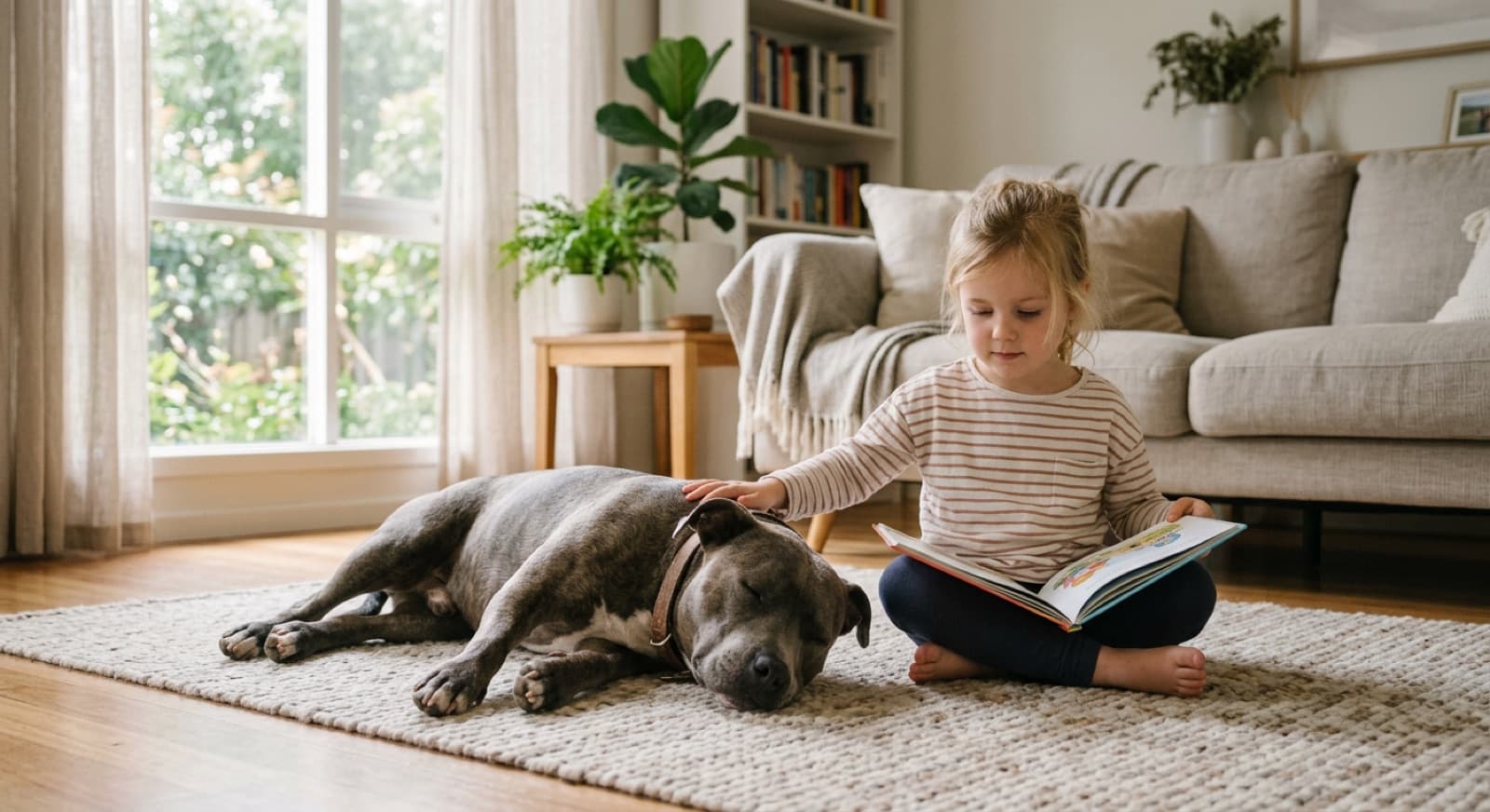
If you have been researching pit-bull-type dogs, you have probably seen two camps online. One swears they are gentle nanny dogs. The other treats them as inherently dangerous. Both are wrong, and both make it harder to make a good decision for your family. The reality lives in the middle and depends entirely on the dog. A foster-based rescue can tell you how a specific dog behaves with kids, cats, and other dogs in a real home, which is worth far more than either camp's slogan.
This page is written for a Vancouver family weighing a pit-type adoption with children, a resident cat, or another dog in the house. We cover what to expect by kid age, the difference between dog-tolerance and human-friendliness, the slow cat introduction, and the multi-dog pairings that need extra care. If you decide a pit-type is right for your home, the Vancouver pit bull adoption guide covers where to find one and what it really costs.
Temperament Beats the Breed Label
The single most useful thing to internalise: the label tells you very little about the dog in front of you. “Pit bull” is not even one breed. It is a loose category that includes American Staffordshire Terriers, Staffordshire Bull Terriers, and a wide mix of unidentified shelter dogs. The variation inside that category is huge. Here is what actually matters:
- Individual temperament. Some pit-types are couch potatoes, some are high-drive athletes. Some adore cats, some cannot live with one. The dog's actual behaviour, observed in a foster home, is the data you want.
- Socialisation history. A dog raised around kids, cats, and other dogs tends to handle them better. A dog with an unknown past needs a careful, observed assessment.
- Age and life stage. Adolescence (roughly 8 to 18 months) can shift behaviour, especially dog-tolerance. A settled adult is more predictable than a puppy.
- The match to your home. A great dog in the wrong home struggles. The goal is fit between this dog and your family, not a verdict on the breed.
Treat the breed label as a starting point for questions, not an answer. Then let the foster report and a slow trial tell you who the dog actually is.
Pit-Type Dogs with Kids: Compatibility by Age
| Kid age | Compatibility | Supervision level |
|---|---|---|
| 0 to 2 years (babies) | Depends fully on the individual dog and its arousal level. | Constant. Never unsupervised, ever. Use baby gates as the default. |
| 3 to 4 years (toddlers) | Mixed. Knockdown risk from normal play. Crowding triggers some dogs. | Constant. Direct adult line of sight whenever both share a room. |
| 5 to 8 years (kids) | Often an easy pairing. The child can learn dog-respect rules. | Active supervision. Teach the child to read dog body language. |
| 9 to 12 years (older kids) | Excellent for most settled pit-types. A strong bond often forms. | Passive supervision. Adult home; child can help with walks and training. |
| 13+ years (teens) | Excellent. Loyal, affectionate companion for a calm teen. | Light. A teen can manage daily care once the dog is settled. |
The single most important rule: never leave a pit-type, or any dog over 15 kg, unsupervised with a child under 5. This is not a breed rule. It is a body-mass rule. Toddler knockdowns happen with friendly dogs of every breed.
The Real Supervision Protocol
These are the same rules any large dog needs around kids. Pit-types do not need special handling. They need the supervision every big dog deserves.
1. Never alone, never
No child under 5 alone with the dog at any time, including the five minutes it takes to move laundry. Use baby gates for physical separation when you cannot directly supervise.
2. Teach dog-respect early
Kids learn the rules: do not climb on the dog, do not bother it while it sleeps or eats, no face-to-face contact, no grabbing tails or ears. The same rules apply with any breed.
3. Give the dog a retreat
A crate or quiet room where the dog can escape the chaos. Kids learn the retreat is off-limits. Many pit-types love a crate once it is introduced positively.
4. Watch arousal during play
Many pit-types play hard. Running kids plus an aroused dog means knockdown risk and accidental injury, even from friendly contact. Break up high-arousal play before it tips over.
5. Learn dog body language
Adults learn the early signals: lip lick, head turn, freeze, growl. Most dog-child incidents follow ignored warnings. A dog rarely “snaps with no warning.” The warnings came first.
6. The school-age sweet spot
Kids 5 to 12 are often the easiest pairing. Old enough to follow the rules, young enough to want a daily companion. Many rescues prefer placing pit-types with this age range.
Toddler Reality Check
Most pit-type family placements that struggle involve toddlers, and usually not bites. The common pattern is knockdowns, accidental scratches during play, and tail-whip bumps. The dog is not aggressive. The dog is large and active around a small, unsteady human.
An honest checklist for toddler homes:
- Run a foster trial first. Foster-based Vancouver rescues support foster-to-adopt for exactly this reason.
- Use baby gates as the default. The dog has access to common space when adults are watching; toddler-only zones stay gated.
- Choose a settled adult, not a puppy. A calm 4 to 7 year old pit-type is an easier toddler match than a bouncy adolescent.
- Trust foster reports over shelter notes. Ask how the dog did in a foster home with kids. Real-living data beats a short shelter observation.
- Be honest about your bandwidth. Constant supervision is real work. If your family is in survival mode with a newborn, this may not be the year to add a 25 kg dog.
Pit-Type Dogs with Cats: The Honest Picture
Some pit-types live happily with cats. Others cannot share a home with a cat at any age. Prey drive varies because the underlying type carries terrier heritage, and terrier prey drive is real. Three honest categories:
1. Low prey drive
Calm around cats from day one, soft body language, no fixation. These dogs integrate well over 4 to 8 weeks using the standard protocol below.
2. Moderate prey drive
Interested in cats, may chase if the cat runs, can settle with training and management. Plan for 2 to 4 months of careful work and permanent baby-gate management.
3. High prey drive
Fixates, stalks, hard-stares. Cannot safely live with a cat. Training does not fix this. Cat-test failures fall here, and a responsible rescue will not place this dog with cats.
The only reliable way to know which category your dog fits is foster-home observation over weeks of daily living. Trust the foster report more than a short shelter cat-test.
What “Cat-Tested at Shelter” Really Means
Cat-testing is a useful screening tool, but it is a few-minute snapshot, not a forecast. Be clear-eyed about what it does and does not tell you:
- What it measures. The dog's first response to a calm, unfamiliar cat in a controlled setting, usually behind a barrier.
- What it does not measure. How the dog will behave with your specific cat, in your home, over weeks. Dogs learn and habituate; some get safer, some get worse.
- What “passed” means. The dog did not lunge, fixate, or escalate in a short window. It does not mean “safe with cats.”
- What you still have to do. Run the full multi-week introduction. A cat-test result does not let you skip steps.
- Foster reports beat shelter tests. A foster report of several weeks of calm cohabitation is far more reliable than any single test.
A foster-based rescue will tell you the test result and what it actually means. Ask the question directly, and ask whether the dog has lived with a cat before.
Multi-Week Cat Introduction Protocol
Pit-types often need a longer protocol than calmer breeds. Plan for 2 to 4 months, not weeks. Slow is fast: the dogs who get rushed are the ones who fail and have to be returned. Watch your individual dog and cat closely, and slow down if either stays stressed.
1. Full separation and scent swap
Different rooms, closed doors. Feed on opposite sides of the same door so each animal links the other's scent to food. Rotate bedding and toys so each carries the other's scent.
2. Visual contact through gates
Baby gate or screen door. Both can see but cannot touch. The cat needs reliable escape routes (cat tree, high shelves). Reward the dog for calm, no-fixation behaviour.
3. Leashed parallel time
Dog on leash, cat free to approach or leave. Start with 5 minute sessions and end on calm. Build duration only if both stay relaxed. If the dog fixates or hard-stares, back up a step.
4. Longer leashed and dragline
Build toward 30 minute sessions. Drop the leash but keep a dragline attached so you can take control instantly. The cat should always have escape routes available.
5. Supervised off-leash
Both free in shared rooms with a handler directly present. Watch for pattern shifts. Some dogs settle over time; some grow more reactive as they learn the cat's movement. Adjust accordingly.
6. Gradual freedom, never fully unsupervised
Many pit-type and cat households reach calm cohabitation by month 3 or 4. Most still use baby-gate separation when the family is out of the house. That is permanent management, not failure.
Most rescues that place pit-types in cat homes use foster-to-adopt and recommend permanent management (baby gates, separate feeding rooms) rather than full unsupervised access. This is not a failure. It is responsible long-term multi-pet life.
Browse adoptable pit-type dogs in Vancouver
Foster reports often list kid-tested, cat-tested, and small-dog compatibility notes. Many Lower Mainland pit-types have lived in foster homes with kids or cats for weeks before listing, which beats a short shelter test.
See Available Pit Bulls →Dog-Tolerance Is Not the Same as Human-Friendliness
This is the distinction most online debates miss, and it matters a great deal for a multi-dog home. Two separate traits are at play:
1. Human-friendliness
Most pit-types are genuinely people-loving, affectionate, and eager to greet strangers. This is a defining trait of the type and a big part of why they make warm family companions.
2. Dog-tolerance
A separate trait. Some pit-types love every dog they meet; others become selective or reactive toward other dogs, especially from adolescence onward. This says nothing about how they treat people.
3. Adolescence can shift dog-tolerance
Reduced dog-tolerance can emerge between roughly 8 and 18 months, even in friendly puppies. A dog that was social at 9 months may grow more selective at 14 months. Plan for the possibility.
4. Manage rather than force
A dog-selective pit-type can be a wonderful only-dog or a careful multi-dog member with structure. Forcing a reluctant dog into busy off-leash parks tends to backfire. Manage to the dog you have.
If you see genuine aggression developing rather than normal selectivity, work with a qualified behaviourist early. The International Association of Animal Behaviour Consultants maintains a directory of certified consultants who use humane, evidence-based methods.
Pit-Types with Small Dogs: A Higher-Risk Pairing
This is the multi-pet pairing where the most rescues draw a careful line. Some pit-bull-focused rescues will not place into homes with very small resident dogs at all. The reasoning is honest:
- Dog-tolerance can shift. Reduced dog-tolerance that emerges in adolescence turns a normal scuffle into a serious problem when the other dog is tiny.
- Size disparity. A 25 kg pit-type and a 4 kg small dog. Even friendly play turns dangerous fast. A correction that would not hurt another large dog can badly injure a small one.
- Prey-drive crossover. Small dogs that run, yelp, or move erratically can trigger a predatory response in a dog that is perfectly safe with calm adult dogs of similar size.
- Adolescence surprises. Some small-dog pairings work fine for the first year, then change as the pit-type matures. Rescues have seen this pattern many times.
If you already have a small dog, ask the rescue about their policy before applying. An honest rescue will tell you no on the phone rather than after you have fallen for a profile. The Vancouver housing and insurance guide also covers strata and rental considerations for bully-type dogs.
Bringing a Baby Home to a Resident Pit-Type
Most resident dogs of any breed adjust to a new baby with planning. A calm four-step protocol that works well for pit-types:
- Step 1. Scent introduction. Bring a blanket the baby has used home before the baby arrives. Let the dog smell it for several days, paired with calm praise and treats.
- Step 2. Build a positive association. When the baby comes home, the dog gets good things while the baby is present: treats, calm attention, a special chew. The dog learns baby means good.
- Step 3. Use baby-gated zones. The nursery and the main play area are gated. The dog has access when adults supervise; the rest of the time, gates separate them.
- Step 4. Never unsupervised, period. The same rule as any large dog. A friendly pit-type can knock over a crawling baby with normal tail wagging. This is a body-mass risk, not a breed risk.
If your dog shows tension, fixation, or avoidance when the baby arrives, contact a qualified behaviourist right away rather than waiting to see if it passes.
How a Foster Assessment Helps
The biggest advantage of adopting through a foster-based rescue is that the dog has already shown you who it is. Instead of guessing from a kennel, you get weeks of real-home data. Vancouver pit-type adopters lean heavily on this for good reason.
What a foster can tell you
- • How the dog behaves around kids in a real home
- • Whether it has lived calmly with a resident cat
- • How it handles other dogs on walks and at home
- • Its true energy level and arousal patterns
- • House-training, crate comfort, and alone-time behaviour
Questions to ask the rescue
- • Has this dog lived with cats or kids before?
- • How does it greet unfamiliar dogs?
- • What is your policy on homes with small dogs?
- • Do you offer a foster-to-adopt trial?
- • What support do you provide after adoption?
A rescue that knows its dogs well will answer all of these without hesitation. Foster-based groups such as HugABull and the BC SPCA place pit-type dogs across Metro Vancouver and can speak to a specific dog's history with kids, cats, and other dogs.
Multi-Pet Condo and Family Life in Vancouver
Vancouver families often manage a dog, a child, and a cat in a townhouse or condo, which makes space and routine matter more than in a sprawling yard. A few local realities worth planning around:
Space and management. In a smaller home, baby gates and a clear retreat spot for the dog do more work than they would in a big house. Plan the floor plan so the dog and cat each have separation options and the dog has a quiet corner away from kid traffic.
Exercise as a pressure valve. A well-exercised dog supervises better and reacts less. The seawall, Pacific Spirit Regional Park, and quieter neighbourhood routes give a Vancouver family steady daily outlets. A pit-type that gets its exercise is an easier housemate for kids and cats alike.
Off-leash with care. Busy off-leash parks like Spanish Banks can overwhelm a dog-selective pit-type. Calmer, structured walks suit many bully-type dogs better than a chaotic park scrum, especially while you are still learning the dog.
Strata rules. Many Metro Vancouver buildings have weight caps or breed restrictions. Confirm your building allows your dog before you adopt, not after. The housing and insurance guide covers this in detail.
Frequently Asked Questions
Are pit-types good with kids?
It depends on the individual dog, not the breed. School-age kids (5 to 12) are often the easiest pairing. Toddlers under 5 need constant supervision because any large dog poses a knockdown risk. A foster report on how the dog behaves around children is the most useful information you can get.
Are pit-types good with cats?
Some are, some are not. Pit-types have variable prey drive due to terrier heritage. Foster-home observation over weeks is the only reliable way to know. Plan for a 2 to 4 month introduction, and trust a foster report over a short shelter cat-test.
Is a dog-aggressive pit-type dangerous to people?
Not necessarily. Dog-tolerance and human-friendliness are separate traits. A pit-type can be deeply affectionate with people and still be selective with other dogs. If real aggression develops, work with a qualified behaviourist rather than guessing at it.
Can pit-types live with small dogs?
Some can, many cannot. Size disparity, shifting dog-tolerance in adolescence, and prey-drive crossover make this a higher-risk pairing. Several Vancouver rescues will not place a pit-type into homes with very small dogs. Ask the rescue about their policy first.
What does cat-tested actually mean?
A few-minute snapshot, not a forecast. The dog passed an initial test, but real cat-tolerance only emerges over weeks of daily home life. Always run the full introduction protocol, even with a cat-tested dog.
Bringing a baby home to a resident pit-type?
Scent introduction with the baby's blanket, a positive association (baby means good things), baby-gated zones, and never unsupervised. The same protocol applies to any large dog meeting a new baby.
Which Vancouver rescues place family-friendly pit-types?
HugABull, the BC SPCA, and foster-based groups such as Loved at Last and Heart and Soul place pit-bull-type dogs across the Lower Mainland. Foster-to-adopt is the most honest way to test family fit. Many will not place into homes with very small dogs.
More Pit Bull guides
Pit Bulls in Vancouver →
Browse adoptable pit-bull-type dogs from Lower Mainland rescues, with filters for size, energy, and compatibility.
Pit Bull Adoption Vancouver →
Where to find rescue pit-types in Metro Vancouver, real costs, the rescue landscape, and what to expect.
Pit Bull Health Issues Vancouver →
Breed-specific medical conditions, skin and joint care, and pet insurance ROI for a pit-type in the Lower Mainland.
Pit Bull Housing & Insurance →
Finding pet-friendly rentals and strata buildings, plus home insurance carriers that cover pit-types in Vancouver.
New dog? Start with these care guides
Everything a new adopter needs to set up a safe, happy home.