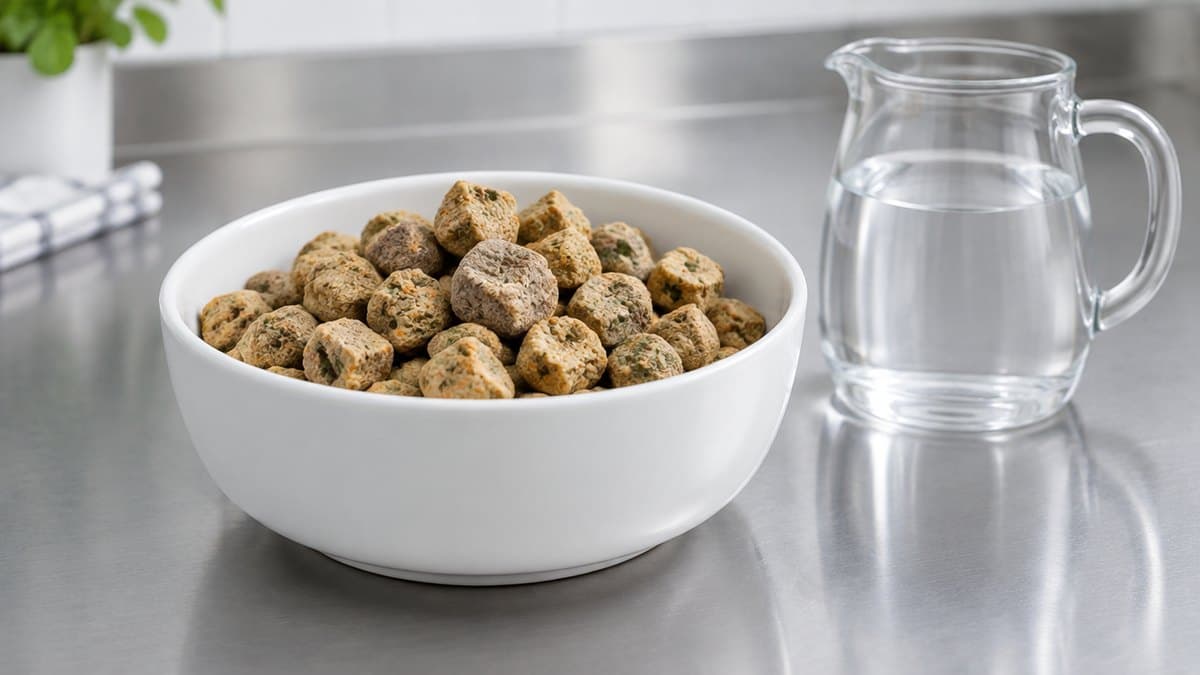
The short answer
The major veterinary bodies advise against raw, and the reason is bacterial risk to your household rather than to your dog. If you are feeding it regardless, buy a commercial complete raw rather than making it yourself — home-prepared raw is frequently unbalanced in ways that take months to show. Stella & Chewy's freeze-dried patties are the practical Canadian option, and Open Farm if you want traceable sourcing. Do not feed raw at all if anyone in the house is pregnant, very young, elderly or immunocompromised.
What the evidence actually says
The risk that drives the veterinary position is not mainly to the dog. It is to the people handling the food, the bowl and the packaging — and a raw-fed dog can shed bacteria in their stool while appearing entirely healthy.
The American Veterinary Medical Association holds a policy discouraging the feeding of raw or undercooked animal-source protein to cats and dogs, on the grounds of pathogen risk to both animals and the humans around them. The US Food and Drug Administration reaches the same conclusion, having tested commercial pet foods and found raw products far more likely to carry salmonella and listeria than other categories.
It is worth being precise about what that does and does not mean. It does not mean a raw-fed dog will get sick; many never do. It means the probability of a pathogen entering your kitchen is materially higher than with cooked food, and that the people most likely to be harmed are not the ones who chose the diet. That is the honest frame, and the claimed benefits — shinier coat, cleaner teeth, better digestion — are largely testimonial rather than demonstrated in controlled work.
Our position is the same as our vets': we would not recommend raw. But a great many Canadian owners feed it anyway, and a page that simply says no is less useful to them than one that says how to do it with the fewest sharp edges.
If you are feeding raw, buy it complete
This is the single most consequential decision within raw feeding, and it is not which brand. Home-prepared raw diets are frequently unbalanced. The recurring failures are the calcium-to-phosphorus ratio and vitamins D and A, and the reason they matter is timing: a deficiency of that kind produces no visible symptom for months, and by the time a growing dog shows skeletal problems the damage is not easily undone. Recipes circulating online are rarely formulated by anyone qualified.
A commercial product labelled complete and balanced for your dog's life stage has at least been formulated against a nutrient standard. Given the voluntary nature of pet food standards in Canada, that claim is worth most from a maker who employs a qualified nutritionist — the same test that applies to any other food.
Stella & Chewy's freeze-dried patties — the practical option
Stella & Chewy's Freeze-Dried Raw Dinner Patties are the most widely available complete freeze-dried raw in Canada and the easiest starting point. Freeze-drying removes the water, so it stores in a cupboard rather than a freezer, which solves the logistics problem that defeats most people attempting frozen raw. The patties rehydrate with warm water and the range is complete and balanced rather than supplemental. A larger bag brings the cost per feed down if you are committing.
Open Farm — if sourcing matters to you
Open Farm's freeze-dried raw morsels cost more and the difference you are buying is traceability: the company publishes sourcing information down to the batch. If the reason you are drawn to raw is wanting to know what is in the bowl, that is a more coherent purchase than a brand simply telling you it is natural.
A note on how most people actually use these. Fed exclusively, freeze-dried raw runs $200 to $400 a month for a medium dog, which is why the common Canadian pattern is a topper over kibble. That is a reasonable compromise — but count the topper within the day's calories rather than adding it on top, or you will simply have a heavier dog.
Some links on this page are Amazon affiliate links — we may earn a small commission at no extra cost to you. It never changes what we recommend, and we would still rather you read the section above first.
The households where we would say don't
There are situations where the calculation is not close, because the person at risk is not the one making the decision:
- Infants and young children. They touch the floor, the bowl and the dog, and then their faces.
- Anyone pregnant. Listeria is precisely the organism pregnancy guidance warns about.
- Anyone immunocompromised — chemotherapy, transplant medication, or any condition suppressing immunity.
- Elderly household members, for the same reason.
- A brand-new rescue. You do not yet know their digestive baseline, their history, or whether they have parasites, and the settling period is the worst time to introduce a variable.
If you do feed raw, handle it exactly as you would raw chicken for yourself: separate boards and utensils, thaw in the fridge rather than on the counter, wash hands and surfaces every time, and clean the bowl after each meal rather than at the end of the day. Raw bones are a separate hazard worth avoiding entirely — they fracture teeth and cause obstructions, which is a common and expensive emergency.
If it is the benefits you want, not the raw part
Most people arrive at raw wanting something specific: fewer fillers, better digestion, a shinier coat, or simply knowing what is in the food. Each of those has a lower-risk route.
- Gently cooked or fresh delivered food gives you whole ingredients and visible quality without the pathogen question. Our guide to fresh dog food in Canada covers what actually delivers here, since several US brands do not.
- Digestive trouble is usually better solved by a highly digestible formula than by a raw one — see feeding a sensitive stomach.
- Coat and skin respond to omega-3 supplementation more reliably than to raw feeding, and at a fraction of the cost.
- Knowing what is in the bowl is really a question about the company, and our guide to the best dog food in Canada covers how to judge one properly.
Frequently Asked Questions
Is raw dog food safe?
It carries a documented risk that cooked food does not, which is why the major veterinary bodies advise against it. Raw meat can carry salmonella and listeria, and the risk runs in two directions: to the dog, and to the people handling the bowl, the packaging and anything the dog then licks. Dogs fed raw can also shed bacteria in their stool while appearing perfectly healthy. None of that means every raw-fed dog gets ill — plenty do fine — but the risk is real, documented, and the reason this guide does not simply recommend it.
Who should definitely not feed raw?
Households with infants, young children, anyone pregnant, elderly relatives, or anyone immunocompromised — someone on chemotherapy, a transplant recipient, or anyone with a condition that suppresses immunity. The risk in those households is not mainly to the dog; it is to the person who touches a contaminated surface. It is also a poor idea for a dog with a compromised immune system, and for a brand-new rescue whose digestive baseline you do not yet know.
Is commercial raw better than making it myself?
Considerably, and this is the most useful thing on this page. Home-prepared raw diets are frequently unbalanced — the recurring problems are calcium and phosphorus ratios, vitamin D and vitamin A — and the effects take months to show, by which point the damage is done. A commercial raw labelled complete and balanced for your dog’s life stage has at least been formulated against a nutrient standard. If you are going to feed raw, buy it complete rather than assembling it from recipes online.
What is freeze-dried raw, and is it safer?
Freeze-drying removes the water while leaving the food uncooked, so it stores at room temperature and is far more practical than frozen raw — it is also most of what actually ships to Canadian addresses. On safety it is better than frozen but not equivalent to cooked: freeze-drying reduces bacterial load rather than eliminating it, which is why reputable makers pair it with a kill step such as high-pressure processing. Handle it as you would raw meat regardless of the convenience.
How much does raw dog food cost in Canada?
Substantially more than kibble. Freeze-dried raw runs roughly $20 to $75 a bag on Amazon.ca, and because the bags are small a medium dog fed exclusively on it can reach $200 to $400 a month. That is why most Canadian raw feeders use it as a topper over kibble rather than a complete diet — which is a reasonable compromise on cost, though it does mean the topper needs to be accounted for in the day’s calories rather than added on top.
Does raw food clean a dog’s teeth?
It is one of the most common claims and the evidence for it is weaker than the confidence with which it is made. Chewing does provide some mechanical cleaning, but so do appropriate dental chews, and the raw diet does not remove the need for actual dental care. Raw bones bring their own problem: they fracture teeth and can cause obstructions or perforations. If dental health is your reason for considering raw, brushing plus vet-approved dental chews is the lower-risk route to the same goal.
How do I handle raw dog food safely?
Treat it exactly as you would raw chicken for yourself, because epidemiologically it is the same thing. Separate cutting boards and utensils, thaw in the fridge rather than on the counter, wash hands and every surface afterwards, clean the bowl after each meal rather than at the end of the day, and do not let the dog lick faces for a while after eating. Store it away from human food in the freezer. If that routine sounds like more than you will sustain every day, that is a genuine argument against raw for your household.
Best Dog Food in Canada
Which food to buy, and how to judge the company behind it.
Best Fresh Dog Food in Canada
What actually delivers here, and whether fresh beats a good kibble.
Dog Food Brands to Avoid
Five checks that work, and the Canadian labelling gap behind them.
Dogs for Adoption in Canada
Rescue dogs from shelters and foster networks across the country.