The short answer
Puppy blues are real, common, and usually longer-lasting than you have been told. In a study of 1,801 dog owners, 45.1% reported significant negative feelings during their dog's puppyhood. Among those affected, only 20.3% were through it in under a month. Another 31.0% took one to five months, and nearly half were still in it at six months or beyond. It shows up as anxiety, frustration and weariness, it is strongly tied to sleep loss, and it does lift: the same owners scored significantly lower once the puppy stage had passed. Protect your sleep, drop the standard you are holding yourself to, get help early for behaviour or safety problems, and do not make a permanent decision from inside the worst week.
You are not imagining this, and you are not weak
Until recently there was almost nothing in the scientific literature about this, even though owners have used the phrase for years. That gap is why it feels like a personal failing rather than a known stage. It now has a validated measurement scale, built specifically because the experience was real and undocumented.
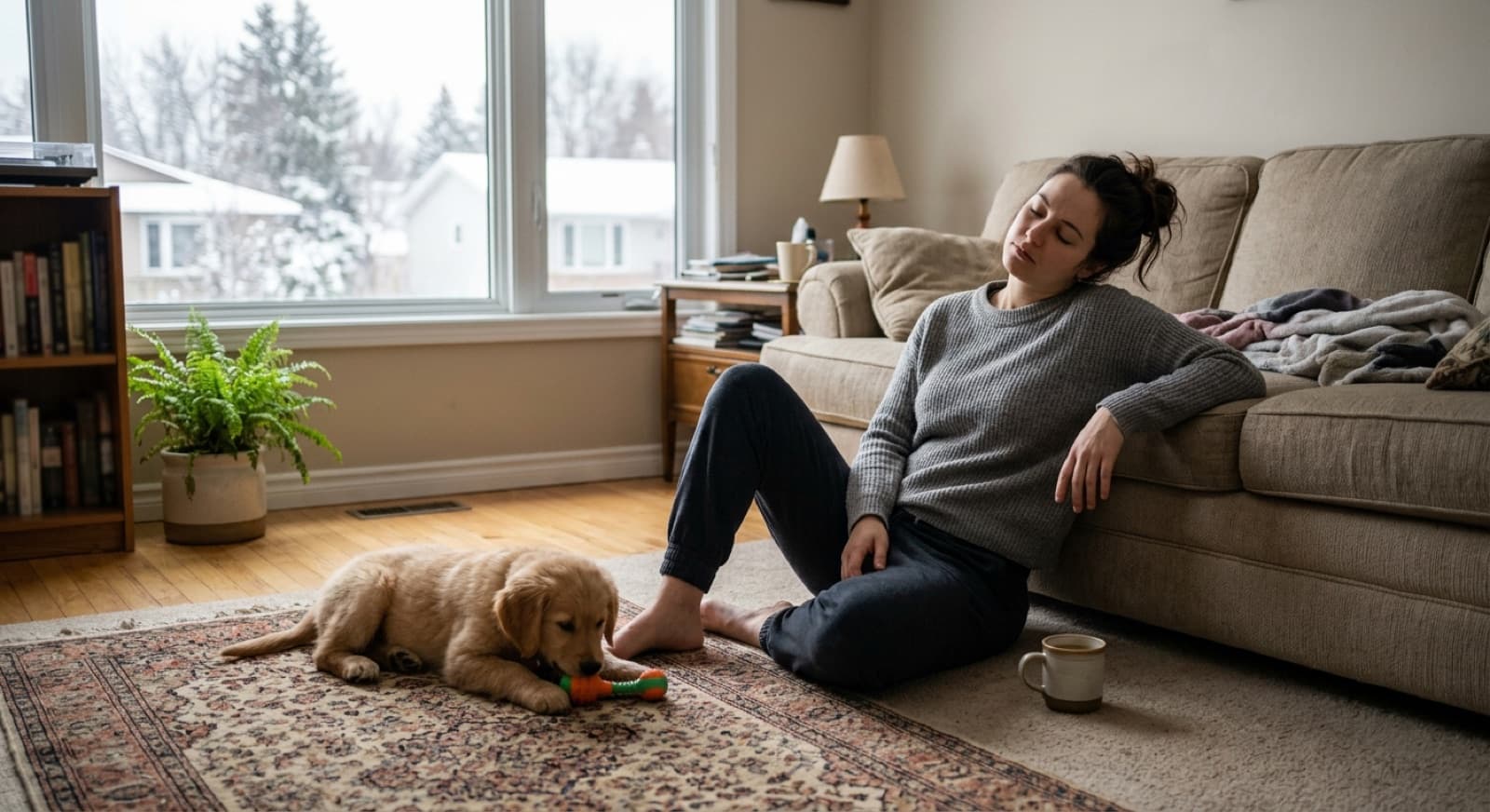
What the research actually found
In 2024 a Finnish research team published the first validated questionnaire for this experience, the puppy blues scale, in the Nature Portfolio journal npj Mental Health Research. They built it from 135 open-text accounts by owners who had struggled, then tested it on 1,801 dog owners, with a further 265 people retested later and 326 owners of one to two year old dogs who rated both the puppy period and the present day.
Their headline finding: 45.1% of respondents reported experiencing significant negative feelings during their dog's puppyhood. For scale, the same paper notes that around 38% of women are thought to experience baby blues after giving birth. You can read the full paper at npj Mental Health Research (Ståhl and colleagues, 2024, open access).
One caveat worth stating plainly, because it matters for how much weight to put on the numbers: the sample was Finnish, 92% women, and people rated the puppy period from memory rather than during it. The direction of the findings is well supported. The precise percentages should be read as a strong signal rather than a universal constant.
How long do puppy blues last?
This is the part almost every other guide gets wrong by being reassuring. Only one in five owners were through it within a month. Roughly half were still in it at six months or more.
| How long the feelings lasted | Share of affected owners |
|---|---|
| Less than a month | 20.3% |
| One to five months | 31.0% |
| Six months to a year | 29.5% |
| More than a year | 19.3% |
If you are four months in and everyone has told you it passes in a few weeks, that gap is its own source of distress. You conclude that something is wrong with you specifically. The data says otherwise: at four months you are squarely inside the normal range, and about half of affected owners are still there at six.
The better news sits alongside it. When the researchers had the same people rate the puppy period and then the present, present-day scores were significantly lower across all three components. They also found a fading affect bias, meaning the further people got from puppyhood, the more positively they remembered it. It ends. It just does not always end on the schedule you were promised.
The three things it is actually made of
The scale separates puppy blues into three components, which often arrive together but can dominate one at a time:
- Anxiety. The largest component, accounting for 39% of the variance. Worry about the puppy, about doing it wrong, about whether this was a mistake.
- Frustration. 34%. Irritation and resentment at the destruction, the interruptions, and the loss of your own time.
- Weariness. 28%. Flat exhaustion, the sense of being depleted and unable to catch up.
Anxiety being the biggest piece is worth sitting with, because it suggests the most useful intervention is not more effort. It is reassurance and information. A lot of new owners are running an exhausting background process of am I ruining this dog, and that process costs more than the actual chores do.
What owners actually reported struggling with
From the open-text accounts of owners who had struggled, the most common themes were:
- Exhaustion, fatigue or sleep problems (45%)
- Feelings of inadequacy as a dog owner (39%)
- Anxiety about the puppy taking up time and attention (36%)
- Worry about raising the puppy correctly (30%)
- Regret about getting a puppy (24%)
Sleep sits at the top, and it is the one that quietly drives the rest. Sleep loss lowers your tolerance, sharpens irritability, and makes ordinary problems feel unsolvable. If you can fix only one thing this week, fix your sleep, even if that means the puppy sleeps somewhere you had not planned or someone else takes a night.
Notice too that feeling inadequate is the second most common symptom. That is worth naming, because it means the sense of being a bad owner is a feature of the condition rather than an accurate assessment of your performance.
Rescue dogs and adult dogs count too
The study measured puppy owners, so the percentages above describe puppyhood. But adopters of adult rescue dogs describe the same shape, and often with an extra layer: you are also learning a history you do not fully have. The dog in your house for the first fortnight is a decompressing dog, not the dog you will end up with.
That is what the 3-3-3 rule describes: roughly three days to decompress, three weeks to learn your routine, three months to feel at home. It is a rough guide rather than a law, but it does the same job the research does. It tells you that judging the situation in week one is judging it at the lowest possible point.
What actually helps
- Protect your sleep first. It is the top reported theme and it makes everything else harder. Treat it as the priority intervention, not a luxury.
- Lower the standard. Most of the anxiety is about doing it perfectly. A fed, safe, reasonably exercised dog is a well-cared-for dog this month.
- Shrink the problem. Use a pen or a crate so the dog is not loose and requiring constant supervision, and you get genuine off-duty time.
- Get real time away. A walker, daycare, or a friend for an afternoon. Being able to leave is what stops the trapped feeling compounding.
- Set a no-decisions line. Pick a date and refuse to make a permanent choice before it. The worst week should not get to decide.
- Tell someone honestly. Your vet, your rescue, or another owner who has been through it. The isolation is a large part of the weight.
When to get help instead of waiting
Ordinary overwhelm and doubt are the normal course and they respond to time and the steps above. Some things do not, and waiting on those makes them harder:
- Aggression, escalating fear, or a safety risk to anyone in the house. A qualified behaviour professional is the right next step. The International Association of Animal Behavior Consultants lists consultants by region.
- Physical symptoms in the dog. Pain and illness drive a lot of behaviour that reads as defiance. Rule it out with your vet first; the American Veterinary Medical Association keeps general owner resources.
- Your own distress, if it is severe, persistent, or affecting how you function. That deserves proper support in its own right, separate from the dog. Speak to your own doctor rather than treating it as a dog problem.
If you genuinely cannot keep the dog
Give it a fair window first if you can do so safely, because the research is clear that most of this resolves. But if the placement truly is not workable, the responsible path is straightforward and carries no shame: contact the rescue or shelter you adopted from. Reputable rescues write a return clause into the adoption contract for exactly this situation.
They would far rather take the dog back into their own network, with everything they know about it, than have it passed along through a classified ad to a stranger. Tell them early and tell them honestly; the sooner they know, the better the landing they can arrange. What is not responsible is quietly rehoming online or letting the situation deteriorate until someone gets hurt.
The researchers themselves raise this. They note that puppy blues, left unaddressed, may contribute to animals being given up. Asking for help early is the thing that prevents that outcome, not the thing that admits it.
Frequently Asked Questions
What are the puppy blues?
The puppy blues are a wave of anxiety, frustration and exhaustion in the weeks or months after bringing a new dog home. Researchers who built the first validated scale for it found three distinct components: anxiety, frustration and weariness, which usually occur together but can show up one at a time. It is a real, measurable state rather than a figure of speech, and it is not a verdict on you or on the dog you chose.
How long do puppy blues last?
Longer than most people are told. In a study of 1,801 dog owners, among those who reported significant negative feelings, 20.3% said it lasted less than a month, 31.0% said one to five months, 29.5% said six months to a year, and 19.3% said more than a year. So roughly half of affected owners were still in it at six months. If you are at month four and wondering why it has not lifted, you are not failing at this. You are in the ordinary range.
Is it normal to regret getting a puppy?
Yes, and it is more common than almost anyone admits. In the same research, 45.1% of owners reported significant negative feelings during their dog's puppyhood, and regret specifically came up in about a quarter of the open-text responses from owners who had struggled. Feeling it does not mean you picked the wrong dog. It usually means you are in the part of the transition where you carry all of the work and none of the bond yet.
Do puppy blues actually get better?
The research says yes. When the same owners rated the puppy period and then rated the present day, their scores were significantly lower across all three components for the present day. The researchers also found what they call a fading affect bias: the further from puppyhood people got, the more positively they remembered it. Both point the same way. The state is real and it is temporary, even when the timeline is longer than you expected.
Am I a bad owner for feeling this way?
No. The most common theme reported by owners who struggled was exhaustion, fatigue or sleep problems, followed closely by feelings of inadequacy as a dog owner. In other words, feeling like a bad owner is itself one of the standard symptoms rather than evidence of anything. Sleep deprivation makes everything else feel worse and harder to solve, which is why protecting your own sleep is a practical intervention and not a selfish one.
Do rescue dogs and adult dogs get the same thing?
The research was done on puppy owners, so the measured figures apply to puppyhood. But adopters of adult rescue dogs describe the same shape: overwhelm, doubt, and the feeling of having broken a settled life, usually while the dog is still decompressing and has not bonded yet. If anything the adult-dog version carries an extra layer, because you are also learning a history you do not fully know. The 3-3-3 rule is the more useful frame there.
Should I get a second dog to help?
Almost never for that reason. Adding a second dog multiplies what is already in the house rather than fixing it, and doing it while you are exhausted and unbonded is the worst possible timing. If the pull is that your dog seems bored or lonely, test that with a midday walker or daycare first, which is cheaper, faster and reversible. Sort the puppy blues out before you consider a second dog, not with one.
When should I get help rather than waiting it out?
Wait out ordinary overwhelm and doubt. Get help sooner if there is aggression, escalating fear, or a safety risk to anyone in the house, in which case a qualified behaviour consultant is the right call rather than more time. Speak to your vet if the dog has physical symptoms, since pain and illness drive a lot of behaviour that looks like defiance. And if your own distress is severe, persistent, or affecting how you function day to day, that deserves support in its own right, separate from the dog.
What if I genuinely cannot keep the dog?
Give it a fair window first if you safely can, because the data says most of this resolves. But if the placement truly is not workable, contact the rescue or shelter you adopted from. Reputable rescues put a return clause in the adoption contract for exactly this situation, and they would far rather take the dog back into their own network than have it passed on unsafely. Doing it through the rescue, early and honestly, is a responsible act rather than a failure.
Bottom line on puppy blues?
They are real, measurable, and far more common than the cheerful version of puppy ownership suggests. Nearly half of owners report significant negative feelings during puppyhood, and only about one in five are through it within a month. It does lift, and people remember the period more warmly the further they get from it. Protect your sleep, lower the standard you are holding yourself to, get help early for behaviour or safety problems, and do not make a permanent decision from inside the worst week.
The 3-3-3 Rule
Three days, three weeks, three months. Why week one is the worst possible time to judge.
First Week With a Rescue Dog
The decompression setup that lowers overwhelm for both of you.
Should I Get a Second Dog?
If you are considering a second dog to fix the first, read this before you apply.
Adoptable Rescue Dogs
Foster-described dogs from rescues across Canada.
New dog? Start with these care guides
Everything a new adopter needs to set up a safe, happy home.