The short answer
Traditional Applehead Siamese (also called Thai in TICA) and Modern Wedge Siamese share the Siamese name but have substantially different body types. Traditional has a rounder apple-shaped head, stockier muscular body, weight 8 to 14 lbs, lifespan often 15 to 20 years. Modern has an extreme wedge-shaped face, slender body, large flared ears, weight 5 to 10 lbs, lifespan often 12 to 16 years. Both share the colour-point pattern and the famous blue eyes. The Modern Wedge body type concentrates show-bred conformation extremes that correlate with somewhat higher rates of dental crowding, respiratory issues, and possibly amyloidosis. For a pet home, Traditional Applehead is generally the better choice. And most rescue cats tagged “Siamese mix” are actually colourpoint Domestic Shorthairs without documented Siamese ancestry: beautiful cats, just not breed-pure.
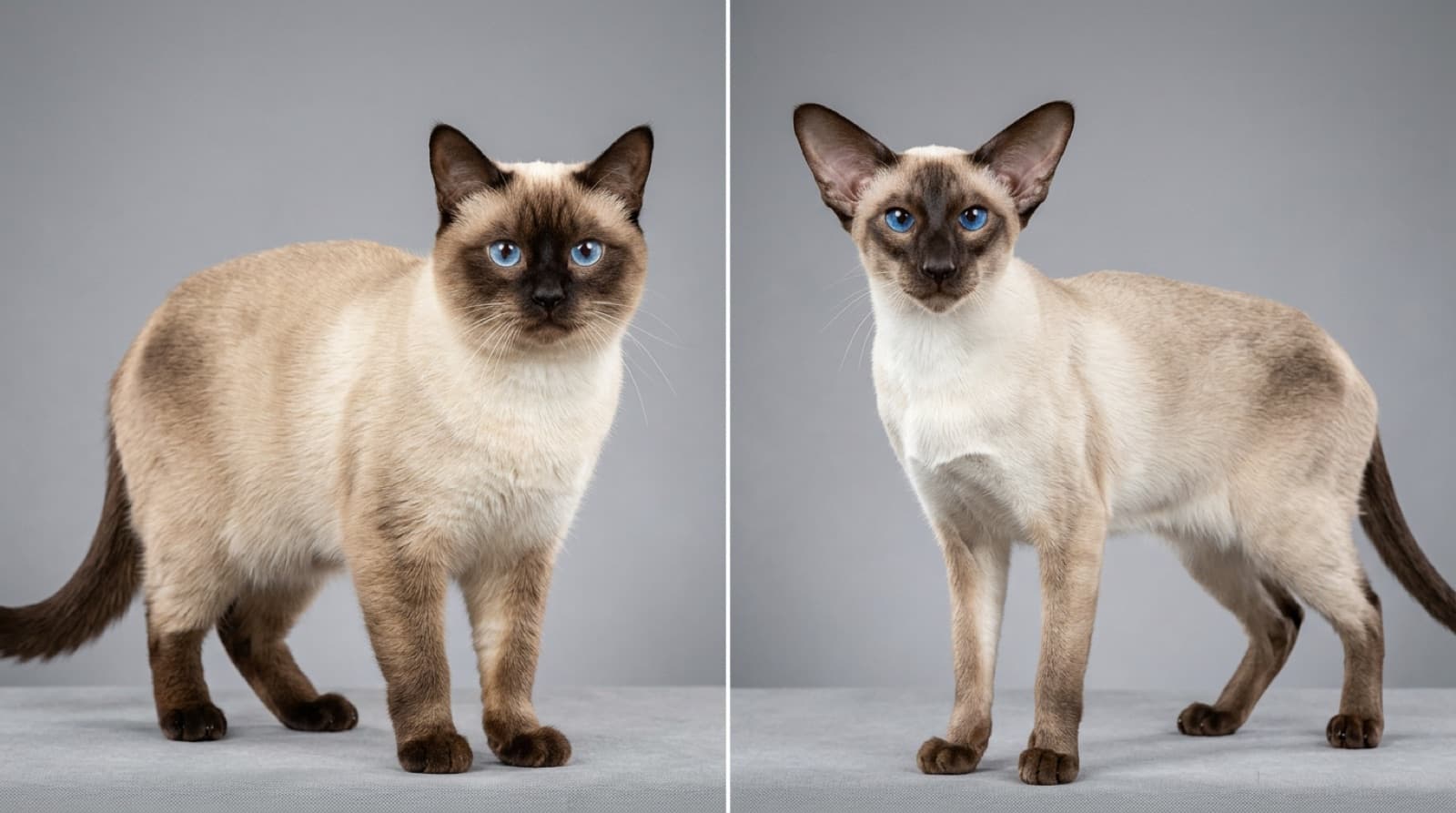
Comparison at a glance
| Trait | Traditional (Applehead / Thai) | Modern (Wedge / Show) |
|---|---|---|
| Head shape | Round, apple-shaped, moderate proportions | Extreme wedge, very flat face profile |
| Ears | Proportionate, set on top of head | Very large, flared outward, set wide on the wedge |
| Body type | Stocky, muscular, moderate proportions | Slender, long-legged, tubular |
| Adult weight | 8 to 14 lbs | 5 to 10 lbs |
| Lifespan | 15 to 20 years | 12 to 16 years |
| Dental crowding | Moderate | More common |
| Respiratory issues | Less common | Modestly more common |
| CFA registration | Siamese | Siamese |
| TICA registration | Thai (separate breed) | Siamese |
| Typical breeder cost | $600 to $1,200 | $1,500 to $2,500 |
| Rescue availability | More common | Rare |
How the two conformations developed
The Siamese is one of the oldest recognised cat breeds, with documented presence in Siam (modern Thailand) by the 14th century. The original conformation, what we now call Traditional or Applehead, had a rounder apple-shaped head, stockier body, and overall robust proportions. This was the Siamese that entered Britain in the 1880s and the United States shortly after, and was recognised at the founding of the Cat Fanciers' Association in 1906.
Through the mid-20th century, show breeders gradually selected for a more slender body and wedge-shaped face. The shift was incremental, driven by show-ring trends rather than a single mutation. By the 1980s the Modern Wedge conformation had become the dominant CFA show standard, with the very extreme wedge face and large flared ears that define the type today.
Traditional breeders preserved the older conformation, recognising the health and longevity advantages. TICA recognised the Traditional conformation as a separate breed called Thai in 2007, while CFA continues to register both conformations as Siamese under the same breed name.
Both conformations share the breed-defining traits: blue eyes, colour-point pattern (cream body with darker face, ears, paws, tail), distinctive vocal personality, dog-like loyalty, intelligence. The differences are in body type and the health consequences that flow from extreme conformation.
The health gap in plain language
Modern Wedge Siamese concentrate the show-bred extremes that correlate with somewhat higher rates of several breed-elevated health concerns. Traditional Applehead Siamese retain the older more robust conformation with somewhat better baseline health and longer average lifespan. The gap is meaningful but not dramatic.
Four health categories show meaningful differences between the body types:
1. Dental crowding. The Modern Wedge elongated jaw concentrates teeth in a narrower space, leading to crowding, rotation, and gum-line pockets that trap food. Periodontal disease develops earlier. Traditional Applehead Siamese have somewhat more space for the dental arcade and less severe crowding.
2. Respiratory issues. Feline asthma rates are modestly higher in Modern Wedge than Traditional. The mechanism is not fully understood; the extreme conformation may correlate with airway sensitivity.
3. Amyloidosis. The Siamese-specific protein deposition disease (affecting liver and kidneys most commonly) is documented as a breed-elevated concern by the Cornell Feline Health Center. Some research suggests Modern Wedge lines may carry somewhat higher risk than Traditional, but the data is limited and individual lines vary widely. The dedicated Siamese health issues guide covers amyloidosis in depth.
4. Lifespan. The combined effect of the above shows up in average lifespan. Traditional Applehead Siamese commonly live 15 to 20 years; Modern Wedge often 12 to 16 years. With proactive care, individuals in both groups can reach the upper end of the range. Plan the pet insurance and annual care budgets for the long lifespan regardless of body type.
Dry winter indoor air (often 15 to 25 percent humidity through furnace season in cold-climate Canadian homes) can aggravate asthma in susceptible Siamese of either body type. A humidifier in the cat's primary room helps known asthmatic cats.
The registry split: CFA vs TICA, FIFe, LOOF
The same cat can have different paperwork depending on which registry the breeder uses. This trips up adopters expecting a “Traditional Siamese” registration certificate.
The Cat Fanciers’ Association (CFA), the dominant North American registry, treats both Traditional and Modern as one breed: Siamese. The CFA show standard favours the Modern type, but a Traditional-bodied cat from registered Siamese parents is still registered as Siamese.
The International Cat Association (TICA) took a different path. After a multi-year application process that began in 2007, TICA granted the Traditional/Applehead body type Championship recognition as a separate breed called Thai. TICA registers Modern as Siamese and Traditional as Thai. The cats themselves are the same lineage; the names reflect the decision that the two body types are distinct enough to warrant separate breed status. European federations FIFe and LOOF have moved in similar directions on different timelines.
Why this matters for adopters: paperwork from a TICA-registered Traditional Siamese kitten will read “Thai,” not “Traditional Siamese.” The cat is the same; the registry just calls it something different. When verifying paperwork, do not be alarmed if the breed reads Thai. Cross-reference the cattery on the registry’s online directory (cfa.org or tica.org). If the cattery exists and the registration number is valid, the paperwork is real regardless of which name appears on it.
What a “Siamese mix” rescue listing actually is
The most adoption-relevant point in this article. Rescue cats labelled “Siamese mix” are almost always colourpoint Domestic Shorthairs without documented Siamese ancestry. They are wonderful cats; they just are not Siamese in the breed-registry sense.
The colour-point gene escaped into the general feline population centuries ago, probably through cats with partial Siamese ancestry several generations back. It now reappears periodically in mixed-ancestry cats. A colourpoint DSH has the colour-point pattern, often blue eyes, and sometimes a slightly slimmer build than a typical Domestic Shorthair. To a casual observer (including most shelter intake staff), it looks like a Siamese. To a breed-aware adopter, it is a colourpoint DSH with no recent Siamese ancestor.
This is fine. These cats are beautiful, healthy, friendly, and absolutely worth adopting. The point is just to set expectations honestly. Here is the quick guide to reading a “Siamese mix” listing:
- Colour-point pattern + blue eyes + average DSH body type: colourpoint DSH. Probably no recent Siamese ancestor. The most common “Siamese mix” at rescues.
- Colour-point pattern + blue eyes + verifiable parent + Modern or Traditional body type: likely real Siamese ancestry. Rare at rescues but does happen, usually through breeder surrenders or owner crises.
- Colour-point pattern + non-blue eyes: not Siamese genetically. Possibly Tonkinese (aqua eyes), possibly colourpoint DSH with non-matching eye genetics.
- Colour-point pattern + white markings on points (mask, ears, feet, or tail): NOT purebred Siamese. CFA and TICA standards both disqualify white on points. The cat may be a Snowshoe, a Snowshoe mix, or a random-bred colourpoint with white spotting.
If you specifically want a Siamese-type cat for the look (colour-point pattern, blue eyes, slender build, vocal personality), the rescue route delivers all of that regardless of breed verification. If you specifically want documented Siamese breed ancestry, you need either parent documentation from a surrender story or DNA confirmation, neither of which most rescue cats have.
Browse adoptable Siamese-type cats
Most rescue Siamese are Traditional Applehead, the healthier body type for pet homes. Rescue colourpoint cats deliver the Siamese look (blue eyes, point pattern) at a fraction of breeder cost, with full vetting included.
See Available Cats →How to choose if you go the breeder route
If you are committed to the breeder path rather than rescue, several questions clarify which body type the breeder produces and how they think about Siamese health.
- “Do you breed Traditional Applehead or Modern Wedge?” An ethical breeder answers directly. Some breeders specialise in one type; others breed both.
- “Can I see side-profile photos of the parents and recent litters?” Side profile makes the conformation obvious. The wedge head versus rounder Traditional head reads clearly.
- “What is your approach to amyloidosis screening?” There is no DNA test for amyloidosis. An ethical breeder tracks family history and discusses the breed-elevated risk openly.
- “Annual HCM echocardiogram on breeding parents?” Non-negotiable for breeding cats. Read by a veterinary cardiologist.
- “Kitten release age?” Twelve weeks minimum, 14 to 16 weeks is better.
- “Registration body?” CFA registers both types as Siamese. TICA registers Modern as Siamese and Traditional as Thai. Verify cattery numbers directly via cfa.org or tica.org rather than trusting a seller's claim.
- “Contract terms?” Spay or neuter clause, return-to-breeder clause if you cannot keep the cat, health guarantee terms.
This article does not name specific breeders. Verify any cattery directly with the registry before sending money.
The practical takeaway
For most adopters, the conclusion is simple: Traditional Applehead Siamese is generally the better pet choice. The body type is healthier, the lifespan is longer, the breed-defining temperament is delivered by both, and most rescue Siamese are Traditional. Adopters who specifically want the show-ring Modern Wedge look can pursue a CFA breeder kitten, with the understanding that the conformation comes with somewhat higher health management over the lifetime.
Either body type requires the same care: indoor-only, attention to amyloidosis risk factors from middle age, dental care, asthma management if symptoms appear, and a humidifier through a long dry winter. Both share the breed's vocal personality and social demands. The dedicated vocalisation and separation anxiety guide covers the behaviour management common to both body types.
If you are still in the adoption-decision phase, our companion guide on Siamese adoption covers the rescue landscape, real costs, and the rescue-vs-breeder math.
Sources and further reading
Sources informing this article include the Cat Fanciers' Association Siamese breed standard, the TICA Siamese and Thai breed reference materials, and the Cornell Feline Health Center on breed-elevated conditions. Health decisions belong with your veterinarian.
Frequently Asked Questions
What is the difference between Traditional and Modern Siamese?
Traditional Siamese (also called Applehead or Old-Style, sometimes called Thai in TICA) has the original pre-1950s conformation: a rounder apple-shaped head, stockier muscular body, and weight 8 to 14 lbs. Modern Siamese (also called Wedge, Show, or Extreme) has the slender body, extreme wedge-shaped face, large flared ears, and long thin legs that define the current TICA and CFA show standard, weighing 5 to 10 lbs. Both share the colour-point pattern (cream body with darker face, ears, paws, tail) and the famous blue eyes. The breeds are registered the same way (Siamese in CFA, sometimes Thai as a separate breed in TICA for the Traditional type), but the conformation differences are dramatic.
Which is healthier, Traditional or Modern Siamese?
Traditional wins by a meaningful margin. The Modern Wedge body type concentrates show-bred conformation extremes (very slender body, extreme wedge face, large ears, long thin legs), which correlates with somewhat higher rates of dental crowding, respiratory issues, and possibly amyloidosis. The Traditional Applehead retains the older more robust conformation with somewhat better baseline health. Lifespan reflects this: Traditional often 15 to 20 years, Modern often 12 to 16 years. For a pet home rather than a show home, Traditional is the better health choice.
Is the Thai cat the same as a Traditional Siamese?
Effectively yes. The Thai is the TICA breed designation for the Traditional Applehead Siamese conformation, recognised as a separate breed since 2007 to preserve the older type. The Thai breed standard describes the rounder face, stockier body, and overall closer-to-Old-Style conformation. In CFA the same cat is still registered as Siamese (or Colorpoint Shorthair for non-traditional point colours). Canadian breeders working with Traditional conformation may market under either name (Thai or Traditional Siamese) depending on their primary registry.
Why does CFA call them both Siamese but TICA calls Traditional "Thai"?
Show standards diverged. By the 1950s and 1960s, CFA show breeders selected for the extreme wedge-headed Modern look, and Traditional cats nearly disappeared from CFA show rings. Breeders who preserved the original body type petitioned TICA to recognise it as a separate breed. TICA granted Thai Championship recognition in 2010 after the application process began in 2007. FIFe and LOOF followed similar paths. CFA never split, so to this day both body types share the Siamese name in CFA. The split is bureaucratic, not biological.
Are Modern Wedge Siamese more expensive than Traditional?
Usually yes. Top-line Modern Wedge show kittens from CFA-titled lines run $1,500 to $2,500 in Canada. Traditional Applehead kittens from breeders specifically preserving the older type often cost $600 to $1,200 because there is less show-circuit demand. For rescue the price difference disappears: a rescue Siamese-type cat is typically $300 to $500 with full vetting included regardless of body type. Most rescue Siamese are Traditional Applehead because the older type was more common in the breeding pool 20 to 30 years ago and continues to be common in pet homes.
Are both Traditional and Modern registered as Siamese?
CFA registers both as Siamese (with the caveat that some point colours register as Colorpoint Shorthair). TICA registers Modern Wedge as Siamese and Traditional Applehead as Thai (a separate breed). Canadian breeders may use either registry. From the day-to-day pet ownership standpoint, the registration body matters less than the body type and the individual cat's health.
Is a "Siamese mix" at a rescue a real Siamese?
Usually not in the registry sense. Most rescue cats labelled "Siamese mix" are colourpoint Domestic Shorthairs: cats with the colour-point pattern and often blue eyes but no documented Siamese breed ancestry. The colour-point gene escaped into the broader cat population centuries ago and reappears in mixed-ancestry cats. These cats look like Siamese to a casual observer (and to most shelter intake staff) but are not breed-pure. They are wonderful, healthy, adoptable cats; the label is just shelter shorthand for "colourpoint cat that may or may not have breed ancestry." If you want the Siamese look (point pattern, blue eyes, vocal personality), the rescue route delivers all of it regardless of breed verification.
Are all Siamese supposed to have blue eyes?
Yes, mandatory. The tyrosinase mutation that produces the colour-point pattern also affects eye pigment, locking purebred Siamese into blue eyes. Both CFA and TICA breed standards require blue eyes. A colourpoint cat with green, gold, or copper eyes is not breed-pure. It may be a Tonkinese (aqua to gold eyes), a colourpoint Domestic Shorthair, or another mixed-ancestry colourpoint cat. Blue eyes are non-negotiable in the breed standard, and white anywhere on the points (mask, ears, paws, tail) disqualifies a cat too.
Does temperament differ between Traditional and Modern?
Slightly. Both body types share the breed-defining Siamese temperament: vocal, social, intelligent, devoted, dog-like in loyalty, demanding of attention. Some Traditional Applehead owners describe their cats as slightly calmer than Modern Wedge; some Modern Wedge owners describe their cats as more intensely interactive and louder. Individual variation within each body type is wider than the average difference between body types. Foster notes on the specific cat matter more than the body-type label.
What are the visual differences I can see in photos?
Three main differences. First, the head: Traditional has a rounder apple-shaped head with proportionate ears; Modern has an extreme wedge-shaped face with very large flared ears that look almost too big for the head. Second, the body: Traditional is stocky and muscular with moderate proportions; Modern is extremely slender, long-legged, and tubular. Third, the overall impression: Traditional looks like a robust working cat; Modern looks like a show creature. Side-profile photos make the head difference obvious. Front-facing photos make the ear-size difference obvious.
Do the four point colours apply to both body types?
Yes. Both Traditional and Modern Siamese come in the four classic point colours: seal (dark brown points), blue (grey points), chocolate (warm brown points), and lilac (pinkish-grey points). The CFA recognises only these four for Siamese; other colours (red, tortie, lynx point) are classified as Colorpoint Shorthair in CFA but registered as Siamese in TICA. The colour distinction is genetic and independent of body type, so a Traditional seal point and a Modern seal point are both seal-point cats, just in different bodies.
Which body type is better for first-time cat owners?
Traditional Applehead, in most cases. The slightly more robust health profile, the slightly longer lifespan, the more moderate body type, and the more common availability through rescue all favour Traditional for first-time owners. Modern Wedge is a more demanding cat in terms of conformational health monitoring and higher initial breeder cost. For experienced owners who specifically want the show look and are prepared for the higher veterinary involvement, Modern Wedge can be a wonderful match. For first-timers, Traditional is the easier path.
Is a $500 "purebred Siamese kitten" a scam?
Almost certainly, if it is sold as registered purebred. Ethical Canadian Siamese breeders charge $1,500 to $3,000 for a registered kitten with paperwork, health screening, and verified parents. Anyone advertising purebred Siamese under $1,000 with no waitlist and immediate availability is either running a scam or selling colourpoint DSH kittens as Siamese. The cat may be perfectly nice; the label and the price together are misrepresentation. The honest path at that budget is rescue, where a colourpoint cat costs $300 to $500 with full vetting included.
Adoptable Cats
Browse adoptable Siamese-type cats and colourpoint mixes from rescues near you.
Siamese Health Issues
HCM, amyloidosis, asthma, dental, and the specialty referral pathway.
Siamese Adoption
Rescue vs breeder, real costs, waitlists, and the buy-vs-adopt math.
Siamese Vocalisation & Separation Anxiety
Why Siamese are so vocal, the bonded-pair solution, and the behaviour playbook.
New cat? Start with these care guides
Everything a new adopter needs to set up a safe, happy home.