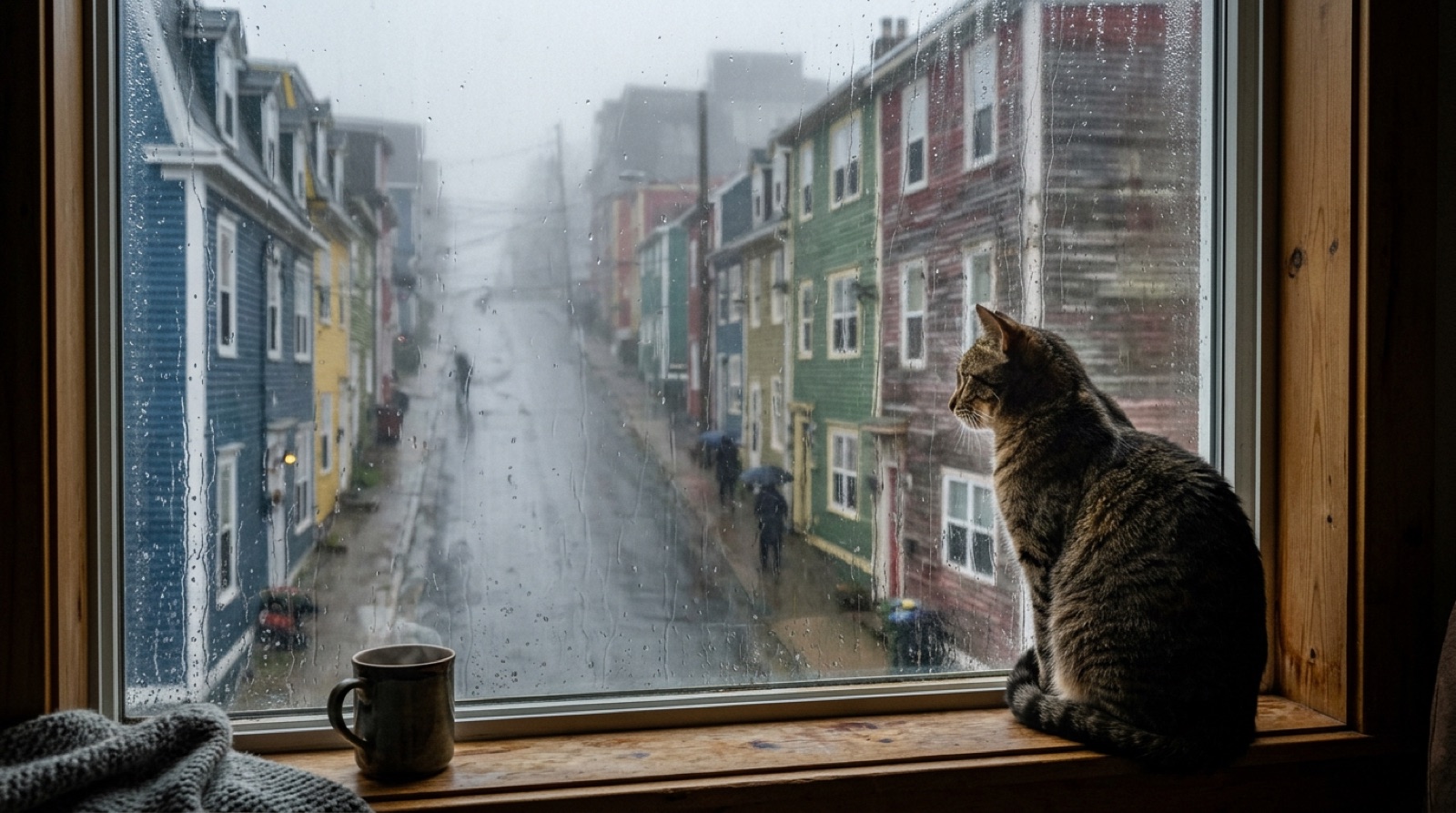
The short answer
Keep cats indoors here, and build an indoors worth living in. The Avalon combines wind, driving rain, dense fog and heavy wet snow with steep downtown traffic and a substantial free-roaming cat population that spreads feline leukemia and FIV. Wet fur stops insulating, so damp is more dangerous than cold. Give a cat height, window perches, daily wand play and, if you can, an enclosed catio built for wind and rain.
Ask around St. John's and you will hear that cats have always gone outside here, which is true, and that they mostly turn out fine, which is less true than people remember. What tends to be forgotten are the cats that did not come back during a bad autumn, or the ones that came back with an abscess from a fight and a vet bill attached.
This is not a lecture about neglectful owners. It is about a specific place. The weather on this peninsula does things to a small animal that the same temperature inland does not, and the traffic pattern on streets tipping down toward the harbour gives a driver very little time to react.
Below is what actually goes wrong, why the local geography makes it worse, and the alternatives that give a cat the outdoors without the risk. If you are still choosing a cat, the St. John's cat listings flag which cats rescues consider indoor-only.
What Actually Goes Wrong Here
| Hazard | Why it matters for a cat | When |
|---|---|---|
| Wind and nor'easters | Gusts off the North Atlantic, doors pulled open, debris in the air | Autumn through spring |
| RDF, rain drizzle and fog | A wet cat chills fast, and drivers cannot see a cat on the road | Heaviest in spring and early summer |
| Wet snow and freeze | Soaked fur loses insulation. Ice under paws, salt and grit on streets. | Winter into spring |
| Steep downtown traffic | Short sightlines on the hills above Water Street, parked cars, warm engine bays | All year |
| Free-roaming cat contact | Fights, abscesses, feline leukemia and FIV transmission | All year |
Wet is the problem, not cold
People picture the winter danger as temperature, and for a dry cat with shelter that is survivable. The thing that actually catches cats out on the Avalon is water. A cat's coat insulates by trapping air. Soak it in driving rain or wet snow and that insulation is simply gone, which is why a mild damp night in a nor'easter can be harder on a cat than a cold clear one.
Fog compounds it in a different way. RDF sits over the city for days at a stretch in spring and early summer, and a driver coming down a hill in it has very little chance of spotting a dark cat on wet asphalt.
Then there is what people put on the ground in winter. Salt and grit irritate paws, and cats groom their paws, which means whatever is on the road ends up ingested. A cat that comes in limping and licking after a slushy night is telling you something specific.
The engine bay problem
On a wet, windy Avalon night, a car that has just been parked is the warmest dry place on the street. Cats climb into wheel arches and engine bays, and the next person to turn a key finds out. This is a genuine local risk rather than a rare curiosity, because the weather here creates exactly the conditions that push cats to look for shelter under vehicles.
Bang the bonnet or sound the horn before starting on a cold or wet morning. It costs nothing. If you have outdoor cats in your neighbourhood, do it as a habit through the winter rather than only when you remember.
Other cats are a bigger risk than wildlife
The Avalon has a well-established free-roaming and feral cat population. Colonies persist through the winter in the sheltered spots the landscape provides, under decks, sheds, wharves and outbuildings, which means an outdoor cat here is not wandering an empty landscape. It is entering occupied territory.
That produces fights, and fights produce abscesses, which are painful, expensive and common. More seriously, fighting and mating are the main routes for feline leukemia and FIV, both of which are far easier to avoid than to manage.
Local groups do real work on this. Feral Felines Rescue & Rehabilitation runs trap-neuter-return across the province with operations reaching St. John's, working to reduce the colonies humanely rather than pretending they are not there. Keeping your own cat sterilised and indoors is the household-level version of the same job.
Making indoors worth it
Go vertical. Cats measure a home in climbable height, not floor space. Shelves, a tall tree or a cleared bookcase route matters more than square footage, which helps in a narrow downtown flat.
Give it a window with something happening. A perch facing a feeder is the single best piece of enrichment you can arrange, and the Avalon supplies plenty of weather to watch.
Play like prey. Ten minutes of wand play twice a day, moving like something that does not want to be caught, then let the cat catch it and feed afterwards. Laser pointers frustrate more than they satisfy.
Rotate toys. Keep most of them in a cupboard and swap weekly. Novelty is doing the work, not quantity.
Build a catio if you can. Solid roof against sideways rain, anchored frame against wind, access through a window or door. It gives a cat the smells and the air with none of the traffic or fights.
Consider two cats. A bonded pair entertains itself through a long grey winter in a way no toy manages. Rescues here list pairs regularly.
Browse adoptable St. John's cats
Many cats on the Avalon are already indoor-only and settle straight into a house without asking for the door. See who is available now. Listings refreshed regularly.
See Available St. John's Cats →Frequently Asked Questions
Should cats go outside in St. John's?
Most cats here are safer and live longer indoors, and the Avalon makes that case more strongly than most Canadian cities. The weather is the first reason. Wind coming off the North Atlantic, driving rain, dense fog and heavy wet snow all soak a cat fast, and wet fur stops insulating. The second reason is the free-roaming cat population, which means fights and disease exposure rather than a peaceful stroll. The third is traffic on streets that drop steeply toward the harbour with short sightlines. Indoor with genuine enrichment beats outdoor with genuine risk.
What makes the Avalon harder on outdoor cats than other places?
The combination rather than any single thing. Plenty of cities are cold. Fewer have persistent fog that hides a cat from a driver on a hill, wind strong enough to move things around outside, and rain that arrives sideways for days. Wet is the real problem more than cold. A dry cat with shelter copes with low temperatures far better than a soaked one copes with a mild damp night. Add narrow streets with parked cars on both sides and a large free-roaming cat population, and the odds stack up in a way they do not inland.
Is my cat going to be bored or unhappy indoors?
Not if the indoors is worth living in, and this is the part people skip. A cat wants height, sightlines, prey-shaped play and something changing to look at. Give it a window perch facing a bird feeder, a tall vertical route it can climb, scratching surfaces in the rooms it actually uses, and ten minutes of wand play twice a day. Rotate toys so they stay interesting. A cat with all of that is not sitting sadly by the door. A cat in an empty flat with a bowl and a cushion probably is, and that is a setup problem rather than an indoor problem.
What is a catio and does it work in this climate?
A catio is an enclosed outdoor run the cat reaches through a window or a door, and it works well here as long as you build for the weather. That means a solid roof rather than mesh alone, because rain here arrives horizontally, and a frame anchored properly for wind. Cats use them enthusiastically. They get the smells, the air and the birds without the traffic, the fights and the disease exposure. Even a small window box enclosure on the sheltered side of the house gives a cat most of what it actually wants from outdoors.
Can I walk my cat on a harness in St. John's?
Some cats take to it, most take time, and a few never will. Start indoors. Let the cat wear the harness around the house until it stops noticing, then add the lead, then try a quiet outdoor spot on a calm day. Choose your weather. A first attempt in wind or fog will go badly and may put the cat off for good. Never use a collar rather than a proper harness, since a startled cat will back straight out of a collar. If your cat flattens itself and refuses to move, that is an answer worth respecting.
My cat has always gone outside. Can I bring it in now?
Usually yes, with a transition rather than a slammed door. Move mealtimes indoors first, then start closing the door for longer stretches, and expect protest at the door for a week or two. Build the indoor environment before you make the change rather than after, because a cat that has just lost the outdoors and gained nothing will keep asking. Litter box placement matters here too, since a cat that has always toileted outside may need a larger uncovered box and a quiet spot to accept the idea.
What about cats that were living outdoors before I got them?
It depends on how feral the cat is, and that is a genuine spectrum rather than a yes or no. A friendly stray that ended up outside usually settles indoors within weeks. A truly feral adult often never becomes a house cat and is happier in a working placement with shelter, food and a caretaker. Feral Felines Rescue & Rehabilitation works specifically with feral and semi-feral cats in Newfoundland and can tell you which category a cat falls into. Being honest at the start saves everyone, including the cat, a great deal of stress.
Why are there so many free-roaming cats around St. John's?
Unsterilised cats outdoors and enough shelter for colonies to survive the winter. Decks, sheds, wharves and outbuildings across the Avalon give cats places to hold on through the cold, so populations persist year to year rather than dying back. Every unfixed cat outdoors adds to it. That is why trap-neuter-return work matters here and why our spay and neuter guide is worth reading even if your own cat never leaves the house.
What should I do if I find a cat outside?
Slow down before you act. Many apparent strays are owned cats that slipped out, and St. John's offers cat tags, so a tag may identify the owner directly. Check for a collar, get the cat scanned for a microchip at a local clinic, and post in neighbourhood groups. If it is friendly, thin and clearly struggling, contact a local rescue or City Humane Services on Higgins Line. If it avoids people entirely and looks like part of a colony, contact a trap-neuter-return group rather than trying to catch it yourself.
Do indoor cats still need vaccines and parasite prevention?
Yes to both, though the conversation is different from an outdoor cat. Fleas ride in on trouser legs, on other pets and in second-hand furniture. Cats also escape occasionally regardless of intentions, and a cat that gets out with no protection is exposed at the worst possible moment. Which vaccines your particular cat needs is a decision for your veterinarian based on its age, health and how much risk of getting out exists in your house. Do not skip the annual visit because the cat never goes anywhere.
How do I stop my cat escaping through the door?
Change the geometry rather than relying on speed. Keep something interesting away from the entrance so the cat is not already waiting there, feed on a schedule that does not coincide with people arriving home, and use a baby gate or a closed inner door as a buffer if your layout allows. Wind matters here too. A gust off the harbour can pull a door wider than you meant, so hold it rather than letting it swing. Make sure the microchip details are current, because that is what actually gets an escaped cat home.
Does keeping cats indoors help local wildlife?
Yes, and it is one of the strongest arguments beyond your own cat's safety. Cats hunt regardless of how well fed they are, because hunting is not driven by hunger. In a place with seabird colonies, coastal habitat and a large free-roaming cat population already in the landscape, keeping owned cats indoors or in enclosed runs removes a pressure that adds up across thousands of households. Enclosed outdoor access solves the problem neatly. The cat gets the air and the smells, and nothing gets hunted.
Related St. John's Guides
One search, every St. John's rescue
Shelter cats and foster cats from across the Avalon, in a single list.
Browse Available St. John's Cats →New cat? Start with these care guides
Everything a new adopter needs to set up a safe, happy home.