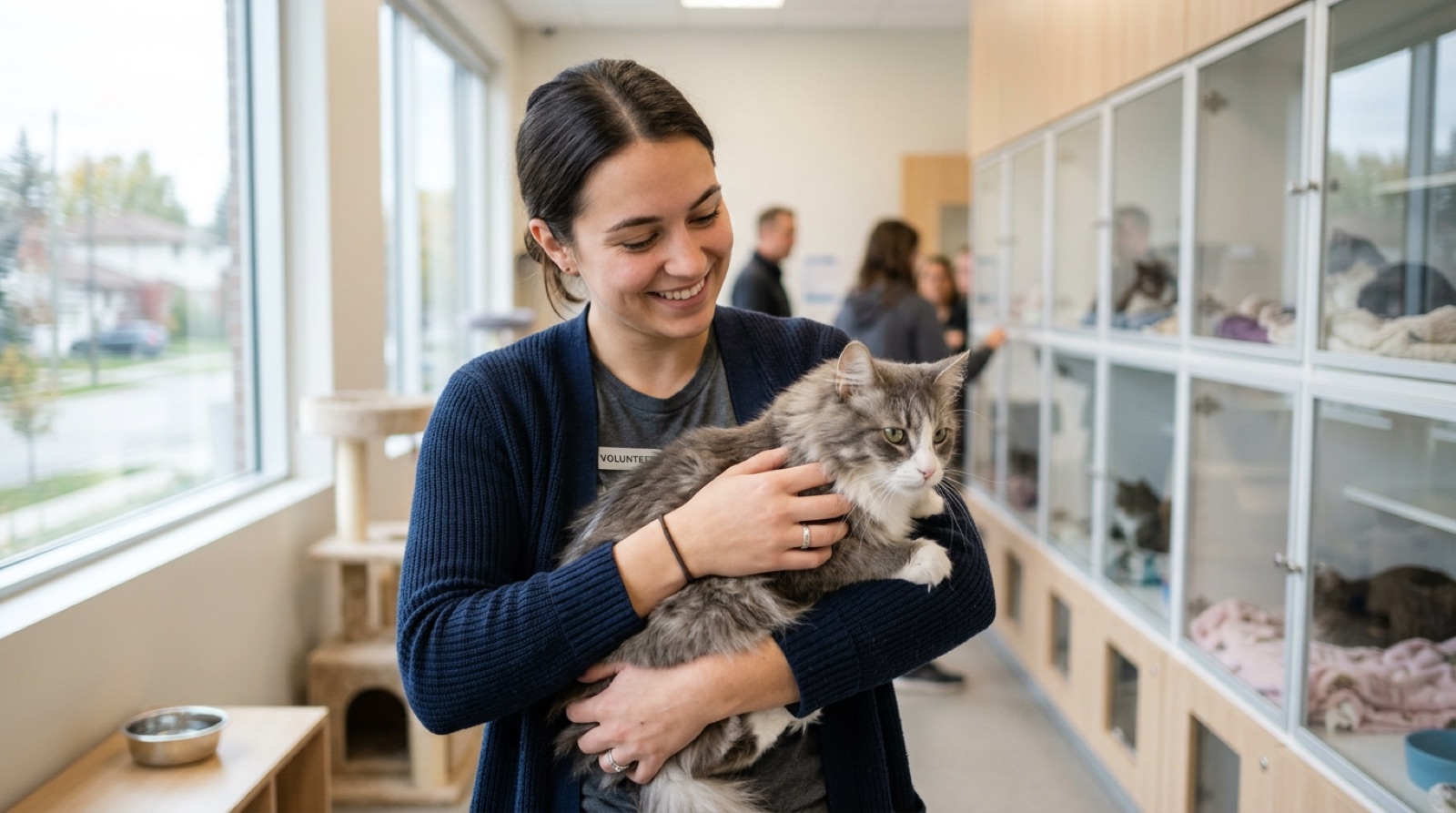
The short answer
For speed and selection, go to the Humane Society of Kitchener Waterloo & Stratford Perth at 250 Riverbend Drive in Kitchener and phone 519-745-5615 for current cat fees, which it does not post online. For an honest picture of how a cat behaves in a real house, go foster-based with Cambridge Homeless Cat Rescue, which keeps cats in volunteer homes across Waterloo Region. Enquire at more than one, because these groups do not share a waiting list. Kitchener does not license cats, so that is one cost you can skip.
Kitchener sits at the centre of Waterloo Region, the tri-city core it shares with Waterloo and Cambridge, and that scale matters when you are adopting a cat. A region of more than half a million people supports more than one kind of rescue. You can walk into the Humane Society on a Saturday and meet a room of cats, or you can talk to a volunteer who has been fostering the same cat in a spare bedroom near Victoria Park since March and knows exactly what it does when the smoke alarm chirps.
Those are different experiences and they suit different people. The shelter route is fast and the selection is broad. The foster route is slower and hands you better information. Neither one is a compromise.
Below is each Waterloo Region option, how it works, and the honest trade-off. If you would rather skip ahead and see which cats are actually available across all of them, the live Kitchener cat listings are refreshed regularly.
Waterloo Region Cat Rescues at a Glance
| Organisation | How it works | Cat fees | Best for |
|---|---|---|---|
| Humane Society of Kitchener Waterloo & Stratford Perth | Open-admission shelter, 250 Riverbend Drive | Not published, call ahead | Fastest route, widest selection |
| Cambridge Homeless Cat Rescue | Volunteer foster network, no building | Ask directly, set per cat | Foster-home behaviour notes |
| Community Cats Program (via the Humane Society) | Trap, neuter, return for colony cats | TNR program, confirm status | Feral and colony cats, not pet adoption |
Details verified July 2026 from each organisation's own website. The Humane Society does not publish cat adoption fees online, and Cambridge Homeless Cat Rescue prices per cat, so confirm both by phone or email before you plan a budget.
The Humane Society: the fastest route
The Humane Society of Kitchener Waterloo & Stratford Perth runs its Kitchener Waterloo Animal Centre at 250 Riverbend Drive, off Bridge Street in the north end. Phone 519-745-5615. As the open-admission shelter for the region, it takes in strays, owner surrenders and transfers, so its cat rooms hold the broadest mix in Waterloo Region on any given day.
Adoption here is quick by design. You browse the cats online or in person, speak with an adoption counsellor, meet the cat, and take it home. The Humane Society is not offering holds, so plan to be ready to bring the cat home the same day once you have met it. Every cat leaves after an exam, spay or neuter surgery, vaccinations, parasite treatment and a microchip, plus a starter bag of food.
Cat adoption fees are not published on the website, so call 519-745-5615 and ask before you build a budget around a number. The same organisation provides municipal animal control for Kitchener and runs the region's Community Cats work, covered in our Kitchener spay and neuter guide.
The trade-off is that a shelter room tells you less about a cat than a living room does. A cat that seems flat and withdrawn behind glass is often a completely different animal a month into a quiet home. Ask staff what they have actually observed, and read our first week guide so the hiding phase does not alarm you.
Cambridge Homeless Cat Rescue: foster homes, no building
Cambridge Homeless Cat Rescue is a registered charity run entirely by volunteers, covering Cambridge, Kitchener, Waterloo, Brantford and the surrounding areas. There is no building. Cats and kittens are pulled out of the community, vetted and fixed in a network of foster homes, and placed up for adoption once they are ready.
Because the group started around trap, neuter and return work, many of its cats began as colony or homeless animals that turned out to be social. Fees are set per cat rather than by tier, so ask about the specific animal when you enquire, and adoptions run through Petfinder listings.
The process is deliberately slower than a shelter. Apply, expect questions and reference checks, then a meeting with the animal. What you get in exchange is real detail: how the cat handles a dog, whether it hides from visitors, whether it wakes the house at five, what it actually eats. Reply times run on volunteer hours, so a two-day gap is normal rather than a brush-off.
Community Cats: colony work, not pet adoption
The Humane Society also runs a Community Cats program aimed at feral and colony cats rather than pet adoption. Through its trap, neuter and return work, community cats are spayed or neutered, vaccinated, treated for parasites, microchipped and ear-tipped, then returned to where they were found.
This matters to adopters for one reason. If what you have found outside is a colony cat rather than a lost pet, this is the program to ask about, and confirm its current status when you call. Truly feral adult cats are usually happiest returned to their territory, while social kittens pulled from a colony often end up in foster care and, eventually, adoption. Waterloo Region has an estimated homeless cat population in the tens of thousands, which is why this work exists at all.
How to choose, honestly
You want a cat this month. Go to the Humane Society. Widest selection in the region, and staff can match you across several cats in one visit.
You already have cats at home. Ask any rescue whether the cat has been tested for FIV and feline leukemia before it comes home, and keep new arrivals separate at first.
You have a toddler, a dog or a nervous resident cat. Go foster-based. You need somebody who has watched the cat around exactly that, and a kennel cannot tell you.
Your budget is tight. Adopt an adult or senior. An adopted cat is already fixed, vaccinated and chipped, which is the single largest first-year cost avoided.
You want a kitten specifically. Late spring through early autumn, and ask the foster groups as well as the shelter.
You have found a cat outside. Get it scanned for a microchip before assuming it is a stray, and ask about the Community Cats program if it turns out to be part of a colony.
The free-kitten trap
Classified listings around Waterloo Region fill with free kittens every summer, and again in the weeks after student leases turn over. A free kitten is not free. It arrives unfixed, unvaccinated, untested for feline leukemia and unchipped, and you pay for all of it afterwards at full clinic rates plus Ontario's 13% HST on everything that is not the surgery itself.
An adopted cat has several hundred dollars of veterinary work already inside the fee, including the tests a classified kitten will not have had. Classified sites also carry a genuine scam risk, including deposits taken for animals that never existed. If you want the numbers side by side, our Kitchener cat cost breakdown runs the full comparison.
Browse adoptable Kitchener cats
See who is available right now across Waterloo Region rescue organisations, in one place instead of four browser tabs. Listings refreshed regularly.
See Available Kitchener Cats →Where LocalPetFinder fits
We are not a rescue, and we do not place cats. We are an aggregator. We pull adoptable cats from Kitchener area rescues into one place and refresh them regularly, so you are not checking several websites and a handful of Facebook pages to see what changed this week. Coverage varies by rescue, so treat this as a starting point rather than the whole picture, and check the rescues above directly too.
We also carry something the rescues do not. Some cats are listed directly by the families rehoming them, so the history comes from the person who actually lived with the animal rather than from an intake form. There is no waitlist and contacting an owner costs nothing.
Frequently Asked Questions
Where is the best place to adopt a cat in Kitchener?
Start at the Humane Society of Kitchener Waterloo & Stratford Perth on Riverbend Drive if you want a cat soon. It is the open-admission shelter for the region, so it holds the widest mix of cats at any given moment and you can meet several in one visit. If you would rather know exactly how a cat behaves at 6 a.m. or around a toddler, go foster-based instead. Cambridge Homeless Cat Rescue keeps cats in volunteer homes across Waterloo Region, so somebody has genuinely lived with the animal you are asking about. Neither route is better. They answer different questions.
How much does it cost to adopt a cat in Kitchener?
The Humane Society does not publish its cat adoption fees online, so phone 519-745-5615 and ask before you build a budget. Foster-based groups like Cambridge Homeless Cat Rescue set fees per cat rather than by tier. Whatever the number, an adopted cat arrives already spayed or neutered, vaccinated, dewormed and microchipped, which is several hundred dollars of veterinary work bundled into one fee. Anything dramatically cheaper than a shelter cat, like a free kitten from a classified listing, usually means that work has not happened yet, and that bill lands on you later at full clinic rates.
What does a Kitchener cat adoption fee include?
The expensive veterinary work, done before pickup. A cat from the Humane Society goes home after an exam, spay or neuter surgery, age-appropriate vaccinations, parasite treatment and a microchip, plus a starter bag of food and some supplies. Foster-based rescues cover the same core veterinary bundle. Ordered separately at a Waterloo Region clinic, that package would run several hundred dollars, plus Ontario's 13% HST on the parts that are not the surgery itself. It is the single biggest reason adopting beats a free kitten.
Do I need a licence for a cat in Kitchener?
No. Kitchener and the rest of Waterloo Region do not require cat owners to buy a licence, which is different from nearby Guelph, where cat licensing has been mandatory since 2018. That saves you a small annual fee, but it also means a lost cat has no municipal registry backing it up. A microchip does the same job better anyway. Every cat adopted through a Waterloo Region rescue leaves microchipped, so keep the registration details current with your address and phone number, because that chip is what actually reunites you if the cat slips out.
What is a foster-based cat rescue, and why does it matter here?
It means the cat lives in a volunteer spare room instead of a shelter kennel until adoption. Cambridge Homeless Cat Rescue works this way, pulling cats and kittens out of the community, vetting them in foster homes, and listing them once they are ready. The payoff is information you cannot get anywhere else. Somebody has watched that cat around a vacuum, a resident dog, a January cold snap when the furnace ran all night, and a five-year-old. A shelter room tells you far less, because most cats behave strangely in one and then turn into different animals three weeks into a quiet house.
How long does a Kitchener cat adoption take?
It depends which route you take. A shelter adoption can move quickly. The Humane Society runs walk-in adoptions and asks you to be ready to take the cat home the same day once you have met it, because it is not offering holds. Foster-based groups run more slowly. Expect an application, a conversation with a volunteer, reference questions and sometimes a home visit before a cat changes hands. That slowness is not disorganisation. It is the same care that produces the behaviour notes people want from a foster placement in the first place.
Can I adopt a cat in Kitchener if I rent?
Yes, and rescues here expect it, especially in a region with a large student and young-professional rental population near the University of Waterloo and Wilfrid Laurier. Have written landlord permission or the relevant lease clause ready before you apply. Chasing a landlord for confirmation is the most common reason an otherwise simple adoption stalls for a week. Renting does not disqualify anyone. Being unable to show the cat is allowed does. If your lease is silent on pets, get something in writing rather than relying on a verbal yes.
Should I adopt a kitten or an adult cat?
An adult is the better bet for most Waterloo Region households, and the workload gap is bigger than the fee gap. An adult skips roughly two years of chaos, night sprinting and furniture testing. It arrives with a settled litter habit, a known personality and no interest in climbing your curtains. If you work full days in the tech corridor or live in a smaller apartment near downtown, an adult or senior cat is usually happier and so are you. Senior cats are the best value in the region and the hardest to place, so they are worth a serious look.
Why do Kitchener rescues fill up in spring and again in late summer?
Two things stack here. Kitten season runs from spring into autumn, so litters land on rescues in waves rather than a steady trickle. On top of that, Waterloo Region has a student population large enough to move the numbers. Leases around the University of Waterloo, Wilfrid Laurier and Conestoga College turn over around the end of April and again at the end of August, and rescues in university regions consistently report surrender enquiries clustered around those dates. Not every student surrender is careless, but the pattern is real and local rescues plan around it.
Do Kitchener rescues adopt out bonded pairs?
Regularly, and it is worth taking seriously rather than avoiding. Cats who arrived together or bonded in a foster home often settle far faster placed as a pair, so rescues list them that way on purpose. Two cats double the food and the litter but barely change the gear, since they share the tree, the scratching post and eventually your bed. Two settled adults also entertain each other, which matters more than people expect during a long Southwestern Ontario winter when nobody is spending much time outside.
What should I do if I find a stray cat in Kitchener?
Treat it as a different situation than adopting, because it probably is. Many apparent strays are owned cats that slipped out, so check for a collar, get the cat scanned for a microchip at a Waterloo Region clinic, and post locally before assuming it is homeless. If the cat looks like part of a colony rather than a lost pet, contact Cambridge Homeless Cat Rescue or ask the Humane Society about its Community Cats program, both of which do trap, neuter and return work in the region. Do not bring an unknown cat straight into a home with resident pets. Untested cats can carry feline leukemia, and that is hard to undo.
What if the cat I want is already spoken for?
You wait or you look at another cat, and it is not personal. Most rescues process one application per animal at a time, so a cat on hold is genuinely off the market until that falls through. The useful move is staying flexible about which cat rather than which rescue. Cats cycle through Waterloo Region organisations steadily, and the one that suits your household may be sitting in a Cambridge Homeless Cat Rescue foster home you have not contacted yet.
Related Kitchener Guides
One search, every Waterloo Region rescue
Shelter cats and foster cats from across Kitchener, Waterloo and Cambridge, in a single list.
Browse Available Kitchener Cats →New cat? Start with these care guides
Everything a new adopter needs to set up a safe, happy home.