The short answer
Size depends on the Poodle used: Standard (50 to 90-plus lbs, a large-dog commitment), Mini (25 to 50 lbs, suits more homes), Tiny (10 to 25 lbs, apartment-friendly). Generation shapes the coat: F1 (50/50, variable, may shed like the Bernese), F1b (~75% Poodle, curlier and lower-shedding, best for allergies, common in minis/tinies), multigen (aims for a stable low-shedding coat). More Poodle means curlier, lower-shedding, and higher-grooming; more Bernese means the reverse. Labels are tendencies, not guarantees, so judge the actual dog, and adopting an adult lets you see the real size and coat rather than guessing.
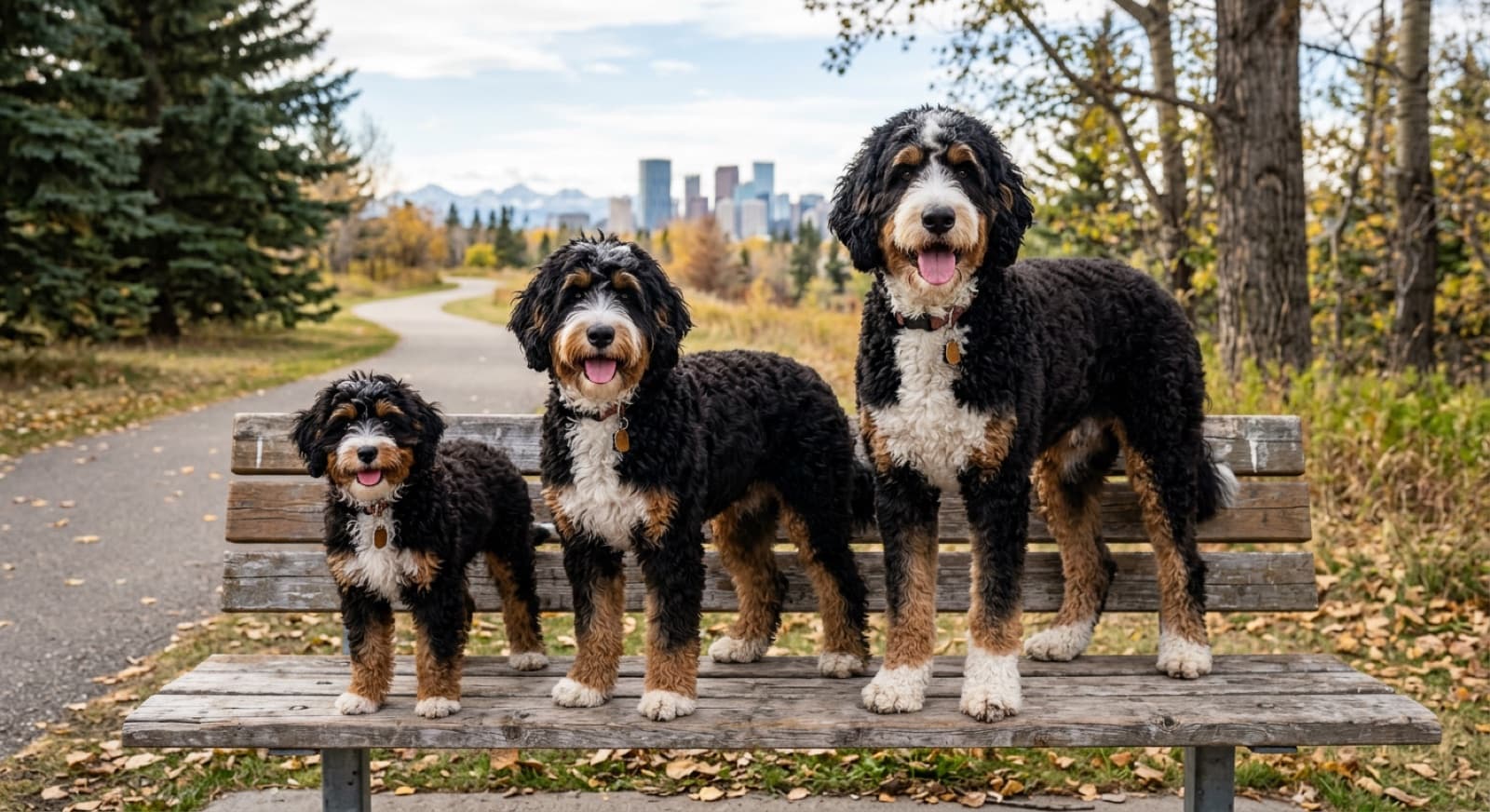
More than most breeds, “bernedoodle” covers an enormous range, from a 10-pound apartment companion to a 90-pound couch-filling giant, with coats from wavy and shedding to tight and curly. Understanding the sizes and generations is the key to matching one to your home, and the good news for adopters is that an adult rescue bernedoodle’s real size and coat are already visible, no guesswork required.
Low-shedding and low-maintenance are opposites
The curlier, more Poodle-like coats (F1b, multigen) shed least and are most allergy-friendly, but they also mat the most and need the most grooming. There is no bernedoodle that is both low-shedding and low-effort. If you want the allergy-friendly coat, commit to brushing several times a week plus professional grooming every 6 to 8 weeks, or keep the coat in a short trim. And a larger dog simply costs more to groom.
Matching size and coat to your home
Size is the biggest practical factor: a standard is a large-dog commitment (space, food, cost, strength), a mini suits more homes including some apartments, and a tiny is apartment-friendly. Lifespan tends to run longer in smaller bernedoodles. Match honestly to your space, budget, and physical ability.
Coat follows generation: more Poodle (F1b, multigen) means curlier, lower-shedding, higher-grooming; more Bernese (some F1s) means wavier and higher-shedding. For allergies, choose a curlier individual, and always meet the dog. Ottawa winters suit most bernedoodles well (dry the coat and wipe salt after snowy walks); larger, thicker-coated dogs need summer heat care (never shave to the skin). See our bernedoodle adoption guide, and the Canadian Kennel Club for parent-breed background.
See the size and coat for yourself
The best way to know a bernedoodle’s size and coat is to meet the dog. Browse available Bernedoodles and doodle mixes from Ottawa and Ontario rescues, each with the rescue’s honest notes.
See Available Bernedoodles →Frequently Asked Questions
What sizes do Bernedoodles come in?
Bernedoodles come in a wide range of sizes, and this is one of the most important practical things to understand about the cross, because the size depends largely on the Poodle used in the breeding and dramatically affects the dog’s needs and suitability for your home. The general categories are: Standard Bernedoodle (bred using a Standard Poodle), typically 50 to 90-plus pounds, a genuinely large dog needing space, more food, and more room to exercise; Mini (or Miniature) Bernedoodle (using a Miniature Poodle, often on an F1b or later cross), typically 25 to 50 pounds, a medium dog that suits more homes including some apartments; and Tiny (or Toy) Bernedoodle (using a Toy Poodle), typically 10 to 25 pounds, a small dog well-suited to apartment living. Because bernedoodles are not a standardised breed, these size ranges are approximate and individual dogs can fall outside them, especially in early-generation (F1) litters where size is less predictable. For an adopter, size is a crucial matching factor: a standard bernedoodle is a large-dog commitment (cost, space, strength), while a mini or tiny is far more manageable for smaller homes. In rescue, you can often assess an adult bernedoodle’s actual size directly, which is a real advantage over guessing a puppy’s adult size, so focus on the individual dog in front of you.
What do Bernedoodle generations (F1, F1b, F2) mean?
The generation labels describe a bernedoodle’s parentage, which loosely predicts its coat and shedding. F1 is a first cross: one purebred Bernese Mountain Dog parent and one purebred Poodle parent, so the puppies are 50/50 and their coats vary a lot, some more Bernese-like (wavier, higher-shedding) and some more Poodle-like. F1b is an F1 bernedoodle bred back to a Poodle, so the puppies are about 75 per cent Poodle, which usually means curlier, lower-shedding, more allergy-friendly coats (F1b is often recommended for allergy sufferers, and mini/tiny bernedoodles are frequently F1b). F2 is two F1 bernedoodles bred together, which increases coat variability again. Multigen (F2b, F3, and beyond) describes bernedoodles bred from bernedoodles over multiple generations, aiming to stabilise a consistent, low-shedding coat, though results still vary. The practical takeaway: more Poodle in the mix generally means a curlier, lower-shedding, higher-grooming coat, while more Bernese generally means a wavier or straighter, higher-shedding coat (the Bernese is a heavy shedder). These are tendencies, not guarantees, individual dogs within a litter differ, so always assess the actual dog. For a rescue bernedoodle, the generation is often unknown, so judge the coat you can see.
Which Bernedoodle is best for allergies?
Generally, bernedoodles with more Poodle in them, such as an F1b (about 75 per cent Poodle) or a well-bred multigen, tend to have the curliest, lowest-shedding, most allergy-friendly coats, so if allergies are the main concern, a curlier-coated F1b or multigen is usually the better bet than an F1 (50/50), which is a coin toss and may take after the heavy-shedding Bernese side. But “best for allergies” comes with a direct trade-off: the curlier, lower-shedding coats are precisely the ones that mat the most and need the most intensive grooming, because low-shedding means the loose hair stays in the coat rather than falling out. So there is no free lunch, the most allergy-friendly bernedoodle is also the highest-maintenance one. And crucially, no dog is truly 100 per cent hypoallergenic (allergens come from dander and saliva too), and coat varies even within a generation, so the only reliable way to know how a specific dog affects your allergies is to meet it and spend real time with it before committing. For an adopted bernedoodle, the rescue can usually describe the coat and shedding from living with the dog, ask directly, and be honest with them about your allergy needs so they can steer you toward a suitable dog. Meeting the actual dog is non-negotiable for allergy sufferers.
How does size affect a Bernedoodle’s needs and cost?
Size dramatically affects nearly every practical aspect of bernedoodle ownership, so it is worth matching carefully to your situation. A Standard Bernedoodle (50 to 90-plus pounds) is a large dog: it needs more space, eats considerably more (higher food costs), costs more for medication doses, grooming, boarding, and gear, requires more physical strength to handle, needs room and opportunity to exercise, and, like other large breeds, may face higher costs for large-dog health issues, it is a genuine large-dog commitment better suited to a house, ideally with a yard. A Mini Bernedoodle (25 to 50 pounds) is a medium dog that suits a wider range of homes, including some apartments with enough exercise, and is more manageable and economical. A Tiny Bernedoodle (10 to 25 pounds) is a small dog well-suited to apartment living, cheaper to feed, and easier to handle, though small dogs have their own considerations. Grooming needs apply across all sizes (the coat is the coat), but a larger dog simply costs more to groom. Lifespan also tends to vary with size, with smaller bernedoodles often living longer than standards, as is typical across dog sizes. For an adopter, honestly assessing your space, budget, and physical ability, and matching the bernedoodle size accordingly, is one of the most important decisions, and adopting an adult lets you know the actual size rather than guessing.
How does Ottawa’s climate suit different Bernedoodles?
Bernedoodles generally suit Ottawa’s climate well, especially on the cold side, though size and coat affect the details. Inheriting the Bernese Mountain Dog’s cold-weather heritage, many bernedoodles love cold and snow and handle Ottawa winters comfortably, larger, thicker-coated standards in particular are well-suited to winter and often revel in it. That said, the doodle coat picks up snow, ice balls, and road salt on walks, so wipe and thoroughly dry the coat, feathering, and paws after winter outings (and salt is irritating and harmful if licked), and snow-clumping in a curlier or longer coat can be a nuisance, so many owners keep the coat trimmed shorter in winter to reduce it and speed drying. In the warmer months, larger and thicker-coated bernedoodles can be prone to overheating, so summer heat calls for sensible care, shade, water, cool-of-day exercise, and never shaving the coat down to the skin (a summer trim is fine, but the coat provides some protection). Smaller bernedoodles tolerate a range of conditions but, being smaller, may feel deep cold more on paws and body, so a coat for walks helps. Year-round, moisture is the enemy of a mat-free coat, so thorough drying after any wet activity is the recurring theme. Overall, Ottawa is a good climate for the breed, winters are often a joy, and summer just needs sensible management, especially for larger dogs.
Related Guides
New dog? Start with these care guides
Everything a new adopter needs to set up a safe, happy home.