The short answer
F1 = 50/50 Lab-Poodle (variable coat). F1b = ~75% Poodle (curlier, lower-shedding, more allergy-friendly, higher grooming). F2 = two doodles crossed (variable again). Multigen = doodles bred over generations to stabilise a low-shedding coat. The rule of thumb: more Poodle means curlier, lower-shedding, and higher-maintenance; more Labrador means the reverse. No doodle is guaranteed hypoallergenic, and the lowest-shedding coats mat the most and need the most grooming (professional every 6 to 8 weeks). Labels are tendencies, not guarantees, so judge the actual dog. For a rescue doodle, the generation is often unknown, which is fine: an adult’s real coat and shedding are already visible.
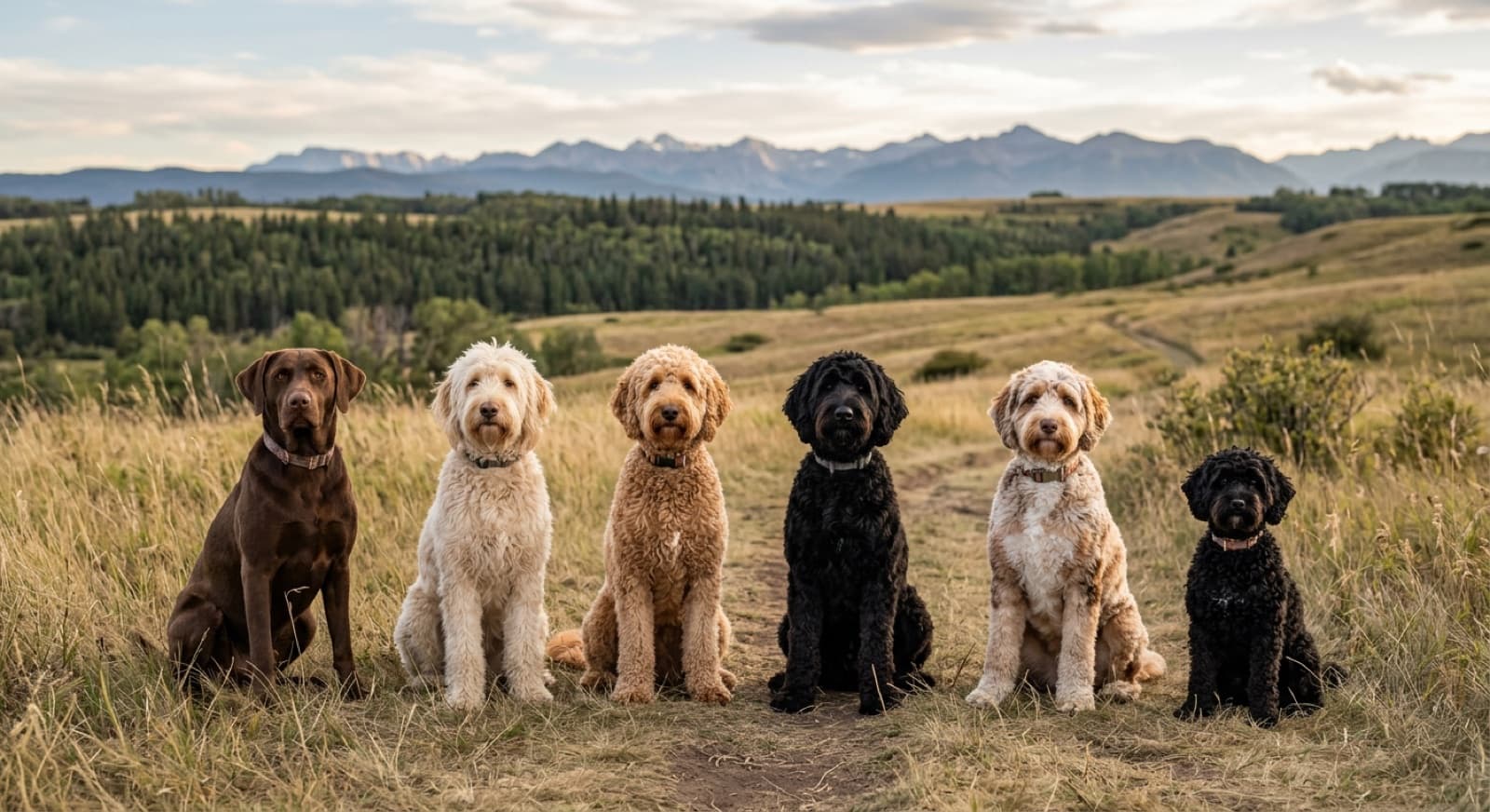
If you have looked at Labradoodles at all, you have run into the alphabet soup: F1, F1b, F2, multigen. These labels describe a doodle’s parentage, and they loosely predict the thing most people actually care about, how much the dog sheds and how much grooming it will need. Understanding them helps, but the single most important lesson is that they are tendencies, not guarantees, and the dog in front of you always trumps the label.
Low-shedding and low-maintenance are opposites
The curlier, more Poodle-like coats shed the least and are the most allergy-friendly, but they also mat the most and need the most grooming. There is no doodle that is both low-shedding and low-effort. If you want the allergy-friendly coat, you must commit to brushing several times a week and professional grooming every 6 to 8 weeks, or keep the coat in a short puppy cut.
Reading the generations, and reading the dog
F1 (50/50) coats vary widely; F1b (~75% Poodle) trends curlier and lower-shedding and is often recommended for allergy sufferers; F2 (doodle × doodle) is variable again; multigen aims for a stable, low-shedding coat. Size tracks the Poodle used (standard, miniature, or toy). More Poodle generally means curlier, lower-shedding, higher-grooming; more Labrador means the reverse. See the American Kennel Club Poodle profile for the Poodle-coat traits doodles inherit.
But temperament and even coat vary within any litter, so do not over-read the label. This is actually good news for adopters: a rescue adult doodle’s real coat, shedding, size, and temperament are already known, no generation guesswork required. Ask the rescue how much the dog sheds and what its coat needs, and plan to line up a good Ottawa groomer early, especially through the 8-to-14-month coat change when matting spikes. For the fuller ownership picture see our Labradoodle adoption guide.
See the coat for yourself
The best way to know a doodle’s coat is to meet the dog. Browse available Labradoodles and doodle mixes from Ottawa and Ontario rescues, each with the rescue’s honest notes on coat and shedding.
See Available Labradoodles →Frequently Asked Questions
What do Labradoodle generations (F1, F1b, F2) mean?
The generation labels describe a doodle’s parentage, which in turn predicts (loosely) its coat and shedding. F1 is a first cross: one purebred Labrador parent and one purebred Poodle parent, so the puppies are 50/50 and their coats vary a lot, some more Lab-like and shedding, some more Poodle-like. F1b is an F1 doodle bred back to a Poodle, so the puppies are about 75 per cent Poodle, which usually means curlier, lower-shedding, more allergy-friendly coats (F1b is often recommended for allergy sufferers). F2 is two F1 doodles bred together, which increases coat variability again. Multigen (F2b, F3, and beyond) describes doodles bred from doodles over multiple generations, aiming to stabilise a consistent, low-shedding coat, though results still vary. The practical takeaway: more Poodle in the mix generally means a curlier, lower-shedding, higher-grooming coat, while more Labrador generally means a wavier or straighter, higher-shedding, lower-grooming coat. But these are tendencies, not guarantees, individual dogs within a litter differ, which is why you should always assess the actual dog rather than trusting the label alone. For a rescue doodle, the generation is often unknown, so judge the coat in front of you.
Which Labradoodle generation sheds the least?
Generally, generations with more Poodle in them shed the least, so an F1b (about 75 per cent Poodle) or a well-bred multigen doodle tends to have the curliest, lowest-shedding, most allergy-friendly coat, while an F1 (50/50) is a coin toss and an F1 that took after the Labrador side may shed noticeably. But “least shedding” comes with a direct trade-off: the curlier, lower-shedding coats are precisely the ones that mat the most and require the most intensive grooming, because low-shedding means the loose hair stays in the coat rather than falling out, and if it is not brushed and professionally groomed regularly it forms painful mats. So there is no free lunch, the lowest-shedding doodle is also the highest-maintenance doodle. For allergy sufferers, a curlier F1b or multigen is the better bet, but only if you commit to the grooming. And because coat type varies even within a generation, the only reliable way to know how much a specific dog sheds is to meet it and, ideally, spend time with it. For an adopted doodle, the rescue can usually describe the coat and shedding level from living with the dog, ask them directly.
Are all Labradoodles hypoallergenic?
No, and this is the most common and costly misconception about the breed. Whether a Labradoodle is allergy-friendly depends entirely on the individual dog’s coat, which varies by generation and by which parent it takes after: a curly, Poodle-dominant coat (common in F1b and multigen doodles) sheds little and is tolerated by many allergy sufferers, while a wavier or straighter, Labrador-dominant coat (possible in any generation, likely in some F1s) sheds more and produces more allergens. No dog is truly 100 per cent hypoallergenic anyway, since allergens come from dander and saliva as well as hair, so even a low-shedding doodle is not guaranteed to be allergy-free. The practical advice for allergy sufferers is: do not rely on the doodle label or even the generation label alone, choose a curlier-coated individual, and, crucially, spend real time with the specific dog before committing to see how you react. For adoption, this means being honest with the rescue about your allergy needs so they can steer you toward a suitable dog, and being prepared that the lowest-allergen coats demand the most grooming. Meeting the actual dog is non-negotiable.
How much grooming does a Labradoodle coat need?
A lot, and it is the single most underestimated part of doodle ownership. The wavy or curly doodle coat grows continuously (it does not shed out like a Labrador’s), so it must be actively maintained or it mats, and matted coats are painful, trap moisture and skin problems, and often have to be shaved down. Practically, that means brushing several times a week at home (daily for the curliest coats or during coat changes) plus professional grooming every 6 to 8 weeks, which in Ottawa often runs $70 to $120-plus per visit. The curlier and lower-shedding the coat, the more grooming it needs, so the allergy-friendly doodle many people want is also the highest-maintenance one. Puppies also go through a coat change (often around 8 to 14 months) when the adult coat comes in and matting suddenly gets much worse, catching many owners off guard. Building a relationship with a good Ottawa groomer early, learning to brush properly (line brushing to the skin, not just over the top), and keeping the ears and sanitary areas trimmed are all part of the routine. Owners who love the doodle look but cannot commit to this often end up keeping the coat in a short “puppy cut,” which is easier to maintain, a perfectly good option.
Does the generation affect a Labradoodle’s temperament or size?
It can influence tendencies, but far less reliably than people assume, and temperament in particular depends more on the individual dog, its socialisation, and its specific parents than on the generation label. Size is somewhat more predictable: it depends largely on the Poodle used (standard, miniature, or toy Poodle crosses produce standard, medium, or miniature Labradoodles), and multigen breeding can help stabilise size, but F1 and F2 litters can still show a range. On temperament, both Labradors and Poodles are intelligent, active, people-oriented dogs, so most Labradoodles of any generation share that friendly, trainable, energetic core, but individual variation within any litter or generation is large. The honest advice is not to over-read the generation label for temperament or size, and instead to assess the actual dog: its energy level, sociability, and (for a puppy) its parents, or (for a rescue) the rescue’s behavioural assessment. For adopters this is freeing, a rescue adult doodle’s temperament and adult size are already known quantities you can evaluate directly, which is often a better basis for a good match than the generation guesswork that comes with a puppy. Meet the dog, judge the dog.
Related Guides
New dog? Start with these care guides
Everything a new adopter needs to set up a safe, happy home.