The short answer
Keep week one quiet, small and predictable. No visitors, no dog park, no long walks, no pet store trip. Short leashed bathroom breaks, the same food the rescue was feeding, a crate or gated room as a safe space, and far more alone time than feels kind. Expect the real dog to appear around week two or three, not week one. Book a vet within the first fortnight, get the City licence, and move the microchip registration into your name.
Almost every adopter makes the same mistake in the first week, and it comes from a good place. They want the dog to feel welcome, so they invite family over, take it on a long walk to show it the neighbourhood, buy it a pile of toys and give it attention all day.
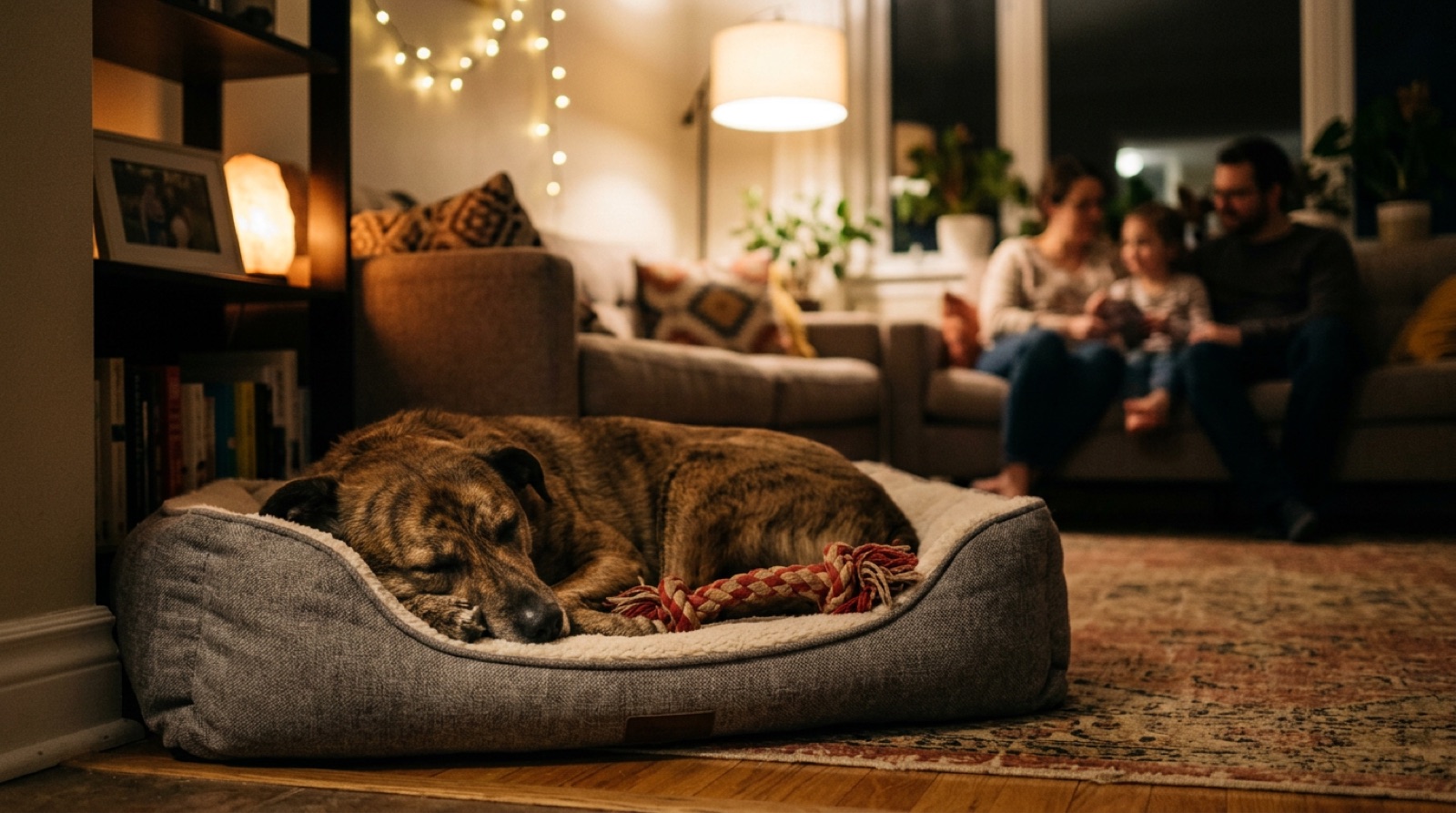
For a dog that has just lost every familiar smell, sound, person and routine in its life, that is a lot of input on top of an already full load. Decompression happens in boring environments. The kindest first week is the dullest one you can manage.
Get this part right and the next ten years are easier. Rush it and you spend months undoing anxiety you created with enthusiasm. Nobody at the rescue that placed your dog will think less of you for going slowly. They will be relieved.
The 3-3-3 Timeline
| Phase | What you see | What to do |
|---|---|---|
| First 3 days | Shut down or hyper-alert, hiding, poor appetite, accidents | Quiet, routine, minimal handling, no visitors |
| First 3 weeks | Real personality appears, including behaviours nobody warned you about | Start training, build routine, address issues early |
| First 3 months | Settled, bonded, confident in the house | Expand the world: parks, trails, new people |
A widely used guide rather than a fixed schedule. Some dogs settle in ten days, some take six months. A dog that seems perfect in week one and difficult in week two is following the pattern, not breaking.
Day One
Before you collect the dog, set up the crate or gated room, put water down, and dog-proof the space. Ask the rescue what food the dog is on and buy that specific food, because changing diet on top of a house move reliably causes stomach upset.
Coming home, go straight to the garden on a leash for a bathroom break before you go inside. Then let the dog explore one or two rooms at its own speed. Do not follow it around, do not call it over repeatedly, and do not photograph it in its face.
Check the harness fit twice. A frightened new dog backing out of a collar on a St. Catharines street is one of the most common first-week disasters, and it usually happens in the first forty-eight hours when the dog has no reason yet to come back to you. A properly fitted harness with a fixed leash, and no retractable.
Then leave it alone. More than feels right. Sit in the room reading rather than interacting. Let the dog approach you rather than the reverse. That is what a good first day looks like, and it is deeply anticlimactic.
Crate and House Training
The crate is a bedroom, never a consequence. Feed meals inside it with the door open. Toss treats in casually as you walk past. Let the dog choose to go in for days before you ever close the door. If your dog arrives with a bad crate history and genuinely panics, use a gated room instead and tell the rescue, because forcing it makes the association worse.
Assume the dog is not house trained, even when the paperwork says otherwise. A new house resets everything a dog knew about where the bathroom is. Out on a leash first thing in the morning, after every meal, after every nap, after play, and last thing at night.
Reward within seconds. Praise and a treat the moment the dog finishes outside, not once you are back indoors. The gap is where the lesson gets lost.
Accidents are data. They tell you the schedule needs tightening, not that the dog is defiant. Clean with an enzymatic cleaner rather than a household one, because ordinary cleaners leave a scent marker that invites a repeat in the same spot.
Vets, Licences and Paperwork
Book a vet in the first week or two. Not because something is wrong, but so a clinic has your dog on file before something is. Bring the whole adoption folder: surgery date, vaccine records, microchip number and any medical notes. Ask specifically about parasite prevention for Niagara, since tick pressure along the escarpment and the Bruce Trail is a genuine local factor.
Get the City dog licence. Every dog living in St. Catharines needs one, at $37.85 a year for a spayed or neutered dog. It takes minutes through the City licensing platform. Our licensing guide walks through it.
Move the microchip registration into your name. This is the step almost everyone misses. Your dog came home chipped, but if the registration still points at the shelter or a previous owner, the chip does not get the dog back to you. Find the chip number on your paperwork and update it with the chip company directly.
Save the emergency number now. The Niagara Veterinary Emergency Clinic in Thorold is open 24 hours, 365 days a year, at 905-641-3185. Put it in your phone this week rather than searching for it at 2am.
Go to emergency, do not wait until morning
A hard or distended belly with unproductive retching, restlessness and drooling can be bloat, formally gastric dilatation and volvulus. It affects deep-chested dogs in particular and it is fatal in hours rather than days, so it is an emergency room trip immediately rather than a phone call in the morning. Same urgency for breathing difficulty, collapse, seizures, suspected poisoning, uncontrolled bleeding, or straining to urinate without producing anything. The Niagara Veterinary Emergency Clinic, 3300 Merrittville Highway in Thorold, is open 24/7 at 905-641-3185. Phone on the way so they can prepare.
When to Widen the World
Niagara is a genuinely good place to own a dog once your dog is ready for it. The paths along the Welland Canal, the trails at Burgoyne Woods, the escarpment sections of the Bruce Trail, and the waterfront at Lakeside Park in Port Dalhousie are all worth building toward.
Building toward is the phrase that matters. Week one is the garden and a quiet street. Week two or three might be a short walk on a low-traffic road. Busy shared spaces come later, once your dog has a reliable recall and you actually know how it feels about other dogs.
Leave the leash-free parks until last. Burgoyne Woods and the Carol Disher park are great once a dog is settled and social, and they are a bad idea for a dog three days into a new life. There is no prize for getting there quickly.
One local note on timing: if you adopt in winter, Niagara gets heavy lake-effect snow off Lake Ontario even though the region stays milder than inland Ontario. Salted sidewalks are hard on paws. Rinse feet after walks, and watch for limping that shows up only after a walk.
Browse adoptable St. Catharines dogs
Foster-based Niagara rescues can tell you how a dog behaves in a real house, which makes week one far more predictable. Refreshed regularly.
See Available St. Catharines Dogs →Frequently Asked Questions
What is the 3-3-3 rule for rescue dogs?
How long does it take a rescue dog to settle in?
What should I do the first day with a rescue dog?
Should I crate train a rescue dog?
How do I house train an adult rescue dog?
When should I take my new dog to the vet?
When should I take a dog to emergency in Niagara?
Should I walk my new rescue dog right away?
How do I introduce a rescue dog to my other dog?
Can I leave my new rescue dog alone?
Why is my rescue dog not eating?
What do I need to do legally after adopting a dog in St. Catharines?
Related Niagara Guides
Ready When You Are
The dullest possible first week is the kindest thing you can give a rescue dog.
Browse Available St. Catharines Dogs →New dog? Start with these care guides
Everything a new adopter needs to set up a safe, happy home.