The short answer
Springers need at least an hour-plus of daily exercise plus real mental stimulation, they are working sporting dogs, not couch dogs. Field-bred lines run higher-energy than show lines, so match the dog to your activity level. They are intelligent and eager to please, so training is rewarding (positive reinforcement, after exercise), and they excel at scent work, agility, and obedience. Their biggest soft spot is separation anxiety, they bond intensely and dislike being alone, so build independence and arrange company. Meet the exercise and companionship needs and a Springer is calm and delightful; miss them and behaviour problems follow. Browse adoptable Toronto dogs.
Exercise and the field-vs-show difference
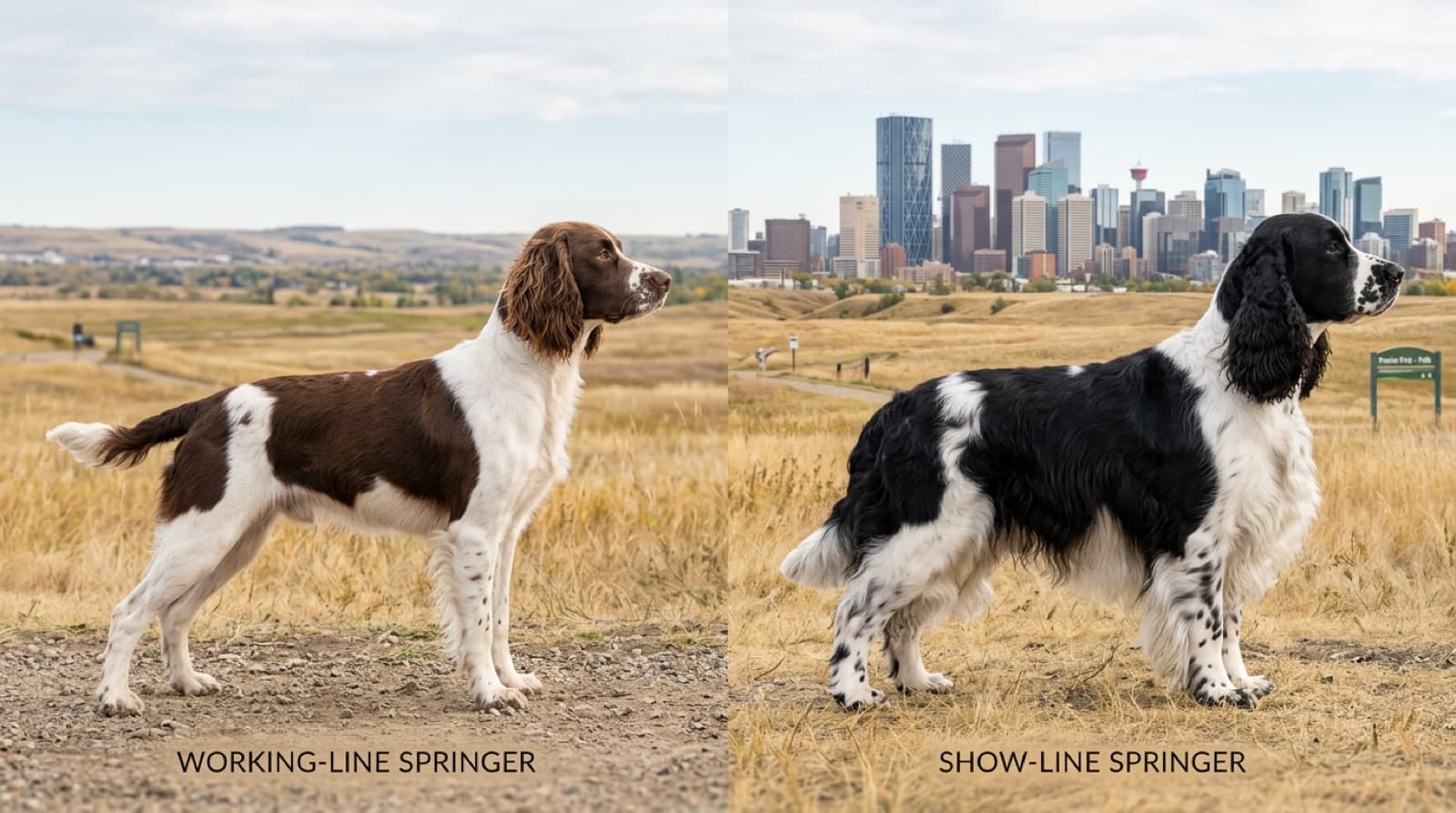
A Springer needs at least an hour-plus of real physical exercise daily, walks, running, hiking, fetch, swimming, plus mental work on top, because a stroll around the block does not touch a sporting breed's needs. How much depends heavily on the line: field-bred (working) Springers are noticeably higher-energy, drivier, and more intense than show-bred (bench) Springers, which are somewhat calmer while still energetic. Neither is better; it is about matching the dog to your lifestyle, and adopting an adult lets you see the actual energy level rather than guessing. The payoff is real: a well-exercised Springer is calm and happy at home, while an under-exercised one becomes hyperactive and destructive, the root of many behaviour problems that land the breed in rescue, as our adoption guide covers.
Training and mental stimulation
Springers are intelligent, eager to please, and people-oriented, which makes them one of the more trainable sporting breeds and a genuine pleasure to work with. They thrive on positive-reinforcement training and love the mental engagement, so they pick up obedience, tricks, and dog sports readily, and they often shine at agility, obedience, rally, and scent work. Two tips: train after the dog has had exercise (a wound-up Springer cannot focus), and keep methods gentle, since the breed is sensitive and harsh handling backfires. Mental stimulation matters as much as physical for this bright breed, so lean on scent games, puzzle toys, training sessions, and dog sports, which tire a Springer wonderfully. The Canadian Kennel Club describes the breed's eager, trainable nature, and our health guide covers the ear and joint care that pairs with an active life.
Managing separation anxiety
The Springer's intense attachment to its people is its greatest charm and its biggest challenge: they bond deeply and are notably prone to separation anxiety, struggling to be left alone for long and sometimes barking, howling, or becoming destructive when they are. This is not a dog for long solo workdays without support. Manage it by building independence gradually from day one (short absences that lengthen), making alone-time positive with a comfy space and food puzzles, exercising the dog well before you leave (a tired Springer copes far better), and keeping departures and arrivals low-key. For a Springer alone during a Toronto workday, a dog walker or daycare a few times a week helps enormously, and if genuine separation anxiety develops, a positive-reinforcement trainer or your vet can help. Meet both the exercise and the companionship needs, and a Springer is a calm, joyful, devoted companion. Adopt through a rescue that knows the dog's temperament to find the right match.
Browse adoptable English Springer Spaniels in Toronto
Active, eager, and devoted. Browse adoptable Springers and Springer mixes from Toronto shelters and rescues.
See Available Springer Spaniels →Frequently Asked Questions
How much exercise does an English Springer Spaniel really need?
Plan on at least an hour, often more, of real physical exercise a day, plus mental stimulation on top of that. Springers are a sporting breed bred to work in the field all day, so a stroll around the block is nowhere near enough. Good exercise for a Springer includes brisk walks, running, hiking, off-leash play in a safe area, fetch, and swimming (many adore water). Because they are intelligent working dogs, they also need their minds worked through training, games, scent work, and puzzle toys, mental tiredness is as important as physical. The amount varies by individual and by line (field-bred Springers need substantially more than show-bred ones), so match the exercise to the specific dog. A well-exercised Springer is a happy, calm companion at home; an under-exercised one becomes hyperactive, destructive, and hard to live with. For an active Toronto owner, meeting these needs is genuinely enjoyable, but it is a real daily commitment.
What’s the difference between field-bred and show-bred Springer Spaniels?
English Springer Spaniels have effectively split into two types that differ noticeably, especially in energy, and knowing which you have (or are adopting) matters. Field-bred (working) Springers were bred for hunting performance and tend to be higher-energy, more athletic, drivier, and more intense, with a stronger hunting instinct and a greater need for exercise and a job; they often have a shorter, less profuse coat. Show-bred (bench) Springers were bred for the show ring and conformation and tend to be somewhat calmer and more laid-back (though still energetic sporting dogs), often with a longer, more feathered coat. Neither is "better", it depends on your lifestyle: a field-bred Springer suits a very active owner or one who wants to do dog sports or fieldwork, while a show-bred one may fit a family that is active but not looking for a canine athlete. When adopting, the foster or rescue can often tell you a dog’s type and, more usefully, its actual observed energy level.
Are English Springer Spaniels easy to train?
Yes, relatively, Springers are intelligent, eager to please, and people-oriented, which makes them one of the more trainable sporting breeds and a joy to work with. They respond very well to positive-reinforcement training (treats, praise, play) and genuinely enjoy the mental engagement of learning, so they pick up obedience, tricks, and dog sports readily. Their trainability is a big part of why they excel at activities like agility, obedience, scent work, and of course fieldwork. Two things to keep in mind: their high energy means training is most successful when the dog has had adequate exercise first (a wound-up Springer struggles to focus), and their sensitivity means harsh methods backfire, gentle, consistent, reward-based training works best. Start early, keep sessions positive and engaging, and channel that eager-to-please nature, and a Springer becomes a delightfully responsive, well-mannered companion. Training also doubles as valuable mental stimulation for this bright breed.
Do English Springer Spaniels get separation anxiety?
Yes, more so than many breeds, and it is one of the most important things to understand before adopting one. Springers are intensely people-oriented, they were bred to work closely with humans and they bond deeply, so they genuinely struggle to be left alone for long and are notably prone to separation anxiety, which can show as barking, howling, destructiveness, house-soiling, or distress when alone. This is not a dog that does well left in a yard or alone during long workdays without support. The good news is that it is largely manageable with the right approach: build independence gradually from the start (short absences that lengthen), make alone-time positive with a comfortable space and engaging toys or food puzzles, ensure the dog is well-exercised before you leave (a tired Springer copes far better), and avoid dramatic departures and arrivals. For a Springer alone during a Toronto workday, a dog walker or daycare helps enormously. If genuine separation anxiety develops, a positive-reinforcement trainer or your vet can help.
What happens if an English Springer Spaniel doesn’t get enough exercise?
An under-exercised Springer is an unhappy, difficult dog, and it is the root of many of the behaviour problems that land the breed in rescue. Without enough physical exercise and mental stimulation, a Springer’s working-breed energy has nowhere to go, and it typically comes out as hyperactivity, destructiveness (chewing, digging), excessive barking, restlessness, difficulty settling, and sometimes anxiety or obsessive behaviours. A bored Springer is also harder to train, because it cannot focus. The frustrating part for owners is that these problems are usually not the dog "being bad", they are a symptom of unmet needs, and they typically resolve or greatly improve once the dog gets adequate exercise and enrichment. This is exactly why matching the breed to an active lifestyle is so important: a Springer with its needs met is a calm, happy, well-behaved companion at home, while the same dog under-exercised can seem like a completely different, difficult animal. Meeting the exercise and mental needs is not optional for this breed.
What mental stimulation and activities suit an English Springer Spaniel?
Because Springers are intelligent working dogs, mental stimulation is as important as physical exercise, and happily, the breed excels at and enjoys a wide range of activities. Great options include scent work and nose games (which tap into their natural hunting instincts and are wonderfully tiring), training sessions and trick training, puzzle toys and food-dispensing toys, and dog sports like agility, obedience, rally, and flyball, at which Springers often shine. Fetch and retrieving games suit their gundog heritage, and many love swimming. Even simple enrichment like food puzzles, snuffle mats, and rotating toys helps on days when physical exercise is limited. The goal is to work the dog’s mind as well as its body, a Springer that gets both physical and mental exercise is calm and content, while one that gets neither becomes problematic. For a Toronto owner, combining daily walks or runs with a bit of training or scent work, plus the occasional dog-sport class, keeps a Springer genuinely fulfilled.
Springer Spaniel Adoption in Toronto
Where to adopt, costs, and the honest Springer reality.
Springer Spaniel Health Issues
Ears, hips, eyes, and immune conditions.
New dog? Start with these care guides
Everything a new adopter needs to set up a safe, happy home.