The short answer
Toronto dog spay typically costs $400 to $800 and neuter $300 to $650 at a full-service vet, the highest range in Canada. The Toronto Humane Society subsidized clinic quotes below those numbers and is open to the public, with priority for low-income owners. Income-qualified owners facing a related medical bill may get help through the Farley Foundation. Every dog adopted from a Toronto rescue arrives already fixed at no extra cost, and the City of Toronto charges a lower annual licence fee for spayed/neutered dogs than for intact ones.
Heads up: This article is informational and is not veterinary advice. Always consult your Toronto veterinarian about timing, individual health factors, and the specific procedure recommendation for your dog. Pricing is current as of June 2026 and changes; confirm fees with the clinic before booking.
Spaying or neutering a dog in Toronto is one of those decisions every new owner runs into in the first year. The surgery prevents unwanted litters, removes several cancers and infections, lowers your annual City of Toronto dog licence fee, and reduces roaming and marking behaviour. The hard part is figuring out where to do it. Toronto is the priciest vet market in Canada, and the spread between the subsidized route and a downtown private vet is wide.
Already adopted from a rescue? Every Toronto rescue includes spay or neuter in the adoption fee. The surgery is already done by the time the dog comes home with you. Skip ahead to recovery if you need it, or to Toronto licensing to register your dog.
Haven't adopted yet? The cheapest total-cost route to a fixed dog is to adopt one that is already fixed. The $300 to $700 adoption fee at any Toronto rescue is generally less than the surgery alone in this market, and it includes vaccines and a microchip.
Spay & Neuter Costs by Clinic Type
| Procedure | Standard Vet | THS Subsidized Clinic | Rescue Adoption |
|---|---|---|---|
| Spay (female, under 25 kg) | $400–$600 | Below standard | Included |
| Spay (female, over 25 kg) | $550–$800 | Below standard | Included |
| Neuter (male, under 25 kg) | $300–$450 | Below standard | Included |
| Neuter (male, over 25 kg) | $450–$650 | Below standard | Included |
Costs vary by weight, age, and health status, and Toronto sits at the top of the Canadian range. Pre-anaesthetic bloodwork ($80–$150) is often recommended for older dogs and is usually quoted separately. Ask for a full written estimate before booking. The Toronto Humane Society subsidized clinic reduces costs further, with priority for low-income owners.
Where to Spay or Neuter Your Dog in Toronto
Toronto Humane Society Subsidized Clinic
The strongest single affordable-spay asset in Toronto. The Toronto Humane Society runs a public veterinary clinic offering spay/neuter, vaccines, microchipping, and dental care at subsidized prices. The clinic is open to all pet owners, not only THS adopters, with priority and additional support for low-income owners. Pricing sits below full-service vet rates because the clinic operates as a charitable service supported by donations. Demand is high and capacity is limited, so book early.
Where: Toronto (book through THS)
Farley Foundation (for owners on income assistance)
The Farley Foundation, run by the Ontario Veterinary Medical Association, supports income-qualified Ontario pet owners facing non-elective veterinary bills. It is aimed at illness and injury rather than elective spay/neuter, so it usually applies to a complication or an urgent medical issue rather than a routine surgery booking. Eligibility requires recipients of provincial income assistance, disability support, a seniors' income supplement, or a similar program. Your Ontario vet has to make the application on your behalf. Most Ontario vets participate.
Where: Province-wide (applied through your vet)
Toronto Animal Services and community clinics
The City of Toronto Animal Services and the Ontario SPCA Toronto Area periodically host community wellness and vaccine events, and several GTA clinics focus on spay/neuter and basic preventive care, which keeps pricing below full-service vet rates. Schedules change by season and capacity is limited. Pre-anaesthetic bloodwork is sometimes an optional add-on at this tier; for older or larger dogs it is worth it. Phone for a current quote tied to your specific dog before you book.
Where: Several Toronto and GTA locations
Standard Toronto veterinary clinics
Full-service Toronto vet clinics offer spay/neuter alongside everything else, and Toronto is the priciest vet market in Canada. Higher prices, but you can bundle pre-anaesthetic bloodwork, vaccines, and a dental cleaning into one anaesthetic event. Worth it if your dog is older, has health concerns, or you want a vet who already knows the file. Ask whether take-home pain medication and the e-collar are included in the quoted price; at most full-service Toronto clinics they are.
Adopt a dog from a Toronto rescue
Every dog adopted from a Toronto rescue arrives already spayed or neutered, vaccinated, and microchipped. The adoption fee is almost always lower than the surgery alone in Toronto's expensive vet market. The Toronto Humane Society, Save Our Scruff, Dog Tales Rescue and Sanctuary, and Etobicoke Humane Society all fix dogs before placement. You skip the surgery booking, the recovery week, and the cone wars.
When to Spay or Neuter Your Dog
Recent veterinary research has moved away from a blanket “always at 6 months” rule. The right timing depends on breed, size, sex, and individual health. The American Veterinary Medical Association's spay/neuter guidance notes the same shift. Always confirm timing with your Toronto vet for your specific dog.
Small breeds (under 20 kg)
Generally safe to spay/neuter around 6 months of age. Smaller dogs reach maturity faster and do not have the joint-development considerations of large breeds.
Large and giant breeds (over 20 kg)
Many vets now recommend waiting until 12 to 18 months to let growth plates close fully. This is especially relevant for breeds like German Shepherds, Golden Retrievers, Labrador Retrievers, and Great Danes.
Rescue dogs
Toronto rescues spay or neuter before adoption regardless of age. If you adopt a young puppy, the rescue will either perform the surgery before handoff or build it into the adoption agreement with a follow-up appointment.
Senior dogs
It is rarely too late. Healthy older dogs can be safely spayed or neutered into their senior years. Pre-anaesthetic bloodwork is more important with age to screen kidney and liver function. Spaying an older female still removes the risk of pyometra, a serious uterine infection.
Pre-Surgery Preparation
Fasting: Standard guidance is no food after midnight the night before surgery. Water access is usually fine until you leave for the clinic. Confirm the specific window with your vet because protocols vary.
Drop-off: Most Toronto clinics ask for morning drop-off (around 7:30 to 8:30 a.m.) and same-day pickup in the afternoon. Subsidized clinic appointments follow a similar pattern.
What to bring: Your dog's vaccination records, any medications, and a snug-fitting leash and collar. Some clinics also ask for your dog to come in wearing a fresh harness or e-collar.
Bloodwork: Pre-anaesthetic bloodwork (around $80 to $150) is optional at most clinics for healthy young adults but strongly recommended for senior dogs or any dog with prior health issues. It is a kidney-and-liver screen that confirms the dog can clear anaesthesia safely.
Recovery Timeline
| Timeline | What to Expect |
|---|---|
| Day 1–2 | Grogginess from anaesthesia, reduced appetite, rest needed. Keep the dog in a quiet area. E-collar on. |
| Day 3–5 | Energy returns. Activity must stay restricted: no running, jumping, or stairs. Leash walks only for bathroom breaks. |
| Day 5–10 | Incision should be healing. Check daily for redness, swelling, or discharge. Keep the cone on. No baths. |
| Day 10–14 | Stitches removed (if not dissolvable). Vet rechecks the incision and clears the dog to return to normal activity. |
| 2–4 weeks | Gradually return to off-leash play, walks, and Toronto dog-park visits. Full healing for female spays can take 3 to 4 weeks. |
Red flags. Call your vet
- Incision opening, gaping, or bleeding
- Discharge, strong odour, or significant swelling at the site
- Fever, vomiting, or lethargy that lasts beyond day 3
- Refusal to eat or drink past 48 hours
- Dog repeatedly chewing or licking the incision (the cone is non-negotiable for the full recovery window)
Post-Surgery Care at Home
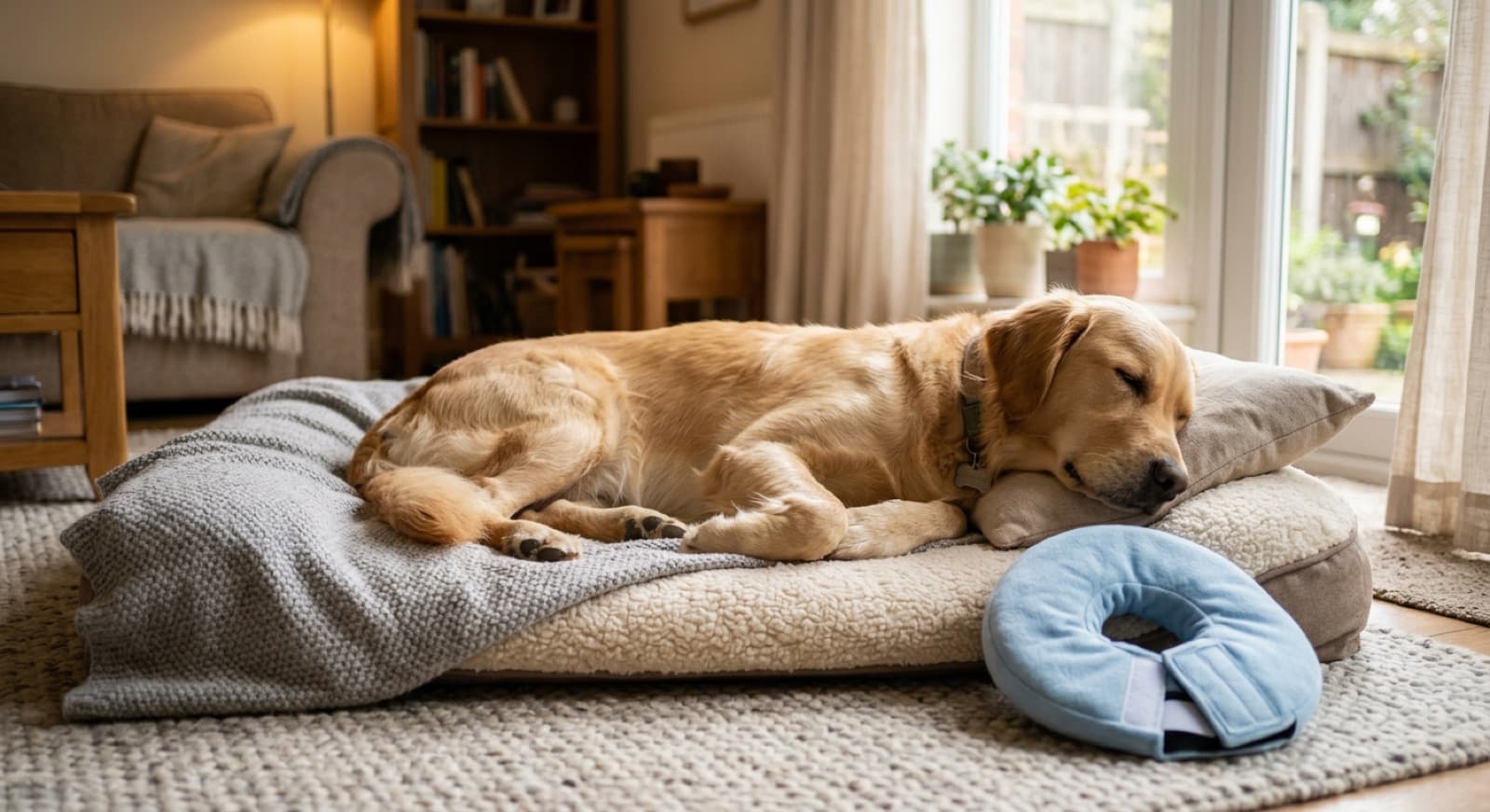
E-collar enforcement: The cone stays on for the full 10 to 14 days. Even one minute of licking can introduce bacteria or pull a stitch. Inflatable donut alternatives work for some dogs but not all; check that yours cannot reach the incision past it.
Leash-only walks: No off-leash, no Toronto dog parks, no zoomies in the backyard. Calm bathroom walks only for 10 to 14 days. This is the hardest part for high-energy dogs. Plan some mental enrichment (puzzle feeders, chew toys, training) to substitute for physical exercise.
No baths for 14 days: The incision must stay dry. Use a damp cloth for spot cleaning if needed. A quick wipe-down after wet or slushy Toronto walks helps keep the area clean.
Crate or contained rest: If your dog is a runner or jumper, crate rest or a pen during the day is the safest call. Stitches popping open is a real risk for active dogs.
Pain medication: Use what your vet prescribed, on the schedule given. Never use human pain meds. Acetaminophen and ibuprofen are toxic to dogs.
Toronto Licensing and the Altered-Dog Discount
The City of Toronto requires every dog to be licensed annually, and the fee is lower for a spayed or neutered dog than for an intact (unaltered) one:
Lower
Annual licence fee
Spayed or neutered dog
Higher
Annual licence fee
Intact (unaltered) dog
That yearly difference adds up over a dog's lifetime, which makes spay/neuter a multi-year cost saver on top of the surgery itself. Toronto's fee structure is intentionally designed to encourage sterilisation. Proof of altered status (a certificate from your vet) is required at registration. Confirm the current fees on the City of Toronto website before you register.
How to register: Apply online through the City of Toronto, by mail, or in person. New dogs are required to be licensed shortly after arriving in Toronto, and licences renew annually. Keeping the licence current also helps reunite you with your dog if it gets lost.
Why the gap exists: Toronto uses the licence-fee differential as a policy lever to reduce overpopulation. The Toronto Humane Society subsidized clinic is the partner side of the same strategy. Together they push more dogs into the altered column without making sterilisation mandatory.
Why Toronto Rescue Dogs Are Already Fixed
Every Toronto rescue spays or neuters before adoption. It is part of the standard adoption package, alongside vaccines, microchip, and a vet check. The Toronto Humane Society, Save Our Scruff, Dog Tales Rescue and Sanctuary, and Etobicoke Humane Society all follow this model.
The math: a Toronto rescue adoption fee usually runs $300 to $700. A private-vet spay alone runs $400 to $800 in this market. Adoption is almost always cheaper than the surgery in isolation, and it gets you the dog. The fee also funds the rescue's next intake, so the dollars do double duty.
Rescues do this for population-control reasons too. The Ontario SPCA and the broader rescue network intake many animals a year, and unspayed or unneutered dogs are a primary driver of the next litter that ends up in foster care. Fixing dogs before placement keeps that cycle from repeating.
Health Benefits
Spaying (female dogs)
- ✓Eliminates the risk of pyometra (uterine infection), which can be life-threatening
- ✓Greatly reduces mammary cancer risk, especially if done before the first heat cycle
- ✓No heat cycles (no bleeding, no scent attracting intact males)
- ✓Prevents unwanted pregnancy and accidental litters
Neutering (male dogs)
- ✓Eliminates testicular cancer risk
- ✓Reduces prostate problems later in life
- ✓Reduces roaming, marking, and some hormone-driven behaviour
- ✓Decreases risk of fight injuries (intact males are bigger targets at off-leash parks)
For the broader health picture, the Ontario SPCA spay/neuter resources are a useful starting point. Always confirm what applies to your dog with your own vet.
Browse adoptable Toronto dogs
Most Toronto rescue dogs arrive already spayed/neutered, vaccinated, and microchipped. Skip the surgery booking and the recovery week.
See Available Toronto Dogs →Frequently Asked Questions
How much does it cost to spay a dog in Toronto?
Spaying a female dog in Toronto costs $400 to $800 at a standard veterinary clinic, the highest range in Canada and dependent on the dog's weight and age. The Toronto Humane Society subsidized clinic quotes lower. Income-qualified owners facing a related medical bill may get help through the Farley Foundation. Rescue dogs arrive already spayed at no extra cost, with the surgery included in the adoption fee.
How much does it cost to neuter a dog in Toronto?
Neutering a male dog in Toronto runs about $300 to $650 at full-service vet clinics. Neutering is less expensive than spaying because it is a simpler surgical procedure with no abdominal incision. The Toronto Humane Society subsidized clinic comes in lower. The cheapest total-cost route is adopting a dog that is already neutered from a Toronto rescue.
Where can I get low-cost spay/neuter in Toronto?
The main affordable route in Toronto is the Toronto Humane Society subsidized clinic, which is open to the public and offers spay/neuter at below-standard prices, with priority for low-income owners. Toronto Animal Services and the Ontario SPCA Toronto Area periodically host community wellness events. The Farley Foundation can help income-qualified owners with non-elective medical bills. Adopting an already-fixed dog from a Toronto rescue is the lowest total-cost option.
Does the Toronto Humane Society offer spay/neuter?
Yes. The Toronto Humane Society operates a public, subsidized veterinary clinic that handles spay/neuter, vaccines, microchipping, and dental care at prices below full-service vet rates. The clinic is open to all pet owners, not only THS adopters, with priority for low-income owners. THS also runs an Urgent Care Fund that supports low-income owners facing serious unexpected medical bills. Demand is high, so book early.
When should I spay/neuter my dog?
Recent veterinary guidance has moved away from a blanket "always at 6 months" rule. Small breeds under 20 kg are generally safe to spay/neuter around 6 months. Many vets now recommend waiting until 12 to 18 months for large and giant breeds so the skeleton develops fully. The right answer depends on your specific dog. Ask your Toronto vet to weigh in based on breed, size, and health history.
How long is dog spay recovery?
Most dogs need 10 to 14 days for full recovery. Day 1 to 2 is grogginess and reduced appetite. Day 3 to 7 is restricted activity with no running, jumping, or stairs. Stitches come out or finish dissolving around day 10 to 14. Spay recovery takes a little longer than neuter recovery because it is an abdominal surgery. Keep the e-collar on the whole time and walk on leash only.
How much is a Toronto dog licence for a spayed/neutered dog?
The City of Toronto requires every dog to be licensed annually, and the fee for a spayed or neutered dog is lower than the fee for an intact (unaltered) dog. Over a dog's lifetime that yearly difference adds up, which makes spay/neuter a multi-year cost saver on top of the health benefits. Proof of altered status (a certificate from your vet) is required at registration. Confirm current fees on the City of Toronto website.
Do rescue dogs in Toronto come already fixed?
Yes. Every Toronto rescue spays or neuters before placement. The Toronto Humane Society, Save Our Scruff, Dog Tales Rescue and Sanctuary, and Etobicoke Humane Society all include the surgery, vaccines, and microchip in the adoption fee. Adoption fees in Toronto typically run $300 to $700, almost always lower than the surgery alone at a private vet in this market.
What is included in a spay/neuter surgery price?
A standard Toronto vet quote usually covers the pre-surgery exam, general anaesthetic, the surgery itself, monitoring, take-home pain medication, and an e-collar. Pre-anaesthetic bloodwork (around $80 to $150) is often recommended and quoted separately, especially for dogs over 5 years old. Ask the clinic for a full written estimate before booking. Low-cost and subsidized clinics may itemise some add-ons separately.
Is there a free spay/neuter option in Toronto?
There is no fully free public dog spay/neuter program in Toronto at the time of writing. The Toronto Humane Society subsidized clinic is the closest equivalent and offers the surgery at below-standard prices, with priority for low-income owners. The cheapest total-cost route is adopting an already-fixed dog from a Toronto rescue. The adoption fee is typically less than even a subsidized surgery and includes vaccines, microchip, and the recovery work.
When is it too late to spay/neuter?
It is rarely too late. Healthy older dogs can be safely spayed or neutered into their senior years. Pre-anaesthetic bloodwork becomes more important with age to screen kidney and liver function. Spaying an older female still removes the risk of pyometra, a life-threatening uterine infection that affects a meaningful share of unspayed senior females. Talk to your Toronto vet about age-specific anaesthetic protocols.
Should large-breed dogs wait longer for spay/neuter?
Many Ontario vets now recommend waiting until 12 to 18 months for large and giant breeds (German Shepherds, Labradors, Golden Retrievers, Great Danes, and similar) so growth plates close and the joints develop fully. The trade-off is one or two heat cycles for females, which raises mammary cancer risk slightly. The right timing is breed-specific and dog-specific. Bring it up at your puppy's first or second vet visit.
Related Toronto Guides
Skip the Surgery Bill. Adopt.
Every Toronto rescue dog comes already spayed/neutered, vaccinated, and microchipped. In Toronto's pricey vet market, adoption fees are less than the surgery alone.
Browse Available Toronto Dogs →Spay & Neuter Cost Across Canada
What the surgery costs by province, what subsidised clinics charge, and how to find one near you.
New dog? Start with these care guides
Everything a new adopter needs to set up a safe, happy home.