The short answer
Give the cat one quiet room, not the house. Put the litter box, food, water, a hiding spot and a scratching post in it, open the carrier, and leave. Expect hiding for days, which is normal. Keep the shelter's food and litter for the first week, then change slowly. Register with a Moose Jaw vet early, and know that a male cat straining in the box is an emergency.
The drive home is the loudest hour of a rescue cat's year. It has just left a building it finally understood, in a box, in a car, going somewhere it has never smelled before.
What that cat needs when the door opens is not affection. It is a small predictable space with everything in it and nobody demanding anything. Get that right and the rest is mostly waiting.
Here is what the first week looks like and what to do when it does not go to plan.
Set up the safe room before you collect the cat
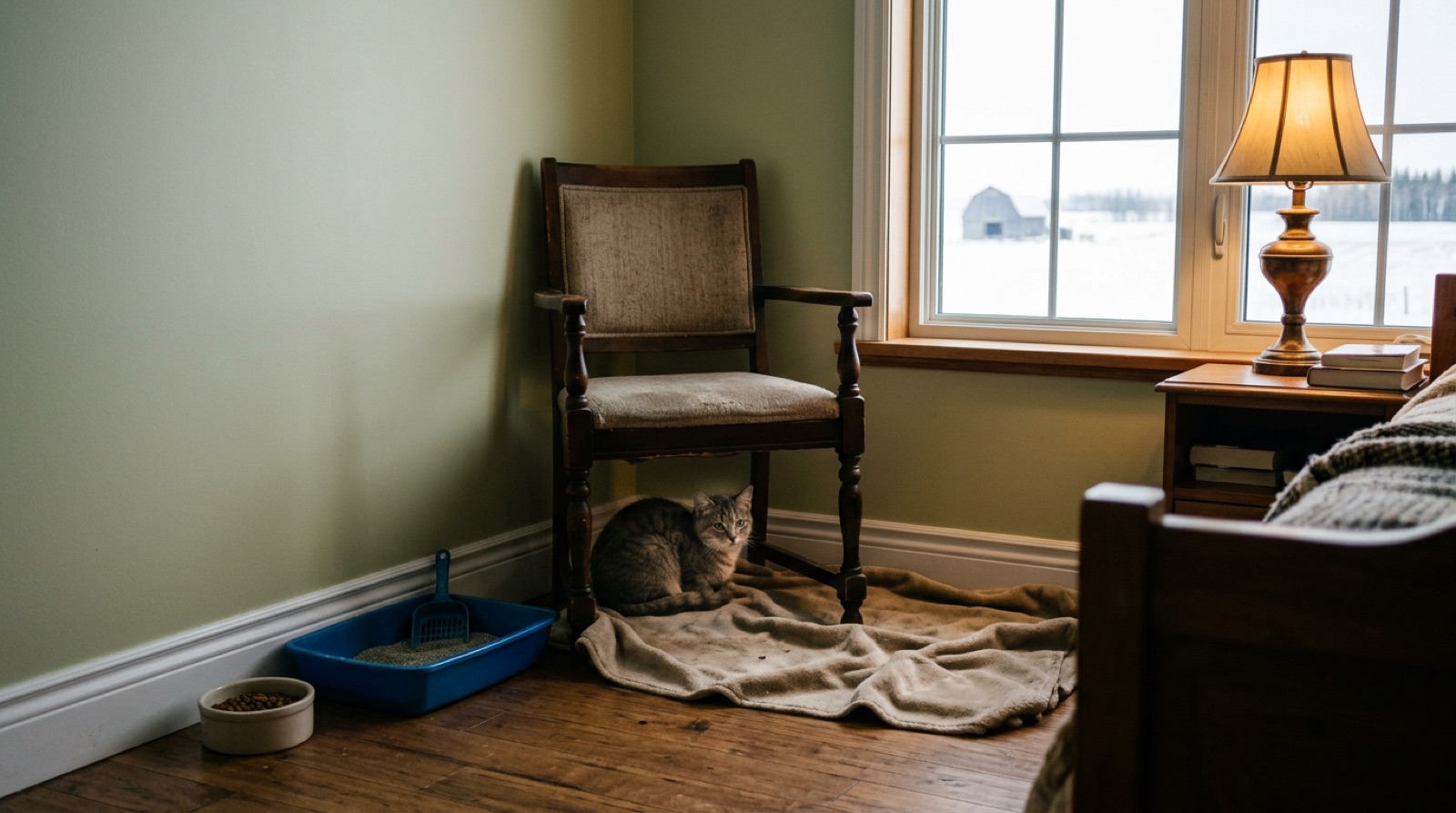
Pick a small quiet room. A spare bedroom or a bathroom with a door that closes. Not the basement, not a laundry room with a noisy machine.
Litter box in a corner with a clear escape route, well away from the food. One box per cat plus one is the standard.
Food and water a few steps from the hiding spot, not across the room. A frightened cat will not cross open floor to eat.
Somewhere to hide. A cardboard box on its side, a covered bed, or space under a chair. Cats settle faster when hiding is allowed than when it is prevented.
Scratching post and one or two toys. A wand toy is the most useful thing you own for the next month.
Block the gaps. Behind the dryer, under the bath panel, inside a box spring. New cats find the one spot you cannot reach.
What the first weeks look like
| When | What to expect |
|---|---|
| Day 1 | Carrier goes in the safe room, door opens, you leave. Most cats hide immediately. Do not pull a cat out from under a bed. Food, water and a box within a few steps of the hiding spot. |
| Days 2 to 3 | Eating and using the box, usually at night while you sleep. That counts as progress. Sit in the room reading aloud without approaching. Ignoring the cat is what builds trust. |
| Days 4 to 7 | Cautious exploring when you are still. Some cats accept a chin scratch by now, some do not. Both are normal. Keep the routine identical every day. |
| Week 2 to 3 | Confidence in the safe room, curiosity about the door. Start opening it to one adjoining room, then more. Do not open the whole house at once. |
| Month 1 to 3 | The real personality shows up, often nothing like the shelter version. Play gets rougher, sleeping spots move to your bed, and the cat starts making requests. |
Every cat runs its own timetable. A confident adult may skip half of this in two days. A shy cat with a hard history may take months, and that is not a failure.
Change nothing you do not have to
Ask the shelter what food and litter the cat has been using and buy the same on the way home. Keep both for at least the first week.
When you do switch, do it over seven to ten days by mixing a growing proportion of the new product into the old. A sudden change stacked on top of moving house is the most common cause of upset stomachs in a new cat, and it muddies the water when you are trying to work out whether the cat is actually unwell.
The same principle applies to everything else. Same feeding times, same room, no visitors for a week, no rearranging furniture. Boring is the whole strategy.
Getting set up with a Moose Jaw vet
Register with a clinic in the first week or two rather than waiting until something goes wrong. Moose Jaw has Moose Jaw Animal Clinic on Caribou Street West, Bellamy Harrison Animal Hospital on Lillooet Street West, and Peak Veterinary Health.
Bring whatever paperwork came from the shelter. Every cat adopted from the Moose Jaw Humane Society is already spayed or neutered, vaccinated and microchipped, so the first visit is usually a wellness check rather than a list of procedures.
Ask two things while you are there: what they recommend for parasite prevention given whether your cat goes outside, and what their after-hours instruction is. Write the second one down.
Symptoms that mean go now
A male cat straining in the litter box and producing nothing is a possible urinary blockage. It is life-threatening within hours, not days, and it needs a vet immediately. Also treat as urgent: laboured or open-mouth breathing, repeated vomiting, no food at all for more than 24 hours, sudden collapse, or a suspected poisoning. Never give a cat human medication, and never wait to see how the night goes on any of these.
Moose Jaw has no dedicated overnight animal hospital. Moose Jaw Animal Clinic states that limited after-hours emergency service is available. The nearest facility offering extended overnight emergency and urgent care is South Saskatchewan Animal Hospital in Regina, about 70 km east. Phone first, and put both numbers on the fridge on day one.
Winter arrivals need one extra step
If you are collecting a cat in January, pre-heat the car and put a blanket over the carrier for the walk out. A short exposure to -30C in a plastic box is genuinely hard on an animal that has been in a heated building for weeks.
Once home, keep the safe room warm and away from a draughty exterior door. And be careful at the entrance for the first month. A cat that has not settled will bolt through an open door, and outside in a Moose Jaw winter is not a place a disoriented indoor cat survives long. That is one of several reasons we make the case for keeping cats indoors here.
Browse adoptable Moose Jaw cats
Adult cats settle faster than kittens and the shelter has plenty waiting. Listings refreshed regularly.
See Available Moose Jaw Cats →Frequently Asked Questions
What do I do on the first day with a rescue cat?
Put the carrier in one small closed room, open the door, and walk away. That single room, ideally a spare bedroom or a quiet bathroom, is the whole world for the first few days. Set up a litter box, food, water, a hiding box and a scratching post within a few steps of each other. Then leave the cat alone. Almost every cat hides on day one, and the biggest early mistake is pulling one out from under the bed to say hello.
Why is my new cat hiding and how long will it last?
Hiding is normal and it is how cats cope with an unfamiliar space rather than a sign of an unfriendly cat. Most rescue cats hide for a few days. Some come out within hours, some take two or three weeks, and the range says more about the cat's history than about your home. The way to shorten it is to be boring and predictable: same feeding times, same quiet room, no visitors, no chasing. Confidence comes from routine, not from coaxing.
Should I change the cat's food right away?
No. Feed whatever the shelter was feeding for at least the first week, then switch gradually over seven to ten days by mixing an increasing proportion of the new food. A sudden change on top of the stress of moving is a reliable way to get diarrhoea, which then makes it hard to tell whether the cat is unwell or just unsettled. Ask what the cat was eating before you leave the shelter and buy a bag of it on the way home.
What about the litter box and litter type?
Same rule. Use the litter the cat is used to for the first week or two, then change slowly if you want to. Put the box somewhere quiet with an escape route, never beside the food, and never in a spot the cat has to pass a dog or a washing machine to reach. The standard advice is one box per cat plus one. Scoop daily. Most litter box problems in a new cat come down to location, cleanliness or a change nobody meant to make.
When should I let the cat into the rest of the house?
When it is confidently using the safe room, eating in front of you and coming to greet you rather than hiding. That is usually somewhere in week two, though it varies. Open the door to one adjoining room first, leave the safe room set up as a retreat, and expand from there over several days. Opening the whole house at once often sends a cat straight under a basement staircase for a fortnight, which sets everything back.
How do I introduce a rescue cat to my existing cat?
Slowly, and through a closed door. Keep them fully separated at first, swap bedding or a towel between them so each learns the other's smell, and feed them on opposite sides of the door so proximity becomes associated with dinner. After several days try a brief supervised look through a cracked door or a baby gate. Hissing at first sight is normal. Sustained stalking or fighting means back up a step. Rushing introductions is what creates permanent tension.
How do I introduce a cat to a dog?
The cat needs an escape route the dog cannot follow, and the dog needs to be on a lead for the first several meetings. Baby gates and cat trees give the cat height and exit options, which matters more than anything else you do. Keep sessions short and end them before either animal gets wound up. A dog that has lived with cats before is much easier than one that has not, so ask about that history before you adopt.
Do I need a vet appointment right away?
Not immediately for a healthy cat, but register with a Moose Jaw clinic in the first week or two and book a wellness check. Moose Jaw Animal Clinic, Bellamy Harrison Animal Hospital and Peak Veterinary Health all serve the city. The visit does two things: it establishes you as a client so you are not a stranger in an emergency, and it gives the vet a baseline for the cat when it is well. Take any paperwork the shelter gave you.
What symptoms mean I should go to a vet now?
A male cat straining in the litter box and producing nothing is the emergency to know. That is a possible urinary blockage, it is life-threatening within hours rather than days, and it needs a vet immediately. Also go now for laboured breathing or open-mouth breathing, repeated vomiting, complete refusal of food for more than 24 hours, sudden collapse, or a suspected poisoning. Never give a cat human medication while you decide. Many are toxic to cats at ordinary doses.
What is the after-hours plan in Moose Jaw?
Sort it out before you need it, because Moose Jaw has no dedicated overnight animal hospital. Moose Jaw Animal Clinic states that limited after-hours emergency service is available, so that is the first number to have. The nearest facility offering extended overnight emergency and urgent care is South Saskatchewan Animal Hospital in Regina, roughly 70 km east on the Trans-Canada. Phone before driving, and factor winter road conditions into the decision rather than assuming a clear run.
The cat is not eating. Should I panic?
A day of picky eating in a brand new home is common, especially if the cat is hiding and only eats overnight. Check whether the food is actually going down before assuming it is not. What is not normal is a cat that eats nothing at all for more than 24 hours, because cats can develop serious liver problems from going without food. If a full day passes with no intake, or the cat also seems lethargic or is hiding more than it was, phone a vet.
How long until the cat acts like itself?
The rough pattern people use is three days to stop panicking, three weeks to settle into the routine, and three months to fully relax and show its real personality. It is a guideline rather than a rule, and shy cats or ones with a rough history take longer. The cat you meet in month three is usually the actual cat. Plenty of adopters are surprised at how different that is from the quiet animal they picked up at the shelter.
Related Moose Jaw Guides
One search, every Moose Jaw cat
Adoptable cats and kittens from the Moose Jaw area, in a single list.
Browse Available Moose Jaw Cats →New cat? Start with these care guides
Everything a new adopter needs to set up a safe, happy home.