The short answer
A Beagle's nose beats its recall, so never trust one off-leash in an unfenced space. This is the breed being a scent hound, not disobedience. Keep a Beagle on leash or long-line in the open, and run it free only inside a securely fenced yard or fully enclosed dog park, proofed against digging and climbing. Beagles are relentlessly food-motivated, which is your training superpower: use high-value treats and reward-based methods, and count the treats against the daily food budget. Manage the baying and howling (a hardwired trait) with exercise, company, and rewarding quiet, never punishment. Above all, channel the nose with scent games and nose work, because a mentally engaged Beagle is a calm, quiet one. Prairie winters mean leaning on indoor nose work.
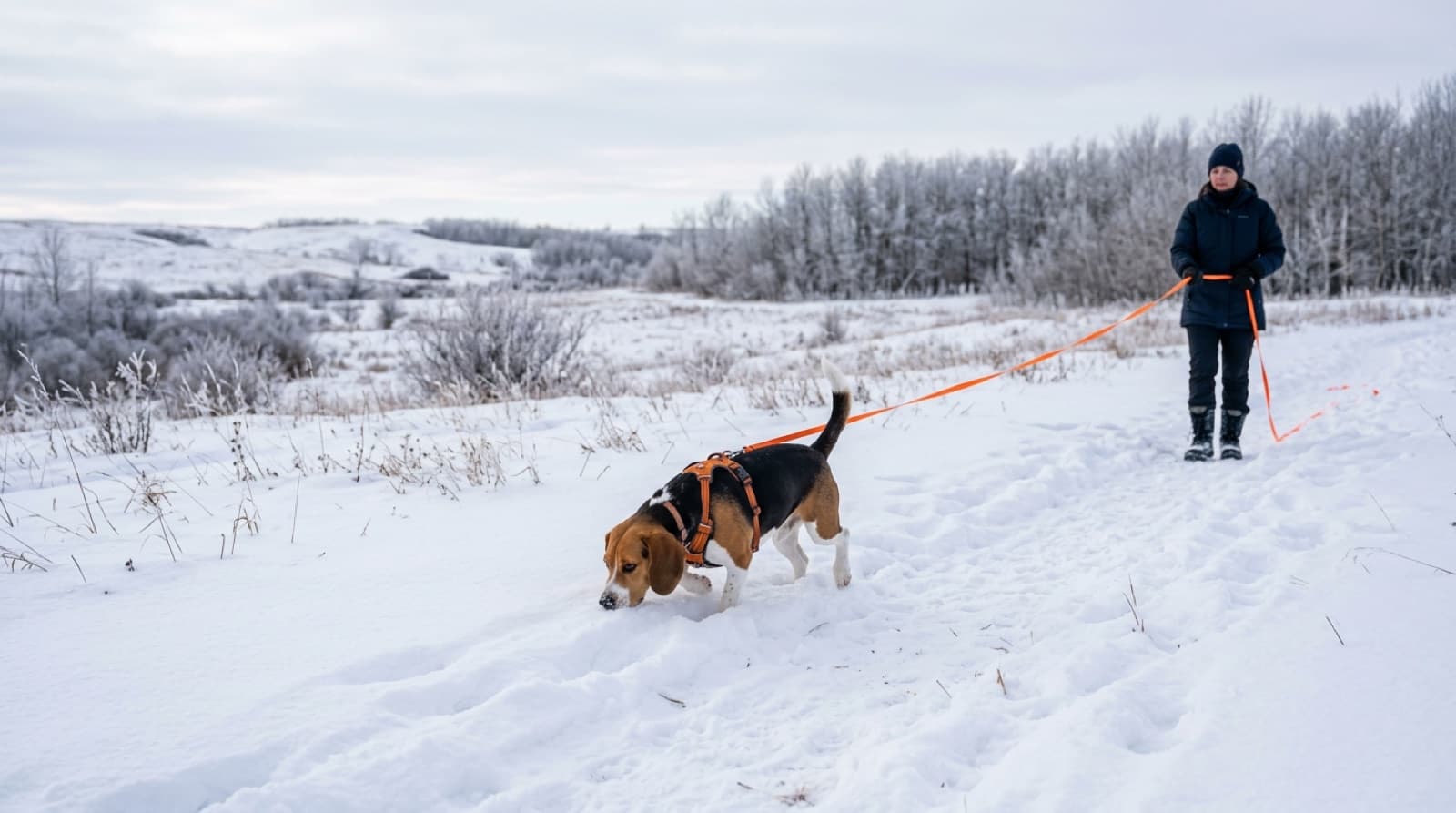
The nose problem: why Beagles seem stubborn
Beagles are not unintelligent, they are independent and scent-driven. Bred as pack hunting hounds to follow a trail for hours without human direction, a Beagle is wired to make its own decisions and to prioritize its nose over your voice. Training a Beagle is less about teaching commands and more about competing with the most powerful nose in dogdom.
The realistic expectation is that a Beagle learns cues well in low-distraction settings but often tunes you out once it catches an interesting smell, which is normal scent-hound behaviour, not defiance, and it fits the merry, determined pack-hound temperament the Canadian Kennel Club describes for the breed. Patience, consistency, short upbeat sessions, and heavy use of food rewards get real results, but a Beagle will never be a biddable off-leash breed, and accepting that shapes how you manage the dog. The good news, covered below, is that the same nose that frustrates you is also the key to a happy, well-behaved Beagle when you channel it.
Never off-leash in the open
This is the single most important rule of Beagle ownership. Once a Beagle catches a scent it wants to track, its recall effectively disappears, so a Beagle off-leash in an unfenced area is a lost-dog situation waiting to happen. Beagles range for kilometres following a trail, oblivious to calling, traffic, or danger, which is why wandering and getting lost are among the top reasons Beagles land in rescue.
The safe rule: a Beagle stays on-leash or long-line in any unfenced space and runs free only inside a securely fenced yard or a fully enclosed dog park, such as the fenced Regina off-leash areas. Train a recall for emergencies and enclosed spaces, but never rely on it in the open. This is not a training failure to overcome, it is the breed being a scent hound, and respecting it is what keeps your Beagle alive on the prairies.
Escape-proofing the yard
A nose-driven dog finds exits other breeds never would. Beagles dig under fences, squeeze through gaps, and occasionally climb, so a secure yard needs a solid fence of adequate height (ideally 1.5 to 1.8 metres) with the bottom secured against digging, buried, lined with an L-footer of wire, or reinforced with paving stones along the fence line.
Check the whole perimeter regularly for gaps and dig spots, keep gates latched and ideally self-closing, and never leave a Beagle unsupervised in a yard you have not fully proofed. Because Beagles bolt through open doors too, teach a wait at doorways and use baby gates or an airlock entry so a slipped collar or opened door does not become a lost dog. Microchipping and a collar tag are non-negotiable insurance for a breed this prone to wandering. Good containment, more than any command, is what keeps a Beagle safe.
Managing the baying and howling
Baying and howling are hardwired Beagle traits, because the breed was developed to give voice on a scent so hunters could follow the pack. Beagles bay when they catch a scent, howl when bored or lonely, and vocalize from excitement, and this noise is one of the top surrender reasons, especially in apartments and close neighbourhoods.
You cannot train the voice out of a Beagle, but you can reduce it: meet the dog's exercise and mental needs so boredom howling drops, avoid leaving the dog alone for long stretches since Beagles are pack animals that vocalize when isolated, and reward quiet calmly rather than giving attention, even negative attention, to the noise. Do not punish baying, which raises anxiety and makes it worse. If noise is a serious concern for your housing, be honest with yourself before adopting, because a Beagle is a naturally vocal dog and no training makes it silent.
Browse adoptable Beagles in Regina
An adult rescue Beagle lets you meet the individual dog and its noise and energy level before you commit. Beagles and Beagle crosses from Regina rescues. Refreshed regularly.
See Available Beagles →Food motivation and scent-work enrichment
A Beagle's intense food drive is your single biggest training asset. Use small, high-value treats as the currency for training, and you can teach cues and build engagement faster than with a less food-focused breed. Just count every treat against the daily food budget, because this obesity-prone breed gains weight fast, and use part of the daily kibble as rewards.
Beyond training, a Beagle needs to use its nose, so scent enrichment is a core need, not a luxury. Scatter-feed kibble in grass or a snuffle mat, hide treats around the house for the dog to find, use food-dispensing puzzle toys, and play find-it games, and formal nose-work training is something Beagles excel at and love. Pair that with real physical exercise, at least an hour a day, and company, since Beagles are pack animals. A Beagle whose nose and body are engaged is calmer, quieter, and happier, while an under-stimulated one finds its own entertainment in ways you will not enjoy. Keeping the dog lean while you do all this ties back to the Beagle health issues guide.
Nose work through a prairie winter
A Beagle still needs real daily exercise and nose work through a Regina winter, and the deep cold makes that harder, so you lean more on indoor enrichment and shorter, warmer outdoor time. A coat helps on the coldest days, booties protect against salt and ice, and a securely fenced yard lets a Beagle snuffle safely.
Indoors is where you make up the difference for a scent hound: scatter-feed meals, hide treats and kibble around the house for the dog to track down, use puzzle feeders and snuffle mats, run short training and scent-work sessions, and play find-it games. This olfactory work tires a Beagle as effectively as a walk and prevents the boredom howling and destructiveness that under-exercised Beagles fall into during long cold spells. With a coat and a good indoor nose-work routine, a Beagle stays happy and well behaved through winter. Our Regina winter dog care guide has the full cold-weather routine.
Frequently Asked Questions
Are Beagles hard to train?
Beagles are not unintelligent, they are independent and scent-driven, which is different, and that catches owners off guard. Bred as pack hunting hounds to follow a scent for hours without human direction, a Beagle is wired to make its own decisions and to prioritize its nose over your voice, so training a Beagle is less about teaching commands and more about competing with the most powerful nose in dogdom. The upside is that Beagles are relentlessly food-motivated, which gives you a genuine training superpower if you use high-value treats and reward-based methods. The realistic expectation is that a Beagle can learn cues well in low-distraction settings but will often tune you out once it catches an interesting smell, which is normal scent-hound behaviour, not disobedience. Patience, consistency, short upbeat sessions, and heavy use of food rewards get results, but a Beagle will never be a Border Collie in terms of biddable off-leash reliability, and accepting that shapes how you manage the dog.
Can Beagles be trusted off-leash?
Honestly, no, not reliably, and this is the single most important thing to understand about the breed. A Beagle follows its nose, and once it catches a scent it wants to track, its recall effectively disappears, so a Beagle off-leash in an unfenced area is a lost-dog situation waiting to happen. Beagles can and do range for kilometres following a trail, oblivious to your calling, traffic, or danger, which is exactly why wandering and getting lost are among the top reasons Beagles end up in rescue. The safe rule is that a Beagle stays on-leash or long-line in any unfenced space and only runs free inside a securely fenced yard or a fully enclosed dog park like the Cathy Lauritsen Off-Leash Dog Park. You can and should still train a recall for emergencies and for use in safe enclosed spaces, but you should never rely on it in the open. This is not a training failure, it is the breed being a scent hound, and respecting it keeps your Beagle alive.
How do I train a recall on a Beagle?
Train a recall knowing it is for safe enclosed spaces and emergencies, not for off-leash freedom in the open. Start in a low-distraction environment like a hallway or fenced yard, use very high-value treats, something better than the smell competing for attention, and make coming to you the best thing that ever happens, with a jackpot of rewards and praise every single time. Use a consistent recall word, never use it to summon the dog for anything unpleasant, and practise on a long line so the dog can never fully self-reward by running off. Gradually add distractions, but expect scent to beat you often, and never punish a Beagle for a slow or failed recall, because that only makes coming to you less rewarding. Practising recall as a fun game with food rewards builds the strongest response you can get, which for a Beagle is useful but never guaranteed in the open. Pair it with a rock-solid habit of leash and fence management, and you have a safe, happy dog.
How do I stop my Beagle from escaping the yard?
Escape-proofing is essential for a Beagle, because a nose-driven dog will find a way out that other breeds never would. Beagles dig under fences, squeeze through gaps, and occasionally climb, so a secure yard needs a solid fence of adequate height, ideally at least 1.5 to 1.8 metres, with the bottom secured against digging, either buried, lined with an L-footer of wire, or reinforced with paving stones or a concrete base along the fence line. Check the whole perimeter regularly for gaps and dig spots, keep gates latched and ideally self-closing, and never leave a Beagle unsupervised in a yard you have not fully proofed. Because Beagles bolt through open doors too, teach a wait at doorways and use baby gates or an airlock entry so a slipped collar or an opened door does not become a lost dog. Microchipping and a collar tag are non-negotiable insurance for a breed this prone to wandering. Good containment, more than any command, is what keeps a Beagle safe.
Why does my Beagle howl and bay so much, and can I stop it?
Baying and howling are hardwired Beagle traits, because the breed was developed to give voice on a scent so hunters could follow the pack, so a vocal Beagle is doing exactly what it was bred to do. Beagles bay when they catch a scent, howl when bored or lonely, and vocalize from excitement, and this noise is one of the top reasons Beagles are surrendered, especially in apartments and close neighbourhoods. You cannot train the voice out of a Beagle entirely, but you can reduce it: meet the dog's exercise and mental needs so boredom howling drops, avoid leaving the dog alone for long stretches since Beagles are pack animals that vocalize when isolated, and reward quiet calmly rather than giving attention, even negative attention, to the noise. Do not punish baying, which can increase anxiety and make it worse. If noise is a serious concern for your housing, be honest with yourself before adopting, because a Beagle is a naturally vocal dog and no amount of training makes it silent.
How do I use a Beagle's food motivation in training?
A Beagle's intense food drive is your single biggest training asset, so lean into it. Use small, high-value treats, something more exciting than the average kibble, as the currency for every bit of training, and because Beagles will work hard for food, you can teach cues, shape behaviours, and build engagement faster than with a less food-focused breed. Two cautions come with this superpower. First, count every training treat as part of the daily food budget, because this obesity-prone breed gains weight fast, so use tiny pieces and reduce meals accordingly, or use part of the daily kibble ration as training rewards. Second, food obsession means a Beagle will counter-surf, raid the garbage, and steal food, so training a solid leave-it and manage the environment by securing food and bins. Puzzle feeders and food-dispensing toys double as training and enrichment, slowing eating while engaging the brain. Used wisely, food turns a stubborn scent hound into an eager, willing partner.
What enrichment does a Beagle need?
A Beagle needs to use its nose, so scent-based enrichment is not a luxury for this breed, it is a core need that prevents boredom, howling, and destructive behaviour. Channel the nose with activities that let the dog do what it was built for: scatter-feeding kibble in the grass or a snuffle mat, hiding treats around the house or yard for the dog to find, food-dispensing puzzle toys, and simple nose-work games where the dog searches for a hidden scent or treat. Formal scent-work or nose-work training is a fantastic outlet and something Beagles excel at and love. Beyond scent, Beagles need real physical exercise, at least an hour a day of walks and safe running, and social time, since they are pack animals that do poorly when isolated. A Beagle whose nose and body are engaged is a calmer, quieter, happier dog, while an under-stimulated Beagle finds its own entertainment in ways you will not enjoy. Building daily nose work into the routine is the best thing you can do for a Beagle's behaviour.
How do I exercise and manage a Beagle through a Regina winter?
A Beagle still needs real daily exercise and nose work through a prairie winter, and the deep cold makes that harder, so you lean more on indoor enrichment and shorter, warmer outdoor time. Outdoors, a coat helps on the coldest days, booties protect against salt and ice, and a securely fenced yard lets a Beagle snuffle safely, but keep outings shorter when it is -35 with windchill and watch for shivering and lifted paws. Indoors is where you make up the difference for a scent hound: scatter-feed meals, hide treats and kibble around the house for the dog to track down, use puzzle feeders and snuffle mats, run short training and scent-work sessions, and play find-it games that engage the nose. This mental and olfactory work tires a Beagle as effectively as physical exercise and prevents the boredom howling and destructiveness that under-exercised Beagles fall into during long cold spells. With a coat and a good indoor nose-work routine, a Beagle stays happy and well behaved through a Regina winter.
Related Guides
New dog? Start with these care guides
Everything a new adopter needs to set up a safe, happy home.