The short answer
The curly coat is low-shed but high-maintenance, and this is the whole commitment. It grows continuously and mats against the skin without care, so plan for professional grooming every 6 to 8 weeks ($60 to $100-plus per visit, roughly $500 to $900-plus a year) plus thorough home brushing several times a week. Brush all the way to the skin, not just the surface, focusing on behind the ears, armpits, groin, legs, and tail. A short puppy-cut clip eases home care but still needs regular grooming. Manage ears, eyes, and paw hair as part of the routine. In a Regina winter, a clipped coat needs a warm dog coat, trimmed paw fur, and steady brushing. Underestimating all this is the top surrender reason, so budget it before you adopt.
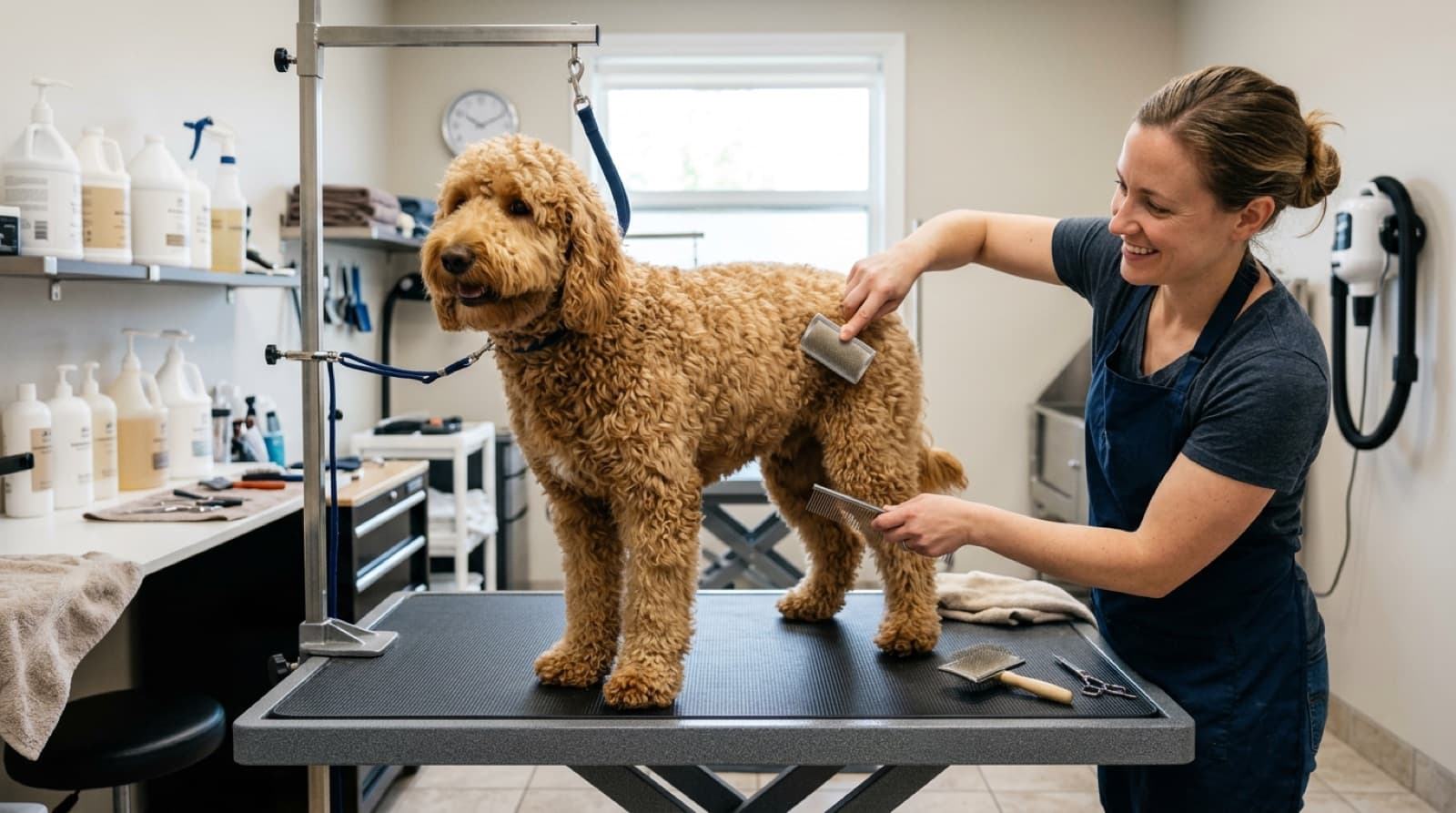
Why the coat is the whole commitment
A Poodle or Doodle coat grows continuously and holds shed hair within the curls instead of dropping it on your floor, which is why it does not shed but instead mats against the skin if not maintained. Plan for professional grooming every 6 to 8 weeks plus regular home brushing, and treat both as non-negotiable.
This is the reality that surprises new owners and drives surrenders. Low-shed does not mean low-maintenance, it means the work moves from vacuuming hair off the floor to brushing hair out of the coat and paying a groomer regularly. That dense, curly, continuously growing coat is exactly the coat the Canadian Kennel Club describes in the Poodle standard. Doodles are often worse than purebred Poodles, because the mixed coat can be softer and more tangle-prone, and it changes texture as a puppy matures around eight to twelve months, which is when heavy matting often appears for the first time. Budget the recurring grooming cost before you adopt, because underestimating it is the number-one reason these dogs end up in rescue, as covered in our Poodle and Doodle adoption guide.
Matting: why it happens and why it matters
Mats are not just cosmetic. They pull painfully at the skin, trap moisture and debris, hide skin infections and parasites, and cut off air to the skin, and severe matting is a genuine welfare problem that usually forces a full shave-down. The fastest-matting spots are behind the ears, the armpits and groin, the legs, the tail, and anywhere a collar or harness rubs.
Mats form at the base of the coat, against the skin, which is exactly where surface brushing misses them, so the mat grows unseen under a fluffy-looking top layer until it is tight and painful. This is why brushing technique matters as much as frequency, and why letting the coat go for a few weeks to save on grooming backfires into a shave-down and an uncomfortable dog. Never bathe a matted dog, because water tightens the mats.
How to brush at home: line brushing
The key is to brush all the way down to the skin, not just over the surface. Use a slicker brush and a metal comb, and work in sections using line brushing: part the coat, brush a thin layer from the skin outward, then move up in layers until the whole area is done. Finish by running the comb through to the skin to confirm there are no tangles left, because if the comb snags, there is still a mat.
Pay special attention to the high-friction spots that mat fastest, and brush at least several times a week, ideally most days for a longer or heavier coat. Keep sessions short and positive with treats so the dog tolerates it as routine. This home brushing between professional grooms is what keeps the coat healthy and the grooming bills manageable, and it is genuinely a several-times-a-week habit, not an occasional one.
Clip length, cost, and the coat lottery
A short puppy cut makes home maintenance much easier and is a popular, legitimate choice, since a Poodle or Doodle has a single growing coat you can safely clip short (unlike a double-coated breed). But a short coat still needs grooming every 6 to 8 weeks because it keeps growing, and it provides little winter insulation.
Professional grooming in Regina runs roughly $60 to $100 or more per visit depending on size, coat length, and condition, adding up to roughly $500 to $900 or more per year. A matted coat costs more because it takes longer or needs a shave-down. And remember the coat is a lottery, especially in Doodles: a Doodle can inherit a low-shed curly coat, a heavier flatter coat, or anything between, even within a litter, so if minimal shedding matters to you, feel the specific dog's coat rather than trusting a promise. The coat also ties directly into health, since matting and trapped moisture cause the skin and ear problems covered in our health issues guide.
Browse adoptable Poodles and Doodles in Regina
If you can commit to the coat, these are wonderful, trainable dogs. Standard, Miniature, and Toy Poodles plus Doodle crosses from Regina rescues. Refreshed regularly.
See Available Poodles and Doodles →Coat care through a Regina winter
Winter changes the job in two directions. Warmth: a short-clipped coat is a poor insulator, so a clipped dog needs a warm, well-fitted coat for deep-cold walks, and it is worth keeping the coat a bit longer through the coldest months. Do not shave to the skin in winter. Matting and paws: snow and ice ball up badly in curly leg and paw hair.
Trim the fur between the paw pads, wipe or rinse the feet after walks to clear salt and ice-melt, and dry the dog thoroughly when you come in, because a damp curly coat mats faster. Salt and dry indoor air can irritate the skin, so do not over-bathe. Keep up the regular brushing, because the coat mats more readily in winter where snow collects and where a coat or harness rubs. With a warm coat on cold days, careful paw care, and steady brushing, a Poodle or Doodle stays comfortable and mat-free through a prairie winter. Our Regina winter dog care guide has the full cold-weather routine.
Frequently Asked Questions
How often does a Poodle or Doodle need grooming?
Plan on professional grooming every six to eight weeks, plus regular home brushing in between, and this is not optional for a curly or wavy coat. Unlike a shedding coat that drops dead hair, a Poodle or Doodle coat grows continuously and holds onto shed hair within the curls, which is why it does not shed on your floor but instead mats against the skin if not maintained. A professional groom includes bathing, drying, clipping or scissoring the coat to length, and tidying the face, feet, and sanitary areas, at roughly $60 to $100 or more per visit in Regina depending on size and coat condition. Between grooms, you need to brush thoroughly several times a week, more for a longer coat or a heavy-coated Doodle, to prevent mats. Skipping either the professional schedule or the home brushing leads to matting, which is uncomfortable for the dog and often means a full shave-down. Budget the recurring grooming cost before you adopt, because underestimating it is the number-one reason these dogs are surrendered.
Why does a Doodle coat mat so badly?
A Doodle coat mats because it combines a continuously growing, curly or wavy texture with hair that sheds into the coat rather than off the dog, so loose hair tangles with growing hair and, without frequent brushing, forms tight mats against the skin. Doodles are often worse than purebred Poodles because the mixed coat can be softer and more prone to tangling, and the coat changes texture as a puppy matures, usually around eight to twelve months, which is when many owners suddenly face heavy matting for the first time. Mats are not just cosmetic: they pull painfully at the skin, trap moisture and debris, hide skin infections and parasites, and cut off air to the skin, and severe matting is a genuine welfare problem that usually forces a full shave-down. The areas that mat fastest are behind the ears, the armpits and groin, the legs, the tail, and anywhere a collar or harness rubs. Frequent, thorough brushing all the way to the skin, not just over the top, is the only thing that prevents it.
How do I brush a Poodle or Doodle at home?
The key is to brush all the way down to the skin, not just over the surface, because mats form at the base of the coat where surface brushing misses them. Use a slicker brush and a metal comb, and work in sections using a technique called line brushing: part the coat, brush a thin layer from the skin outward, then move up in layers until the whole area is done, and finish by running the comb through to the skin to confirm there are no tangles left, because if the comb snags, there is still a mat. Pay special attention to the high-friction, fast-matting spots: behind the ears, armpits, groin, legs, tail, and under the collar or harness. Brush at least several times a week, ideally most days for a longer or heavier coat, and never bathe a matted dog, because water tightens mats. Keeping sessions short and positive with treats makes it a routine the dog tolerates. Regular home brushing between professional grooms is what keeps the coat healthy and the grooming bills manageable.
Should I shave my Poodle or Doodle down short?
A short all-over clip, often called a puppy cut or a short summer cut, is a completely legitimate and popular choice that makes home maintenance much easier, and many Regina owners keep their Doodle in a short clip year-round for exactly that reason. It is not the same as shaving a double-coated breed, which you should never do, because a Poodle or Doodle has a single continuously growing coat, so clipping it short simply resets the length and it grows back normally. The trade-offs to know: a short-clipped coat still needs professional grooming every six to eight weeks because it keeps growing, and a short coat provides little insulation, so a short-clipped Poodle or Doodle genuinely needs a warm coat for a Regina winter and should be kept a bit longer through the coldest months. Discuss the length with your groomer based on your maintenance ability and the season. A shorter clip is the practical choice for many owners, but it does not eliminate the grooming schedule, only the daily brushing intensity.
Are Poodles and Doodles low-shedding or non-shedding?
Low-shedding, not non-shedding, and the difference matters. Poodles and many Doodles shed very little compared to a typical dog, because the shed hair is caught within the curly coat instead of falling onto your floor and furniture, which is a real advantage for cleanliness and for some allergy sufferers. But the hair is still shedding, it is just staying in the coat, which is exactly why the coat mats and why brushing is essential, so low-shed does not mean low-maintenance, it means the maintenance moves from vacuuming to brushing and grooming. Doodles are less predictable than Poodles, because the coat is a lottery: a Doodle can inherit a low-shed curly coat like the Poodle, a heavier-shedding flatter coat like the other parent, or anything in between, even within one litter. If minimal shedding is important to you, meet the specific dog and feel its coat rather than trusting a low-shed promise, especially with a Doodle.
How much does Poodle or Doodle grooming cost in Regina?
Professional grooming in Regina typically runs roughly $60 to $100 or more per visit, depending on the dog's size, coat length and condition, and the salon, and at an every-six-to-eight-week schedule that adds up to roughly $500 to $900 or more per year, a genuine recurring cost that belongs in your budget before you adopt. A large Doodle in a longer coat costs more than a small Poodle in a short clip, and a matted coat costs more because it takes longer and may require a shave-down. You can reduce the cost somewhat by keeping the coat in a shorter, easy-care clip and by doing thorough home brushing so grooms go faster, and some owners learn to do basic maintenance clipping themselves, though this takes skill and the right tools. What you should not do is stretch the interval to save money and let the coat mat, because that leads to a painful, unhealthy dog and a bigger bill. Budgeting realistically for grooming is essential, since underestimating it is the top reason these dogs end up in rescue.
Do Poodles and Doodles need special ear and eye care?
Yes, and it is part of the grooming routine that keeps them healthy. Poodles and most Doodles grow hair inside the ear canal, which combined with floppy ears traps moisture and leads to frequent ear infections, so the ears need regular cleaning and the canal hair managed as your groomer or vet advises, and the ears dried thoroughly after every bath. The eyes need attention too, because hair growing around the eyes can irritate them and cause staining, and it should be trimmed carefully or kept out of the eyes, which a groomer handles at each visit. The feet also need care: hair grows between the paw pads and should be trimmed to prevent matting and, in a Regina winter, to stop snow and ice balling up painfully between the toes. All of this is why a groom is more than a haircut, and why the six-to-eight-week schedule matters for health, not just appearance. Between grooms, check ears weekly and keep eye and paw hair from causing problems.
How do I manage a Poodle or Doodle coat through a Regina winter?
Winter changes the coat job in two directions. First, warmth: a short-clipped Poodle or Doodle coat is not a good insulator, so a clipped dog needs a warm, well-fitted coat for walks in deep cold, and it is worth keeping the coat a bit longer through the coldest months for extra warmth rather than clipping tight. Do not shave to the skin in winter. Second, matting and paws: snow and ice ball up badly in curly leg and paw hair, so trim the fur between the paw pads, wipe or rinse the feet after walks to clear salt and ice-melt, and dry the dog thoroughly when you come in, because a damp curly coat mats faster. Salt and dry indoor air can also irritate the skin, so do not over-bathe. Keep up the regular brushing, because the coat mats more readily in winter where snow collects and where a coat or harness rubs. With a warm coat on cold days, careful paw care, and steady brushing, a Poodle or Doodle stays comfortable and mat-free through a prairie winter.
Related Guides
New dog? Start with these care guides
Everything a new adopter needs to set up a safe, happy home.