The short answer
The Rottweiler's biggest health concern is bone cancer (osteosarcoma), which the breed develops at some of the highest rates of any dog, plus elevated lymphoma and hemangiosarcoma. Next come hip and elbow dysplasia, a high rate of cruciate ligament tears, the heart defect subaortic stenosis, and, as a deep-chested breed, bloat. Add hypothyroidism, entropion, and the Rottweiler-specific JLPP. Life expectancy is a relatively short 8 to 10 years. The habits that matter most: keep the dog lean, insure early, and take any limp or leg swelling seriously given the bone-cancer risk. Regina emergencies go to the 24 HR Animal Care Centre (306-761-1449), and oncology and cardiology refer to the WCVM in Saskatoon. This is general information. Always consult your veterinarian.
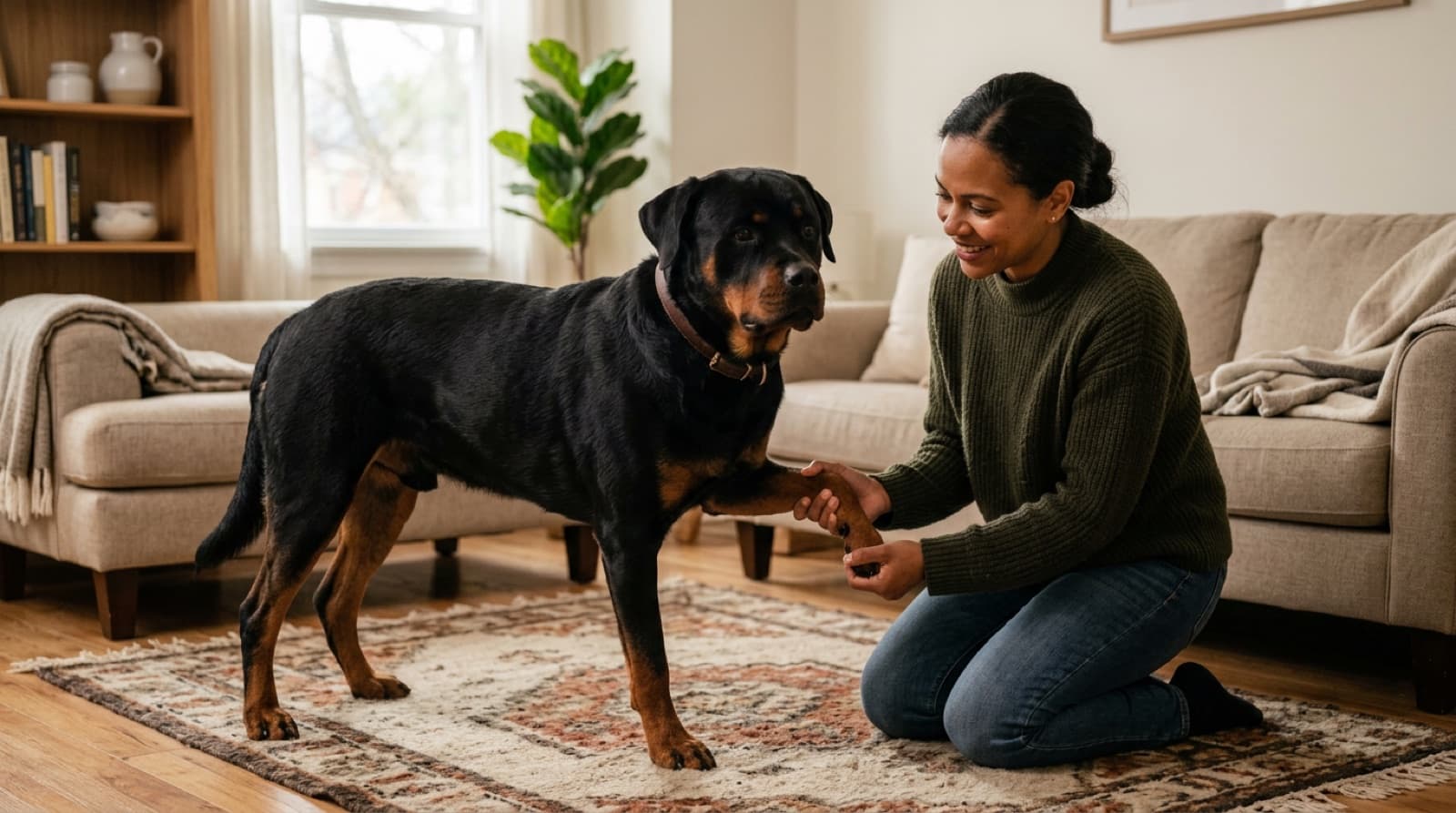
Bone cancer: the breed-defining concern
Rottweilers develop osteosarcoma, an aggressive bone cancer, at some of the highest rates of any breed, and it is a leading cause of death. It usually strikes the long bones of the legs, and the first sign is often a limp or lameness, or a firm swelling on a leg, that does not resolve. Rottweilers also see elevated lymphoma and hemangiosarcoma.
The practical takeaway is a rule every Rottweiler owner should live by: any persistent limp or leg swelling gets a prompt vet visit, not a wait-and-see. Osteosarcoma is aggressive and can spread, so early diagnosis matters for both treatment options and the dog's comfort. Treatment ranges from amputation and chemotherapy to palliative pain control depending on the stage.
This risk is the single strongest argument for enrolling pet insurance while the dog is young and healthy, because cancer treatment for a large dog runs into the thousands. Learn to run your hands over the dog monthly, and never dismiss a new limp in a Rottweiler as just a strain without a vet look.
Hips, elbows, and cruciate tears
Hip and elbow dysplasia are both common in the breed, and Rottweilers also have a high rate of cranial cruciate ligament rupture, essentially a torn knee ligament that often needs surgery and can affect both knees over time. Responsible breeders screen parents through the Orthopedic Foundation for Animals.
Watch for stiffness after rest, reluctance to jump or climb stairs, a bunny-hop gait, slowing on walks, or sudden lameness in a hind leg, which can signal a cruciate tear. In a rescue Rottie you usually will not have clearances, so raise any signs with your vet, who can grade the joints and plan care. Weight is the biggest lever you control: a lean Rottweiler puts far less load through hips, elbows, and knees, protecting all of them. Regina winters are the trap, because walks shrink during the -35 to -45 windchill weeks, so cut the food to match or the winter pounds land straight on vulnerable joints.
Heart: subaortic stenosis
The main congenital heart concern in Rottweilers is subaortic stenosis, a narrowing below the aortic valve that makes the heart work harder, and the breed is one of the classic ones for it. A vet often first notices it as a murmur, and a cardiologist confirms severity with an echocardiogram.
Mild cases can live normal lives. More severe cases need monitoring and sometimes medication, and severe stenosis carries a risk of sudden collapse, which is one reason breeding parents should carry a cardiac clearance. Rottweilers can also develop dilated cardiomyopathy with age. For a rescue Rottie, ask whether a murmur has ever been noted and have your vet listen carefully at the first exam. Fainting, exercise intolerance, or laboured breathing warrants prompt attention. A board-certified veterinary cardiologist, reachable through referral from Regina to the WCVM in Saskatoon, assesses severity and guides management.
Bloat, thyroid, and weight
As a large, deep-chested breed, Rottweilers carry real bloat risk, a sudden emergency where the stomach fills with gas and can twist. Know the signs, a hard swollen belly with unproductive retching, restlessness, and drooling, and treat it as go-now, because bloat kills within hours. Ask your vet about smaller meals, avoiding hard exercise right after eating, and whether a preventive gastropexy fits your dog.
Rottweilers can also develop hypothyroidism, easily diagnosed by blood test and managed with a daily pill, and entropion, an eyelid that rolls inward and irritates the eye, which is surgically correctable. Underneath all of it sits weight: a lean Rottweiler has healthier joints, an easier-working heart, and better odds all round. You should feel the ribs easily under a light layer. If you cannot, talk to your vet about portions, because obesity accelerates every other problem this breed faces.
Browse adoptable Rottweilers in Regina
A rescue Rottweiler comes with a vet workup and, often, a known history, which is a real head start on the breed's health picture. Refreshed regularly.
See Available Rottweilers →Emergency and specialty vet care from Regina
For after-hours crises, the 24 HR Animal Care Centre (306-761-1449) in Regina is Saskatchewan's only true 24-hour animal hospital, so it is your first call for a bloat emergency or a sudden collapse. For tertiary specialty work, the province's referral centre is the WCVM Veterinary Medical Centre at the University of Saskatchewan in Saskatoon, which offers oncology, cardiology, and surgery, close to the exact range a Rottweiler may need. That is roughly a 2.5-hour drive north, so it is worth knowing the path before you need it.
Because bloat and some cardiac events are true emergencies, keep the 24 HR Animal Care Centre address and phone where everyone can find them, and read our Regina emergency vet guide before you ever need it. A hard swollen belly with unproductive retching, or sudden collapse, means go immediately. And take any persistent limp or leg swelling to your vet promptly, given the breed's bone-cancer risk. Your regular Regina vet coordinates the WCVM oncology and cardiology referrals and handles local follow-up.
Frequently Asked Questions
What health problems are Rottweilers most prone to?
The biggest concerns in Rottweilers are cancer and joint disease. Cancer is the breed-defining issue, especially osteosarcoma, an aggressive bone cancer that Rottweilers develop at some of the highest rates of any breed, along with elevated lymphoma and hemangiosarcoma. Joint disease means hip and elbow dysplasia, both common in the breed, plus a high rate of cranial cruciate ligament tears, the dog equivalent of a torn ACL. Rottweilers also carry heart risk, mainly subaortic stenosis, a congenital narrowing near the heart, and as a deep-chested breed they are at risk of bloat. Add hypothyroidism, entropion, obesity, and JLPP, a Rottweiler-specific inherited neurological disease, and you have the full picture. Rottweilers also live a relatively short 8 to 10 years. None of this should scare you off a magnificent breed, but it should shape your budget and insurance. Always consult your veterinarian for diagnosis and treatment.
Are Rottweilers prone to bone cancer?
Yes, and it is the breed's most serious health concern. Rottweilers develop osteosarcoma, an aggressive bone cancer, at some of the highest rates of any breed, and it is a leading cause of death in the breed. It typically strikes the long bones of the legs, and the first sign is often a limp or lameness, or a firm swelling on a leg, that does not resolve. Because osteosarcoma is aggressive and can spread, any persistent limp or leg swelling in a Rottweiler warrants prompt veterinary attention rather than a wait-and-see, since early diagnosis matters for both treatment options and comfort. Treatment can involve amputation, chemotherapy, or palliative care depending on the stage, all of which are reasons to enrol pet insurance while the dog is young and healthy. Rottweilers also see elevated rates of lymphoma and hemangiosarcoma. This is one of the strongest arguments for insuring the breed early. Consult your veterinarian about any lameness or swelling.
Do Rottweilers have hip and joint problems?
Yes, several. Hip and elbow dysplasia are both common in Rottweilers, which is why responsible breeders screen the parents through the Orthopedic Foundation for Animals. Dysplasia is a malformed joint that leads to arthritis, with signs like stiffness after rest, reluctance to jump or climb stairs, a bunny-hop gait, and slowing on walks. Rottweilers are also prone to cranial cruciate ligament rupture, essentially a torn knee ligament, which often needs surgery and can affect both knees over time. For a rescue Rottweiler you usually will not have parent clearances, so watch for the signs and raise them with your vet. Weight control is the single biggest lever you control: a lean Rottweiler carries far less load through vulnerable joints, which protects hips, elbows, and knees alike. Regina winters make weight management harder because exercise drops in the -35 to -45 windchill weeks, so watch the food bowl when walks get short. Your vet can grade the joints and build a plan.
What heart conditions affect Rottweilers?
The main congenital heart concern in Rottweilers is subaortic stenosis, a narrowing below the aortic valve that forces the heart to work harder, and the breed is one of the classic ones for this condition. A vet may first detect it as a murmur during an exam, and a cardiologist confirms severity with an echocardiogram. Mild cases can live normal lives, while more severe cases need monitoring and sometimes medication, and severe stenosis carries a risk of sudden collapse or death, which is why breeding parents should carry a cardiac clearance. Rottweilers can also develop dilated cardiomyopathy, a disease of the heart muscle, as they age. For a rescue Rottie, ask whether a murmur has ever been noted and have your vet listen carefully at the first exam. Any fainting, exercise intolerance, or laboured breathing warrants prompt veterinary attention. A board-certified veterinary cardiologist, reachable through referral from Regina to the WCVM in Saskatoon, guides diagnosis and management. Always consult your veterinarian.
Are Rottweilers at risk of bloat?
Yes. Rottweilers are a large, deep-chested breed, which raises the risk of bloat, medically gastric dilatation-volvulus, a sudden and life-threatening emergency in which the stomach fills with gas and can twist. Signs include a distended or hard belly, unproductive retching or trying to vomit with nothing coming up, restlessness, drooling, and collapse. Bloat kills quickly, often within hours, so it is a go-to-the-emergency-vet-immediately situation, not a wait-and-see one. In Regina that means the 24 HR Animal Care Centre. Risk-reduction steps your vet may suggest include feeding two or three smaller meals rather than one large one, avoiding heavy exercise right after eating, and, for some deep-chested dogs, a preventive surgical procedure called a gastropexy, sometimes done at the same time as spay or neuter. Know the signs before you ever need them, and keep the emergency clinic's number handy. Consult your veterinarian about prevention for your dog.
What is JLPP in Rottweilers?
JLPP, or juvenile laryngeal paralysis and polyneuropathy, is a serious inherited neurological disease specific to Rottweilers. It affects nerve function, causing breathing difficulty from laryngeal paralysis along with progressive weakness and coordination problems, usually appearing in young dogs. It is a recessive genetic condition, which means there is a DNA test, and responsible breeders test their breeding stock so they never produce an affected puppy. For a rescue Rottweiler you will usually not know the parents' status, but JLPP is relatively uncommon and typically shows early, so an adult rescue dog without symptoms is very unlikely to develop it. If you are buying from a breeder rather than adopting, confirming that both parents have been JLPP-tested is essential, because it is one of the few Rottweiler conditions that is entirely preventable through testing. Any breathing difficulty, voice change, or hind-end weakness in a young Rottweiler warrants prompt veterinary assessment. Consult your veterinarian.
How long do Rottweilers live?
Rottweilers commonly live only 8 to 10 years, shorter than most breeds, largely because of the breed's high cancer rate and the toll that large size takes on the body. That shorter runway is worth being honest with yourself about before adopting, especially with a puppy or younger dog. The good news is that good weight management, dental care, parasite prevention, and staying current on vet checks all support the healthiest possible life, and keeping a Rottweiler lean is one of the biggest levers an owner controls, protecting joints and reducing strain on the heart. Because cancer and joint disease are the leading concerns, twice-yearly vet checks for a middle-aged or senior Rottie help catch problems early, when treatment works best and comfort can be preserved longest. A senior Rottweiler still has love and good years to give, so do not let the lifespan number rule out a senior adoption. Consult your veterinarian about an age-appropriate wellness schedule.
Should I get pet insurance for a Rottweiler?
For this breed, strongly yes, and enrol early. Rottweilers carry one of the highest bone-cancer rates of any breed, plus real joint, cruciate, and heart risk, and any one of those can produce a large vet bill, from cancer surgery and chemotherapy to cruciate repair and cardiology workups. Pet insurance for a young healthy Rottweiler is commonly $50 to $100 per month, reflecting the size and risk, and the key is to enrol before any condition appears, because pre-existing conditions are excluded once diagnosed. If you adopt an adult or senior Rottweiler that already has a noted condition, insurance is harder and pricier, so weigh a dedicated vet savings fund instead. Either way, plan as if a significant medical event is likely at some point, because for this breed the odds of a serious health issue over a lifetime are meaningfully higher than average, and the bills are large-dog bills. This is general information, not financial advice.
Are Rottweiler mixes healthier than purebreds?
Sometimes, but do not count on it. Crossbreeding can widen the gene pool and reduce the odds of some inherited conditions, an effect often called hybrid vigour, but it does not erase risk. A Rottador or Shepweiler can still inherit hip or elbow dysplasia, cancer predisposition, cruciate weakness, or heart disease from either parent, and the other breed adds its own concerns. What actually protects health in a mix is the same as in a purebred: the health of the parents, a lean body weight, good preventive care, and early insurance. In a rescue you rarely know the parents, so treat any Rottweiler cross as carrying the breed-typical large-dog risks and budget accordingly. A mixed-breed Rottie is a wonderful dog, but adopt it for the individual dog in front of you, not for a health guarantee that crossbreeding cannot actually provide. Consult your vet about screening for your specific dog.
Where can I find emergency and specialty vet care for a Rottweiler from Regina?
For after-hours emergencies, the 24 HR Animal Care Centre (306-761-1449) is Saskatchewan's only true 24-hour animal hospital, and it is in Regina, so it is your first call for a bloat emergency or a sudden collapse, both of which are true emergencies in this breed. For tertiary specialty work such as oncology, cardiology, and complex surgery, the province's referral centre is the Western College of Veterinary Medicine at the University of Saskatchewan in Saskatoon, roughly a 2.5-hour drive north, which is exactly the range a Rottweiler may need for bone cancer, heart disease, or a cruciate repair. Because bone cancer is such a serious breed risk, take any persistent limp or leg swelling to your regular Regina vet promptly. Keep the 24 HR Animal Care Centre number on the fridge, and if you see the bloat signs of a hard swollen belly with unproductive retching, or sudden collapse, go immediately. Your regular vet coordinates the WCVM referral and handles local follow-up.
Related Guides
New dog? Start with these care guides
Everything a new adopter needs to set up a safe, happy home.