The short answer
A well-bred, well-raised Rottweiler is calm, confident, and devoted, a steady guardian rather than an aggressive dog. That temperament is built, not guaranteed: early, ongoing socialization is non-negotiable for the breed, and training must be force-free and reward-based, because harsh methods create the reactive dog people fear. Rottweilers need 60 to 90 minutes of daily exercise plus real mental work as a working breed. They can be excellent with family kids but need supervision for their size. The reputation is mostly caricature, but honesty matters: a powerful guardian demands a committed owner. Confirm housing and insurance allow the breed before adopting. Prairie winters mean moving the work indoors on the coldest days.
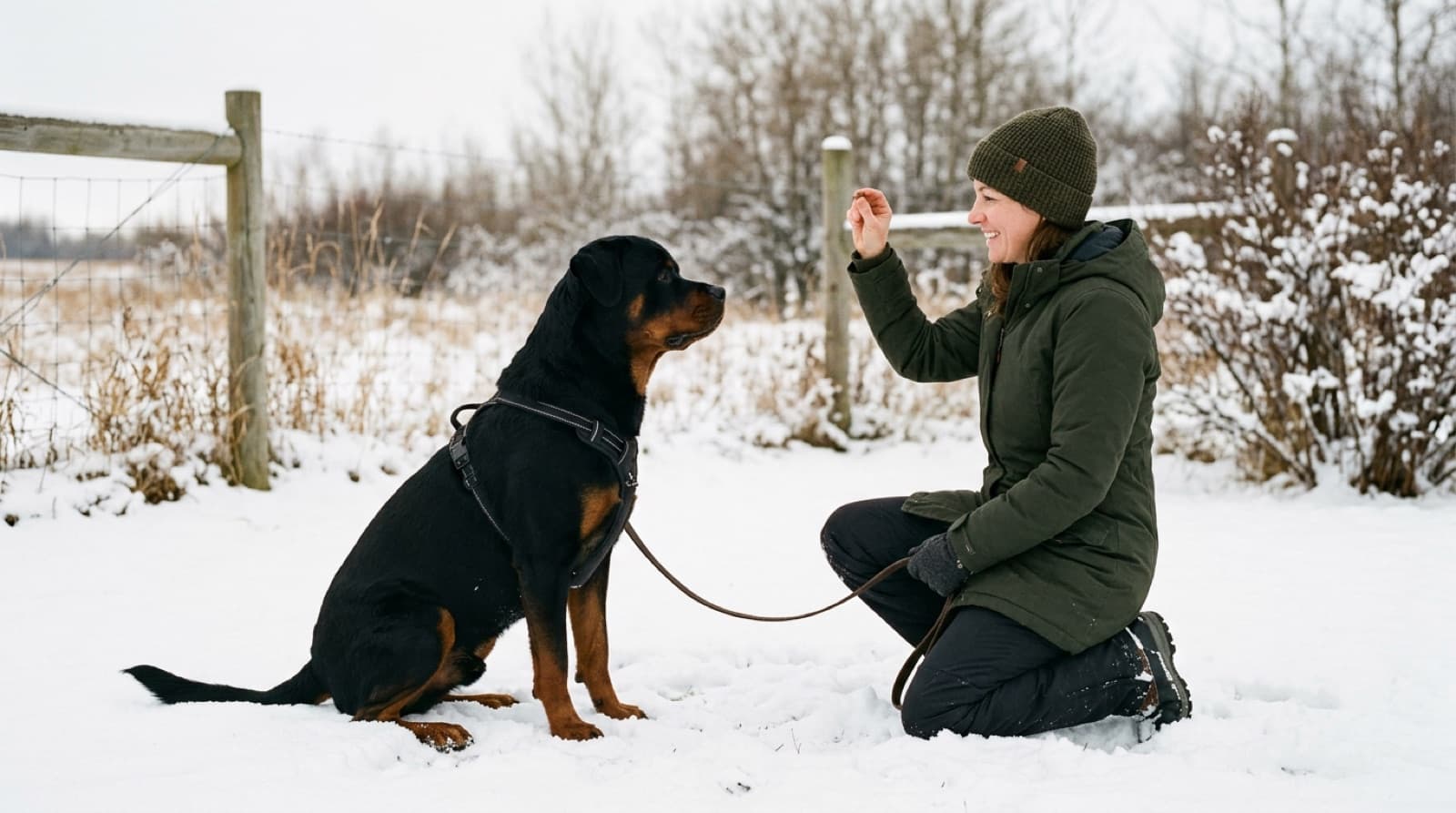
What a Rottweiler is really like
Calm, confident, intelligent, and deeply devoted to its family, a well-raised Rottweiler is naturally watchful without being aggressive, often aloof with strangers but affectionate and even goofy with its own people. Developed as a working guardian and drover, the breed is loyal and self-assured. Good Rottweilers are not the snarling media caricature.
What the breed is not is a low-effort dog. That confidence and guarding instinct need shaping through early socialization and consistent training, or they can tip into wariness, over-protectiveness, or reactivity. Temperament also depends heavily on breeding, since poorly bred Rottweilers can be nervous or sharp, which is why a rescue's foster temperament assessment is your best guide to the individual dog. It aligns with the confident, good-natured, and courageous temperament the Canadian Kennel Club describes for the breed. Raised right, a Rottweiler is one of the steadiest, most trustworthy family guardians there is, which is exactly the dog our Rottweiler adoption guide helps you find.
Socialization is non-negotiable
A guardian breed's confidence is shaped by early experience. A Rottweiler that meets many people, dogs, places, and sounds calmly and positively learns the world is generally safe, letting its natural steadiness win out. An under-socialized Rottweiler is far more likely to become suspicious, fearful, or reactive, and that is exactly the behaviour that drives surrenders.
Socialization is not a one-time event. It is ongoing, positive exposure through the first two years and maintained into adulthood. For a rescue Rottweiler with an unknown history, work with a force-free trainer to socialize carefully at the dog's pace, never flooding a wary dog. This is the single most important thing you do to raise a stable, trustworthy Rottweiler, and for this breed it is not optional.
Training: force-free, and start now
Rottweilers are intelligent and eager to work with their people, which makes them very trainable, but they are also sensitive despite the tough looks, so they respond best to force-free, reward-based methods and can become fearful or reactive under harsh, dominance-based training. Start early, keep sessions short and positive, and be consistent.
Prioritize the fundamentals that make a large guardian safe: a reliable recall, loose-leash walking, a solid sit and down, impulse control, and calm behaviour around strangers and at the door. Group classes are excellent for training and socialization both. In Regina, choose a trainer who uses reward-based methods and has experience with large or guardian breeds, and avoid anyone selling correction or dominance approaches, because those create the reactive dog people fear. A trained Rottweiler is a joy; an untrained 100-pound one is a serious problem.
Strength, reputation, and management
A Rottweiler is a 90-to-110-pound dog, so physical management is part of ownership: solid leash skills, impulse control, and calm greetings are not optional, because a dog this strong that pulls or reacts is genuinely hard to hold. Teach loose-leash walking early, use well-fitted equipment, and practise calm behaviour at the door and around guests.
The reputation piece is real too. Fair or not, many people are wary of the breed, so a responsible Rottweiler owner manages sensibly in public: sound recall, polite leash manners, careful introductions, and never putting the dog in a situation it is not ready for. This protects the dog, the public, and the breed's reputation. It also intersects with housing, because breed restrictions in rentals and insurance are a leading surrender cause, so confirm your lease and policy allow a Rottweiler before you adopt, as covered in the adoption guide.
Browse adoptable Rottweilers in Regina
An adult rescue Rottweiler comes with a foster-assessed temperament, so you can choose a dog whose steadiness is already known. Rottweilers and Rottie crosses. Refreshed regularly.
See Available Rottweilers →Exercise and management through a prairie winter
A Rottweiler's short, dense double coat gives moderate cold tolerance, better than a Boxer but not built for living outside, so most handle winter walks fine with a coat on the coldest days, booties against salt and ice, and shorter outings at -35. The bigger challenge is meeting the exercise and mental needs of a large working breed when outdoor time shrinks, because an under-exercised Rottie has energy and drive to spare, and that can feed both destructiveness and reactivity.
Move the work indoors: training sessions, scent games hiding treats around the house, puzzle feeders, tug, and structured obedience all burn mental and physical energy without frostbite risk. On milder winter days, a securely fenced yard or an off-leash area lets a Rottie run properly. The goal is to keep a guardian breed physically and mentally satisfied through the coldest weeks, because a satisfied Rottweiler is a calm, well-behaved one. Our Regina winter dog care guide has the full cold-weather routine.
Frequently Asked Questions
What is a Rottweiler's temperament really like?
A well-bred, well-raised Rottweiler is calm, confident, and deeply devoted to its family, steady rather than nervous, and naturally watchful without being aggressive. The breed was developed as a working guardian and drover, so it tends to be intelligent, loyal, and self-assured, often described as aloof or reserved with strangers but affectionate and even goofy with its own people. Good Rottweilers are not the snarling caricature of media reputation. What the breed is not is a low-effort dog: that confidence and guarding instinct need shaping through early socialization and consistent training, or they can tip into wariness, over-protectiveness, or reactivity. Temperament also depends heavily on breeding, because poorly bred Rottweilers can be nervous or sharp. When you adopt from a rescue, the foster temperament assessment is your best guide to the individual dog. A properly raised Rottweiler is one of the steadiest, most trustworthy family guardians there is.
Are Rottweilers aggressive or dangerous?
Not by nature. A Rottweiler bred for sound temperament and raised with proper socialization and training is a stable, confident dog, not an aggressive one, and many are gentle, tolerant family companions. The breed carries a fearsome media reputation, but behaviour is driven far more by breeding, socialization, training, and management than by breed alone. That said, honesty matters: a Rottweiler is a large, powerful dog with a guarding instinct, so the consequences of poor breeding, no socialization, or bad handling are more serious than with a small breed, and a fearful or poorly managed Rottweiler can be a genuine problem. The responsible framing is that Rottweilers are not dangerous when done right, but they demand a committed owner who socializes early, trains with reward-based methods, and manages the dog sensibly around strangers and other dogs. Get those right and you have a steady guardian; skip them and any powerful breed becomes a liability.
Why is socialization so important for a Rottweiler?
Because a guardian breed's confidence and protectiveness are shaped, for better or worse, by early experience. A Rottweiler that meets many people, dogs, places, sounds, and situations calmly and positively as a puppy and young dog learns that the world is generally safe, which lets its natural steadiness win out over wariness. A Rottweiler that is under-socialized, isolated, or only exposed to its own household is far more likely to become suspicious, fearful, or reactive toward strangers and other dogs, and that is exactly the behaviour that scares owners into surrendering. Socialization is not a one-time event, it is ongoing, positive exposure through the first two years and maintained into adulthood. For a rescue Rottweiler with an unknown history, work with a force-free trainer to socialize carefully at the dog's pace. Good socialization is the single most important thing you do to raise a stable, trustworthy Rottweiler, and it is non-negotiable for this breed.
How do I train a Rottweiler?
Train early, train with rewards, and be consistent. Rottweilers are intelligent and eager to work with their people, which makes them very trainable, but they are also sensitive despite their tough looks, so they respond best to force-free, reward-based methods and can become fearful or reactive under harsh, heavy-handed, or dominance-based training. Start young or, for a rescue, from day one, keep sessions short and positive, and prioritize the fundamentals that make a large guardian safe and manageable: a reliable recall, loose-leash walking, a solid sit and down, impulse control, and calm behaviour around strangers and at the door. Group classes are excellent for both training and socialization. In Regina, choose a trainer who uses reward-based methods and has experience with large or guardian breeds, and avoid anyone selling correction or dominance approaches, because those create the reactive dog people fear. A trained Rottweiler is a joy; an untrained 100-pound one is a serious problem.
Are Rottweilers good with kids and other pets?
Rottweilers can be excellent with children in their own family, especially when raised with them, and many are patient, gentle, and protective of the kids they love. The caution is size and management, not temperament: a 100-pound dog can accidentally knock over a small child in play, and a guarding breed needs to be taught appropriate behaviour, so supervision with young children and teaching gentle interaction are essential. With other dogs, socialization and the individual dog matter a lot, and some Rottweilers, particularly intact males, can be same-sex selective or dog-reactive, so early socialization and careful introductions are key. With cats and small pets it depends on the individual and its prey drive, and a rescue's foster notes are the best guide, so ask specifically. As with any powerful breed, supervise interactions, go slowly with introductions, and manage sensibly. A well-socialized Rottweiler from a good match can be a wonderful, steady family dog.
How much exercise and mental work does a Rottweiler need?
Plan on 60 to 90 minutes of real exercise a day for an adult Rottweiler, plus mental work, because this is a working breed that needs a job to stay balanced. Physical exercise means walks, secure off-leash running, and play, while mental work means training, puzzle feeders, scent games, and having a purpose, and a Rottweiler that gets one without the other is only half-satisfied. A bored, under-exercised Rottweiler has the size and strength to be genuinely destructive, and pent-up energy can feed reactivity, so meeting both needs is part of managing the breed safely. Rottweilers also love having a role, so activities like obedience, rally, tracking, cart-pulling, or simply structured training give them the mental engagement they crave. Avoid heavy forced exercise while a Rottweiler is still growing, to protect developing joints, and always exercise sensibly in prairie heat and cold. A well-exercised, mentally engaged Rottweiler is a calm, settled dog at home.
Can I keep a Rottweiler in an apartment or rental in Regina?
Physically a Rottweiler can live in an apartment if its exercise and mental needs are fully met, since a well-exercised adult is often calm indoors, but the real obstacle in a rental is breed restrictions, not space. Many Regina landlords and some insurers restrict Rottweilers, so before you adopt, read your lease, get written landlord approval, and confirm your tenant insurance covers the breed without excluding dog-bite liability, because a housing or insurance problem is one of the most common reasons Rotties get surrendered. If you clear the housing hurdle, an apartment Rottweiler needs a committed daily exercise and enrichment routine, careful management in shared hallways and elevators where the dog will meet strangers and other dogs, and solid training for calm behaviour in tight spaces. It can absolutely work, but it takes more planning than a house with a yard. Sort the lease and insurance first, then commit to the exercise, and an apartment Rottweiler can thrive.
How do I exercise and manage a Rottweiler through a Regina winter?
A Rottweiler's short, dense double coat gives moderate cold tolerance, better than a Boxer's but not built for living outside, so most handle prairie winter walks fine with sensible care: a coat on the coldest days, booties against salt and ice, and shorter outings when it is -35 with windchill, watching for shivering or lifted paws. The bigger winter challenge is meeting the exercise and mental needs of a large working breed when outdoor time shrinks, because an under-exercised Rottweiler has energy and drive to spare, and that can feed both destructiveness and reactivity. Move the work indoors: training sessions, scent games hiding treats around the house, puzzle feeders, tug, and structured obedience all burn mental and physical energy without frostbite risk. On milder winter days, a securely fenced yard or a Regina off-leash area lets a Rottie run properly. The goal is to keep a guardian breed physically and mentally satisfied through the coldest weeks, because a satisfied Rottweiler is a calm, well-behaved one.
Related Guides
New dog? Start with these care guides
Everything a new adopter needs to set up a safe, happy home.