First hour: do these now
- Do not roam the neighbourhood calling. A scared cat hides and goes silent.
- Search quietly and close: under the deck, porch, bushes, sheds, parked cars, starting at the exit point and moving outward a few houses.
- Search again after dark with a flashlight to catch eye-shine. Cats move when it is quiet.
- Leave their litter box, bedding, and a little food by the door they got out of.
- Call 311 to report to Calgary Animal Services and check the online impounded-cats list.
- Post to YYC Pet Recovery on Facebook and set up a PawBoost alert.
The instinct when a cat gets out is to do what you would for a dog: walk the block, call their name, widen the search. With cats that instinct works against you. A frightened cat hides close and stays silent, and the owners who get their cats back are the ones who search slowly and quietly near home, not the ones who cover the most ground. This guide is built around how cats actually behave when they are lost.
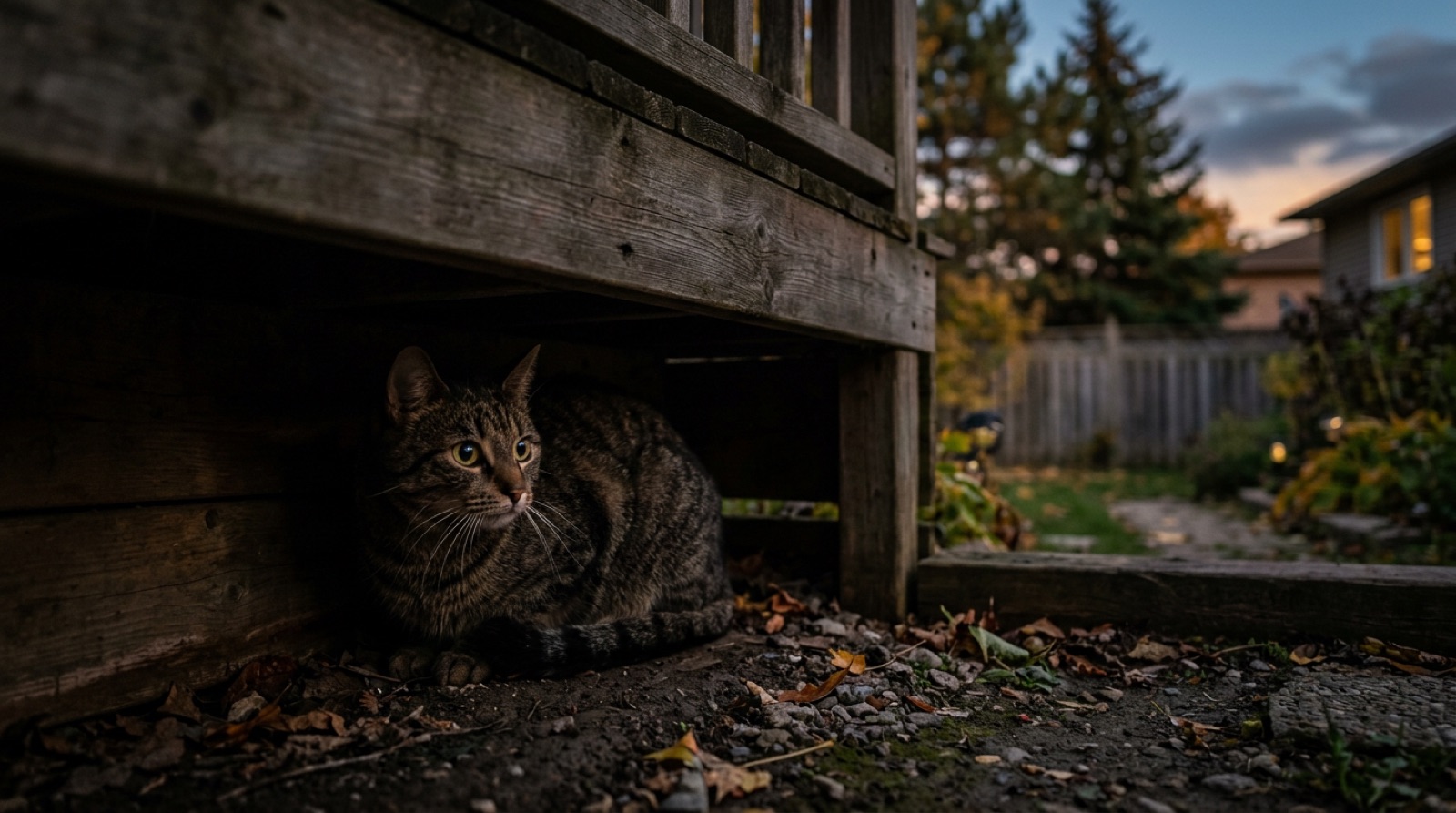
Search Like It Is a Cat, Not a Dog
This is the part that changes everything, and it is backed by research. According to the lost-pet behaviour work compiled by the Missing Animal Response Network, a displaced indoor cat does not flee and travel. It bolts a short distance, finds the nearest cover, and freezes there in silence, often for days. It will not meow back, because meowing would draw predators. That silence is survival behaviour, not a sign your cat is gone or does not care.
The distances are smaller than almost anyone expects. A University of Queensland study of more than 1,200 missing cats found escaped indoor-only cats were recovered a median of about 50 metres from home, two or three houses. Lost-cat specialist Kat Albrecht documented that 92% of escaped indoor-only cats were found within a five-house radius. So your search effort should be concentrated, not spread out:
- Start at the exit point and work outward house by house. Most cats are within your own yard or your immediate neighbours'.
- Get low and look into hiding spots: under decks and porches, inside sheds and garages, in dense bushes, window wells, under parked cars, behind stored items.
- Search at night. A hidden cat is more likely to move and respond after dark when it is quiet. Use a strong flashlight to catch the green eye-shine.
- Bring a calm voice and strong-smelling food, not a search party. Quiet and patient beats loud and fast every time.
- Ask neighbours to check their garages, sheds, and crawl spaces. Cats slip into open structures and get shut in.
Indoor Escapee vs Outdoor-Access Cat
Indoor-only cat that slipped out
Terrified and displaced. Hides silently very close to home, often within a few houses, and stays put. Search radius: your yard and immediate neighbours first.
Strategy: quiet physical search of nearby hiding spots, a feeding station at the exit point, and a humane trap. Do not chase or call loudly.
Cat with regular outdoor access
Travels farther and is harder to predict. In the U of Queensland study these cats were found a median of about 315 metres away, roughly a 17-house radius. A confident outdoor cat that suddenly vanishes can mean it was trapped somewhere or something happened.
Strategy: widen the physical search, talk to more neighbours, and check garages, sheds, and construction sites where a roaming cat can get shut in.
Where to Report and Search in Calgary
1. Calgary Animal Services (call 311)
Cats lost within city limits go to City Animal Services, not the Humane Society, so start here. Report your lost cat and check the City of Calgary online impounded-cats list, which updates every 15 minutes during business hours. A cat with ID (licence, legible tattoo, or microchip) is held 10 days; a cat with no ID is held only 4 days, so check often and early.
2. YYC Pet Recovery and Calgary lost-pet groups (Facebook)
YYC Pet Recovery is Calgary's most active lost-pet community and is recommended by MEOW Foundation's own lost-cat resources. Post a clear photo, last-seen location with cross-streets, the time, and your phone number. Add the same post to your neighbourhood group. Do not post your full address.
3. MEOW Foundation (humane trap rental + lost-cat guide)
MEOW Foundation rents humane traps and publishes a Calgary lost-cat guide. A trap is the proven way to recover a scared cat that is hiding nearby and will not come to you. Bait it with strong-smelling food near the suspected hiding spot or exit point and check it frequently.
4. PawBoost (pawboost.com)
A free lost-pet alert service that creates a shareable post and alerts the local community. Quick to set up and useful for reaching people beyond your immediate street.
5. Vet clinics in your radius
Anyone who finds a cat often takes it to a vet to be scanned for a microchip. Call clinics within a few kilometres, give them your cat's description and chip number, and ask them to watch for it.
Microchip and Licence Reality Check
A microchip is what turns a found cat back into your cat, but only if the registration is current. Right now, before anything happens, find your cat's chip number, enter it at petmicrochiplookup.org to see which registry it is in, and confirm your phone and address are up to date. The most common failure in Calgary is a rescue or shelter chip that was never transferred into the adopter's name.
Calgary also requires a City licence for cats, and a licensed, identified cat is held longer at the impound and can be returned through the City's Pet Drive Home Program. Two layers of ID, a microchip and a licence tag on a breakaway collar, give a lost cat the best odds of coming home.
Check your chip today, not in an emergency. A microchip with an old phone number is functionally useless. The five minutes it takes to log in and confirm your details is the cheapest insurance you will ever buy for your cat.
The Calgary Clock: Cold and Coyotes
Two Calgary realities make speed matter more here than in milder cities. First, the cold: a cat caught outside in a sub-freezing snap or a sudden storm faces real frostbite and hypothermia risk, so a winter escape is genuinely urgent. Second, coyotes. The City of Calgary notes that coyotes are found across the city and specifically advises keeping cats indoors to keep them safe.
None of this means panic. It means search hard and early, concentrate your effort close to home where your cat almost certainly is, and get a trap and a feeding station going quickly rather than waiting to see if the cat wanders back on its own.
Prevention (Especially for New and Indoor Cats)
Most lost-cat emergencies start with something small and preventable. The fixes are cheap:
- Secure window and balcony screens. A pushed-out screen is the classic indoor-cat escape. Check that every screen latches firmly.
- Mind the door during moves and deliveries. The riskiest moments are a move, a party, or a contractor propping the door, especially in a new cat's nervous first weeks. Our first week with a rescue cat guide covers settling a new cat safely.
- Breakaway collar with an ID tag. Breakaway so it releases if it snags, with your phone number on the tag.
- Current microchip and City licence. The two-layer backup that works even if the collar comes off.
- Keep cats indoors. The City of Calgary recommends it for coyote safety, and indoor cats simply go missing far less. See our guide to indoor vs outdoor cats in Calgary.
- Harness-train for outings. If your cat wants fresh air, a harness and supervised time out beats free-roaming.
Frequently Asked Questions
My indoor cat just got out in Calgary. What do I do first?
Do not roam the neighbourhood calling for them. A frightened indoor cat almost never runs far and almost never answers. It hides, silently, very close to home. Search quietly instead: check under your deck, porch, bushes, sheds, and parked cars, starting right at the door they slipped out of and working outward a few houses. Search again after dark when it is quiet, using a flashlight to catch eye-shine. Leave their litter box, bedding, and a little food by the exit. Then report to Calgary Animal Services at 311 and post to the YYC Pet Recovery Facebook group and PawBoost.
How far do lost cats actually travel?
Usually not far at all, which is the most important thing to know. A University of Queensland study of over 1,200 missing cats found escaped indoor-only cats were recovered a median of about 50 metres from home, roughly two or three houses away. Lost-cat specialist Kat Albrecht found that 92% of escaped indoor-only cats were located within a five-house radius. Outdoor-access cats range farther (a median of around 315 metres in the same study). The takeaway: search your own yard and immediate neighbours thoroughly before you widen the net.
Why won’t my lost cat meow when I call its name?
Silence is a survival instinct, not a sign your cat does not hear you or does not bond with you. A displaced, frightened cat stays quiet and still to avoid drawing predators, and it often hides within metres of you without making a sound. This is exactly why calling and walking around looking does not work the way it does with a dog. A slow, quiet, physical search of hiding spots, especially at night, finds far more cats than calling does.
Does Calgary Animal Services take in lost cats?
Yes. Calgary licenses cats and impounds stray cats the same way it does dogs. Per the City of Calgary, an impounded cat with ID (a licence tag, legible tattoo, or readable microchip) is held for 10 days, while a cat with no ID is held for only 4 days. Check the City of Calgary online impounded-cats list, which updates every 15 minutes during business hours, and call 311. One nuance: cats lost within Calgary city limits go to City Animal Services, not the Calgary Humane Society, so start with the City.
How do I check my cat’s microchip registration?
Find the chip number on your adoption paperwork or from your vet, then enter it at petmicrochiplookup.org to see which registry it is in. Log into that registry and confirm your phone, email, and address are current. The most common failure is a rescue or shelter chip that was never transferred into the adopter’s name, so it still points to the rescue. See our full guide to pet microchipping in Calgary for how registries and scanning work.
Where can I get a humane cat trap in Calgary?
MEOW Foundation rents humane traps and publishes a lost-cat guide, and a trap is often the single most effective tool for recovering a scared cat that is hiding nearby and will not come to you. Bait it with strong-smelling food, place it near the suspected hiding spot or the exit point, and check it frequently. A wildlife trail camera aimed at a feeding station can confirm your cat is circling back before you set the trap.
How do I stop my cat from getting lost in the first place?
Keep cats indoors, which the City of Calgary recommends specifically because of the city’s urban coyote population. Secure window and balcony screens (a pushed-out screen is a classic escape), put a breakaway collar with an ID tag on your cat, keep the microchip registration and City licence current, and if your cat enjoys going out, harness-train rather than free-roaming. Most lost-cat emergencies start with a slipped screen or a door left open during a move or a delivery.
Pet Microchipping in Calgary
How chips and registries work, and how to keep yours current.
Pet Licensing in Calgary
Cats need a City licence too, and it helps get a lost cat home.
Indoor vs Outdoor Cats in Calgary
The coyote and winter case for keeping cats inside.
Calgary Lost Dog Action Plan
The companion playbook for a dog that got out.
New cat? Start with these care guides
Everything a new adopter needs to set up a safe, happy home.