The short answer
Bernedoodles come in three sizes set by the Poodle parent: Tiny (10 to 24 lbs), Mini (25 to 49 lbs), Standard (50 to 90 lbs). Coat is more variable than other doodles because Bernese double coat genetics are dominant. F1 is a real coat lottery (40% straight-shed, 30% wavy, 30% curly). F1B and multigenerational lines deliver reliable low-shed coats. Mini is the most popular Calgary size; Standard needs a detached home and AC; Tiny works for condos but carries compound size-related health risks. Coat colour does not predict shed level.
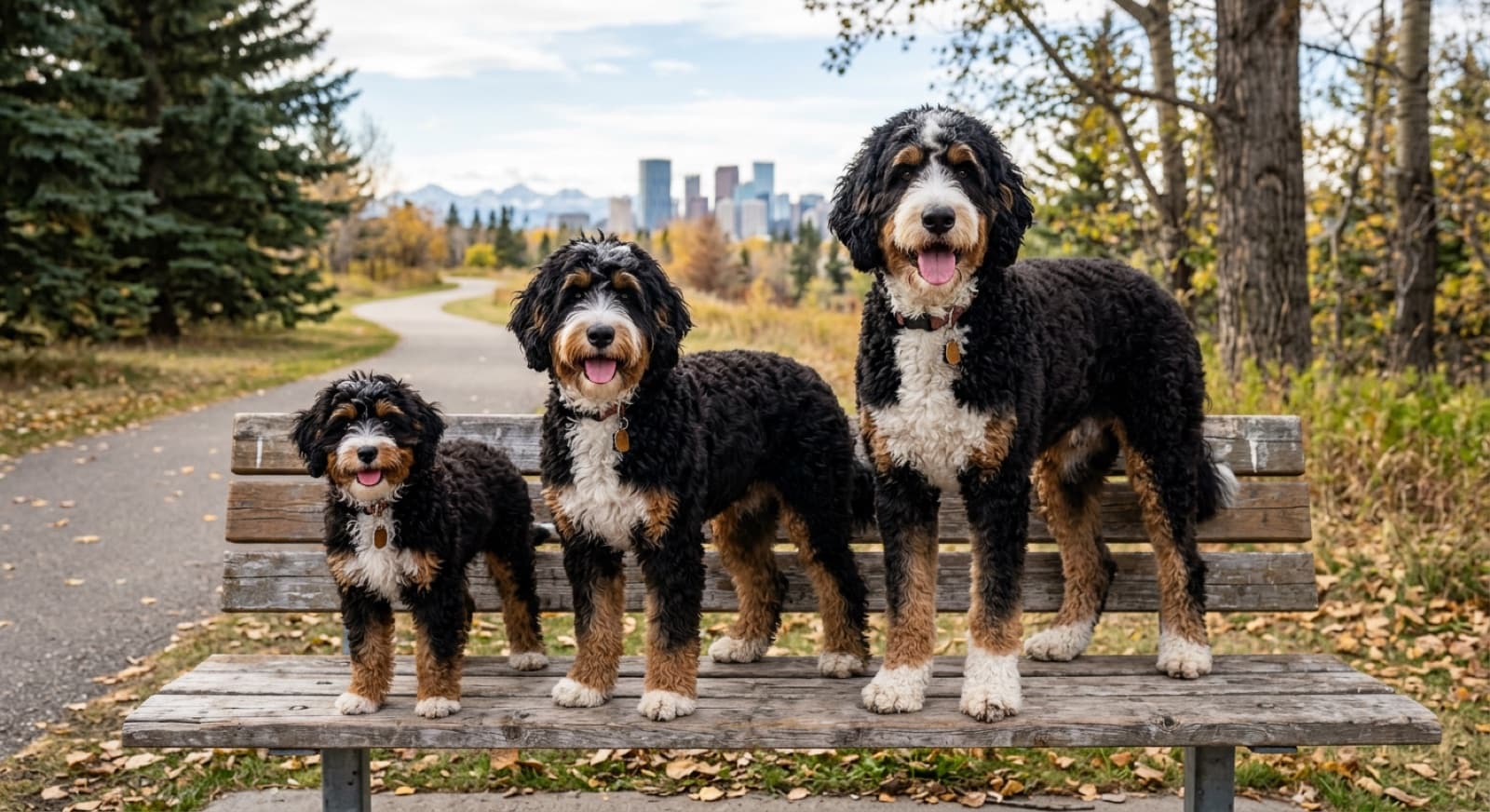
The three Bernedoodle sizes
Bernedoodle size is set by which Poodle is on the parent side of the cross. Bernese Mountain Dogs are a single large size (typically 80 to 110 lbs), so the size of the puppy depends almost entirely on the Poodle. Standard Poodles produce Standard Bernedoodles. Mini Poodles produce Mini Bernedoodles. The Tiny size requires multigenerational programming because a direct Toy Poodle and Bernese cross is mechanically unsafe.
Size comparison
The three sizes drive different household-fit decisions in Calgary.
| Size | Weight | Exercise | Apartment Fit | Lifespan | Breeder Price | Calgary Climate |
|---|---|---|---|---|---|---|
| Tiny | 10-24 lbs | 30-45 min/day | Yes (most condos) | 14-17 yrs | $3,500-$5,500 | Winter coat below -10C |
| Mini | 25-49 lbs | 45-75 min/day | Possible with exercise | 12-15 yrs | $3,000-$4,500 | Moderate winter, manage summer |
| Standard | 50-90 lbs | 60-90 min/day | No (detached home) | 8-11 yrs | $2,800-$4,000 | Winter dog, summer above 24C hard |
Tiny Bernedoodle (10 to 24 lbs): the smallest variety. Tiny Bernedoodles are NOT produced by directly crossing a Toy Poodle with a Bernese Mountain Dog because the size mismatch makes natural breeding mechanically dangerous and artificial insemination still produces wildly variable puppies. Instead, Tiny Bernedoodles come from multigenerational programs that work down the size scale over two or three generations, typically by crossing a Mini Bernedoodle with a Toy Poodle. Tiny Bernedoodles fit Calgary downtown condos easily and live the longest of the three sizes (14 to 17 years). The trade-off is health risk. Chondrodysplasia (skeletal dwarfism) appears in some lines because the size compression crowds the skeletal framework. Patellar luxation rates climb. Hypoglycemia in puppies under 6 months is a real risk. Calgary winter cold below -15 degrees C burns calories fast and small dogs can drop blood sugar quickly. Verify breeder genetic testing for IVDD, patellar luxation, and PRA.
Mini Bernedoodle (25 to 49 lbs): the most popular Calgary size. Mini Bernedoodles are produced by crossing a Mini Poodle with a Bernese (often F1B with a Mini Poodle backcross to lock in the smaller size). The 25 to 49 lb range fits most Calgary condo weight limits (typically 25 to 40 lbs depending on the building). Daily exercise needs run 45 to 75 minutes. Temperament is the easygoing Bernese personality moderated by Poodle smarts, which suits active suburban families and condo dwellers with Bow River pathway routines. Mini is the practical sweet spot for the largest number of Calgary households.
Standard Bernedoodle (50 to 90 lbs): the largest variety and the closest in feel to a Bernese Mountain Dog. Standard Bernedoodles come from a direct Standard Poodle and Bernese cross. They need a detached home with a yard, daily 60 to 90 minute exercise, and air conditioning in summer. The Bernese inheritance brings heat sensitivity that makes Calgary summers above 24 degrees C genuinely uncomfortable. Lifespan averages 8 to 11 years (shorter than Mini or Tiny because the Bernese genetic load brings shorter-lived cancer and orthopedic risks). For active suburban Calgary families with off-leash access at Nose Hill or Fish Creek and a detached home with AC, Standard is the breed-true experience.
Predicting adult size from a puppy
The most reliable size predictor is the parent weight. A reputable breeder will tell you the dam and sire weights and give you a litter weight range. The puppy paw size at 8 to 10 weeks is a secondary signal; large paws on a small puppy generally indicate a larger adult size. Both signals are estimates not guarantees. Variability within an F1 litter can run 15 lbs or more between the smallest and largest puppy, especially when the Bernese parent is at the upper end of the 80 to 110 lb breed range.
For multigenerational Tiny Bernedoodles, the size estimate is more reliable because the lines have been selected over generations for predictable size outcomes. Most Tiny breeders can give you a tighter range of 5 to 8 lbs of expected adult weight.
Breeder honesty matters more than any chart. A Calgary breeder who says “your Mini puppy will be exactly 35 lbs at adult” is making a marketing claim. A breeder who says “based on the parents, the litter should land between 28 and 45 lbs at adult, with most settling around 35 to 38” is telling you the truth. Ask for the weight distribution of previous litters from the same parents. A breeder with two or more prior litters from the same dam and sire should have actual data to share.
The three Bernedoodle coat types
Coat type matters more than generation for predicting shedding and grooming workload. Three coat categories appear in Bernedoodles: curly (wool), wavy (fleece), and straight (hair). The visible curl pattern at 6 to 8 weeks is the best early indicator of adult coat type, alongside whether the puppy has facial furnishings.
Curly (wool) coat: the most Poodle-like coat, with dense tight ringlets across the body. Curly coats shed the least of the three because loose dander gets trapped in the curls rather than released into the air. They are the most allergy-friendly Bernedoodle coat type. The trade-off is grooming. Curly coats mat fastest and need daily brushing with a slicker brush plus a metal comb. Professional grooming every 4 to 6 weeks in Calgary at $80 to $130. Skipping a week can produce deep mats at the armpits, behind the ears, and along leg feathering that need to be shaved out. F1B and multigenerational Bernedoodles most often have curly coats.
Wavy (fleece) coat: the middle ground, with loose wavy curls rather than tight ringlets. Wavy coats are the most common Bernedoodle coat type in F1B litters and have moderate shedding (lower than straight, higher than curly). Brushing every 2 to 3 days plus professional grooming every 6 to 8 weeks at $70 to $110. Wavy coats are less mat-prone than curly and easier for first-time Doodle owners to manage. For most Calgary families looking for a balance of low-shed and lower grooming workload, wavy is the practical target.
Straight (hair) coat: the most Bernese-like coat, with a straight or very loosely wavy texture that resembles a Bernese Mountain Dog more than a Poodle. Straight coats shed normally, including a heavy twice-yearly coat blow in spring and fall. Straight coats are NOT hypoallergenic. The grooming maintenance is the lowest of the three: weekly brushing plus twice-yearly bath and tidy at a salon, with intense home brushing during the coat blow. Straight Bernedoodles are most often F1 and represent the Bernese-dominant outcome of the F1 coat lottery.
The Calgary grooming budget by coat type:
- Curly coats: $80 to $130 every 4 to 6 weeks, plus daily owner brushing. Annual budget $900 to $1,300.
- Wavy coats: $70 to $110 every 6 to 8 weeks, plus 3 to 4 brushings per week. Annual budget $600 to $900.
- Straight coats: $50 to $80 twice yearly for bath and tidy, plus weekly home brushing and heavy work during the spring and fall coat blow. Annual budget $400 to $800.
Generation labels and coat predictability
Bernedoodle generations follow the same naming framework as other doodles (F1, F1B, F2, multigenerational), but the practical outcomes differ because of the Bernese coat dominance problem. Here is the framework Calgary adopters should understand before talking to any breeder.
F1 (50% Bernese, 50% Poodle): the first-generation cross. Coat outcomes are a true lottery within the same litter. Based on data from the Goldendoodle Association of North America coat-type studies (which apply to Bernedoodles with similar genetics), roughly 30% of F1 Bernedoodles inherit a Poodle-curly low-shed coat, 30% inherit a wavy moderate-shed coat, and 40% inherit a Bernese-straight shedding coat. F1 Bernedoodles are the most variable coat outcome among all major doodle F1 crosses because Bernese double coat genetics are unusually dominant.
F1B (25% Bernese, 75% Poodle): an F1 Bernedoodle bred back to a purebred Poodle. The result is 75% Poodle, with a much higher probability of inheriting the two copies of the furnishing gene needed for reliable low-shedding. F1B Bernedoodles are the practical sweet spot for Calgary families with mild to moderate allergies who want a Bernese-influenced temperament with a more reliably low-shed coat.
F2 (F1 x F1): two F1 Bernedoodles bred together. Coat outcomes are even more variable than F1 because both parents are themselves coat-lottery dogs. Avoid F2 if coat predictability matters. Most ethical breeders skip F2 entirely and move from F1 directly to F1B or to multigenerational programs.
Multigenerational (F1B x F1B or higher): two low-shed Bernedoodles bred together over multiple generations, with each generation selected for coat consistency and temperament. The most consistent coat outcomes of any Bernedoodle generation. Most reputable Tiny Bernedoodles come from multigenerational lines because the size reduction requires generational selection.
The Bernese-coat dominance problem
Most Calgary adopters going into a Bernedoodle adoption know the F1 coat lottery exists. What they often do not know is that the Bernedoodle F1 coat lottery skews more toward shedding than F1 Goldendoodles or F1 Labradoodles. The reason is genetic.
Bernese Mountain Dogs carry a double coat with a dense undercoat designed for Swiss alpine winters. The genetics driving that coat type are unusually dominant compared to other large breed coat genetics. According to AKC breed-genetics literature on furnishing gene inheritance in hybrid crosses, the Bernese coat genes have higher penetrance in F1 crosses than Golden Retriever or Labrador Retriever coat genes do.
The practical result is that F1 Bernedoodles produce a straight, Bernese-style shedding coat about 40% of the time. F1 Goldendoodles and F1 Labradoodles produce hair coats about 25 to 30% of the time. That 10 to 15 percentage point difference is the reason so many Calgary F1 Bernedoodle adopters get surprised by shedding. They expected a Doodle, they got a smaller Bernese.
The fix is F1B or multigenerational lines. By backcrossing to Poodle, the furnishing gene inheritance becomes much more reliable. F1B Bernedoodles produce reliable low-shed coats about 85% of the time. Multigenerational Bernedoodles approach 95%. For Calgary allergy households, F1 is genuinely risky and F1B is the practical minimum.
If you want the F1 50/50 genetic mix for temperament reasons (the Bernese easygoing personality combined with Poodle intelligence is most pronounced in F1), accept that you may end up with a shedding dog. Ask the breeder to Embark DNA test the puppies for the furnishing gene before you commit. The shed score result will tell you whether your specific puppy inherited the low-shed genetics or not.
Coat colour patterns
Bernedoodles come in several colour patterns. The most popular is tricolour, which mirrors the classic Bernese Mountain Dog pattern: black body with rust tan points (above the eyes, on the cheeks, chest, and legs) and white markings on the chest, face blaze, and feet. Tricolour Bernedoodles often command a price premium because adopters specifically want the Bernese look.
Other patterns include:
- Bicolour: black and white, or black and tan, without the third colour
- Sable: black-tipped hair with brown undercoat, producing a shifting colour that can change as the dog ages
- Phantom: black body with tan markings only, no white
- Parti: heavy white coverage with patches of black or rust, often more Poodle-influenced in appearance
- Merle: mottled pattern that can introduce serious health risks (deafness, blindness) particularly in double-merle breedings. Calgary adopters should avoid merle Bernedoodles from breeders who do not health-test for the merle gene
Critical point: coat colour does NOT predict coat type or shed level. A tricolour Bernedoodle can have a curly, wavy, or straight coat with any combination of generation. Do not pay a colour premium expecting it to deliver a specific coat outcome. The look you want and the coat behaviour you want are two separate variables.
Predicting puppy coat type
Three signals help predict adult coat type at puppy age:
1. The visible curl pattern at 6 to 8 weeks. A puppy with tight curls visible across the body at 8 weeks usually develops a curly adult coat. A puppy with loose waves usually develops a wavy adult coat. A puppy that looks smooth or straight usually stays straight. Coats do change between 6 months and 14 months as the adult coat replaces the puppy coat, but the early signal is reasonably reliable.
2. Facial furnishings. Look at the puppy face. A furnished puppy has eyebrows, a beard, and a moustache (visible darker or longer hair on the muzzle and around the eyes). A smooth-faced puppy has no facial hair distinction. Furnished puppies generally develop wavy or curly adult coats with low shedding. Smooth-faced puppies generally develop straight Bernese-style coats with normal shedding. Facial furnishings are tied to the same furnishing gene that drives low shedding across the body.
3. DNA testing. Embark and other DNA testing services offer a coat-shed score that measures the furnishing gene inheritance directly. A reputable Calgary breeder will DNA-test the puppies before placement and share the results. The shed score is the most reliable predictor of adult coat behaviour and is worth requesting before committing to a specific puppy, especially for allergy households.
Both parent coats also matter. Two curly parents tend to produce curly puppies. A curly parent and a straight parent produce a mix. Ask to see photos of the parent dogs and ideally meet at least one parent in person or via video call. If the breeder refuses to show parent dogs, walk away.
Calgary climate fit by size
Standard Bernedoodles overheat fast in Calgary summers. AC is mandatory, midday exercise May to September is dangerous, and heat stroke can develop within 20 minutes of strenuous activity above 24 degrees C. Calgary 24-hour ER vet visits for heat stroke spike around Stampede week and long weekends.
Bernedoodle climate fit varies dramatically by size. The Bernese inheritance means heat sensitivity is real, but the Poodle inheritance softens it. Smaller sizes also have less mass, which changes both winter cold tolerance and summer heat tolerance.
Tiny Bernedoodle (10 to 24 lbs): apartment-friendly year-round, but smaller mass means faster heat loss in winter. Calgary winter walks below -10 degrees C need a winter coat. Below -20, paw protection (booties or paw wax) becomes mandatory. Hypoglycemia risk in puppies under 6 months is higher because the small body burns through glucose stores quickly. In summer, Tiny Bernedoodles tolerate heat better than Standards because their small body releases heat more efficiently, but air conditioning is still recommended above 26 degrees C.
Mini Bernedoodle (25 to 49 lbs): the most balanced climate fit. Apartment-possible with daily exercise. Moderate winter tolerance with a coat below -15 degrees C. Summer tolerance up to about 26 degrees C with adequate water and shade. The 25 to 49 lb mass range balances heat and cold reasonably well, making Mini Bernedoodles the most adaptable Calgary size for year-round comfort.
Standard Bernedoodle (50 to 90 lbs): the best winter tolerance of any doodle. The Bernese double coat (in dogs with the straight coat inheritance) is genuinely built for cold weather. Standards comfortably enjoy walks below -20 degrees C in dry conditions. Calgary winter is their favourite season. Summer is the opposite story. Standards overheat fast above 24 degrees C and the risk climbs sharply above 28. AC is mandatory in summer. Midday exercise May through September is genuinely dangerous; walk before 8 AM and after 8 PM only. Cooling vests, elevated cots, and access to cold water all help, but the safest approach is to limit outdoor activity during the hottest hours.
For Calgary families considering a Standard Bernedoodle, the climate fit is the single biggest lifestyle decision. If your home does not have AC, do not adopt a Standard. If your work pattern requires midday outdoor activity in summer, reconsider the size. Mini Bernedoodles are a better climate fit for most Calgary households.
Browse adoptable Bernedoodles in Calgary
Calgary rescues see Bernedoodle surrenders every month, often from pandemic-era impulse adoptions where the coat or size did not match the household. Adult coats are already established, so the shedding profile and size are visible. See current listings.
See Available Bernedoodles →Frequently Asked Questions
How do I tell what size a Bernedoodle puppy will be as an adult?
Three signals matter. First, the parent weights. Standard Poodle parents produce Standard Bernedoodles in the 50 to 90 lb range. Mini Poodle parents produce Mini Bernedoodles in the 25 to 49 lb range. Toy Poodle ancestry (usually via multigenerational lines, not direct crosses) produces Tiny Bernedoodles in the 10 to 24 lb range. Second, the puppy paw size at 8 to 10 weeks. Large paws on a young puppy generally indicate a Standard adult size. Third, breeder honesty. A reputable Calgary breeder will give a weight range estimate based on the specific litter and parent history, not a marketing number. Variability within an F1 litter can run 15 lbs or more, so the estimate is a range not a guarantee.
What is the difference between F1 and F1B Bernedoodles for coat predictability?
F1 is the first-generation cross with one purebred Bernese Mountain Dog parent and one purebred Poodle parent, producing puppies that are 50% Bernese and 50% Poodle. F1 Bernedoodles are a coat lottery, and the lottery skews more toward the Bernese side than F1 Goldendoodles or Labradoodles do because Bernese double coat genetics are unusually dominant. Roughly 40% of F1 Bernedoodles inherit a straight, shedding Bernese-style coat. F1B is an F1 Bernedoodle bred back to a purebred Poodle, producing puppies that are 25% Bernese and 75% Poodle. F1B coats are much more reliably low-shed. For Calgary allergy households or families who want a predictable low-shed coat, F1B is the safer choice over F1.
Which Bernedoodle size is best for an apartment?
Mini Bernedoodles in the 25 to 40 lb range are the practical sweet spot for Calgary downtown condos. Most condo weight limits cap at 25 or 40 lbs depending on the building, and a Mini Bernedoodle fits within that range while still carrying enough Bernese temperament to be the calm couch companion most adopters want. Tiny Bernedoodles work too but can be more terrier-influenced (the Toy Poodle ancestry brings higher energy and more vocal tendencies). Standard Bernedoodles in the 50 to 90 lb range should not live in apartments, both because of the weight limits and because the Bernese inheritance makes them prone to overheating in poorly ventilated indoor spaces.
Which Bernedoodle size is best for families with young kids?
Mini and Standard Bernedoodles are the best fit for active families with kids over 5 years old. Both sizes carry the Bernese easy-going temperament that makes them tolerant of household chaos. Standard Bernedoodles can knock over toddlers by accident at full grown 70 lb size, which is why we generally suggest Mini for households with kids under 5. Tiny Bernedoodles are NOT a good kid-family choice because their small size makes them fragile in households with young children, and the Toy Poodle ancestry can carry anxious or nippy tendencies that do not pair well with rough handling. Most Calgary Bernedoodle adopters with kids land on Mini.
What is the grooming workload by coat type?
Curly (wool) coats need the most work: daily brushing plus professional grooming every 4 to 6 weeks in Calgary at $80 to $130 per visit. Skipping a week between brushings can produce deep mats that need to be shaved out. Wavy (fleece) coats are the middle ground: brushing every 2 to 3 days plus professional grooming every 6 to 8 weeks at $70 to $110. Straight (hair) coats are the lowest grooming workload of the three: weekly brushing plus twice-yearly bath and tidy at a salon, with significant home maintenance during the spring and fall coat blow when the Bernese double coat sheds heavily. Calgary annual grooming budget runs $400 to $800 for straight, $600 to $900 for wavy, and $900 to $1,300 for curly coats.
Can a Bernedoodle coat change over time?
Yes, especially during the puppy-to-adult transition. Most Bernedoodle puppies are born with a softer puppy coat that changes between 6 months and 14 months as the adult coat grows in. A puppy that looks curly at 8 weeks can develop a wavier adult coat. A puppy that looks straight at 8 weeks usually stays straight. The wavy curl pattern visible at 6 to 8 weeks is the best early predictor, alongside whether the puppy has facial furnishings (eyebrows, beard, moustache hair). Furnished puppies generally develop wavy or curly adult coats; smooth-faced puppies generally develop straight Bernese-style coats. Embark DNA testing reports a coat shed score that can confirm the prediction.
What health risks do Tiny Bernedoodles carry?
Tiny Bernedoodles carry compound size-related risks beyond the standard Bernedoodle health profile. Chondrodysplasia (skeletal dwarfism) appears in some lines because the size reduction from Bernese to Toy Poodle scale crowds the skeletal framework. Patellar luxation rates climb in dogs under 25 lbs. Hypoglycemia in puppies under 6 months is a real risk, particularly during the first weeks home; Calgary winter walks under -15 degrees C burn calories fast and small dogs can drop blood sugar quickly. The reduced lifespan benefit (most Tiny Bernedoodles live 14 to 17 years versus 8 to 11 for Standards) is real, but the genetic compression brings unique risks. Verify breeder genetic testing for IVDD, patellar luxation, and PRA before adopting Tiny.
How do I manage Calgary summer heat with a Standard Bernedoodle?
Standard Bernedoodles inherit the Bernese double coat and the Bernese love of cold weather, which means Calgary summers above 22 degrees C are genuinely uncomfortable for them. Three rules. First, air conditioning is mandatory in summer. A poorly ventilated apartment above 26 degrees can be dangerous for a Standard. Second, midday exercise May through September is off the table; walk before 8 AM and after 8 PM only. Third, cooling vests and elevated cots help in yards. Heat stroke onset in a Standard Bernedoodle can happen within 20 minutes of strenuous activity on a hot day. Calgary 24-hour emergency vet visits for heat stroke spike around long-weekend hikes and Stampede week. Standard Bernedoodles are winter dogs first and summer dogs second.
What does a Bernedoodle cost from a Calgary breeder by size?
Tiny Bernedoodles run $3,500 to $5,500 from a reputable Calgary breeder. Mini Bernedoodles run $3,000 to $4,500. Standard Bernedoodles run $2,800 to $4,000. Pricing inverts the size logic because smaller doodles are harder to produce reliably (the multigenerational lines needed for Tiny outcomes are uncommon) and the demand is higher. Multigenerational and F1B lines command a premium over F1. The premium reflects health testing, parent dog screening, and breeder selection rigor. By comparison, Calgary rescue adoption fees through AARCS, Pawsitive Match, or BARCS run $300 to $700 for any Bernedoodle size that comes through their network. See our adoption hub for the full Calgary rescue contact list.
Is a multigen Bernedoodle better than an F1B?
For coat consistency and predictability, yes, marginally. Multigenerational Bernedoodles (F1B bred to F1B, or further generations) produce the most consistent coat outcomes because both parents have already been selected for low-shed coats. F1B Bernedoodles are a single backcross to Poodle and are usually reliably low-shed but with some variability. Multigenerational is the safer choice for severe allergy households. For mild-to-moderate allergy households or families without allergy needs, F1B from a reputable breeder is usually sufficient and slightly less expensive. The marketing line in Calgary often blurs F1B and multigen; verify the actual generation on paper before paying the multigen premium.
What coat colours do Bernedoodles come in?
Tricolour is the most popular and most marketable: the Bernese-style pattern of black body, rust tan points, and white markings on the chest, face, and feet. Tricolour Bernedoodles often command a price premium because adopters want the look. Other patterns include bicolour (black and white, or black and tan), sable (black-tipped with brown undercoat), phantom (black with tan markings), and parti (heavy white with patches). Colour does NOT predict coat type or shed level. A tricolour Bernedoodle can have a curly, wavy, or straight coat regardless of pattern. Do not pay a colour premium expecting it to deliver a specific coat outcome.
How is grooming different for a wavy vs curly Bernedoodle coat?
Curly coats need daily brushing with a slicker brush plus a metal comb to catch the undercoat mats. Skipping two days can produce deep mats at the armpit, behind the ears, and along the leg feathering that need to be shaved out at the salon. Professional grooming every 4 to 6 weeks at $80 to $130. Wavy coats need brushing every 2 to 3 days with a slicker brush, less risk of deep mats, and professional grooming every 6 to 8 weeks at $70 to $110. The Calgary climate matters. Winter coats can pick up ice balls in the feet and feathering on long walks; carrying a small towel for paw drying is the routine. Spring and fall coat changes mean extra brushing time across both wavy and curly coats. Most Calgary owners learn the routine in the first six months.
Adoptable Bernedoodles in Calgary
Live listings of Bernedoodles from the Calgary rescue network, updated regularly.
Bernedoodle Adoption Calgary
The Calgary Bernedoodle adoption hub. Rescue sources, real costs, surrender patterns, and breeder verification.
Bernedoodle Health Issues: What Each Parent Adds
Bernedoodle health issues to plan for: cancer risk from the Bernese side, hip and elbow dysplasia, bloat, degenerative myelopathy, Addison’s and skin and ear problems.
Labradoodle Generation and Coat Guide
F1, F1B, multigen, and Australian Labradoodle compared for Calgary allergy families.
New dog? Start with these care guides
Everything a new adopter needs to set up a safe, happy home.