The short answer
Labradoodle generations follow a simple framework. F1 is 50% Lab and 50% Poodle (coat lottery). F1B is 25% Lab and 75% Poodle (reliably low-shed). F2 is high variability (avoid). Multigenerational (F3+) and Australian Labradoodles are the most consistent. Pick by allergy need: F1 for families OK with possible shedding, F1B for mild allergies, Australian Labradoodle for severe allergies and predictable temperament. Coat types are fleece (wavy, silky), wool (tight curls), and hair (sheds like a Lab). No dog is 100% hypoallergenic.
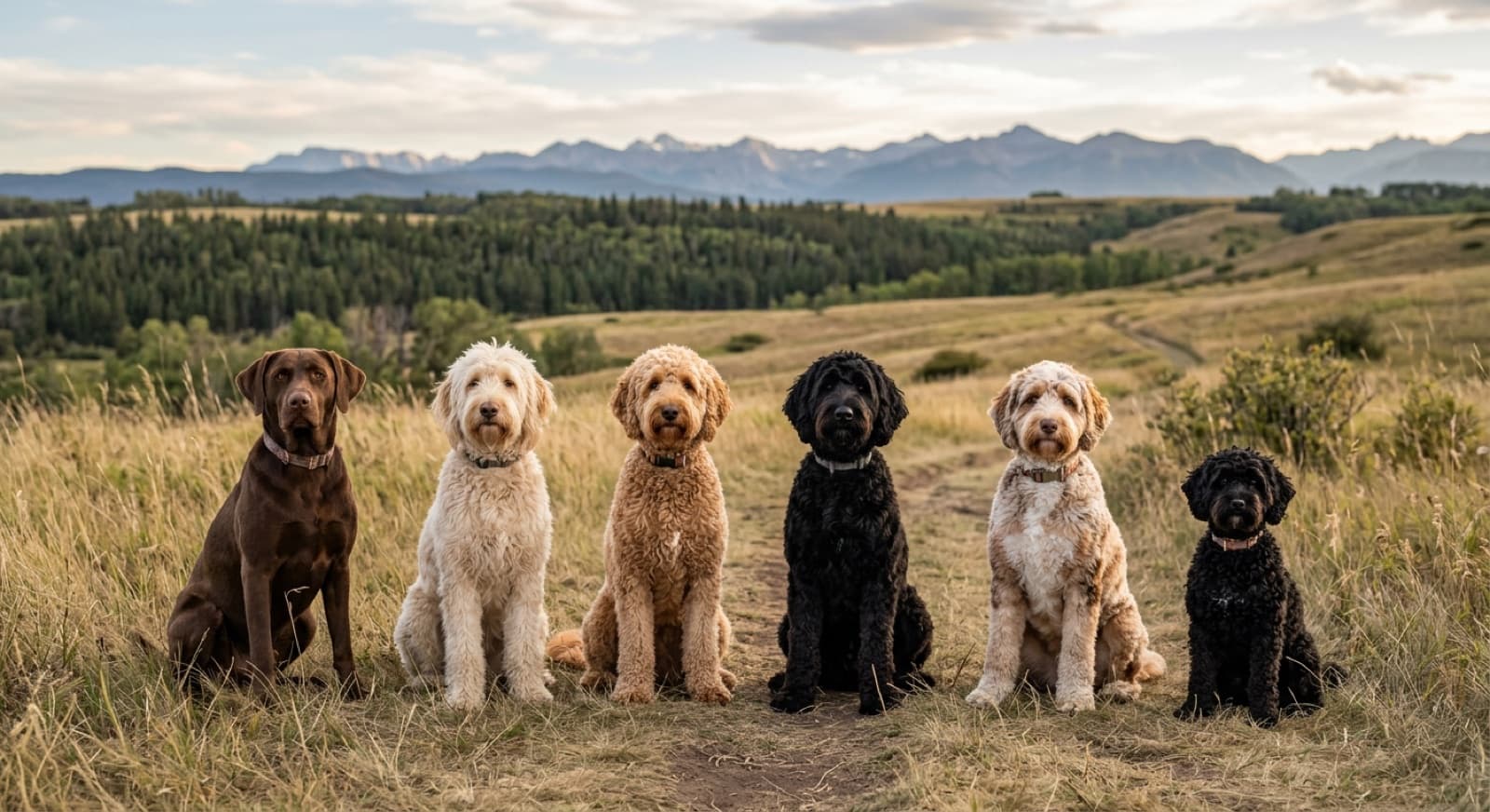
The 1989 origin story
The first Labradoodle was bred in 1989 by Wally Conron at the Royal Guide Dogs Association of Australia (now Guide Dogs Victoria). Conron was the breeding manager and was tasked with finding a guide dog suitable for a vision-impaired woman in Hawaii whose husband was severely allergic to dog dander. The standard Labrador Retriever guide-dog candidates all triggered the husband's allergies.
Conron crossed a Standard Poodle with a Labrador Retriever, hoping to combine the Labrador's biddable retriever temperament with the Poodle's low-shedding coat. The first litter produced three puppies. One of them, Sultan, was sent to Hawaii. He worked successfully as a guide dog for ten years and the husband's allergies remained manageable. Conron coined the name “Labradoodle” for the cross.
What happened next was not what Conron intended. Within a few years, breeders worldwide began crossing Labs and Poodles to sell as designer dogs, marketed as hypoallergenic. The market exploded. By the early 2000s, Labradoodles were one of the most popular crossbreeds in North America, and other doodle crosses followed (Goldendoodle, Bernedoodle, Sheepadoodle, Cavoodle, and dozens more).
In a 2019 interview with the Australian Broadcasting Corporation, Conron said he regretted creating the Labradoodle. The original cross was a deliberate medical solution. The mass market that followed produced poorly bred F1 dogs with unpredictable coats, unmet allergy promises, and breeder practices Conron called “unethical, ruthless.” The Australian Labradoodle program that followed at Tegan Park and Rutland Manor was an attempt to do the cross properly, with documented lineage and breed-standard targets.
The generation framework
Labradoodle generations are written as F1, F1B, F2, F2B, multigen (F3+), or Australian Labradoodle. The letters and numbers track how many generations separate the puppy from the original purebred parent breeds. Each generation has different coat predictability and hypoallergenic reliability. Here is the full framework Calgary adopters should understand before talking to any breeder or rescue.
Generation comparison
Coat and hypoallergenic reliability increase the further removed from the original F1 cross.
| Generation | % Lab | % Poodle | Coat Reliability | Hypoallergenic | Best For |
|---|---|---|---|---|---|
| F1 | 50% | 50% | Lottery (fleece, wool, or hair) | Unreliable | Families OK with possible shedding |
| F1B | 25% | 75% | More reliably low-shed | Mild to moderate allergies | Mild allergy households |
| F2 | ~50% | ~50% | High variability (avoid) | Unreliable | Not recommended for allergy needs |
| F2B | ~25% | ~75% | Increasingly Poodle-dominant | Mild to moderate allergies | Mild allergy households |
| Multigen (F3+) | Varies | Varies | Consistent (selected over gens) | Moderate allergies | Ethical breeders work here |
| Australian Labradoodle | Lab + Cocker | Poodle + Spaniel | Most consistent (breed standard) | Severe allergies | Severe allergy + predictable temperament |
F1 (50% Lab + 50% Poodle): a first-generation cross with one purebred Lab parent and one purebred Standard Poodle parent. Coat outcomes are a lottery within the same litter. Some puppies inherit a fleece or wool coat and shed minimally. Others inherit a hair coat and shed like a Lab. The furnishing gene that produces low-shedding only expresses reliably when a puppy inherits two copies, and F1 puppies often inherit zero or one copy. Best for Calgary families who want the Labradoodle look-and-feel and are OK with the possibility of a shedding dog.
F1B (25% Lab + 75% Poodle): an F1 Labradoodle bred back to a purebred Standard Poodle. The result is genetically 75% Poodle, with a much higher probability of inheriting the two copies of the furnishing gene needed for reliable low-shedding. F1B is the practical sweet spot for Calgary families with mild to moderate allergies who want a Lab-influenced temperament with a more reliably low-shed coat.
F2 (F1 x F1): two F1 Labradoodles bred together. Coat outcomes are even more variable than F1 because both parents are themselves coat-lottery dogs. Avoid F2 if coat predictability matters. Most ethical breeders skip F2 entirely and move from F1 directly to F1B or to multigenerational programs.
F2B (F1B x F1 or F1B x F1B): increasingly Poodle-dominant generations that further reduce shedding probability. F2B coats are generally reliable but the temperament can drift further from the original Lab-friendly target. Some Calgary breeders work in F2B as a stepping stone toward multigenerational lines.
Multigenerational (F3+, Doodle x Doodle): two Labradoodles bred together over multiple generations, with each generation selected for coat consistency, temperament, and breed type. The further removed from F1, the more consistent the offspring tend to be. Ethical North American Doodle breeders increasingly work in the multigen range because the outcomes are predictable enough to honour the low-shed marketing promise.
Australian Labradoodle: a separate breed program, covered in detail in the next section.
The Australian Labradoodle distinction
This is where most Calgary adopters get confused. The Australian Labradoodle is not just a Labradoodle bred in Australia. It is a documented separate breed program with its own breed standard, parent organizations, and verified multi-generation lineage.
The program began in the 1980s in Australia at two breeding kennels: Tegan Park (run by the Conron family at the original Royal Guide Dogs program) and Rutland Manor (run by Beverley Manners). Both kennels worked from the original F1 Labradoodle stock and then deliberately infused additional breeds over multiple generations to lock in coat type, temperament, and size consistency. The breeds infused were:
- American Cocker Spaniel (for coat softness and temperament moderation)
- English Cocker Spaniel (for friendliness and coat texture)
- Irish Water Spaniel (for the wavy fleece coat and water-retriever heritage)
- Curly-Coated Retriever (for additional retriever drive and coat type)
The result is a multi-generation breed with documented pedigrees, a published breed standard, and parent-organization oversight. The two main organizations are the Australian Labradoodle Association of America (ALAA) and the Worldwide Australian Labradoodle Association (WALA). In Canada, the Australian Labradoodle Club of Canada coordinates the breeder network.
Critical point: not all “multigen Labradoodles” are Australian Labradoodles. A North American Doodle breeder selling F3 or F4 Labradoodles is producing multi-generational Labradoodles, but unless the dogs carry ALAA or WALA registration with documented Cocker, English Cocker, Irish Water Spaniel, and Curly-Coated Retriever infusions, they are not Australian Labradoodles. The marketing line in Calgary is often blurred. Verify registration paperwork before paying the Australian Labradoodle price premium.
Price reality: Australian Labradoodles in Calgary command $3,500 to $5,000 or more from ALAA or WALA breeders, versus $1,500 to $3,500 for a standard Labradoodle (F1, F1B, or non-Australian multigen). The premium reflects multi-generation health testing, predictable outcomes, smaller litter sizes, and parent-organization oversight. For families with severe allergies or a strong preference for consistent temperament and coat, the premium is often justified. For families with milder needs, a well-bred F1B from a CKC-affiliated Doodle breeder is often the better Calgary value.
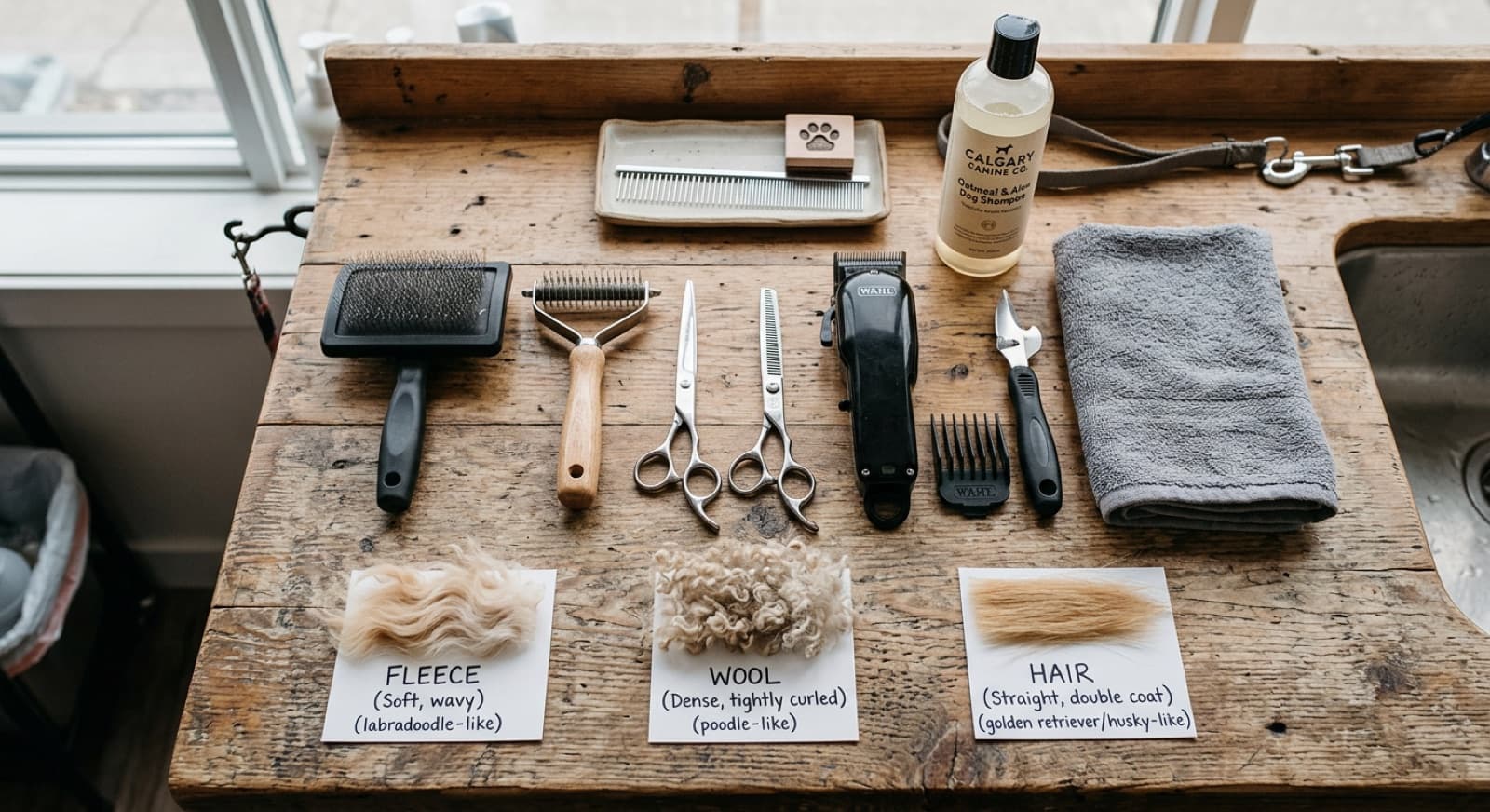
Coat types and what they mean
Generation tells you the genetic mix. Coat type tells you what the dog actually looks and feels like, and how much it sheds. The three coat categories in Labradoodle terminology are fleece, wool, and hair.
Fleece: the wavy, silky coat that is most common in Australian Labradoodles and well-bred F1B Labradoodles. Fleece coats have a soft drape with loose waves rather than tight curls. They shed minimally, are generally allergy-friendly, and are less prone to matting than wool coats. Grooming workload is moderate: daily brushing with a slicker brush plus professional grooming every 6 to 8 weeks in Calgary. Most ALAA and WALA breed-standard Australian Labradoodles have fleece coats.
Wool: the tight curly Poodle-style coat with dense ringlets across the body. Wool coats shed the least of the three because the loose dander gets trapped in the curls rather than released into the air. The trade-off is grooming. Wool coats mat quickly without daily brushing and require professional grooming every 4 to 6 weeks in Calgary. Skipping a week between brushings can result in deep mats that need to be shaved out rather than detangled. F1B and multigenerational Labradoodles often have wool coats.
Hair (also called straight or smooth): the Lab-like coat that sheds normally. Hair coats look more like a Lab than a Doodle and have either a straight or very loosely wavy texture. Hair coats are not hypoallergenic. Grooming maintenance is low (the lowest of the three) but the shedding makes the dog unsuitable for allergy households. Hair coats are most commonly seen in F1 Labradoodles, particularly those that did not inherit the furnishing gene.
The Calgary grooming budget by coat type:
- Wool coats: $90 to $130 every 4 to 6 weeks, plus daily owner brushing
- Fleece coats: $80 to $120 every 6 to 8 weeks, plus 3 to 4 brushings per week
- Hair coats: $50 to $80 every 8 to 12 weeks for routine bathing and tidying, plus weekly brushing
Annual grooming runs roughly $700 to $1,300 for the four largest breeds covered in our PWD vs Poodle vs Doodle comparison, and Labradoodles fall in the middle of that range.
The hypoallergenic reality
No dog is 100% hypoallergenic, including F1B Labradoodles and Australian Labradoodles. All dogs produce dander and saliva proteins. Always spend time with the specific adult dog before committing if allergic.
Allergy reactions are triggered by proteins in dander (dead skin), saliva, and urine, not by hair itself. The Can f 1 protein in dog saliva is the most common allergen. A low-shedding dog reduces airborne dander because less hair is being deposited around the home with each shed, but the dog still produces dander, still licks itself, and still urinates.
The reliability hierarchy across Labradoodle generations looks like this:
- F1 Labradoodles: coat lottery, often unreliable for allergy households. Some F1s shed like a Lab.
- F1B Labradoodles: reasonably reliable for mild to moderate allergies if the breeder DNA-tests for the furnishing gene.
- Multigenerational Labradoodles: more consistent than F1B but quality depends on the breeder's selection rigor over generations.
- Australian Labradoodles: the most reliable of the Labradoodle generations for allergy households, because the breed standard targets a fleece coat and ALAA/WALA breeders test for the relevant genetic markers.
The Calgary practical test: spend several hours with the specific adult dog you intend to adopt before committing, ideally in a small enclosed space. Pet the dog, hold the dog, sit on the floor with it. If allergy symptoms develop within 30 minutes, the match is unlikely to work long-term. If you tolerate the dog for two or three hours without symptoms, it is a reasonable bet. Most Calgary rescues will facilitate this kind of meet-and-greet on request, and the Australian Labradoodle Club of Canada specifically encourages it before placing dogs with allergy-sensitive families.
For severe allergy cases or households with asthma, consult an allergist before adopting. Some allergy-prone people react to all dogs regardless of breed or coat type. A skin prick test or specific IgE blood test can confirm whether dog dander is a true trigger or whether the allergy is to something else (such as the dander of a different species mistaken for dog).
Size variants
Labradoodle size is mostly driven by which size Standard Poodle or Miniature Poodle is in the parent cross. The three common size categories are:
Standard Labradoodle: 50 to 80 lbs, 21 to 24 inches at the shoulder. Bred from a Standard Poodle parent. The most common size and the closest to the original 1989 cross. Suits active suburban Calgary families with off-leash routines and access to Nose Hill, Fish Creek, or Edworthy Park. Standard Labradoodles need 60 to 90 minutes of daily exercise.
Medium Labradoodle: 30 to 50 lbs, 17 to 20 inches at the shoulder. Bred from a smaller Standard Poodle or a Medium Poodle parent. A practical middle-ground for Calgary households that want the Labradoodle temperament in a more manageable size. Daily exercise needs run 45 to 75 minutes.
Mini Labradoodle: 15 to 30 lbs, 14 to 17 inches at the shoulder. Bred from a Miniature Poodle parent. The Mini size fits most Calgary downtown condo weight limits (typically 20 to 25 lbs). Daily exercise needs run 30 to 60 minutes. Temperament can be more terrier-influenced because Miniature Poodles tend toward higher energy than Standard Poodles.
The Australian Labradoodle program also recognizes Standard, Medium, and Miniature sizes with similar weight ranges. The Australian Labradoodle Club of Canada coordinates registration across all three sizes.
Calgary breeder vetting framework
The Labradoodle market in Calgary includes ethical breeders doing the work properly, and a long tail of backyard breeders selling unvetted F1 crosses at designer-dog prices. Here is the framework Calgary adopters can use to separate the two.
For Australian Labradoodles specifically:
- ALAA or WALA membership in good standing, with breeder registration number
- Documented multi-generation pedigree showing Cocker, English Cocker, Irish Water Spaniel, or Curly-Coated Retriever infusions
- Published health testing for both parent dogs (hip evaluation through OFA or PennHIP, elbow evaluation, eye certification, PRA DNA test, EIC DNA test, vWD DNA test)
- Willingness to discuss coat outcomes honestly, including the small percentage of puppies in any litter that may not match the breed standard
- A written contract with a take-back clause covering the dog at any age, for any reason
For standard Labradoodles (F1, F1B, multigen):
- Documented health testing for both parent dogs (the Labrador and the Standard Poodle each need their own breed-specific screening)
- For F1B and multigen: DNA testing of the puppies for the furnishing gene if allergy reliability is the goal
- Willingness to discuss coat lottery honestly for F1 crosses (the breeder should tell you up front that some puppies may shed)
- Parent dogs visible on the property or via video call. If you cannot meet at least one parent, this is a red flag.
- A written contract with a take-back clause
- References from previous adopters you can contact
Calgary force-free trainers like Raising Canine and Pup City Pup Academy can also help vet a breeder by reviewing the contract and the breeder's socialization protocols. The first 16 weeks of a puppy's life are critical for temperament development, and a breeder who keeps puppies under-socialized in a barn or shed produces dogs with lifelong reactivity issues regardless of the genetic mix.
Why some “Labradoodle” puppies are actually unethical
The Labradoodle market in Canada is largely unregulated. Neither the Canadian Kennel Club nor the American Kennel Club recognizes the Labradoodle as a breed, which means there is no official registration body, no breed standard enforcement, and no required health testing. This is exactly the gap Wally Conron warned about in his 2019 interview.
Red flags Calgary adopters should watch for:
- Untested F1 backyard crosses. A Lab and a Poodle in someone's backyard producing puppies without health testing of either parent. Common on Kijiji and Facebook Marketplace. Puppies often arrive with undiagnosed hip dysplasia, eye conditions, and temperament problems.
- “Australian Labradoodle” without ALAA or WALA registration. Some breeders use the Australian Labradoodle label loosely without the documented lineage. Verify registration paperwork before paying the price premium.
- “Rare colour” marketing. Phantom, parti, merle, and other unusual colour patterns are often sold at premium prices but can carry serious health risks. Merle in particular is linked to deafness and blindness, and double-merle breedings (both parents merle) are unethical.
- Free or cheap Facebook listings. “Free to good home” or low-priced Labradoodle puppy listings on Facebook Marketplace and Kijiji often involve dogs with undiagnosed health conditions, behaviour issues, or are scam ads. The Calgary Police Service has warned about pet scams that take deposits for puppies that do not exist.
- Puppies under 8 weeks old. Reputable breeders do not place puppies before 8 weeks. Anyone offering a 6 or 7 week old puppy is not following established breed-development practice.
- No willingness to meet parent dogs. If the breeder refuses to let you meet the parents in person or via video call, walk away.
- Multiple breeds available at once. A breeder with Labradoodles, Goldendoodles, Bernedoodles, and Cavoodles simultaneously is usually running a volume operation rather than a careful single-breed program.
For Calgary families who find a Labradoodle through rescue rather than breeder, none of these vetting requirements apply directly, but the meet-and-greet process matters more. Calgary rescues (AARCS, BARCS, Pawsitive Match) foster-test Doodles before placement and provide health and temperament history where available. See the Labradoodle adoption hub for the full Calgary rescue contact list.
Browse adoptable Labradoodles in Calgary
Calgary rescues see Labradoodle surrenders every month, often from pandemic-era impulse adoptions. Most are F1 coat-lottery dogs with friendly temperaments and adult coats already established (so the shedding profile is visible). See current listings.
See Available Labradoodles →Frequently Asked Questions
What is the difference between F1 and F1B Labradoodles?
F1 is the first-generation cross: one purebred Labrador parent and one purebred Standard Poodle parent, producing puppies with roughly 50% Lab and 50% Poodle genetics. F1B is an F1 Labradoodle bred back to a Standard Poodle, producing puppies with roughly 25% Lab and 75% Poodle. The practical consequence is shedding. F1 puppies are a coat lottery because the furnishing gene that produces low-shedding only expresses reliably with two copies, and an F1 puppy might inherit zero, one, or two copies from its parents. F1B puppies have a much higher probability of inheriting two copies of the furnishing gene and therefore have a more reliable low-shed coat. For Calgary families with mild to moderate allergies, F1B is usually the safer starting point than F1.
Is an Australian Labradoodle worth the extra cost?
For severe allergy households and families who want the most consistent temperament, yes. Australian Labradoodles are a documented multi-generation breed program with Cocker Spaniel, English Cocker Spaniel, Irish Water Spaniel, and Curly-Coated Retriever infusions, developed at Tegan Park and Rutland Manor in Australia and now organized through the Australian Labradoodle Association of America (ALAA) and the Worldwide Australian Labradoodle Association (WALA). The breed standard targets a fleece coat with reliable low-shedding, a calmer temperament than the typical Labradoodle, and consistent size ranges. The cost premium ($3,500 to $5,000 versus $1,500 to $3,500 for a standard Labradoodle) reflects multi-generation health testing, predictable outcomes, and parent-organization oversight. For families with milder allergy needs or a flexible coat preference, a well-bred F1B Labradoodle is often the more practical Calgary option.
Are Labradoodles hypoallergenic?
No dog is 100% hypoallergenic, including Labradoodles. Allergy reactions are triggered by proteins in dander (dead skin), saliva, and urine, not by hair itself. A low-shedding dog reduces airborne dander because less hair is being deposited around the home with each shed. F1 Labradoodles are a coat lottery and some shed like a Lab. F1B and Australian Labradoodles are more consistently low-shed and generally tolerated by allergy-prone families, but reactions vary by individual. The reliable Calgary practical test is to spend several hours with the specific adult dog you intend to adopt in a small enclosed space before committing. If symptoms develop within 30 minutes, the match is unlikely to work long-term.
Which coat type sheds least?
Wool coats shed the least, followed closely by fleece coats. Wool is the tight curly Poodle-style coat that traps loose dander in the curls rather than releasing it. Fleece is the wavy silky coat that is most common in Australian Labradoodles and well-bred F1B Labradoodles, and it produces minimal shedding while being less mat-prone than wool. Hair coats (sometimes called straight or smooth) shed like a Lab and are not hypoallergenic. The trade-off is grooming workload: wool coats mat fastest and require professional grooming every 4 to 6 weeks in Calgary, fleece every 6 to 8 weeks, hair every 8 to 12 weeks for routine bathing and tidying.
How do I know what generation a Labradoodle is?
A reputable breeder provides written pedigree documentation showing the generation (F1, F1B, F2, F2B, multigen, or Australian Labradoodle) along with the parent breeds and health testing records. Australian Labradoodles registered through ALAA or WALA carry a registration number that traces the documented multi-generation lineage. For dogs sourced through Calgary rescue, the generation is often unknown because surrender paperwork rarely includes breeder records. DNA testing through Embark or Wisdom Panel can reveal the approximate parent-breed contribution (typically Lab and Poodle percentages, sometimes with Cocker Spaniel or Irish Water Spaniel for Australian Labradoodle lineage) but cannot definitively identify the generation. For allergy households adopting from rescue, spending time with the specific dog matters more than the paperwork.
Why does Wally Conron regret creating the Labradoodle?
Wally Conron created the first Labradoodle in 1989 at the Royal Guide Dogs Association of Australia, crossing a Standard Poodle with a Labrador to produce a guide dog suitable for a vision-impaired client whose husband had dog allergies. The cross was a deliberate medical solution, not a market product. Conron has said publicly in interviews (Australian Broadcasting Corporation, 2019) that he regrets popularizing the cross because it opened the door to unethical Doodle breeding worldwide. Backyard breeders flooded the market with poorly screened F1 crosses, marketed as designer dogs at inflated prices, often without health testing of either parent. The Australian Labradoodle program at Tegan Park and Rutland Manor represented the ethical multi-generation development that followed, but the broader Doodle phenomenon Conron started is what he regrets.
What is a multigenerational Labradoodle?
Multigenerational (F3 and beyond, sometimes written as multigen) means two Labradoodles bred together over multiple generations, typically selected for coat consistency, temperament, and breed-type. The further removed from the original F1 cross, the more genetically consistent the offspring tend to be in coat type and shedding profile. Multigenerational Labradoodles are a step toward what the Australian Labradoodle program achieved with documented lineage, but most North American multigenerational lines do not carry the Cocker Spaniel, English Cocker Spaniel, Irish Water Spaniel, or Curly-Coated Retriever infusions that distinguish the Australian Labradoodle. Ethical Doodle breeders increasingly work in the multigen range because the coat outcomes are predictable enough to honour the low-shed marketing promise that F1 cannot reliably deliver.
Is an F2 Labradoodle a good choice?
F2 is generally the worst predictability of the common generations. F2 means an F1 bred to another F1, which produces puppies with highly variable coat and temperament outcomes because both parents are themselves coat-lottery dogs. Within an F2 litter you can see a Lab-coat shedder, a Poodle-coat curly low-shedder, and everything in between. For Calgary families with specific coat or shedding needs, F2 is the generation to avoid. F2B (F2 bred back to a Poodle) is somewhat more predictable, and multigen lines further out are more consistent again. If a breeder is selling F2 Labradoodles without DNA-testing the puppies for the furnishing gene, ask hard questions about why the breeding choice was made.
Can I find an Australian Labradoodle through Calgary rescue?
Rarely. Australian Labradoodles in Canada are uncommon and most live in homes that purchased through documented ALAA or WALA breeders. The premium price tag and detailed adopter screening through those programs means the dogs are usually well-placed and stay in homes long-term. When Australian Labradoodles do appear in Calgary rescue, it is typically through life-circumstance surrenders rather than buyer-remorse surrenders. AARCS, Pawsitive Match, and BARCS occasionally see Doodle mixes that may have Australian Labradoodle background, but verification usually requires DNA testing. For Calgary families seeking an Australian Labradoodle, the realistic path is the Australian Labradoodle Club of Canada breeder network with multi-month waitlists.
What size Labradoodle should I get?
Three sizes are commonly recognized: Standard (50 to 80 lbs, from a Standard Poodle parent), Medium (30 to 50 lbs, from a Medium or smaller Standard Poodle parent), and Mini (15 to 30 lbs, from a Miniature Poodle parent). Size in Labradoodles is mostly driven by which size Poodle is in the parent cross, with some variability from the Lab side. For Calgary condo and apartment dwellers, Mini Labradoodles fit weight limits at most downtown buildings (typically 20 to 25 lbs). For active suburban families with off-leash routines, the Standard size suits the breed temperament best because it carries the working drive and athletic build needed for Calgary outdoor lifestyle. The Australian Labradoodle program also recognizes Standard, Medium, and Miniature sizes with similar ranges.
Labradoodle Adoption Calgary
The Calgary Labradoodle adoption hub. Rescue sources, real costs, surrender patterns, and breeder verification.
Is a Labradoodle Right for You?
Honest lifestyle-fit guide. Exercise demand, family compatibility, Calgary climate, and the coat-care reality.
Labradoodle Health Issues: Joints, Ears, Eyes
Labradoodle health issues to plan for: hip and elbow dysplasia, weight, exercise-induced collapse, Addison’s disease, ear infections, eye disease and bloat.
PWD vs Poodle vs Doodle Calgary
Five low-shed breeds compared side by side for Calgary allergy-prone families.
Adoptable Labradoodles in Calgary
Live listings of Labradoodles from the Calgary rescue network, updated regularly.
Adoptable Poodles in Calgary
Standard, Mini, and Toy Poodles available through the Calgary rescue network.
New dog? Start with these care guides
Everything a new adopter needs to set up a safe, happy home.