Calgary is built for Berners (eight months a year)
The Bernese Mountain Dog was developed in the Swiss Alps as a farm and draft dog. The AKC breed standard describes a thick double coat, heavy bone, deep chest, and calm temperament shaped by cold mountain agriculture. Calgary's long winter (October through April, -10 to -30C) suits the breed perfectly. Snow is enrichment. Sub-zero air is comfortable. A Berner at -25C is doing exactly what 200 years of Swiss breeding asked of it. The summer is the inverse story. Calgary July and August reach 22 to 30C, sometimes higher. Above 22C, outdoor exercise becomes risky. Above 25C, an unconditioned Berner can develop heat stroke in under 30 minutes. This guide is the playbook for eight months of joy and three months of careful management.
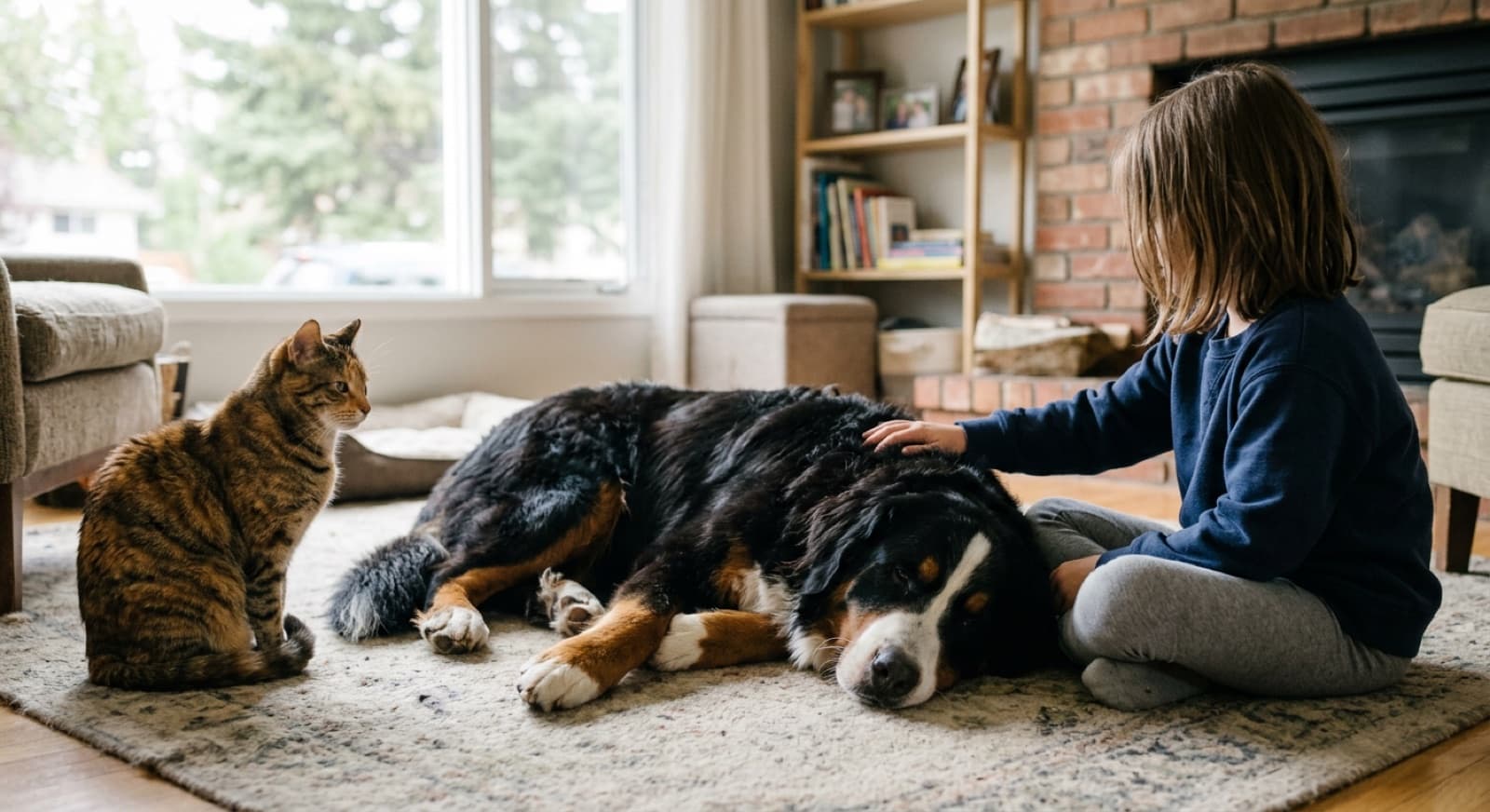
Calgary's killer advantage: the cold
Berners thrive at -20 to -30C. Snow play is their natural element. A Calgary winter is closer to a Swiss alp than a Toronto winter is, and far better than Vancouver or anywhere south of the 49th.
The Bernese double coat does two jobs. The dense undercoat traps body heat at the skin. The longer outer guard hairs shed snow, water, and wind. The result is a dog that is genuinely warm in conditions that send most breeds inside.
What adult Berners can handle in Calgary:
- 60 to 90 minute walks at -20 to -25C with no gear
- Fresh snow play for 30 to 60 minutes without fatigue
- Cart-pulling, sled-pulling, or pulling toddlers on a sled (the breed's draft instinct)
- Sleeping on cold floors by choice (they often pick the coldest spot in the house)
- Off-leash romping at -25C while humans freeze in two parkas
Below -30C, watch paw pads on packed snow and salted sidewalks. Booties are optional for most adult Berners but useful for puppies, seniors, or dogs that develop pad cracking.
Many Berner owners report their dog's mood visibly lifts the first snow of the season. Some dogs that seemed flat through summer become playful, alert, and engaged in October. The breed is doing what it was bred to do.
The summer reality: Calgary heat is the Berner's enemy
Calgary July and August daytime highs reach 22 to 30C, with heat-wave spikes above 32C. For a Berner, these are dangerous temperatures.
| Air temperature | Berner risk level | Calgary protocol |
|---|---|---|
| Below 18C | Safe | Normal walks and off-leash play |
| 18 to 22C | Caution | Shade required, avoid midday sun, watch panting |
| 22 to 25C | Risky | Walks 6 to 8 AM or after 9 PM only, short duration |
| 25 to 28C | Heat stroke risk in 30 min | Indoor enrichment only, AC required indoors |
| Above 28C | Emergency-level risk | Stay indoors with AC, potty breaks only, watch closely |
Calgary asphalt reaches 60C surface temperature on a 25C air-temperature day. That burns paw pads in under one minute. Use the back-of-hand test: press your hand to the pavement for seven seconds. If you cannot hold it, your dog cannot walk on it.
Why heat kills Berners faster than other breeds
Three breed traits stack together to make heat a serious risk. The Bernese Mountain Dog Club of America flags heat sensitivity as the breed's single biggest lifestyle constraint outside of Alpine climates.
- Dense double coat traps body heat. The same undercoat that insulates at -25C also blocks heat loss at 25C. Berners cannot offload heat by panting as efficiently as short-coated breeds.
- Dark tri-colour coat absorbs sun. The black, rust, and white pattern looks beautiful and acts like a solar panel in direct sun. Surface coat temperature on a sunny 25C day can exceed 50C within minutes.
- Large body mass = poor thermoregulation. A 90+ pound dog generates and stores far more heat than a 30 pound dog. Cooling the core takes longer. By the time a Berner shows distress, internal temperature is often dangerously high.
This is why heat stroke can develop in under 30 minutes of moderate outdoor activity above 25C. Other large breeds (Labs, Goldens) tolerate Calgary summers better because their coats are shorter and lighter-coloured. A Berner is the worst-case combination.
Heat-stroke symptoms (emergency vet immediately)
Heat stroke progresses fast in Berners. Recognize it early.
Early signs:
- Excessive panting that does not slow with rest
- Thick or ropey drool
- Bright red or dark red gums (healthy gums are pink)
- Reluctance to move, seeking cool surfaces
Progressing signs:
- Vomiting or diarrhea
- Weakness, stumbling, glassy eyes
- Body temperature above 40C (normal is 38.3 to 39.2C)
Late signs (life-threatening):
- Collapse
- Seizures
- Unconsciousness
What to do immediately: move to AC or deep shade. Apply cool (not ice-cold) water to belly, paws, and armpits. Offer small amounts of cool water. Drive directly to a Calgary 24-hour emergency veterinary centre. Call ahead so they can prep for arrival. Per AVMA heat-safety guidance, every minute of cooling on the way matters more than driving speed.
Do not wait to see if the dog improves. Berner heat stroke has a high mortality rate once organ damage starts. Prevention is the only safe strategy.
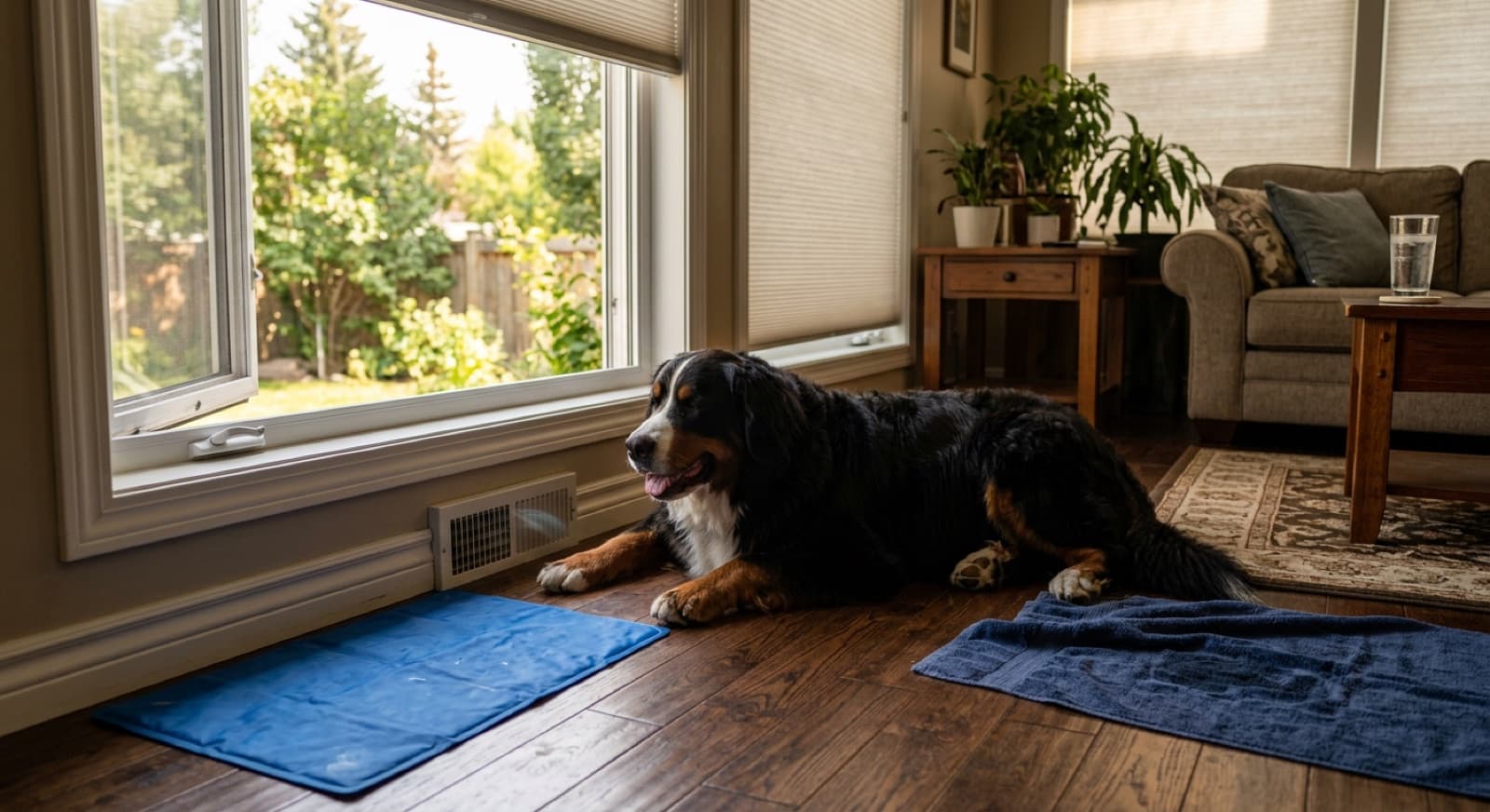
The Calgary summer protocol
From late June through early September, run this protocol every day:
- AC required indoors. A Berner without AC during a Calgary heat wave is at hospital-level risk. Confirm AC works before the season starts. Have a backup plan (basement, ground-floor room, cooling mat) if AC fails.
- Walks at 6 to 8 AM or after 9 PM only. Midday walks are not negotiable on hot days. Plan around it.
- Never leave in a parked car. A 22C day produces 38C inside a parked car within 10 minutes. Even with windows cracked. Even in shade. Even for “a quick errand.” This kills Berners every Canadian summer.
- Never walk on hot pavement. Stick to grass and shaded trails. Calgary asphalt at 60C burns pads in 60 seconds. Booties help but do not eliminate the heat-radiation problem.
- Wet cooling vests can help on cooler-but-still-warm days (18 to 22C). Soak before walks, apply to chest and belly. Not a substitute for staying inside above 25C.
- Indoor enrichment replaces some exercise. Puzzle feeders, frozen Kongs (peanut butter, plain yogurt, dog-safe), scent work (hide treats around the house), basic obedience refreshers. 20 to 30 minutes of mental work tires a Berner as much as a 45-minute walk.
- Cool floors and water access. Tile, hardwood, basement floors. Keep water bowls in multiple rooms. Some Berners drink more when bowls are easily reachable.
- Watch for early warning signs. If your dog seeks cool spots, pants without slowing, or refuses food, cancel the walk. Stay in.
Browse adoptable Bernese Mountain Dogs in Calgary
Foster reports often include heat tolerance, joint health, and apartment compatibility notes. Critical for Calgary climate planning. For rescue options, application steps, and what to expect on a Berner home visit, see our Berner adoption Calgary guide.
Calgary apartment + condo reality
A Berner in a Calgary apartment is doable but suboptimal. Four constraints decide whether it works.
- Summer AC reliability. Confirm AC works before adopting. Many older Calgary buildings lack central AC. A Berner in a top-floor unit without AC during a July heat wave is at hospital-level risk for days at a time. Window AC units help but check whether your building allows them.
- Stair access. A 90+ pound dog plus multiple stair flights daily creates cumulative hip and elbow damage. Elevator buildings are far better than walk-ups. Avoid top-floor walk-ups entirely. If your building has stairs only, plan to carry the dog up and down for puppy phase and senior years.
- Floor space. A Berner needs roughly 800 square feet of usable floor to stretch out, turn, and rest without bumping furniture. A 500 square foot studio is rough on a giant breed. Open-plan one-bedrooms work better than chopped-up layouts.
- Condo board bylaws. Many Calgary buildings cap pet weight at 25 to 35 pounds. That excludes Berners entirely. Read the bylaw before signing a lease or buying a unit. Service-animal status is a separate process and not a workaround for pet rules.
The house-with-yard Berner is happier and easier. The Calgary apartment Berner can work with a committed owner, AC, an elevator, daily off-leash park visits, and a building that allows large dogs.
Plan for heavy shedding in a small space. Monthly professional grooming is close to mandatory in an apartment, since vacuuming alone cannot keep up with twice-yearly “coat blow” periods (spring and fall). For brushing schedules, summer-coat decisions, and Calgary groomer options for a giant double-coated breed, see our Berner grooming and shedding guide.
Exercise math for an adult Berner
60 to 90 minutes of daily activity, low-impact preferred. Joints take priority over intensity. Two moderate sessions beat one hard session.
Good Berner exercise
- • Two 30-minute leash walks (morning + evening)
- • 30 minutes of off-leash sniffing at a fenced park
- • Slow trail hikes on soft surfaces
- • Snow play in winter (self-regulating, joint-friendly)
- • Swimming in warm weather (zero joint impact)
- • Cart-pulling or backpack work for adults
- • Scent games, puzzle feeders, basic obedience
Avoid for Berners
- • Forced jogging or biking alongside
- • Repeated stair sprints
- • Jumping from heights (truck beds, decks)
- • Hard fetch sessions on hot or hard surfaces
- • Agility jumps (puppy growth or adult joints)
- • Long midday walks in summer (above 22C)
- • Asphalt walking in summer (60C surface burn)
Mental work counts toward daily exercise on hot days or after a vet has flagged joint issues. A 20-minute scent game tires a Berner as much as a 30-minute walk.
Best Calgary off-leash parks for Berners
Calgary has roughly 150 off-leash areas across every neighbourhood. The City of Calgary off-leash areas directory is the authoritative list with hours, fenced status, and any seasonal restrictions. For Berners, the picks below balance shade, fencing, and giant-breed-friendly space.
- Sue Higgins Park (Southland). Top pick. Large, fully fenced, riverfront, with multiple shaded areas. Room for a giant breed to amble without colliding with smaller dogs. Best year-round.
- Nose Hill Park. Winter ideal. Open prairie, wind-blown snow, big horizons. Berners love it. In summer, only safe before 9 AM due to open exposure and minimal shade.
- Fish Creek Provincial Park. Sikome Lake area and Bow Valley Ranch corridors offer shaded forest cover that holds up better than open-prairie parks on warm days. Many kilometres of river-adjacent trail.
- River Park (Altadore). Off-leash during set hours. Shaded sections along the escarpment make it usable on warmer days. Good escarpment views and walkable to other off-leash sections of the Elbow River pathway.
- Bowmont Park (Silver Springs Gate). Fenced section, smaller and safer for recall practice. Useful for training a Berner that does not yet have rock-solid off-leash manners.
- Edworthy Park. River access for cooling off in warmer months. Watch gravel paths in mid-summer afternoons.
- Weaselhead Flats. Wooded river-valley trail, plenty of shade, gentler grades than Nose Hill. A favourite shoulder-season Berner walk when the prairie parks are too hot or too windy.
- Avoid in summer afternoons: Tom Campbell's Hill, Bow Habitat Station, anywhere with minimal shade and southern exposure. These cook large dogs fast.
Fenced parks (Sue Higgins, Bowmont Silver Springs) are best for off-leash training. Berners can be slow to recall when distracted by competing scent, and a 90+ pound dog ignoring a recall is a problem at unfenced sites.
Winter joy: the Berner element
Berners come alive in Calgary winter. -30C walks are fine for an adult Berner with a healthy coat. Snow zoomies, drift-rolling, and digging are breed-appropriate enrichment.
What Calgary winter offers that other Canadian cities cannot match:
- Eight months where outdoor exercise is comfortable for the breed
- Deep snow conditions ideal for cart-pulling and weight-pulling enrichment
- Long stretches of cold weather without the freeze-thaw cycle that plagues coastal cities
- Off-leash parks usable year-round (with proper paw care)
- Dry cold (less risk of wet-coat hypothermia than coastal winters)
The cart-pulling instinct from the breed's Swiss draft-dog history sometimes emerges in winter. Many adult Berners enjoy pulling a child's sled, dragging a heavy branch, or wearing a snow-day backpack. This is breed-appropriate work and a useful outlet on cold days.
Puppy joint-protection rules still apply in winter. The 5-minute-per-month rule is independent of weather. A 4-month-old Berner does not get a 90-minute snow hike just because it is cold outside. Bring breaks, bring water, watch for ice between toes, and rinse paws after walks on salted sidewalks.
Summer indoor enrichment
On days above 25C, swap most outdoor exercise for indoor mental work. A tired Berner brain is as satisfied as a tired Berner body, and joints get a rest.
- Frozen Kongs. Stuff with peanut butter (xylitol-free), plain Greek yogurt, wet food, or kibble soaked in broth. Freeze overnight. 30 to 45 minutes of work for an adult Berner.
- Puzzle feeders. Outward Hound, Nina Ottosson, or Kong Wobbler. Replace one meal a day with a puzzle on hot days.
- Scent games. Hide treats in towels, boxes, or around the house. Cue “find it.” Mental work for the same body tax as a short walk.
- Snuffle mats. Cheap, washable, and replace 15 minutes of mealtime with foraging work.
- Hide-and-seek. Family members hide and call the dog. Builds recall and burns mental energy. Free.
- Lick mats. Smear with yogurt, dog-safe peanut butter, or pumpkin puree. Freeze for longer engagement. Calming for anxious dogs.
- Basic obedience refreshers. 10-minute training sessions on sit-stay, down-stay, and recall. Cognitive load = real fatigue.
- New trick a week. Spin, roll over, paw shake, weave through legs. Trick training is mental cardio.
Puppy joint-protection rule (until 18 months)
Five minutes of structured exercise per month of age, once or twice daily, until 18 months. The rule is conservative because Berner joint damage during growth is permanent.
Berner growth plates close late (around 18 to 24 months). The breed is predisposed to hip dysplasia, elbow dysplasia, and cruciate ligament injuries. Over-exercising a Berner puppy raises the lifelong risk of all three. For the full screening picture (OFA hips, elbows, cardiac, eye, and von Willebrand panel) and which Calgary specialists handle Berner orthopaedics, see our Berner health issues guide. For low-impact obedience and force-free puppy training around the joint rules, our Berner training guide covers what works for the breed's calm, sensitive temperament.
What “5 minutes per month” looks like in practice:
- 2 months: 10 minutes max per structured session
- 4 months: 20 minutes max per session
- 6 months: 30 minutes max per session
- 9 months: 45 minutes max per session
- 12 months: 60 minutes max per session
- 18 months: adult schedule (60 to 90 min daily)
What counts as “structured exercise”: leash walks, hikes, sustained running, fetch sessions. Free play on soft surfaces (grass, snow, dirt) is largely self-regulating and does not need a timer; puppies stop when tired.
What to avoid during growth:
- Jogging alongside a runner or bike
- Repeated stair sprints (especially down stairs)
- Jumping from heights (truck beds, decks, couches)
- Forced fetch with high-impact landings
- Long-distance hikes on hard surfaces
- Agility jumps
Many adult Berners with poor joint scores had owners who unintentionally over-exercised them as puppies. The rule is conservative on purpose. Mental work, calm socialization, and short positive walks build a healthy adult dog more reliably than physical exhaustion.
Frequently Asked Questions
Is Calgary a good climate for a Bernese Mountain Dog?
Yes, arguably the best major-city climate in North America. Eight months of cold weather suits the Swiss-bred breed perfectly. The summer (22 to 30C in July and August) is the risk window and requires AC, early-morning walks, and indoor enrichment.
How much exercise does a Bernese Mountain Dog need?
Adult: 60 to 90 minutes daily, low-impact preferred. Two 30-minute walks plus 30 minutes of off-leash sniffing beats one 90-minute hard session. Puppy: 5 minutes per month of age until 18 months.
At what temperature is it too hot to walk a Berner?
Above 22C is risky. Above 25C, heat stroke can develop in under 30 minutes. Walk only at 6 to 8 AM or after 9 PM in summer. Avoid asphalt (60C surface at 25C air temp).
Signs of heat stroke in a Berner?
Excessive panting, bright red gums, thick drool, vomiting, weakness, collapse. Move to AC, apply cool water to belly and paws, drive to a Calgary 24-hour emergency veterinary centre immediately. Cooling on the way matters more than speed.
Can a Berner live in a Calgary apartment?
Doable but suboptimal. Four constraints: reliable summer AC, elevator (not walk-up stairs), 800+ sq ft floor space, condo board pet weight bylaws. Read the bylaw before signing.
Best Calgary off-leash parks for a Berner?
Sue Higgins (large + fenced + riverfront), Nose Hill (winter ideal), River Park (off-leash hours + shade), Bowmont Silver Springs Gate (fenced section), Edworthy (river access). Avoid open exposure parks in summer afternoons.
How do I exercise a Berner in winter?
Adult Berners are comfortable at -25C with no gear. Below -30C watch paw pads. Snow play is enrichment. The cart-pulling instinct often emerges in winter. Puppy 5-minute rule still applies in cold.
What is the 5-minute rule for Berner puppies?
Five minutes of structured exercise per month of age until 18 months. A 6-month-old gets 30 min; a 12-month-old gets 60 min. No jogging, jumping, stair sprints, or agility during growth. Joint damage in growth is permanent.
More Bernese Mountain Dog guides
Is a Berner Right for You? →
Honest fit check built from Calgary surrender patterns. Time, budget, climate, lifestyle reality.
Berner Training Calgary →
Force-free training that fits the breed's calm, sensitive temperament. Calgary trainer options.
Berners with Kids and Cats →
Why Berners are nicknamed “nanny dogs.” Compatibility with kids, cats, and other dogs.
Berner Adoption Calgary →
The full Calgary Berner playbook: rescues, fees, health screening, what to expect.
Berner Health Issues Calgary →
Hip and elbow dysplasia, cancer risk, bloat, screening tests, Calgary vet specialists.
Berner Cancer + Lifespan →
The hard truth about Berner lifespan, histiocytic sarcoma, and quality-of-life decisions.
Berner Cost of Ownership →
Lifetime cost breakdown for a Calgary Berner: food, vet, grooming, insurance, end-of-life.
Berner Pet Insurance Calgary →
Why pet insurance is close to mandatory for the breed. Calgary insurer comparison.
Berner Grooming + Shedding →
Twice-yearly coat blow, brushing schedule, Calgary groomer options, summer coat decisions.
Buy or Adopt a Berner →
Honest comparison of Calgary breeders, rescues, and the cost-versus-risk math for the breed.
New dog? Start with these care guides
Everything a new adopter needs to set up a safe, happy home.