The Bernese trainability paradox
New Berner owners expect a giant teddy bear who follows them everywhere and learns quickly. Most of that is true. What blindsides people is the stubborn streak. A Berner who is corrected harshly does not get tougher. He goes quiet, looks away, refuses food, and stops offering behaviour. The American Kennel Club breed profile and the Bernese Mountain Dog Club of America both describe a sensitive, slow-maturing working dog that needs patient socialization. The fix is not more pressure. It is the right method. Force-free positive reinforcement with high-value food works on this breed the way wind works on a sail. This guide covers what works by age, what damages Berners, how to survive the puppy blues, and how to choose a Calgary force-free trainer.

Training Timeline by Age
| Age | Focus |
|---|---|
| 8 to 16 weeks | Critical socialization window. Name, baby recall, sit, settle on a mat, crate love, gentle paw and ear handling. Biting and mouthing redirection to chew toys. Slow stair access to protect developing joints. Expose to people, dogs, surfaces, sounds, and Calgary environments. |
| 16 weeks to 6 months | Loose-leash walking foundations while the puppy is still light. Polite greetings to prevent jumping on toddlers and seniors. Settle duration on a mat. Long-line recall in fenced yards. Introduce sniff games and trick training for mental work. |
| 6 to 18 months | Adolescent regression hits. “Selective deafness” emerges. Leash pulling intensifies because the dog is now strong. Distractibility peaks. Hold the line, do not raise the pressure. Reactivity windows can open here, so manage stress and avoid bad dog-park encounters. Long-line recall in low-distraction parks. |
| 18 to 30 months | Adult brain settles in. Off-leash recall starts to firm up. Loose-leash walking consolidates. Add scent work, rally, or trick titles for ongoing mental load. Polish greetings, counter-surfing prevention, and settle in busy environments. |
| 2.5+ years | Most Berners reach reliable off-leash recall here, not earlier. Maintenance training weekly. Keep paying recall and settle. A Berner trained well stays trained for life. |
Six Essential Skills for Bernese Mountain Dogs
1. Crate training (the foundation)
Berners are den-seeking and most love a crate within 2 to 4 weeks of positive conditioning. Buy a 48-inch crate from the start. Feed meals inside. Offer chews and frozen Kongs inside. Build to closed-door brief periods, then short absences. Helps with house training, alone-time work, separation anxiety prevention, safe car transport, and post-op recovery (Berners have a high lifetime rate of orthopedic surgery).
2. Settle / “place” (Berners love this)
The most useful cue for a velcro giant. Pick a mat or bed, mark and reward the dog for lying on it, build duration in 5-second steps to 30 minutes over weeks. Berners take to settle faster than most breeds because they want to lie down anyway. Pair with frozen Kongs and lick mats for longer holds. Gives you back your kitchen during meal prep, your couch during work-from-home calls, and your front door during guest visits.
3. Loose-leash walking (the 100-pound challenge)
Start when the puppy is small and easy to manage, not at 80 pounds. Use a front-clip harness. Never use a choke chain, prong collar, or slip lead on a Berner. Reward the dog for walking near you with frequent small treats early on. Stop walking when the leash tightens. Resume when it loosens. Slow work, real results in 2 to 3 months. For adolescent Berners already pulling hard, a head halter (Halti or Gentle Leader) gives mechanical advantage without pain. Pair with positive reinforcement.
4. Recall (off-leash freedom)
Long-line work plus high-value rewards over months. Start indoors. Move to fenced yard. Move to a 15 to 30 foot long-line in a fenced off-leash park (Sue Higgins is the best Calgary option). Pay every recall with chicken, cheese, or hot dog. Never call your Berner off something interesting without paying more than the distraction is worth. Never punish a slow return. Reliable off-leash recall typically arrives at 18 to 24 months, not at the end of puppy class. Plan for the long-line years.
5. Greetings (preventing jumping on toddlers and seniors)
A 100-pound dog jumping on a 3-year-old or an 80-year-old grandparent is a serious injury risk. Train four-paws-on-floor from day one. Turn away and give zero attention if the puppy jumps. Mark and reward calm sit greetings. Have guests do the same. Avoid the “but it is cute when he is a puppy” trap. The behaviour you reward at 20 pounds becomes a problem at 100. Calgary practice spots: a friend's doorway, your local off-leash park gate, the vet clinic waiting room. For broader family-fit work with toddlers and other pets, see our Berners with kids & cats guide.
6. Counter-surfing prevention (smart dog + tall reach)
An adult Berner can reach most kitchen counters without standing on hind legs. Clear counters until the dog is trained. Teach a strong “off” or “leave it” cue. Increase mental enrichment so the dog has a job. Never punish counter-surfing after the fact, the dog will learn to do it only when you are not in the room. Manage the environment while you train the alternative.
Browse adoptable Bernese Mountain Dogs in Calgary
Adult rescue Berners often have basic obedience already established. Foster temperament reports flag stubbornness, recall, and reactivity cases up front.
See Available Berners →Food vs Play vs Praise: What Motivates a Berner
Most Berners are highly food-motivated. A smaller share are play-motivated. Very few work for praise alone, especially as adolescents. Pay them.
Food motivation (most Berners)
Chicken, cheese, hot dog, freeze-dried liver, training treats. Cut treats to pea size. A Berner eats ten pea-sized rewards in a session without weight gain. Save the highest-value foods (chicken, hot dog) for recall and new cues. Use kibble or basic biscuits for known behaviours. Most Calgary pet retailers and grocery stores carry suitable training treats; if your dog has food sensitivities, ask your vet about acceptable options.
Play motivation (some Berners)
A tug toy, a fetch ball, or a flirt pole. Useful for outdoor, high-distraction training where food is harder to deliver fast enough. If your Berner lights up for play, use it. If he is lukewarm on toys, do not force it.
Praise alone (rarely enough)
Praise pairs well with food but rarely works as the only reward. Adolescent Berners check out for praise the moment a squirrel appears. Pay them in the currency that beats the distraction.
What Force-Free Actually Looks Like
1. Use markers and rewards
A clicker, a marker word (“yes!”), or a unique sound. Mark the exact moment of desired behaviour. Follow with a high-value treat. Berners pick up marker-reward sequences within a handful of reps because they want to engage with you when the environment feels safe.
2. Reward what you want, remove reinforcement from what you do not
Dog jumps up to greet, turn away and give no attention until 4 paws on floor, then mark and reward. No yelling, no kneeing, no punishment. The wanted behaviour gets a party. The unwanted behaviour gets nothing.
3. Manage the environment
If your Berner pulls toward squirrels, change route or use a head halter. If your Berner barks at the window, close blinds or use window film. If counter-surfing is a problem, clear counters. Management prevents practice of the unwanted behaviour while you train the alternative.
4. Train in short, frequent sessions
Three to 5 minute sessions, 3 to 5 times per day. Berners fatigue mentally before physically. Quit while the dog is still engaged and successful. Never train past frustration. A bored, tired Berner shuts down.
5. Protect the soft temperament
No yelling. No leash pops. No choke chains. No prong collars. No e-collars. No alpha rolls. Berners shut down with aversive methods and the breed community is unusually clear about this. If a trainer suggests these tools, leave the session and find a new one.
The Bernese puppy blues, and what to do
Owner communities describe a phase between 8 and 16 weeks where new Berner owners regret the dog and want to return him. It is so common it has a name. Sleep deprivation, sharp puppy teeth shredding hands and pant legs, accidents in the house, an 80-pound future dog growing visibly in the kitchen, and the gut-punch realization that this is a 7-to-10-year commitment to a dog with elevated lifetime cancer risk. The blues are not a sign you made the wrong choice. They are a phase. For the lifespan and cancer-risk context, see our Bernese cancer & lifespan guide.
What helps. Build a support network: Berner owner groups, the Bernese Mountain Dog Club of Canada, your neighbours with dogs. Accept respite from a trusted friend or breeder for a weekend if you are burnt out. Hire a force-free trainer for early structure so you are not figuring it out alone. Prioritize your own sleep. The 4-hour-puppy-wake-up cycle is real and recovery without sleep is impossible.
What does not help. Pushing through silently. Adding pressure to the puppy by training when you are angry. Comparing your puppy to perfect Instagram Berners. Talking to a breeder or rescue and being too proud to admit you are struggling.
If the regret persists past 6 months. Contact your breeder (good breeders take dogs back at any age) or a Berner rescue for a re-home option. Do not surrender to a shelter without trying breed rescue first. The dog will be placed faster and better through a breed-specific channel. For full adoption-routing context, see our Bernese adoption Calgary guide.
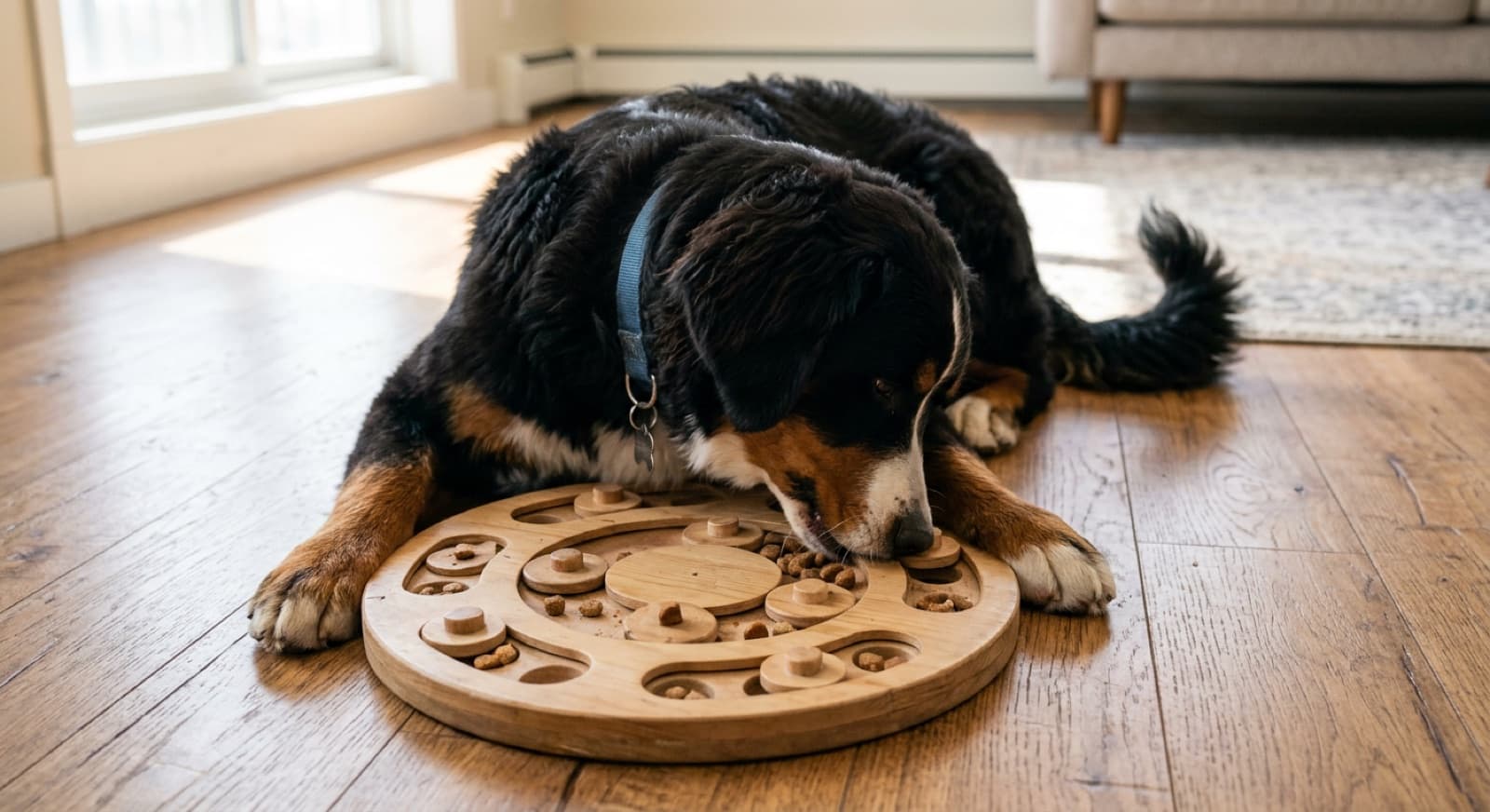
Mental Stim Menu (Rotate Weekly)
Berners are not Border Collie-level work-driven, but they are smart working dogs and they need a job. A bored Berner barks, counter-surfs, and chews. Pick 2 to 3 from this list daily and rotate weekly.
Puzzle feeders
Slow-feeders, Kong Wobbler, Outward Hound puzzles. Delay meals from 30 seconds to 15 minutes.
Frozen Kongs and lick mats
Stuff with wet food, kibble, peanut butter (xylitol-free). Freeze. 15 to 45 minutes of engagement.
Scent work / “find it”
Hide treats around the house. Build up to scent containers. Tires a Berner brain quickly.
Trick training
Spin, bow, target a paw, ring a bell. Aim for 1 new trick per week. Berners love novelty and learn fast.
Cart and draft work
Berners were bred to pull carts. Once skeletally mature (18+ months), draft training is enrichment with breed heritage. Calgary working-dog clubs occasionally run intro sessions; check with the Bernese Mountain Dog Club of Canada for current offerings.
Dog sports
Rally, scent work, tracking. Avoid high-impact jumping in agility until skeletally mature. A local Calgary obedience or agility club can introduce both. For exercise-load and joint-protection context, see our Bernese exercise & Calgary climate guide.
Long-line sniff walks
A 30-minute sniff walk on a long-line at River Park or Bowmont is more tiring than a 60-minute structured leash walk.
Settle on a mat with chew
Counts as enrichment when paired with a frozen Kong or lick mat. Builds calm and duration at the same time.
Choosing a Calgary Force-Free Trainer
Pick by credentials and methods, not by brand. The two Calgary force-free trainers on our editorial canon are Raising Canine and Pup City Pup Academy; we expect to add others as we verify them. Other Calgary trainers worth shortlisting are those who carry recognized force-free credentials and have direct large-breed experience.
Credentials that mean force-free
Look for letters after the trainer's name from one of these certifying bodies: CCPDT (CPDT-KA, CPDT-KSA), Karen Pryor Academy (KPA-CTP), IAABC (CDBC), or PMCT (Pat Miller). These bodies publish codes of conduct that prohibit aversive equipment and methods. A trainer with no credentials is not disqualified, but a credentialed trainer is the safer default for a sensitive giant.
Three questions to ask before booking
(1) What tools do you use to stop unwanted behaviour? Acceptable: management, redirection, marker-reward. Not acceptable: any aversive collar. (2) What is your policy on prong, choke, and e-collars? Acceptable: never used. (3) What do you do if a dog shuts down in session? Acceptable: stop, reduce difficulty, end on a success. Anything that escalates pressure is a red flag for this breed.
What to avoid
Trainers using e-collars, prong collars, choke chains, slip leads as everyday gear, dominance theory, alpha rolls, leash pops, or who describe themselves as “balanced.” Berners do not benefit from these tools. The breed community is unusually consistent on this point. For severe behaviour concerns beyond obedience (separation anxiety, reactivity, resource guarding), ask your vet for a referral to a veterinary behaviourist rather than relying on a general trainer.
Editorial note: specific Calgary trainer names appear on our internal verification list and will be added here as we confirm current operating status and methods. If a trainer you are considering is not listed, use the three questions above to vet them.
Calgary Training Spots by Skill
| Spot | Best for |
|---|---|
| River Park | Long-line work, loose-leash walking practice, moderate distractions. Bow River views and a steady stream of other on-leash dogs to proof around. |
| Sue Higgins Off-Leash | Fenced enclosure is the best Calgary spot for early off-leash recall practice. Perimeter fencing means a missed recall is not a disaster. |
| Bowmont (Silver Springs Gate) | Partial fenced section. Good intermediate recall step between fenced yard and fully open off-leash. Mixed terrain helps loose-leash work. |
| Nose Hill | High-distraction off-leash zone with deer, scent, other dogs. Save this for when your recall is rock solid. Not the place to test. |
| Edworthy Park | Off-leash river area. Good for socialization once vaccinated and for sniff walks. Moderate dog traffic. |
Regret recovery: you are past the return window
You bought or adopted a Berner. The puppy blues did not pass. You are 4 months in, exhausted, and the dog is now 60 pounds and pulling you off your feet. You feel stuck. Here is what works.
1. Hire a force-free trainer this week. Not next month. The single biggest predictor of whether Berner owners stay or surrender is whether they got professional help early. Book with one of the canonical Calgary force-free options (Raising Canine, Pup City Pup Academy) or any Calgary trainer credentialed through CCPDT, KPA-CTP, or IAABC. A package of 3 to 5 private sessions in Calgary typically runs $300 to $700; confirm current pricing with the trainer.
2. Build a daily structure. Berners thrive on predictability. Same wake time, same feeding time, same walk time, same training time, same sleep time. Chaos makes them harder. A predictable day makes them easier.
3. Front-load exercise and enrichment. A morning sniff walk plus a frozen Kong plus a 5-minute training session before you start your work day. A Berner who has been mentally and physically worked sleeps through your meetings.
4. Use the crate more, not less. Owners who feel guilty about the crate end up with a dog who never naps. A Berner needs 14 to 18 hours of rest per day. The crate is a feature, not a punishment.
5. Join a Berner community. The Bernese Mountain Dog Club of Canada, online Berner owner forums, and Calgary breed Facebook groups. Hearing other people describe the exact thing you are going through helps more than you think.
6. If you still cannot make it work after 6 months and trainer support, reach out to a Berner-specific rescue or your breeder. A planned re-home through a breed channel is better for the dog than a shelter surrender or white-knuckling through a relationship that is not working. The full surrender-routing playbook lives in our Bernese adoption Calgary guide.
Frequently Asked Questions
Are Bernese Mountain Dogs hard to train?
They are a paradox. Smart and willing AND stubborn and soft. They learn fast under positive reinforcement and shut down under correction. Plan for a 2-year training arc, not a 12-week class. Recall and loose-leash walking are the long projects.
Why is force-free non-negotiable?
Berners shut down under aversive methods. E-collars, leash pops, prong collars, choke chains, and yelling damage the dog and break trust. Positive reinforcement is the only method the breed community endorses.
Food, play, or praise?
Food, for most Berners. Cut treats to pea size. Chicken, cheese, hot dog, freeze-dried liver for high-value cues. Praise pairs with food but rarely works alone.
What is the puppy blues?
An 8-to-16-week phase where many Berner owners regret the puppy. Sleep deprivation, biting, accidents, and the size shock. It is normal and usually passes by 6 months. Build a support network, hire a trainer, and prioritize your own sleep.
When do I start training?
Week 1 home (8 weeks). Critical socialization window closes at 16 weeks. Most Calgary force-free puppy classes start enrolling at 8 to 10 weeks. Expect to pay roughly $200 to $400 for a 6-week course; confirm current pricing with the trainer.
How do I leash train a 100-pound dog?
Start small. Use a front-clip harness or a head halter for already-pulling teens. Reward walking near you. Stop walking when the leash tightens. 2 to 3 months of consistent work.
How do I train recall?
Long-line work plus high-value rewards over months. Sue Higgins Off-Leash is the best Calgary fenced practice spot. Reliable off-leash recall typically arrives at 18 to 24 months.
How do I pick a Calgary force-free trainer?
Pick by credentials and methods, not by brand. Canonical Calgary force-free options are Raising Canine and Pup City Pup Academy. Beyond those, screen for CCPDT, KPA-CTP, IAABC (CDBC), or PMCT credentials and direct large-breed experience. Decline any trainer who describes themselves as “balanced,” recommends e-collars or prong collars, or uses dominance language. For severe behaviour cases, ask your vet for a referral to a veterinary behaviourist.
More Bernese Mountain Dog guides
Is a Bernese Right for You? →
Honest truths about owning a Berner: shedding, lifespan, drool, exercise, and the puppy blues.
Bernese Exercise & Calgary Climate →
How much exercise a Berner needs, heat stroke risk, winter advantages, and Calgary-specific routines.
Berners with Kids & Cats →
Family dynamics, multi-pet households, and managing 100 pounds around toddlers.
Bernese Adoption Calgary →
The full Calgary adoption playbook: rescues, costs, common surrender reasons.
Bernese Health Issues →
Hip and elbow dysplasia, cancer, bloat, and the orthopedic surgery odds.
Bernese Cancer & Lifespan →
The honest math on Berner lifespan and cancer risk.
Buy or Adopt a Bernese? →
Breeder vs rescue decision tree for Calgary buyers.
Bernese Cost of Ownership →
Year one and lifetime cost of a Berner in Calgary.
Pet Insurance for Berners →
Why insurance is non-optional for a cancer-prone breed in Calgary.
Bernese Grooming & Shedding →
Coat care, blowing coat seasons, and brush routines for a heavy shedder.
New dog? Start with these care guides
Everything a new adopter needs to set up a safe, happy home.