The short answer
Plan on professional grooming every 4 to 6 weeks at a Calgary salon ($60 to $110 per visit), 5 to 10 minutes of home brushing every day, and a weekly bath with thorough drying. Total grooming spend runs $700 to $1,200 a year, more if your dog matts and needs a shave-down reset. Bichons are allergy-tolerated because the curly double coat traps shed hair against the skin, which is also why matting risk is daily rather than weekly. Vet-derm referrals are warranted for chronic ear, eye, or skin issues that do not respond to a normal vet workup.
This article is informational only and does not replace veterinary advice. Skin conditions, ear infections, eye issues, and medication choices are veterinary work. Consult your Calgary veterinarian for individualised guidance for your dog.
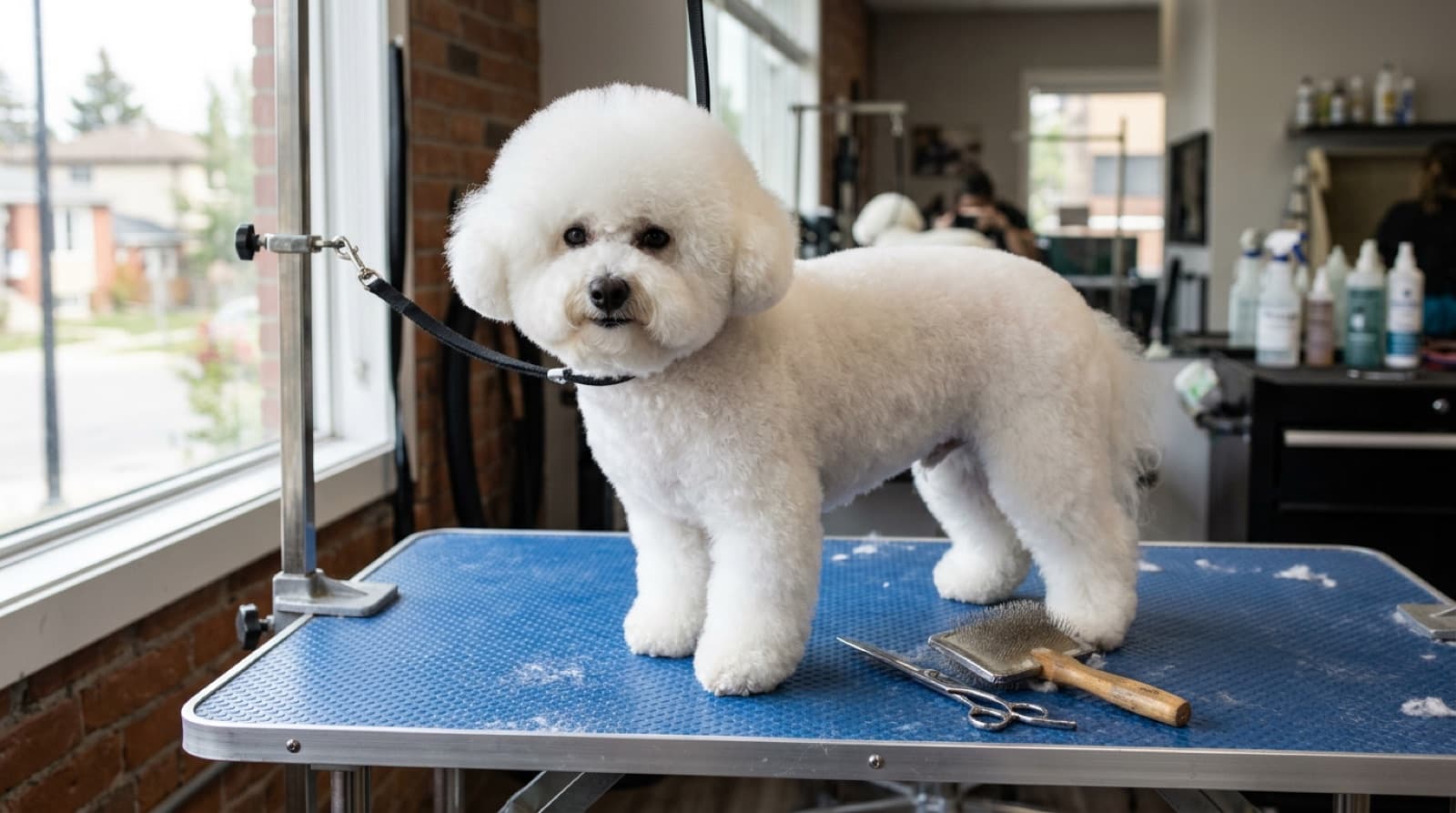
Why the Bichon coat is unique among small breeds
The Bichon Frise (developed in the Mediterranean as a companion breed and refined into its modern show form over the past two centuries) carries a coat structure unlike most other small breeds. The outer coat is a soft cottony curl 1 to 2 inches long. Underneath sits a dense soft undercoat. Both layers are non-shedding in the sense that loose hair does not fall off the dog the way it would from a Labrador or a Westie. Instead, hair that comes loose stays trapped inside the curls.
That trapped-hair structure is the reason Bichons are tolerated by many people with mild to moderate dog allergies. The dander and shed hair that trigger allergic reactions in most homes are held against the dog instead of distributed onto floors, furniture, and clothing. Weekly bathing lifts the trapped allergens out of the coat and into the bathwater, which is part of why Bichon owners bathe more often than owners of most other small breeds.
The same structure that traps allergens also traps tangles. Loose hair inside the curls turns into matts in days if not brushed out. Where a single coated dog might go a week between brushings without serious consequence, a Bichon left unbrushed for 3 to 4 days will already have small matts forming in the friction zones (behind the ears, in the armpits, at the collar line). This is the central trade-off of the breed: low shedding in exchange for high maintenance.
The breed look is the powder-puff cut: a round head scissored into a smooth dome, a body scissored or clipped to a uniform length, and legs scissored into columns. The round head is the breed signature and the hardest part of the cut to do well. A Calgary groomer with poodle or Bichon-specific scissor experience will produce a head that looks like a Bichon. A generalist who clips everything the same way often produces a head that looks like a generic white fluffy dog.
Why Bichons need more frequent grooming than other small breeds
The 4 to 6 week professional cycle is shorter than the 6 to 8 week cycle most other small breeds run on. A Westie, a Yorkie, or a Cockapoo can typically stretch to 8 weeks between salon visits without serious cost. A Bichon that goes 8 weeks usually walks in with matts that turn the routine $80 groom into a $140 shave-down reset.
The mechanism is the non-shedding coat. In a shedding breed, loose hair leaves the dog (onto your floor or out in the yard) and the coat stays clear. In a Bichon, loose hair stays in the live curls, builds up over days, and tangles with the live coat into matts that brushing alone cannot dissolve. The only fix at that point is to cut the matt out, which is why neglected Bichons get shaved down to skin and have to regrow the coat for 2 to 3 months before they look like Bichons again.
The other reason for the tighter cycle is the scissor work. The powder-puff head shape needs to be maintained on a regular schedule or it grows out of the breed look. A Bichon at 4 weeks post-groom looks like a Bichon. A Bichon at 8 weeks post-groom looks like a small white mop. Owners who care about the breed look book a groom every 4 to 6 weeks for cosmetic reasons even before the matting math kicks in.
None of this is a reason to skip the breed. Bichons are cheerful, allergy-tolerated, and well suited to Calgary apartment and condo life. It is a reason to know the grooming workload before adopting. The cost is real and the cycle is shorter than other small breeds.
The daily home brushing routine
Daily brushing is the foundation of Bichon care. 5 to 10 minutes a day is the realistic minimum for most adult dogs. Skip a day and you can usually catch up. Skip three days and you will find small matts forming. The routine is short but it has to happen.
The basic sequence:
- Slicker brush, line brushing. Part the coat with one hand and brush the section underneath. Move from the skin outward in short strokes. Work systematically from chest to hips, then down each leg, then the head and tail. Line brushing is the difference between brushing the top of the coat (which feels productive but does not prevent matts) and brushing the layer near the skin (where matts actually form).
- Detangling spray on tough spots. A light mist on a small tangle helps the slicker work through without pulling the skin. Avoid soaking the coat.
- Metal comb check. A fine to wide greyhound comb tells you whether the coat is clear at skin level. If the comb glides through, you are done. If it catches, go back with the slicker on that spot.
- Focus zones. Behind the ears, under the armpits, along the inner thighs, around the collar, at the base of the tail, around the beard and muzzle, and the sanitary area. These matt fastest. Give them an extra 30 seconds each.
- Eye wipe. Damp soft cloth across the eye area to lift overnight tear residue.
- Reward. Treat at the end. Most Bichons settle into the routine well if it starts early and stays gentle.
The home kit:
- Medium slicker brush ($25 to $40)
- Metal greyhound comb, fine and wide tines ($15 to $25)
- Detangling spray ($10 to $20)
- Gentle hypoallergenic shampoo (groomer or vet picks the brand for your dog)
- Tear-stain wipes or soft damp cloth ($10 to $20)
- Ear cleaning solution (vet recommended only)
- Curved scissors for sanitary trims if you do them at home ($20 to $50, optional)
- Nail clipper or grinder ($20 to $50)
Specific brands are a groomer and vet conversation, not a website pick. The structure above is the kit; the brand choices are personal to your dog.
Weekly bathing and the drying problem
Weekly bathing is the cadence most Calgary Bichon groomers recommend, which is more frequent than the every 4 to 6 weeks most breeds get. The reasoning runs through the allergen story. Bichons are allergy-tolerated because the coat traps dander against the skin. Weekly washing lifts that trapped material out before it builds up.
Use a gentle hypoallergenic shampoo your groomer or vet recommends. Lather thoroughly, rinse twice as long as you think you need to (residual shampoo is a common cause of itchy skin in Bichons), and move to drying.
Drying is the step that matters most. The curly coat structure locks in tangles as it dries. A wet Bichon left to air dry will matt within hours because the curls tighten around any loose hair inside them. The correct sequence:
- Towel dry firmly. Squeeze water out of the coat rather than rub. Rubbing creates tangles.
- Brush while wet. Slicker brush through the damp coat to lift hair and separate the curls before they start to dry.
- Blow dry on low heat. Section by section, brushing the coat out as you dry. The goal is fully dry coat at skin level, not just dry on the surface. This is what the salon does and the reason a professional dry takes 30 to 45 minutes.
- Final comb check. Once dry, run the metal comb through to confirm the coat is clear.
If you cannot give a Bichon a proper dry at home, plan baths for days you can use a salon bath-and-dry service ($40 to $60 at most Calgary groomers) or push the weekly bath to a less frequent cadence rather than skip the drying. A poorly dried Bichon matts faster than an unbathed one.
The professional grooming schedule in Calgary
Every 4 to 6 weeks at $60 to $110 a visit, totalling $700 to $1,200 a year. What a Calgary Bichon groom actually includes:
- Pre-bath brush out. The groomer works through any developing tangles before water touches the coat. Brushing dry is easier than brushing wet.
- Bath. Hypoallergenic shampoo, double rinse, occasional whitening shampoo on a stained coat.
- High-velocity dry. A salon dryer blows water out of the coat faster than a home blow dryer can, which is part of the reason a professional finish looks different from a home finish.
- Body scissor or clip. Most Calgary groomers scissor the body rather than clip, because scissoring preserves the curl shape. Clipping with electric clippers shortens the session and lowers the cost but distorts the curl over time as the cut edges become uniform rather than tapered.
- Powder-puff head scissor. The head is scissored into the rounded dome shape that defines the breed look. This is the part of the cut that takes the most skill and the part that varies most between groomers. Ask to see Bichon head work before committing.
- Ear care. Inspect, clean if needed, pluck inner ear hair if your dog and your groomer agree the dog tolerates it.
- Eye care. Trim hair around the eyes so it does not scratch the cornea or contribute to tearing. Wipe tear-stained area.
- Sanitary trim. Trim hair around the genital and anal area for hygiene.
- Nails. Clip or grind to a length where they do not click on the floor.
- Paw pad trim. Trim hair between the paw pads. In Calgary winter this is critical because long pad hair traps ice and salt between the toes.
The session usually runs 2 to 3 hours start to finish. Some groomers operate as full appointments and some as drop-off-and-pick-up. Bichons tolerate either reasonably well; the choice is yours and your dog's.
Cut styles and what they actually look like
Most Calgary Bichon owners settle into a modified or teddy bear cut after trying a few options. The main styles:
- Full show powder-puff. Body length 2 to 3 inches, full round head, full leg columns. The breed standard look. High maintenance (every 3 to 4 weeks at the salon, daily brushing required). Most pet owners do not maintain this length.
- Modified powder-puff (most common). Body length 1 to 1.5 inches, round head retained, legs tidied to columns. Looks like a Bichon. Sustainable on a 4 to 6 week cycle.
- Teddy bear cut. Body length 0.5 to 1 inch, slightly less rounded head, scissored face. Easier to maintain. Some breed-look purists call it not-quite-Bichon; most owners find it the best balance of look and workload.
- Calgary winter cut. Slightly longer than usual (1 to 1.5 inches body) for insulation on cold walks. Most groomers will do this at your November or December visit.
- Calgary summer cut. Slightly shorter (0.5 to 0.75 inch body) for heat comfort. Resist a full shave; the coat insulates against heat as well as cold and provides sun protection.
Talk to your groomer at the first visit about which style fits your home routine. A teddy bear cut on a household that brushes 3 times a week is more sustainable than a modified powder-puff on a household that intends to brush daily but realistically manages 4 times a week.
Ear, eye, and dental routine
Ears. Bichon ears are pendulous and the inner canal carries dense furry growth, which restricts airflow and traps moisture. That structure makes Bichons more ear infection prone than upright eared breeds. Lift the flap and inspect once a week. Healthy ears are pale pink with minimal wax and no smell. If you see redness, swelling, dark discharge, or smell a yeasty or foul odour, book a vet visit rather than clean. Recurrent ear infections (more than two in 12 months) sometimes signal underlying allergic skin disease and warrant a vet workup beyond local treatment. The American Animal Hospital Association covers chronic otitis externa as a condition requiring long-term management rather than one-off treatment.
Eyes. Daily wipe of the eye area is the routine. Bichons show tear staining more visibly than darker coated breeds because the white coat reveals the reddish brown porphyrin pigment in tears. Causes include normal tearing, mild eye irritation, blocked tear ducts, or allergic eye disease. Daily wiping prevents the stain from setting. Heavy persistent tearing, redness, or squinting warrants a vet visit; persistent epiphora (overflow tearing) is a medical issue, not a cosmetic one. The Cornell Riney Canine Health Center publishes owner-facing material on common eye conditions in small breeds.
Dental. Bichons are small dogs with crowded teeth and a strong predisposition to periodontal disease. Daily or near-daily tooth brushing, dental chews appropriate for small breeds, and annual or biennial professional dental cleanings under anaesthesia at your vet ($600 to $1,200 in Calgary depending on extractions needed) are the standard care. Periodontal disease in small breeds is the dental issue that quietly drives most senior vet spending if left to progress.
The American College of Veterinary Dermatology maintains owner-facing resources on allergic skin disease for further reading. The Bichon Frise Club of America publishes a grooming standard that aligns closely with the cuts described above for show dogs; the Canadian Kennel Club references the same breed standard.
Calgary climate strategies
Calgary's climate creates a handful of Bichon care considerations that owners in milder coastal cities do not face the same way.
Winter coat strategy. The Bichon double coat insulates well. Most healthy adult Bichons handle walks down to about minus 10 to minus 15 degrees Celsius without a coat; below that, a fitted dog coat helps, especially for seniors. A clipped Bichon at 1 to 1.5 inch winter body length retains good insulation. A heavily shaved Bichon in winter will need a coat sooner. Seniors and dogs with active skin issues benefit from a jacket earlier in the temperature range.
Winter paw care. Paw pad hair grows long fast on Bichons and traps ice and salt between the toes. Calgary sidewalks see heavy salt and ice melt from November through March. Ask your groomer to trim paw pad hair short at every winter groom. Rinse paws with lukewarm water after walks (a quick paw soak for longer outings) and watch for cracking or redness between the toes. Many Bichons who refuse winter walks are actually dealing with ice balls between the pads, and a paw trim solves it instantly.
Summer paw care. Hot pavement burns paw pads. The 7 second rule (place the back of your hand on the pavement for 7 seconds; if you cannot keep it there, it is too hot for the dog) is a reasonable test. Walk early morning or late evening on hot days. Bow River pathways and Edworthy Park grass trails are easier on paws than direct pavement on summer afternoons.
Chinook season. Chinooks swing Calgary temperatures by 20 to 30 degrees within hours. The practical effect on Bichon care: rapid wet to dry to wet cycles tangle the coat and irritate sensitive skin. Towel dry thoroughly after wet outings, especially in the shoulder seasons (October to November, March to April) when chinook melt-and-freeze cycles are most active.
Coat whiteness in summer. Bow River and Fish Creek Park trails carry soil and grass stains that show on the white coat fast. Wiping paws and belly after off-leash time, and using a coat-brightening shampoo at bath time, helps. Some yellowing is inevitable in an active Calgary Bichon and not a health issue.
The cost of grooming neglect
Most Calgary Bichon owners learn the maintenance math the hard way at their second or third groom appointment. They skipped brushing during a busy stretch, brought the dog in expecting a routine $80 groom, and were told the coat had to be shaved off because the matts were too deep to safely brush out.
The cost picture, neglect versus routine:
- Routine groom every 4 to 6 weeks: $60 to $110 a session, $700 to $1,200 a year.
- Shave-down after matting: $120 to $160 for the reset visit, plus 2 to 3 months of regrowth where the coat is too short to look like a Bichon.
- Chronic ear or eye infection: $200 to $400 a vet visit, often 2 to 4 visits a year if maintenance lapses. Allergic disease has a genetic component and is not fully preventable, but consistent care reduces the flare frequency and severity.
- Dental cost acceleration: small breeds with neglected daily brushing routinely need extractions by 7 to 9 years old. A full mouth dental with extractions runs $1,200 to $2,500. Daily home brushing is the preventive lever.
- Groomer-aversive Bichon: harder to quantify but real. Dogs who go through a difficult shave-down session often develop anxiety around future grooming visits, which compounds the workload at every appointment thereafter.
The fix is prevention. Daily brushing during the puppy coat blow (months 8 to 14), 5 to 7 sessions a week as an adult, weekly bath with proper drying, and the 4 to 6 week professional cadence locked in. The Bichons who do best at the salon are the ones who do not need anything dramatic done, because the owner kept the coat clear at home.
Browse adoptable Bichons in Calgary
Bichons are cheerful, allergy-tolerated, and well suited to Calgary condo and apartment life. The grooming workload is the trade-off and most rescue Bichons come with their adult coat already established, so you can plan the salon cadence and home routine for a known dog rather than guess how a puppy will develop. The Calgary rescue network can match you with a Bichon whose grooming needs and temperament fit your household.
See Available Bichons →The puppy coat to adult coat transition
The Bichon coat changes meaningfully between roughly 8 and 14 months. The soft puppy curls shed out and the denser adult double coat replaces it. During the transition, two coat textures live on the dog at once and matting risk is at its lifetime peak. This is the window where most owners either lock in a sustainable routine or end up at an interim shave-down.
The cadence through the transition:
- Months 1 to 5: 3 to 4 light brushings a week. The puppy coat is soft and short, so the goal is habit building and conditioning the puppy to enjoy the routine. First salon visit (gentle bath, dry, light tidy, ear and nail care) at 12 to 16 weeks after the full vaccination series. The first powder-puff scissor cut usually happens at 4 to 6 months when there is enough coat to shape.
- Months 6 to 8: daily brushing, 5 minutes. Grooms every 4 to 6 weeks to build tolerance to the full routine.
- Months 8 to 14: daily brushing, 5 to 10 minutes. This is the non-negotiable window. The adult coat is coming in underneath the puppy coat and the two layers tangle fast. Most owners who end up at an interim shave-down at 10 to 12 months missed the daily routine somewhere here.
- Months 14+: 5 to 7 brushings a week (sustainable adult cadence), with daily during seasonal coat shifts. Professional cadence settles at every 4 to 6 weeks for the rest of the dog's life.
Talk to your Calgary groomer at the 4 to 6 month first scissor visit about which cut style (modified powder-puff, teddy bear, full show) fits your home routine. The choice you make in the first year tends to stick, and switching cuts later means a transition period where the dog is between lengths.
When to escalate to a vet or specialist
Most Bichon coat and skin care happens at the home and salon level. Some situations call for vet involvement:
- Recurrent ear infections. Two or more in 12 months warrants a workup beyond local treatment. May signal underlying allergic skin disease.
- Heavy persistent tearing. Daily wiping is normal; constant wet face, redness, or squinting needs a vet exam to rule out blocked tear ducts, eyelash issues, or eye disease.
- Itchy paws or hot spots. Constant licking of the front paws, recurrent hot spots, scratching at the belly or armpits, or skin that flushes red after walks all warrant a vet exam.
- Coat changes. Sudden thinning, bald patches, or coat texture changes are clinical signs, not grooming problems.
- Treatment failure. Two or three medication courses without lasting control of skin or ear issues warrants a dermatology referral.
Calgary specialty options:
- Western Veterinary Specialist Centre. Multi-specialty hospital with dermatology services available by referral.
- VCA Canada West Veterinary Specialists. Specialty hospital with dermatology referral capacity in the Calgary area.
- Calgary Pet Wellness and Spay or Neuter Clinic. Lower-cost general practice option that can serve as a first stop for routine skin exams and follow-ups, then refer up if needed.
Pet insurance enrolled before any chronic diagnosis covers most ongoing skin and ear costs. Insurance enrolled after diagnosis excludes the existing condition as pre-existing. This is the single strongest financial argument for insuring a Bichon from puppyhood or from the day a rescue dog comes home. See the Bichon health issues guide for the full pet insurance breakdown for the breed.
Frequently Asked Questions
How often does a Bichon Frise need professional grooming in Calgary?
Every 4 to 6 weeks is the standard cadence, which is shorter than most other small breeds. The Bichon coat is a curly double coat that does not shed out the way a Cockapoo or Westie coat does. Hair that comes loose stays trapped inside the curls, and that trapped hair turns into matts in days if the home brushing routine slips. Calgary salons charge $60 to $110 for a routine Bichon groom (bath, dry, brush, scissor or clip body, scissor head into the powder-puff shape, ear care, nail care, sanitary trim). Owners who do good daily brushing at home can sometimes stretch to 6 weeks. Skipping past 6 weeks usually means a longer (and more expensive) reset visit when the dog finally goes in. Plan on $700 to $1,200 a year for the professional cadence alone.
Can I learn to groom my Bichon at home?
Partial work, yes. Full grooming, realistically no for most owners. Daily brushing, weekly baths, ear checks, eye wipes, and paw pad trims are reasonable home tasks. Scissoring a Bichon into the powder-puff head shape is a learned skill that takes years; the rounded head with the precise scissor work is what makes the breed look like a Bichon rather than a generic white fluffy dog. Most Calgary Bichon owners do the maintenance at home and leave the scissor work to a professional groomer every 4 to 6 weeks. If you want to learn, ask your groomer if they will walk you through technique during a visit. Some are happy to teach.
How much daily brushing does a Bichon Frise actually need?
Five to ten minutes a day is the realistic minimum for most adult Bichons. Skip a day and you can usually catch up. Skip three days and you will find small matts forming behind the ears, in the armpits, and around the collar. The curly coat structure that makes Bichons allergy-tolerated is also what traps shed hair against the skin, where it tangles into the live coat fast. The brushing routine is a slicker brush, followed by a metal comb pass to check the coat is clear at skin level. Brushing only the top of the coat feels productive but does not prevent the matts that form near the skin. Line brushing (parting the coat with one hand and brushing the layer underneath) is the technique that actually works.
How do I prevent matting in my Bichon?
Daily home brushing during the puppy coat blow (months 8 to 14) and 5 to 7 sessions a week during the adult coat phase. Focus on the matting zones: behind the ears, under the armpits, along the inner thighs, around the collar, at the base of the tail, around the beard, and the sanitary area. These spots matt fastest because they get friction and trapped moisture. A weekly bath with thorough drying also reduces matting because clean coat tangles less than oily coat. The single biggest matting risk is a wet Bichon left to air dry without being brushed during the drying process; the curls lock the tangles in as they dry. Towel dry, then brush while you blow dry on low heat.
Should the cut be different in summer versus winter?
Slightly, but resist the urge to shave in either direction. A modified or teddy bear cut at about three quarters of an inch to one inch body length works year round for most Calgary Bichons. In deep winter (November through February), some owners go a touch longer (one to one and a half inches) for insulation on cold walks. In summer, a slightly shorter clip (half an inch to three quarters of an inch) keeps the dog comfortable but should never be a full shave. The Bichon coat insulates against both heat and cold; a full shave removes the natural temperature regulation and exposes the skin to sunburn on bright prairie days.
What does a year of Bichon grooming actually cost in Calgary?
Plan for $700 to $1,200 a year in professional grooming (8 to 13 visits at $60 to $110 each), plus $80 to $200 for at-home brushes, combs, shampoo, and ear solution, plus $200 to $400 for the annual vet exam and basic dental check. Total $980 to $1,800 a year. Bichons that mat out and need a shave-down reset run $120 to $160 per shave-down visit and the coat takes 2 to 3 months to grow back to a presentable length. Chronic ear or eye infections from skipped maintenance add another $200 to $400 per vet visit. The math strongly favours the prevention path.
How often should I bathe my Bichon?
Weekly is the cadence most Calgary Bichon groomers recommend, which is more frequent than most other breeds. Weekly bathing helps lift trapped allergens from the curly coat (the reason Bichons are allergy-tolerated in the first place is the coat traps dander rather than releases it) and keeps the white coat bright. Use a gentle hypoallergenic shampoo your groomer or vet recommends, rinse thoroughly to avoid residue, and dry completely. Drying is the critical step. A wet Bichon left to air dry will matt fast because the curls lock tangles in as they tighten. Towel dry first, then blow dry on low heat while brushing the coat out section by section.
How do I manage tear staining on my Bichon?
Daily wipe of the eye area with a damp soft cloth or a vet-approved tear-stain wipe is the routine. Bichons are prone to reddish brown staining below the eyes because the white coat shows porphyrin pigments in tears more than darker coats would. Causes include normal tearing, mild eye irritation, blocked tear ducts, or allergic eye disease. Daily wiping prevents the stain from setting. If the staining is heavy, the area is wet most of the day, or the eyes look red or irritated, book a vet visit rather than try over-the-counter stain removers. Persistent heavy tearing is usually a medical signal, not a cosmetic one.
How often should I check my Bichon ears?
Lift the ear flap and look inside once a week. Bichon ears are pendulous (they hang down rather than stand up) and the inner ear has dense furry growth, which means airflow is restricted and moisture gets trapped. That structure makes Bichons more ear infection prone than upright eared breeds. Healthy Bichon ears are pale pink, minimal wax, no smell. If you see redness, swelling, dark discharge, or a yeasty or foul odour, book a vet visit rather than clean. Calgary climate (humid summer, dry winter) flips moisture management twice a year and ear care should follow. Some Bichons benefit from having the ear canal hair plucked at every groom; ask your groomer and vet whether that is right for your specific dog.
How do I pick a Calgary groomer for my Bichon?
Look for a groomer with breed-specific experience scissoring Bichons, poodles, or similar curly coated breeds. The powder-puff head shape is the breed signature and the difference between a good groomer and a generalist is most visible in the scissor work. Ask whether they hand scissor or only clip, what their typical Bichon session looks like, how they handle a dog who fidgets during scissoring, and what their shave-down policy is. A good groomer will also examine coat and skin at every visit and flag changes you might miss. Ask for before and after photos of Bichons they have worked on. Calgary force-free trainers like Raising Canine and Pup City Pup Academy often share groomer referrals from their client networks. Most owners settle on a groomer after one or two trial visits.
What is the puppy coat to adult coat transition like?
Months 6 to 14 are the coat change window. The soft puppy curls shed out and the denser adult double coat replaces it. Two coat textures live on the dog at once and matting risk is at its lifetime peak. Daily brushing during this window is non-negotiable. Most owners who end up at a 10 to 12 month shave-down reset missed the daily routine somewhere in the transition. The first proper powder-puff scissor cut usually happens between 4 and 6 months at a Calgary salon, with grooms every 4 to 6 weeks thereafter to build tolerance to the full routine. By month 14 the adult coat is set and the long-term schedule locks in.
Which shampoo should I use on a Bichon with sensitive skin?
This is a groomer and vet conversation, not a website pick. The shampoo that suits your dog depends on coat condition, skin tolerance, any diagnosed sensitivities, and whether your vet has prescribed a medicated bath protocol. The general principles: gentle, hypoallergenic, free of harsh detergents and synthetic fragrance, rinsed thoroughly to avoid residue irritation. For Bichons with diagnosed skin issues, follow the medicated shampoo protocol your vet prescribes exactly. Switching products on your own can mask symptoms or trigger flares. If you have not had a skin diagnosis but the coat is dull or the dog scratches more after baths, ask your vet to evaluate before changing products.
Adoptable Bichons in Calgary
Live listings of Bichon Frise dogs from the Calgary rescue network, updated regularly.
Bichon Frise Adoption Calgary
The Calgary Bichon adoption hub. Rescue sources, real costs, surrender patterns, and breeder verification.
Is a Bichon Right for You?
Lifestyle fit, companion temperament, Calgary climate match, and the grooming workload reality.
Bichon Health Issues Calgary
Inherited conditions, allergy depth, Calgary specialty vet contacts, and pet insurance ROI for Bichons.
New dog? Start with these care guides
Everything a new adopter needs to set up a safe, happy home.