The short answer
For most Calgary adopters, a Doberman is right if five conditions hold. One: you can give the dog 60 to 90 minutes of structured exercise plus real mental work daily. Two: your schedule supports a pack-bonded dog (work from home, daycare, walker, or partner at home). Three: your vet budget can absorb annual cardiac monitoring and the realistic chance of DCM treatment. Four: your housing and home insurance will accept the breed in writing. Five: you accept the breed comes with a stigma that will follow your dog regardless of how lovely the individual is. If those five fit, the breed is one of the most rewarding companions in dogdom. If even one is shaky, our resources hub covers steadier first-dog options.
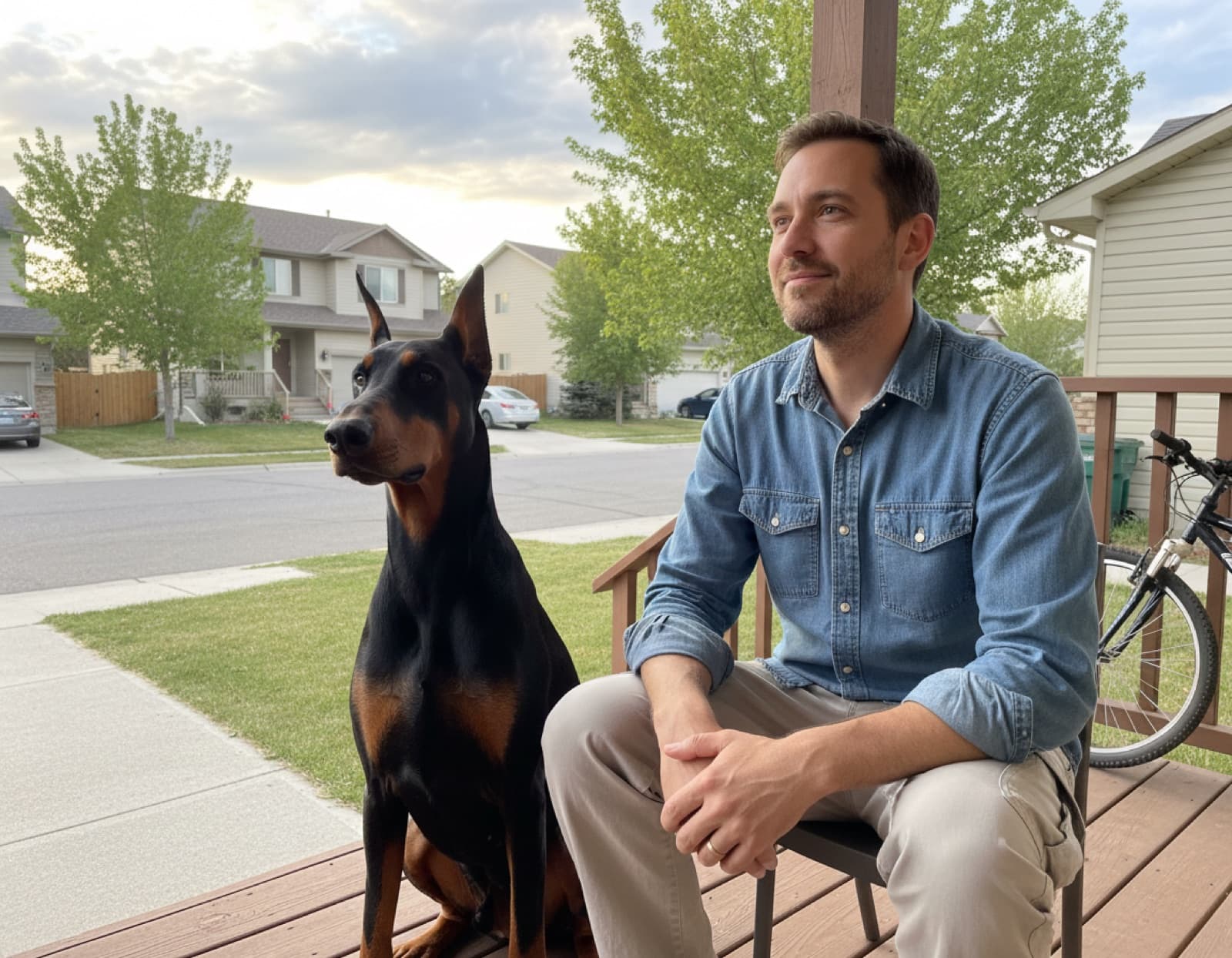
Honest Pros: Why People Love the Doberman
Intelligent and highly trainable
Dobermans consistently rank among the top five most trainable breeds in obedience research, and Calgary force-free trainers will confirm that a young Doberman picks up new cues in two or three reps. The breed wants to engage with its handler, watches faces and body language closely, and offers behaviours generously when reinforcement is consistent. The catch is the same intelligence makes a poorly-managed Doberman a problem-solver in less helpful ways. Counter-surfing, door-bolting, and creative escape are real possibilities in an under-stimulated dog. Channel the brain or it will find its own job.
Loyal and family-bonded
The Doberman is one of the most pack-bonded breeds in existence. Once the dog accepts you as family, the loyalty is total and lifelong. Dobermans will follow their primary person from room to room, sleep at the foot of the bed, and read the household’s emotional weather in a way that surprises owners. For households where a deeply bonded companion is the goal, the breed delivers like few others. For households who want a dog that is content to be on its own, the same trait reads as needy.
Athletic and active
A Doberman is built to run, jump, and work. The breed thrives in households where someone runs, bikes, hikes, or plays a daily sport with the dog. Calgary off-leash spaces like Nose Hill, Fish Creek, and the fenced section at Sue Higgins Park are perfect Doberman venues. The breed excels at agility, dock diving, Rally Obedience, and Schutzhund work. Owners who want a genuine adventure partner who can keep up with anything reasonable get one of the best matches in dogdom.
An elegant, beautiful breed
The Doberman silhouette is striking. The lean muscular frame, the long-line head, the sharp coat patterning in black-and-rust, red-and-rust, blue-and-rust, or fawn-and-rust, and the alert posture all create a dog that turns heads in a way few breeds match. People stop on Calgary sidewalks. Beauty is a real ownership benefit, even if it is the least practical one on this list. It also amplifies the stigma, which is covered below.
Generally non-aggressive when raised right
The modern Doberman is not a naturally aggressive dog. The breed standard has selected for stable, biddable temperament for decades. A well-bred, well-socialised Doberman is confident around strangers, gentle with family, and discerning rather than reactive. The breed will alert and intervene if the family is genuinely threatened, but that is protective loyalty, not unprovoked aggression. The vast majority of Doberman behavioural problems come from under-socialisation, harsh training, or genetic shortcuts by backyard breeders, not from the breed itself.
A good first dog for the right first-time owner
First-time owners often hear the breed is too much for a beginner. The accurate version is: the Doberman is a good first dog for an active, time-rich, training-committed beginner with a stable home and a real vet budget. The breed is biddable, eager to please, naturally clean, and a fast learner. What disqualifies most first-timers is not the dog, it is the lifestyle gap. If yours closes that gap, the Doberman is an outstanding first dog. If it does not, choose a Labrador or a Golden.
Naturally clean and easy to groom
The Doberman coat is short, fine, and minimally shedding compared to most large breeds. A weekly rubber curry or hound glove keeps the coat sleek; bathing is monthly or less. The breed has very little doggy odour. Owners who hate vacuuming or who have allergies often find the Doberman tolerable in ways a Labrador or Husky is not. The trade-off is the same short coat is the source of the Calgary winter problem, covered in cons.
Honest Cons: What the Photos Do Not Show
High exercise needs (60 to 90 minutes plus mental work)
A bored Doberman is a destructive Doberman. The breed needs 60 to 90 minutes of structured exercise daily, plus 15 to 30 minutes of genuine mental enrichment (training, scent work, puzzle feeders, structured games). Skipping a day produces a pacing, vocalising, chewing dog. Skipping a week produces a dog whose welfare is poor and whose behaviour is unmanageable. Calgary winter cold limits outdoor sessions, so indoor mental work has to fill the gap. Households who cannot honestly hit this daily target should choose a lower-drive breed.
Velcro separation anxiety risk
Dobermans were bred as personal protection dogs whose value depended on staying close to their handler. That selection pressure produced a breed whose default state is “within arm’s reach of my person.” Owners describe a Doberman shadow that follows them from the kitchen to the bathroom to the laundry room. For pack-oriented households, this is the breed’s greatest charm. For households who leave the dog alone all day, the same trait drives genuine separation anxiety, vocalising, destruction, and self-injury. See our velcro and separation anxiety guide for the full pattern and the mitigations.
DCM cardiac risk (the highest of any breed)
Dilated cardiomyopathy affects approximately 50 to 60 percent of Dobermans in their lifetime, the highest incidence of any breed studied. Onset is most common between ages 5 and 10. The disease can present silently and progress to sudden cardiac death without warning. The countermeasure is annual cardiac screening (Holter monitor plus echocardiogram) from age 3 onward, performed by a board-certified veterinary cardiologist at Western Veterinary Specialist Centre or VCA Canada West. Calgary screening cost is roughly $500 to $1,500 per year. Treatment cost if DCM is diagnosed runs $3,000 to $10,000+ in the first year. Pet insurance enrolled before any diagnosis is one of the strongest ROI cases in any breed.
Short coat in a Calgary winter
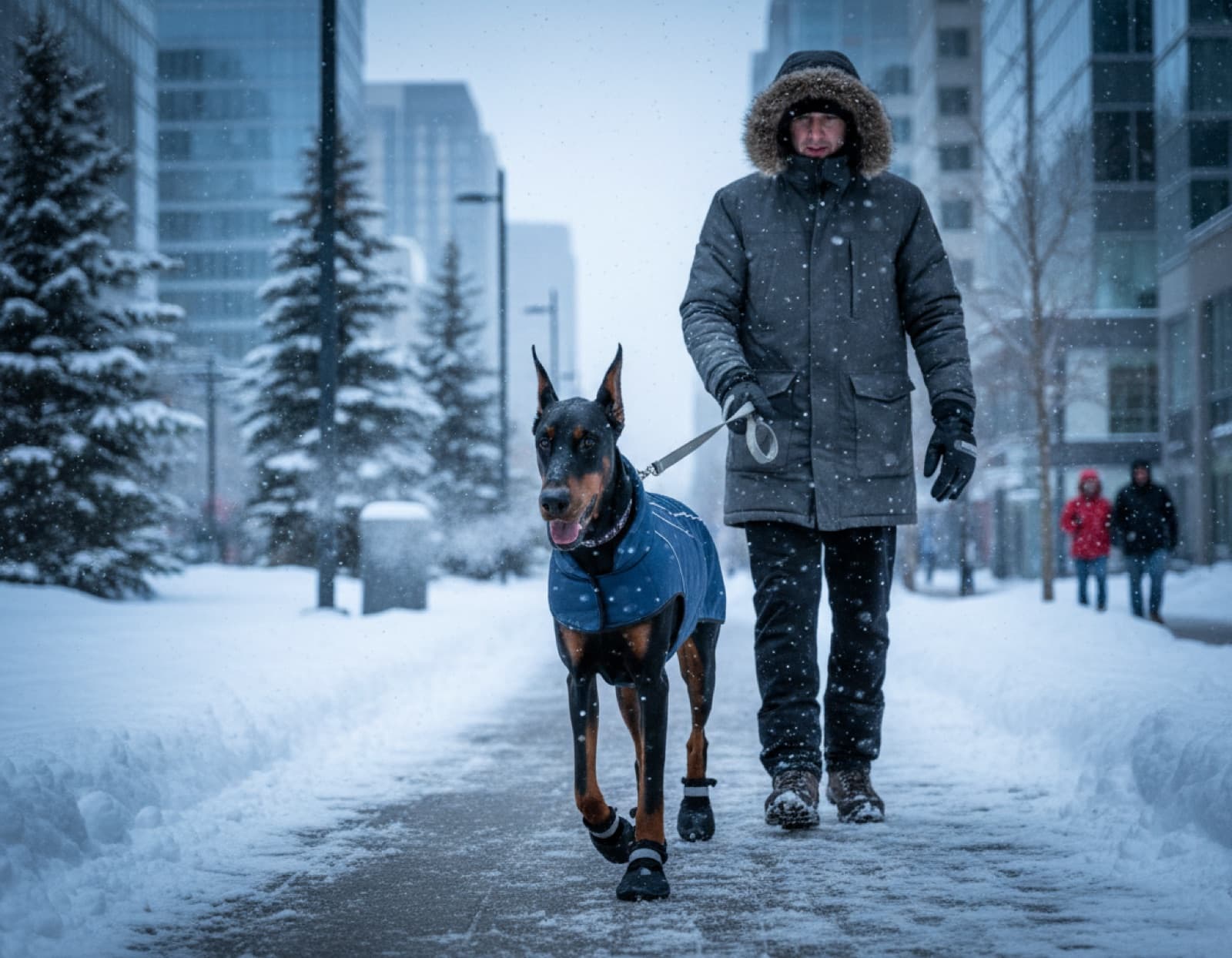
The Doberman coat is single-layer with minimal undercoat and very little body fat. Below 0C the dog gets cold; below -10C an insulated coat is non-negotiable; below -20C the dog also needs booties and shortened walks. Calgary winters routinely hit -25C cold snaps with weeks of -10C to -15C ambient. From November through March your Doberman will live in winter gear, and the gear is not optional. Budget $150 to $300 for a quality dog coat plus $80 to $160 for booties. See our Doberman winter care guide for the full gear list.
Landlord and insurance restrictions
Many Calgary condo boards maintain restricted breed lists that include Dobermans alongside Pit Bulls, Rottweilers, Cane Corsos, and Akitas. Many Canadian home insurance providers refuse coverage or surcharge heavily for Dobermans regardless of individual temperament. Many rental landlords decline applicants with the breed sight unseen. None of this depends on your dog’s actual behaviour. Before you adopt, get a written copy of your condo board’s pet policy, a written quote from your home insurance provider that confirms the breed, and a written acknowledgement from your landlord if you rent. The dog can be perfect; the policy can still evict you.
The aggression stigma
The breed carries a public image that will follow your dog through every park, sidewalk, and elevator. Strangers cross the street. Neighbours give wider berth. Other dog owners pull their dogs back. None of this is the dog’s fault, and it does not match the modern breed standard, but it is the lived reality of Doberman ownership in Calgary. Owners who can act as a calm, confident advocate (good leash skills, clear introductions, no apologising for the dog) do fine. Owners who find the constant low-grade social friction exhausting eventually surrender. Be honest about your social tolerance before adopting.
Same-sex aggression risk
Same-sex aggression toward other dogs is a real concern in some Doberman lines, particularly between two intact same-sex adults. The pattern is most pronounced male-on-male and somewhat less so female-on-female. Opposite-sex pairings have the lowest friction rate. For single-dog households this is a non-issue. For multi-dog households, factor it in honestly and consult the rescue’s temperament evaluation before adopting a Doberman into a home with a same-sex resident dog.
10 to 12 year lifespan, often shortened by DCM
The published breed-standard lifespan is 10 to 12 years. The real-world Calgary average sits closer to 9 to 11 years because DCM removes many Dobermans before they reach the upper end. Lean body condition, consistent exercise, annual cardiac screening, and prompt treatment push toward the high end. Obesity, lack of screening, and undiagnosed cardiac disease push toward the low end. The honest planning horizon for a Calgary Doberman adopter is roughly a decade. That is shorter than many large breeds, and it is part of the breed’s adoption math.
Von Willebrand’s Disease (vWD)
Von Willebrand’s Disease is a hereditary bleeding disorder that affects a meaningful portion of Dobermans. The defect impairs blood clotting and can turn a routine spay, neuter, or dental into a transfusion emergency. The condition is DNA-testable, and reputable breeders screen breeding stock. Rescue Dobermans without a known vWD status should be tested before any planned surgery. The Doberman Pinscher Club of America and the Canadian Kennel Club both publish vWD screening recommendations responsible breeders follow.
Who Dobermans Are RIGHT For
Active households with 60+ minutes of daily exercise capacity
If your weekend is a hike in Bowness Park or a long off-leash session at Sue Higgins, and your weekdays already include a daily run or bike ride, you have the energy profile a Doberman needs. The breed is a genuine adventure partner. Active households who already exercise daily often find the dog matches their pace better than a slower breed would.
Work-from-home or flexible-schedule households
A Doberman thrives with a person home most of the day. Remote workers, retirees, shift workers with off-days, and households with a partner home all hit the schedule shape the breed needs. If your household empties for 8 to 10 hours every weekday, the velcro pattern produces serious distress unless daycare or a walker fills the gap.
Force-free training commitment from day one
Dobermans are sensitive dogs in soft-tissue terms. Harsh handling, leash pops, e-collars on a young Doberman, or dominance-based training shuts the breed down or produces a fear-based dog who looks confident but is brittle. Force-free training with high-value rewards, structured socialisation, and clear consistent boundaries produces the steady adult the breed standard describes. Calgary force-free trainers like Raising Canine and Pup City Pup Academy are the right fit for the breed.
Financially ready for cardiac monitoring and above-average vet costs
A Calgary Doberman runs $2,000 to $4,000 per year for a healthy dog, before cardiac monitoring. Add $500 to $1,500 for annual Holter plus echo. Pet insurance from a young age ($60 to $100 per month) is one of the best ROI cases in any breed. If a $5,000 vet emergency would be a household financial crisis, the breed is the wrong pick.
Fenced yard or leash-discipline commitment
Dobermans are fast and athletic. A securely fenced yard is ideal for daily off-leash time. If a fence is not possible, a strict leash-discipline routine for life works as long as you commit to it. Calgary off-leash spaces like Nose Hill, Fish Creek, Bowmont, Edworthy, and the fenced section at Sue Higgins Park work well for socially confident dogs with good recall. Off-leash on the Bow River pathway is not legal and the breed’s speed makes it risky regardless.
Willing to advocate for the breed against stigma
If you can introduce your dog calmly, hold the leash with confidence, and not apologise for the breed, you will handle the stigma fine. The dog reads your body language and matches it. Owners who absorb every cross-the-street stranger and every nervous neighbour as proof their dog is dangerous burn out within 18 months. Owners who hold steady normalise the breed in their immediate community within a year.
Who Dobermans Are NOT Right For
Full-workday-alone households without daycare or a walker
A standard 9-to-5 workday with no support is the single most common reason 1 to 3 year old Dobermans surrender to Calgary rescue. Without daycare (Pup City Doggy Daycare, Paws Dog Daycare), a midday dog walker, a flexible work schedule, or a partner at home, the breed develops genuine separation anxiety inside 60 to 120 days. The dog suffers, the household suffers, and the dog ends up at Calgary Humane or AARCS. Choose a more independent breed if your schedule cannot flex.
Low-activity lifestyles
If your daily exercise is a 15-minute neighbourhood loop and your weekends are couch-based, the Doberman will out-energy you within weeks. The breed needs serious daily movement, not because the dog cannot rest, but because under-exercised Dobermans become destructive, vocal, and reactive. Low-activity households should choose a Cavalier, a Bulldog, a Basset Hound, or a Greyhound. All three are calmer and content with less.
Households with kids under 5 in small homes
Dobermans are gentle with family kids, including small ones, when the dog is well-socialised. The risk is not aggression. It is accidental knock-down. A 75 to 100 lb athletic dog bouncing through a small condo can pancake a toddler without intent. Calgary families adopting Dobermans into homes with kids under 5 should choose adults of 4+ years (calmer) and have realistic space (a small condo with a young Doberman plus a toddler is a hard fit).
Condos with restricted breed lists
If your condo board’s pet policy lists Doberman as a restricted breed, the matter ends there. The board can demand the dog be removed regardless of your dog’s actual temperament. Some boards make exceptions for licensed therapy or service dogs, but most do not. Always get the board’s pet policy in writing before you adopt. The same applies to rental landlords.
Low-vet-budget households
Annual cardiac screening, the realistic possibility of DCM treatment, vWD considerations on any planned surgery, and routine large-dog vet care add up. A $5,000 cardiac emergency on a 6-year-old Doberman is genuinely on the table. If the household budget cannot absorb that, the breed is the wrong pick. Pet insurance helps but is not a cure-all. A Cavalier or a Beagle costs significantly less per year over a 10-year horizon.
People expecting a “naturally aggressive guard dog”
The Doberman is not a naturally aggressive guard dog. People who adopt the breed because they want a sharp, intimidating animal to deter intruders typically reach for harsh training, encourage suspicion of strangers, and produce a brittle, fear-aggressive dog. That dog bites family, neighbours, or visitors within a few years and ends up euthanised. If protection is the goal, hire a professional protection-dog trainer with a purpose-bred working dog and full liability coverage. Do not try to manufacture one from a family-stock rescue Doberman.
Rescue vs Breeder, Male vs Female, Puppy vs Adult
Most Calgary Doberman adopters spend more time on this decision than the dog deserves. The short version:
- Rescue vs breeder: Calgary rescue Doberman fees run $300 to $800 (Calgary Humane Society, AARCS, BARCS, ARF Alberta, Cochrane Humane, Pawsitive Match,). CKC-registered Alberta breeder pricing runs $2,500 to $5,000+. A rescue adult arrives temperament-evaluated and often with a recent cardiac screening; the price difference can fund years of monitoring. A breeder puppy gives you genetic line transparency, vWD and DCM-1 / DCM-2 testing of parents, and full socialisation choices, but the cost differential is real.
- Male vs female: Males run 75 to 100 lbs, mature emotionally slowly, and tend to be the most pronounced velcro pattern. Females run 60 to 90 lbs, sometimes mature into steady adults earlier, and can be slightly more independent. Both make excellent companions. For single-dog households, pick the individual whose temperament matches your home rather than the sex. For multi-dog households, opposite-sex pairings carry the lowest friction risk.
- Puppy vs adult: For most first-time owners, an adult between 3 and 7 is the safer pick. The temperament is known, the 6 to 16 week socialisation window is already done (well or badly), and a recent cardiac screening often comes attached. A Doberman puppy is rewarding but unforgiving. Mistakes in the socialisation window shape the dog for life, and force-free puppy class needs to start the week the puppy comes home. Seniors past 8 with known cardiac status are a wonderful pick for calmer adopters who accept a 3 to 5 year horizon.
See our full Doberman adoption guide for the rescue-by-rescue breakdown, the named-rescue verification rule, and the free-pet scam warnings specific to the breed.
The “Is a Doberman a Good First Dog?” Question
This is the single most searched Doberman query, and the answers online are mostly polarised. The honest answer is conditional.
A Doberman is a good first dog if you check all of these:
- You are physically active and already exercise daily.
- Your work or schedule supports a velcro-bonded dog (work from home, flexible hours, partner at home, daycare budget).
- You are committed to force-free training from week one and willing to take a class.
- Your vet budget can handle $2,000 to $4,000 per year plus the realistic chance of a $5,000 to $10,000 cardiac event.
- Your housing accepts the breed in writing, including condo board and home insurance.
- You can tolerate the social stigma and act as a calm advocate for your dog in public.
A Doberman is the wrong first dog if any of these apply:
- You expect a low-maintenance starter dog you can leave alone all day.
- You wanted a “naturally aggressive” guard or protection dog.
- Your housing or insurance prohibits the breed.
- Your vet budget is tight and a $5,000 emergency would be a financial crisis.
- Your daily activity is sedentary and unlikely to change.
The pattern Calgary rescue coordinators describe is consistent: first-time owners with the right profile do beautifully with the breed; first-time owners who skipped the honest self-assessment land back at the rescue’s door within 18 months. The breed itself is not the deciding factor. The lifestyle gap is.
The Calgary Lifestyle Math
Calgary is a mixed environment for the breed. The honest picture:
- Summer is the easy season: Calgary summers above 18C are great Doberman weather. The breed loves long walks at Nose Hill, off-leash sessions at Fish Creek, swims in the Bow River at Sandy Beach, and trail time at Bowmont or Edworthy. Hot pavement above 26C still needs paw checks, but Calgary heat rarely sustains long enough to be a real summer constraint.
- Winter is the hard season: Below -10C, a fitted insulated coat is non-negotiable. Below -20C, add booties and shorten walks to brisk 15 to 25 minute outings. The breed will refuse to potty in the yard on a -25C morning without gear. Plan for a real winter routine and budget the gear ($150 to $300 coat plus $80 to $160 booties).
- Check landlord and insurance FIRST: Before you fall in love with an adoptable Doberman, get the condo board’s pet policy in writing, get your home insurance to confirm the breed in writing, and (if renting) get the landlord’s written sign-off. Skipping this step is the most common Doberman housing crisis in Calgary.
- Off-leash spaces work: Nose Hill, Fish Creek, Bowmont, Edworthy, and the fenced section at Sue Higgins Park are all good Doberman venues for socially confident dogs with reliable recall. The Bow River pathway is on-leash only and the breed’s speed makes off-leash there risky anyway.
- Rescue inventory is steady: Calgary Humane Society, AARCS, BARCS, ARF Alberta, Cochrane Humane, and Pawsitive Match all see Dobermans intermittently. The there is no verifiable Alberta Doberman-specific rescue, so general Calgary rescues are the route applying. Set up rescue alerts; Dobermans typically adopt out fast.
- Calgary specialty veterinary care is good: Western Veterinary Specialist Centre and VCA Canada West both offer board-certified cardiology, the speciality that matters most for the breed.
The Aggression Stigma Reality
This is the part of Doberman ownership most adopters underestimate. It is separate from your individual dog’s temperament. The stigma exists, and it has material consequences:
- Condo and rental restrictions: Many Calgary condo boards list Dobermans on their restricted breed list. Many rental landlords decline applicants with the breed. This is not a function of how well-trained your dog is. It is a function of how the breed is perceived in the property-management ecosystem.
- Home insurance refusals and surcharges: Several major Canadian home insurance providers list the breed as “ineligible” or apply meaningful surcharges. Some require obedience certification or written behavioural assessment as a condition of coverage. Get it in writing before adopting.
- Public social access limitations: Sidewalks, parks, elevators, patios. Strangers will cross the street. Other dog owners will pull their dogs back. Restaurant patios that nominally welcome dogs may decline a Doberman. None of this is fair, and none of it depends on your dog’s actual behaviour.
- What works: calm, confident handling; perfect leash skills; clear introductions; choosing socially confident routes; and not apologising for the breed. Owners who advocate for their dog from a place of confidence normalise the breed in their immediate community within a year. Owners who absorb every social slight as a wound burn out.
- What does not work: trying to “prove” the breed by forcing interactions. Defending the dog reactively. Skipping training because “he’s a good boy already.” The dog who lives the easiest life is the dog with the best training and the calmest owner.
Browse adoptable Dobermans in Calgary
Dobermans appear in Calgary rescue intake steadily. Apply early when a listing matches your household; the right adults adopt out fast. no verifiable Alberta Doberman-specific rescue exists, so the general Calgary rescues are the route alongside general Calgary rescues.
See Available Dobermans →10-Question Self-Assessment
Answer honestly. If you answer “no” or “not sure” to more than two, the Doberman is probably not the right fit right now. That is useful information, not a judgment.
1. Can I commit to 60 to 90 minutes of structured daily exercise plus mental work?
Not a 15-minute walk and a backyard. Real movement, plus 15 to 30 minutes of training, scent work, or puzzle feeders. Every day, including the -20C ones.
2. Does my schedule support a velcro dog (work from home, partner at home, daycare, or walker)?
A standard 9-to-5 with no support produces serious separation distress within months. Calgary daycare (Pup City Doggy Daycare, Paws Dog Daycare) or a midday walker is the realistic mitigation if your household empties for the workday.
3. Can I budget $2,000 to $4,000 annually plus annual cardiac monitoring?
Healthy-year baseline plus $500 to $1,500 cardiac screening. Add pet insurance ($60 to $100 per month) before any diagnosis. The realistic possibility of a $5,000 to $10,000 cardiac event is genuinely on the table.
4. Does my housing accept the breed in writing?
Condo board pet policy, home insurance quote, rental landlord sign-off. All three in writing before you adopt. The dog can be perfect; the policy can still evict you.
5. Am I willing to use force-free, positive-only training?
No alpha rolls, no leash pops, no e-collars on a young Doberman. Force-free trainers like Raising Canine and Pup City Pup Academy are the Calgary go-to. Start week one.
6. Can I plan for winter gear and a real -25C cold-snap routine?
Insulated coat, booties, shortened walks, paw care after salted sidewalks. November through March. Budget $230 to $460 in gear up front.
7. Can I tolerate the breed stigma and act as a calm advocate?
Strangers will cross the street. Neighbours will be wary. Other dog owners will pull their dogs back. Calm confident handling defuses most of it; reactive defensiveness amplifies it.
8. Does my household match the breed for kid age and dog roommates?
Kids under 5 in small spaces means adopt a calmer 4+ year old adult. Multi-dog homes mean opposite-sex pairings if possible. Same-sex aggression risk is real in some lines.
9. Am I prepared for a 9 to 12 year horizon, possibly shorter with DCM?
Lean body, consistent exercise, annual cardiac monitoring, pet insurance from day one. Even with all of that, DCM is the breed’s defining health concern and may shape the second half of the dog’s life.
10. Am I adopting because I want THIS dog, or because I want a guard dog?
If the answer is “guard dog,” this is the wrong breed for the wrong reason. The Doberman is a family companion who will alert and protect because it loves you, not because it is naturally aggressive. People who chase aggression in the breed produce brittle, fear-based dogs who bite the wrong people and get euthanised.
Frequently Asked Questions
Is a Doberman a good first dog?
Yes for the right first-time owner, no for most. A Doberman is a good first dog if you are active, work from home or have flexible hours, can commit to force-free training from week one, have a healthy vet budget for cardiac monitoring, and accept that the breed will follow you to the bathroom for life. The breed is intelligent, eager to please, naturally clean, and bonded to its people in a way Lab and Golden first-timers can find shocking. The breed is the wrong first dog if you expect a low-maintenance starter or a naturally aggressive guard dog. Both expectations end in surrender or in a dog whose temperament was shaped badly. Calgary rescues see 1 to 5 year old Dobermans surrendered routinely because their first owners hit the velcro reality, the cardiac cost reality, or the breed-restricted housing reality. None of that is the dog's fault.
Are Dobermans really aggressive?
No, the modern Doberman is not naturally aggressive. The breed standard for decades has selected for stable temperament, biddability, and family-bonding. A well-bred, well-socialised Doberman is confident with strangers, gentle with family, and discerning rather than reactive. The aggression stigma comes from three sources: 1970s and 1980s pop culture, a small number of poorly-bred or poorly-raised individuals, and the visual intimidation factor (the breed looks like a guard dog because the silhouette is sharp, not because the temperament is). The breed will alert and act protectively if the family is genuinely threatened. That is loyalty, not aggression. The real behavioural risk in adult Dobermans is leash reactivity from under-socialisation, not unprovoked aggression. Same-sex aggression toward other dogs is a separate, real concern for some lines.
Can I have a Doberman if I work full-time?
Only with serious mitigation. Dobermans are pack-bonded and pack-distressed when isolated. A standard 9-to-5 workday with no support is a recipe for separation anxiety, destructive behaviour, and a dog whose welfare is genuinely poor. Calgary households that make it work pair a Doberman with at least two of the following: daycare two to four days a week (Pup City Doggy Daycare, Paws Dog Daycare), a midday dog walker, a work-from-home partner, a flexible schedule, or a calm adult Doberman roommate. The fully-out-of-the-house, no-support day is the single most common reason 1 to 3 year old Dobermans land in Calgary rescue. If your schedule cannot flex and you cannot afford daycare or a walker, choose a more independent breed.
Do Dobermans do well in apartments?
Physically yes, structurally often no. The breed is naturally clean, short-coated, and content to be still indoors after exercise. A well-exercised Doberman is a calm apartment dog. The barrier is rarely the dog. It is the building. Many Calgary condo boards maintain restricted breed lists, and Dobermans appear on a meaningful share of them alongside Pit Bulls, Rottweilers, and Cane Corsos. Many Canadian home insurance providers also refuse coverage or surcharge heavily for the breed regardless of individual temperament. Before adopting into a condo or rental, get a written copy of the board's pet policy and the rental owner's insurance position. The dog can be perfect; the policy can still evict you.
How much exercise does a Doberman actually need?
A minimum of 60 to 90 minutes of structured exercise daily, plus 15 to 30 minutes of dedicated mental enrichment. The breed was developed as a working protection and personal dog, and that drive lives on under the sleek coat. Skipping a day of exercise produces a Doberman who paces, vocalises, chews household items, and escalates into separation behaviours. Calgary owners typically split the load: a morning leash walk or off-leash session at a fenced space, a structured evening activity (running, biking, scent games, training), and snuffle mat or puzzle work scattered through the day. Adolescents from 8 to 24 months need the upper end of this range. Adults from 3 to 7 stabilise toward the middle. Seniors past 8 with cardiac diagnoses scale way down on vet guidance.
What is the DCM risk and what does monitoring cost?
Dilated cardiomyopathy (DCM) is the single biggest health concern in the breed. Approximately 50 to 60 percent of Dobermans develop DCM in their lifetime, the highest incidence of any breed studied. Onset most commonly appears between ages 5 and 10. Annual cardiac monitoring is the gold standard from age 3 onward: a 24-hour Holter monitor plus an echocardiogram performed by a board-certified veterinary cardiologist. Calgary cost is roughly $500 to $1,500 per year for screening. Western Veterinary Specialist Centre and VCA Canada West are the Calgary-area specialty cardiology destinations. Pet insurance enrolled before any diagnosis is one of the strongest ROI cases in any breed. See our full cardiac monitoring guide for the protocol detail.
Can a Doberman handle a Calgary winter?
Yes with proper gear, no without. Dobermans have a short, single-layer coat with minimal undercoat and very little body fat. Below 0C they get cold; below -10C they are visibly uncomfortable without an insulated coat; below -20C they need a coat plus booties and shortened walks. Salt and ice-melt on Calgary sidewalks will crack the pads of an unprotected Doberman within a single bad winter. The breed handles summer beautifully and shoulder seasons fine. The honest math is that your dog will live in winter gear from November through March, and bathroom breaks during a -25C cold snap are brisk. See our full Doberman winter care guide for the gear list and the threshold table.
Male or female Doberman: which is better for first-time owners?
Both can be excellent. The honest pattern most rescue coordinators describe is this: males run 75 to 100 lbs, are pronouncedly velcro-bonded to the primary handler, and tend to mature emotionally a little more slowly. Females run 60 to 90 lbs, are sometimes a touch more independent, and often mature into a steadier adult earlier. Same-sex aggression toward other dogs of the same sex is a real consideration if you already own a dog. For a first-time, single-dog household, both sexes work; pick the individual whose temperament matches your home rather than the sex. For a multi-dog household, opposite-sex pairings have the lowest friction rate.
Should I adopt a Doberman puppy or an adult?
For most first-time Doberman owners, an adult between 3 and 7 years old is the safer pick. Rescue adults arrive temperament-evaluated for behaviour around kids, cats, other dogs, vets, alone time, and grooming. Many also arrive with a recent cardiac screening, which removes a huge unknown. Puppies require the 6 to 16 week socialisation window to be done well, and a mistake there shapes the dog for life. Force-free puppy classes (Raising Canine, Pup City Pup Academy) need to start the week the puppy comes home. Calgary Humane Society, AARCS, BARCS, ARF Alberta, Cochrane Humane, and Pawsitive Match all see Dobermans intermittently. no verifiable Alberta Doberman-specific rescue exists, so the general Calgary rescues are the route before applying.
What is the realistic Doberman lifespan?
The published breed-standard lifespan is 10 to 12 years. The real-world Calgary average sits lower because DCM shortens many Dobermans before age 10. Dogs who screen clear on annual cardiac monitoring, stay lean, get consistent exercise, and live in pet-insured households frequently reach the upper end and occasionally past 13. Dogs surrendered late with undiagnosed DCM or carrying significant orthopaedic disease often do not. The honest planning horizon for a Calgary Doberman adopter is 9 to 12 years with the upper end conditional on diligent care and luck on the genetic lottery. That is shorter than many large breeds, and it is part of the breed's adoption math.
Sources and further reading
- Doberman Pinscher Club of America (dpca.org): breed standard, health screening (vWD, DCM, hip and thyroid), and ethical breeding guidance.
- Canadian Kennel Club (CKC) at ckc.ca: registered breeders, Canadian breed standard, and the breed group.
- American Kennel Club at akc.org: Doberman Pinscher breed page, temperament, lifespan, and history.
- Orthopedic Foundation for Animals: breed-specific screening recommendations for hips, hearts, and thyroid.
- Calgary Humane Society at calgaryhumane.ca: local adoption process and surrender support.
This article is informational only and not a substitute for veterinary, behavioural, or insurance advice. Consult a Calgary veterinarian, a force-free trainer, and a Doberman-experienced rescue for personalised guidance.
Related Doberman guides
Doberman Adoption Calgary →
Where to find a rescue Doberman in Calgary, real adoption costs, the named-rescue verification rule, and the free-pet scam warnings specific to the breed.
Doberman Cardiac Monitoring Calgary →
The DCM reality, annual Holter and echo protocol, Calgary cardiology specialists, pimobendan therapy, and pet insurance ROI.
Doberman Velcro & Separation Anxiety Calgary →
The pack-bonded pattern, alone-time training, daycare and walker mitigations, and the genuine welfare risks of leaving the breed isolated.
Dobermans for Adoption in Calgary →
Live listing of available Dobermans and Doberman mixes across Calgary rescues when inventory exists.
New dog? Start with these care guides
Everything a new adopter needs to set up a safe, happy home.