The short answer
English Bulldogs have 6.7% prevalence of skin fold dermatitis with an odds ratio of 38.12 versus crossbreeds (RVC VetCompass disorder predispositions study, O’Neill 2022). It is the highest predisposition odds ratio of any disorder studied in the breed. Daily skin-fold care is required, not optional. Three fold zones need attention: facial folds (under eyes, nose roll, deep wrinkles), the tail pocket (the most overlooked), and vulvar or penile folds. A 5-to-10-minute daily routine prevents most flare-ups. Calgary summer humidity raises yeast risk; winter dry air is favourable but does not eliminate the requirement. When folds smell, redden, ooze, or the dog scratches them obsessively, escalate to a vet within 48 hours.
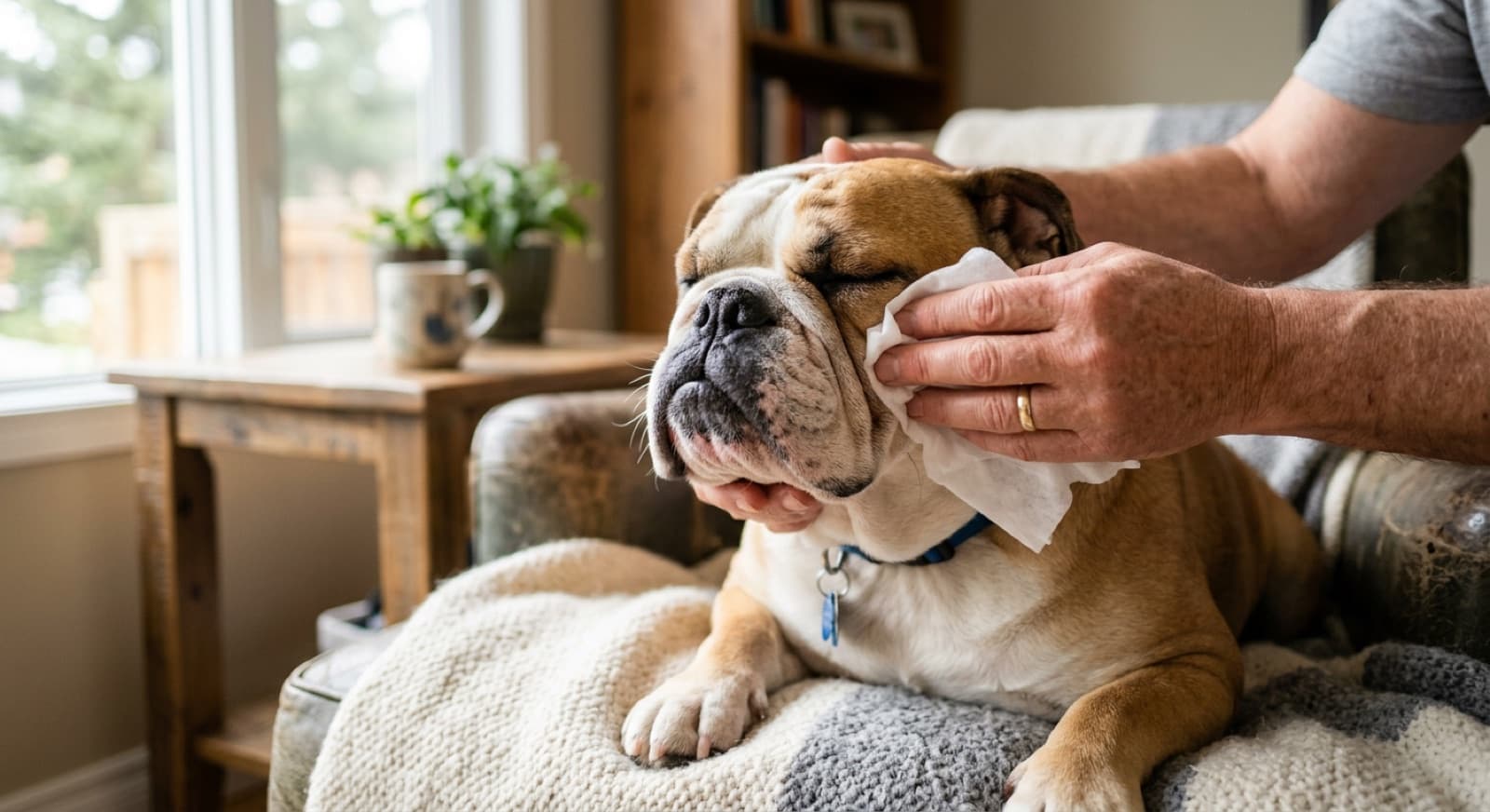
Why English Bulldog skin folds need so much management
The numbers behind the daily-care requirement are not vague advice. They come from the largest veterinary records study on the breed to date. The Royal Veterinary College’s VetCompass programme analysed primary care veterinary records for 2,662 English Bulldogs across the UK and reported in the 2022 disorder predispositions study (O’Neill et al.) that skin fold dermatitis was the disorder with the highest predisposition odds ratio of any condition studied. The breed had 6.7% prevalence compared with the general dog population, an odds ratio of 38.12 versus crossbreeds.
For context, breed-disorder predisposition odds ratios above 5 are considered clinically significant. An OR of 38 is exceptional. It means an English Bulldog is roughly 38 times more likely to develop skin fold dermatitis in any given year than a typical dog. This is not a maybe. It is a defining feature of owning the breed.
The anatomy explains it. Decades of selective breeding for the breed’s signature look produced a dog with a compressed brachycephalic skull, a heavy thick-set body, and a tail conformation that often pockets against the body. The result is multiple deep skin folds where moisture, skin oils, debris, and skin-surface bacteria accumulate faster than air can dry them. The fold environment is dark, warm, moist, and rarely exposed to air. That combination is ideal habitat for Malassezia yeast and opportunistic Staphylococcus bacteria. Without daily intervention, dermatitis develops within days.
The three primary fold zones each have their own dynamics. Facial folds (under the eyes, in the nose roll, and within deep facial wrinkles) catch tears, food debris, drool, and water. The tail pocket (under the tail base, where the curled or pocketed tail creates a hidden cavity) catches fecal debris and sweat-equivalent secretions and is the fold most often missed entirely by new owners. Vulvar or penile folds (between the legs) catch urine pooling and sweat. All three need daily attention.
The Calgary climate adds nuance. Summer (June through September) brings higher indoor humidity, often 45 to 55% RH in homes without air conditioning, which is yeast-favourable. Summer fold infections in Calgary Bulldogs are noticeably more common than winter ones. Winter (October through April) drops indoor humidity to 20 to 30% RH due to dry prairie air plus forced-air heating, which is less yeast-favourable but does not eliminate the daily care requirement; bacterial fold infections still occur, and the cracked dry skin of winter creates its own irritation pathway. Chinook events bring rapid temperature and humidity swings that can trigger flares in dogs with marginal control.
The practical implication: daily fold care is the standard year-round, with a slight emphasis on yeast-control hygiene in summer and a slight emphasis on dry-skin moisture balance in winter. Owners who treat this as part of the daily care routine, alongside feeding and walking, are the ones whose Bulldogs avoid recurring vet visits.
The three fold zones — what each needs
Each fold zone has its own anatomy, its own typical contamination, and its own daily-care approach. Most new Bulldog owners know about facial folds. Many miss the tail pocket entirely. The vulvar or penile folds sit somewhere in between.
Facial folds (nose roll, under eyes, deep wrinkles)
The most visible fold zone and the one owners focus on first. The nose roll (the deep fold across the bridge of the nose) catches drool, water, and food particles. The deep wrinkles around the eyes catch tear overflow and dust. The folds under the eyes accumulate tear staining (porphyrin oxidation, same mechanism as in flat-faced cats and dogs generally).
Daily wipe with a vet-approved chlorhexidine wipe or saline-dampened soft cloth. Open each fold fully so the cleaning surface reaches the bottom of the fold rather than just the top. Wipe once in one direction, do not scrub. Dry with a dry medicated pad afterward. Calgary winter dry air helps reduce the yeast load here; summer worsens it. If facial folds are chronically inflamed despite daily care, the underlying issue is often allergic dermatitis (atopic), not just hygiene.
Tail pocket (under the tail base)
The most overlooked fold and the one with the highest infection rate when neglected. The English Bulldog tail, especially the shorter and curled or pocketed variants, creates a fold of skin underneath the tail base that traps fecal debris from defecation, sweat-equivalent apocrine secretion, and skin oils. Many new owners do not realise this fold exists until a vet points it out at the first annual exam.
To clean: lift the tail gently with one hand, expose the fold with the other, wipe front-to-back with a vet-approved chlorhexidine or saline-dampened cloth. The fold can be surprisingly deep. Some Bulldogs need a cotton swab (not a cotton ball, which sheds fibres) to reach the bottom of the pocket. Dry thoroughly with a dry medicated pad. Daily.
If the tail pocket is chronically infected despite consistent daily care, surgical correction (tail pocket removal or tail amputation) at a specialty practice is sometimes the kindest long-term option. This is not a routine first-line intervention; it is reserved for cases where conservative management has clearly failed and the dog is in chronic discomfort. Discuss with your vet if you are cleaning twice daily and still getting recurrent infections.
Vulvar or penile folds (between the legs)
Less obvious than facial folds, less hidden than the tail pocket. Urine pooling and sweat are the main contaminants. Female Bulldogs with deep vulvar folds and male Bulldogs with prepuce-area folds both need attention here, though the specifics differ slightly.
Daily wipe with a damp soft cloth or vet-approved wipe. Watch for redness, foul odour, or excessive licking of the area (the dog will tell you something is wrong). Dry thoroughly. In intact male Bulldogs, prepuce discharge is normal in small amounts but should not pool or smell strongly; if it does, vet visit.
The daily skin-fold care routine that actually works
5 to 10 minutes every day. Same time, same order, treat-paired. The dog learns it like feeding routine.
The tools first. A modest kit:
- Vet-approved chlorhexidine wipes OR plain saline solution plus a stack of soft microfiber cloths. Chlorhexidine wipes have antibacterial and mild antifungal action and are the most common standard daily product. Saline is gentler and a reasonable everyday option if your dog has sensitive skin.
- Dry medicated pads (drying after cleaning is critical, sometimes more important than the cleaning itself). Leaving a fold damp is worse than not cleaning it.
- Cotton pads (NOT cotton balls; the latter shed fibres that can stick in folds or in eyes).
- Small flashlight for fold inspection, especially in dark facial folds. A phone torch works.
- High-value treats for treat-pairing the routine, especially in the first few weeks.
The session itself, in order:
- Face first (2 to 3 minutes). Under eyes, then nose roll, then deep facial wrinkles. Open each fold fully, gentle wipe in one direction, dry with medicated pad.
- Tail pocket (1 to 2 minutes). Lift tail, expose fold, wipe front-to-back, dry thoroughly. Some dogs do better if you do this immediately after a defecation walk, so the pocket is empty.
- Vulvar or penile folds (1 to 2 minutes). Gentle wipe, check for redness or excessive moisture, dry.
- Quick body check (1 to 2 minutes). Run your hands over the body. You are checking for new lumps, hot spots, broken skin, weight changes, or behaviour shifts in response to touch. Daily handling means you catch problems weeks before they become emergencies.
The method matters. Gentle wipe in one direction, not scrub. Scrubbing creates micro-abrasions in already-inflamed skin and worsens dermatitis. Open the fold to expose all surfaces; cleaning just the top of the fold does almost nothing. Dry thoroughly with a separate dry pad. If you only do one thing well, do the drying step well.
Most Calgary owners settle on morning or after-meal as the daily slot, because the dog is calm and predictable. Treat-pair the session for the first few weeks (treat after each fold zone), then treats become optional once the dog accepts the routine. If the dog resists, do not force; back off, shorten the session, and rebuild tolerance gradually with treat pairing. Forcing creates lasting resistance.
The daily handling has a bonus diagnostic value. Owners who do fold care daily catch lumps, weight changes, mood shifts, and early dermatitis flares weeks earlier than owners who do not. The 5-to-10-minute session is a health check disguised as a hygiene routine.
Yeast vs bacterial vs allergic: the differential matters
When folds become infected, the three most common causes look slightly different and require different treatments. Getting the right diagnosis matters because treating yeast with antibiotics does nothing for the yeast, and treating bacteria with antifungals does nothing for the bacteria.
Yeast (Malassezia)
The most common fold infection in Bulldogs. Smell: musty, cheesy, sometimes described as “old socks.” Discharge: brown-yellow, greasy. Skin: pink to red, often greasy texture. Most common in facial folds and the tail pocket. Treatment: vet typically prescribes a topical antifungal wipe (often miconazole or chlorhexidine combinations) used daily for 2 to 3 weeks, then maintenance daily cleaning. Severe cases may need oral antifungal medication, vet-directed only.
Bacterial (often Staphylococcus species)
Smell: foul, putrid, sometimes sharp. Discharge: yellow-green pus, sometimes blood-tinged. Skin: painful, swollen, sometimes hot to touch. The dog may flinch on touch. Treatment: oral or topical antibiotics, vet-prescribed. Bacterial fold infections do not respond to home cleaning alone once established; do not delay the vet visit.
Allergic (atopic dermatitis)
The underlying driver of many recurrent fold infections. Skin: pink to red, inflamed, intensely itchy. The dog scratches, licks, or rubs the area obsessively. Allergic dermatitis can be seasonal (pollen, grass) or year-round (dust mites, food). When fold infections recur 2 to 3 times per year, the underlying issue is usually allergic dermatitis. A dermatology workup (allergy testing, food trial, or specialist consultation at Western Veterinary Specialist & Emergency Centre) becomes worthwhile. Treatment involves managing the underlying allergy alongside the fold care, often with vet-prescribed allergy management protocols.
Most folds: combination
The clinical reality is that most chronic Bulldog folds end up being a combination of all three. Allergic skin is more susceptible to yeast and bacteria; yeast and bacteria worsen the allergic skin; the loop self-perpetuates. This is why a vet-directed culture (taking a sample of the fold contents to identify the specific organism and test antibiotic sensitivity) is sometimes warranted for recurrent cases. Empirical treatment is the first-line approach for the first or second infection; for the third recurrence, push for diagnostic workup rather than another round of the same wipe.
When to escalate to a vet
Same-day or 48-hour vet visit criteria. Do not wait for the next annual exam if any of these are present.
Same-day to 48-hour vet escalation criteria:
- Smell intensifies despite daily cleaning. The fold should not get worse with consistent care. If it does, infection is established.
- Skin redness with heat or swelling. Heat and swelling indicate active infection or cellulitis, not just irritation.
- Pus or yellow-green discharge. Bacterial infection. Topical wipes alone will not resolve it.
- Open sores or hot spots. The skin barrier has broken down and the infection is spreading.
- The dog refuses to let you touch the area. Pain is the signal. Bulldogs are stoic; a dog that flinches has more pain than the average dog showing the same response.
- The dog scratches or rubs the face on furniture obsessively. Multiple times per hour for more than a day is not normal.
- Recurring infections (more than 2 to 3 episodes per year). Pattern suggests underlying allergic dermatitis. Push for a dermatology workup rather than treating each flare in isolation.
Calgary specialty access. Western Veterinary Specialist & Emergency Centre provides dermatology referral services for cases that need specialist diagnostics or allergy workups beyond what a general-practice vet can offer. Your regular vet will refer if the case warrants it; expect a $400 to $800 initial consult plus diagnostics.
What to bring to the appointment: a list of what products you have been using and for how long, photos of the fold during clean and during flare (timestamped on your phone), and a rough log of how often infections have occurred. This information meaningfully changes the diagnostic path.
General coat grooming and bathing
English Bulldogs are short-coated and shed moderately year-round. Beyond the daily fold routine, general coat care is relatively straightforward.
Brushing. Weekly with a soft bristle brush or rubber curry. Removes loose hair, distributes skin oils, and reduces the amount of hair on Calgary furniture. Brushing also gives you a chance to check for hot spots, lumps, broken skin, or weight changes (an under-recognised health-monitoring habit).
Bathing. Every 4 to 6 weeks. Not more than monthly; over-bathing strips the protective skin oils Bulldogs already lack and can trigger dermatitis flares. Use only vet-approved dog shampoo. Never use human shampoo (wrong pH for canine skin) and never use products containing tea tree oil, pennyroyal, citrus essential oils, or pyrethrins; some of these are outright toxic to dogs.
The Calgary bath protocol: pre-warm the bathroom to 22 to 24 degrees Celsius, especially in winter. Use lukewarm water (test on your inner wrist; cats and dogs burn more easily than humans). Avoid head submersion; wipe the face with a damp cloth instead. Lather methodically by section. Rinse extremely thoroughly; residual shampoo causes irritation in dogs already prone to dermatitis. Towel dry first, then short blow-dry on cool setting with special attention to drying the folds completely. Never bathe and immediately walk outside in Calgary winter. A damp Bulldog in minus 15 cold develops respiratory irritation (the breed’s brachycephalic airway is already compromised) and the wet coat does not insulate.
Medicated baths. If your vet prescribes a medicated shampoo for active dermatitis, follow the prescribed schedule (often weekly for 2 to 4 weeks during a flare). Do not switch medicated products mid-treatment without vet guidance.
Nail trimming. Every 3 to 4 weeks. Bulldog nails grow fast and the quick (the blood vessel inside the nail) is more sensitive than in many other breeds. Use guillotine-style clippers or a Dremel-style grinder. Take small slices rather than trying to cut the nail in one go. Keep styptic powder on hand for accidents. Overgrown nails change paw posture and can contribute to joint discomfort, so do not skip this.
Teeth. Daily brushing if the dog tolerates it, weekly minimum. English Bulldog dental crowding from the brachycephalic skull means dental disease starts early. A vet dental check at every annual exam is the baseline; some Bulldogs need professional dental cleaning starting at age 3 to 4. The American Animal Hospital Association publishes accessible owner-facing dental care guidelines.
Ears. Bulldogs have narrow ear canals prone to infection, especially if combined with allergic dermatitis. Weekly ear check; clean only if the ear looks dirty, using vet-approved ear cleaner (do not use cotton swabs deep in the canal). If the ear smells, has discharge, is red, or the dog shakes their head obsessively, vet visit. Ear infections in Bulldogs are common and often part of the broader allergic-dermatitis picture.
Calgary climate factors
Calgary is not a gentle climate for English Bulldogs, but the specific challenges differ by season and the daily fold routine adapts accordingly.
Winter (October through April)
Indoor humidity drops to 20 to 30% RH due to dry prairie air plus forced-air heating. Yeast load is lower in this environment, which is the one piece of good news for Calgary Bulldog skin. However:
- Cracked dry skin. Low humidity can crack skin in folds the same way it cracks human lips. Watch for new redness or cracking; a humidifier targeting 40 to 50% RH in the room where the dog sleeps helps both the dog’s skin and your own.
- Cracked paw pads. Calgary winter sidewalks with salt and de-icer worsen this. Apply vet-approved paw balm before walks. Wipe paws on return.
- Cracked nose. A vet-approved nose balm helps. Avoid human lip balms.
- Brachycephalic cold exposure. Limit outdoor walks to short sessions when temperatures drop below minus 15 degrees Celsius. The breed’s narrow airway plus very cold air equals respiratory irritation. Body coat is not insulating enough for prolonged exposure either.
- Bacterial fold infections. Bacterial fold flares can still occur in winter even though yeast load is lower. Daily fold care remains the standard.
Spring and fall
Chinook events bring rapid temperature and humidity swings (a dry minus 20 morning turning into a 5-above afternoon, or vice versa). Yeast can flare from the rapid humidity change. Owners of Bulldogs with marginal control sometimes see flares during chinook weeks. Increase the dry-down step in daily fold care during chinook periods.
Summer (June through September)
Higher indoor humidity (45 to 55% RH in homes without AC) plus higher outdoor temperatures equal the highest-risk yeast season for Calgary Bulldogs. Daily fold cleaning becomes more critical, not less.
- Air conditioning is non-negotiable. Indoor temperatures above 24 degrees Celsius drive heat-stress risk in the breed (a separate concern from skin care; see our English Bulldog summer heat & BOAS guide).
- Yeast risk peaks. Some Calgary Bulldogs benefit from twice-daily fold cleaning through July and August.
- Swimming hazards. Wet folds after swimming need immediate thorough drying. Better practice: avoid swimming for Bulldogs (they sink due to body density and short legs) and stick to wading at most. If the dog gets wet, dry every fold immediately.
- Stampede week. The first half of July is hot, noisy, crowded, and packed with food debris. Most Calgary Bulldogs are happier at home in air conditioning than at Stampede events.
The “I cannot keep up with grooming” surrender pattern
This is the honest conversation. The second most common reason English Bulldogs end up at Alberta Bulldog Rescue Society is owners overwhelmed by daily skin-fold care plus recurring vet visits. The pattern is consistent. An adopter falls in love with the look of the breed. They commit to “wiping the wrinkles every couple of days.” By week 3, the folds start smelling. By month 2, the dog has its first vet visit for dermatitis. By month 4 to 6, the owner is at a rescue with the dog, citing “more than we expected” as the reason.
If you are reading this and recognising yourself, the path forward is structural rather than shame-based.
- Vet partnership first. Book a baseline dermatology consult to understand this specific dog’s fold needs. Some Bulldogs have shallow folds that tolerate every-other-day care. Others have deep folds that need twice-daily cleaning. Knowing your dog’s baseline lets you design a realistic routine.
- Sustainable routine design. Pick a time you are actually home and the dog is actually calm. Pair it with another daily activity (after morning kibble, before evening walk). Set a phone reminder. Treat-pair every session in the first weeks. Do it like teeth-brushing: short, automatic, every day, no negotiation.
- Foster-first option for prospective adopters. Alberta Bulldog Rescue Society sometimes places dogs in foster trial so prospective adopters experience the daily routine before committing. If you are considering a Bulldog and uncertain about the daily care commitment, ask about foster-to-adopt or extended foster trial.
- If still not sustainable: contact Alberta Bulldog Rescue Society early. They sometimes facilitate foster placement, rehoming, or owner-support resources before the dog reaches a neglected state. Reach out at the first signs of overwhelm, not after months of progressive neglect. Surrendering before neglect is responsible; surrendering after months of skin breakdown harms the dog and creates a much harder rescue intake.
There is no shame in admitting the breed is not for you. English Bulldogs are demanding. The lifetime cost of skin care alone is meaningful (see our cost of ownership guide), the daily commitment is real, and Calgary climate adds its own challenges. Many wonderful dogs in Calgary rescues do not require this level of skin care. If your current life cannot sustain the routine, the right call is acknowledging it early rather than letting the dog deteriorate.
For the broader Bulldog adoption picture, including where Bulldogs come from in Calgary and what realistic adoption looks like, see our English Bulldogs in Calgary breed page.
First-week grooming routine for new English Bulldog adopters
If you have just adopted an English Bulldog, the first few weeks set the grooming relationship for the rest of the dog’s life. Rush into a full daily session day one and you create lasting resistance. Build up gradually and the dog learns fold care is a normal calm part of the day.
- Day 1 to 3: minimal handling. Let the dog settle into the home. Hands-off grooming. Only intervene on folds if there is visible discharge or smell, with the gentlest possible wipe.
- Day 4 to 7: introduce a single fold zone with treat pairing. Two-minute sessions only. Show the wipe, treat. Touch the face gently, treat. One gentle fold wipe, treat. Build positive association before increasing duration or scope.
- Week 2: 5-minute sessions covering facial folds and tail pocket. Continue treat-pairing. If the dog shows distress, back off and go shorter.
- Week 3 to 4: full 5 to 10 minute routine covering all three fold zones. By this point the dog should accept the routine as part of the daily pattern. Book the first vet skin-care check for the 4 to 6 week mark to establish a baseline.
Treat pairing is the consistent ingredient. High-value protein treats (freeze-dried chicken, salmon, or a small piece of cooked plain chicken) work far better than dry kibble. Use them only for grooming so the dog learns the association. The 3-3-3 transition principles from our 3-3-3 rule guide apply to fold care too: 3 days to settle, 3 weeks to learn the routine, 3 months to feel fully at home with the daily handling.
Browse adoptable English Bulldogs in Calgary
Many English Bulldogs at Alberta Bulldog Rescue Society arrive after owners could not sustain the daily skin-fold routine. Foster home notes describe the dog’s actual fold-tolerance and care needs, which is far more useful than generic breed claims.
See Available English Bulldogs →Calgary cost reality (skin-fold focus)
The economics of daily fold care alone:
- Daily care supplies: $20 to $40 per month for chlorhexidine wipes (or saline plus cloths), dry medicated pads, cotton pads, and dog shampoo. Annual: $240 to $480.
- Optional professional grooming: $60 to $100 per session in Calgary 2026, every 3 to 4 months. Annual: $180 to $400. Not strictly required for the short coat but useful for nail trims, gland expression, and a second set of trained eyes on the folds.
- Routine dermatitis flare-ups: $200 to $600 per episode at a general-practice vet, including the consult, any diagnostics, and the prescribed wipes or topicals. Most owners see 1 to 3 episodes per year in dogs without active allergy management.
- Chronic management for severe recurring dermatitis: $500 to $1,200 per year for ongoing medication, periodic re-checks, and prescription products.
- Specialty dermatology referral: $400 to $800 for the initial consult plus diagnostics at Western Veterinary Specialist & Emergency Centre or similar. Often a one-time or rare-recurrence cost, but worth budgeting if your dog turns out to have allergic dermatitis driving recurrent fold issues.
Conservative annual budget for skin care alone: $800 to $2,000 per year. This is on top of food, preventatives, routine vet care, and any other health issues. The full picture for English Bulldog ownership is in our cost of ownership guide, but skin care is the line item most owners underestimate at adoption.
Owners who keep daily fold care consistent typically spend at the lower end of these ranges. Owners who skip daily care end up at the higher end through more frequent vet visits.
Common grooming mistakes Calgary Bulldog owners make
Patterns we see consistently from Alberta Bulldog Rescue Society intake and from owner-forum threads. Avoid these and you avoid most of the trouble.
- “Every couple of days is enough.” It is not. Daily is the standard for the breed, given the 38-fold predisposition odds ratio.
- Skipping the dry-down step. Cleaning a fold and leaving it damp is worse than not cleaning it. The drying step is non-optional.
- Ignoring the tail pocket entirely. Many new owners do not know it exists. Find it. Clean it. Daily.
- Using baby wipes or human face wipes. Fragrances, alcohol, and preservatives in these products irritate already-inflamed canine skin. Vet-approved chlorhexidine wipes or plain saline only.
- Scrubbing instead of wiping. Scrubbing creates micro-abrasions that worsen dermatitis. Gentle one-direction wipes.
- Bathing too often. Weekly baths strip protective oils and trigger flares. Every 4 to 6 weeks for healthy dogs, vet-directed for active dermatitis.
- Using human shampoo or dog shampoo with essential oils. Wrong pH for canine skin and some essential oils are toxic. Vet-approved canine shampoo for sensitive skin only.
- Treating each dermatitis flare in isolation. Three flares per year means an underlying allergy. Push for a dermatology workup rather than another round of the same wipe.
- Bathing and walking outside immediately in Calgary winter. Wet brachycephalic dog plus cold air equals respiratory irritation and inadequate insulation.
- Forcing through dog resistance. Dogs remember bad handling experiences for months. Shorter sessions, treat pairing, and patience build lasting cooperation. Forcing builds lasting resistance.
- Stopping daily care when the folds “look fine.” The folds look fine because of the daily care. Stop the routine and the folds will not look fine within a week.
- Ignoring the Calgary summer humidity impact. Twice-daily cleaning in July and August prevents most flares in dogs with marginal control.
Frequently Asked Questions
How often do English Bulldogs need their skin folds cleaned?
Every day. Not weekly. Not “when it smells.” Daily fold cleaning is the single highest-impact intervention against the breed’s 6.7% prevalence of skin fold dermatitis (OR 38.12 vs crossbreeds, per the RVC VetCompass 2022 disorder predispositions study). The session itself runs 5 to 10 minutes covering three fold zones: facial folds, tail pocket, and vulvar or penile folds. Skip a day and the fold environment starts brewing yeast or bacterial overgrowth within 48 to 72 hours.
What products are safe for English Bulldog skin folds?
Vet-approved chlorhexidine wipes are the most common standard. Plain saline solution with soft microfiber cloths works as a gentler daily option. Dry medicated pads to dry the fold afterward are essential. Avoid baby wipes, human face wipes, alcohol-based cleansers, and anything with tea tree oil or essential oils. For active dermatitis your vet will prescribe a specific medicated product; do not switch products mid-treatment without vet guidance.
What is the tail pocket and how do I clean it?
The tail pocket is the fold of skin underneath the tail base, where the tail creates a hidden cavity. It is the most commonly neglected fold zone. To clean: lift the tail, wipe the fold front-to-back with a vet-approved chlorhexidine or saline-dampened cloth, open the fold to expose all surfaces, dry thoroughly. Some Bulldogs have such a deep tail pocket that cleaning requires a cotton swab. If chronically infected despite daily care, tail amputation surgery at a specialty practice is sometimes the kindest long-term option.
Why do English Bulldogs smell so much?
A clean, well-maintained English Bulldog should not smell. The “Bulldog smell” most owners describe is almost always skin fold dermatitis, ear infection, dental disease, or anal gland issues. The breed is not naturally smelly; the smell is a clinical signal. Check facial folds first (most common), tail pocket (most overlooked), ears, teeth, and anal glands in that order. If daily fold care is consistent and the smell persists, vet visit within a week.
How do I know if my Bulldog has a skin fold infection?
Five signs that escalate to a vet visit within 48 hours: smell intensifies despite daily cleaning, skin redness with heat or swelling, yellow-green or thick discharge, the dog scratches or licks the area obsessively, the dog refuses to let you touch the fold. Open sores or visible skin breakdown move the timeline to same-day vet. A faint musty smell with mild pink discolouration is early yeast and often responds to daily cleaning plus a vet-prescribed antifungal wipe.
Yeast vs bacterial fold infection — what is the difference?
Yeast (Malassezia): musty cheesy smell, brown-yellow greasy discharge, pink-red greasy skin. Most common in Bulldogs. Treated with topical antifungal wipes. Bacterial (often Staphylococcus): foul putrid smell, yellow-green pus, painful swollen skin. Needs oral or topical antibiotics. Allergic dermatitis underlies many recurrent infections; the inflamed skin makes folds more susceptible to both yeast and bacteria. Most chronic Bulldog folds are a combination of all three, which is why recurrent cases need a dermatology workup.
How often should I bathe my English Bulldog?
Every 4 to 6 weeks for healthy Bulldogs. Less is more; over-bathing strips protective skin oils Bulldogs already lack and can trigger dermatitis flares. Use only vet-approved dog shampoo with no human shampoo, no tea tree oil, no essential oils. Pre-warm the bathroom, use lukewarm water, rinse thoroughly, towel dry, and short blow-dry on cool setting paying special attention to drying the folds completely. Never bathe and immediately walk outside in Calgary winter.
Can I use human shampoo on my English Bulldog?
No. Human shampoo is formulated for a pH around 5.5; dog skin sits closer to neutral at pH 6.5 to 7.5. Using human shampoo disrupts the dog’s skin barrier and accelerates dermatitis. Also never use shampoos containing tea tree oil, pennyroyal, citrus essential oils, or pyrethrins; some are outright toxic to dogs. Stick to vet-approved canine shampoos labelled for sensitive skin.
Do English Bulldogs shed?
Yes, moderately, year-round. The short coat sheds steadily rather than in seasonal bursts. Weekly brushing with a soft bristle brush or rubber curry removes loose hair and distributes skin oils. Bulldogs are not hypoallergenic and not a low-shed breed. If shedding worsens suddenly (excessive shedding, bald patches, broken hair), see a vet; sudden coat changes can indicate hypothyroidism, allergies, or skin infection.
How often do English Bulldogs need professional grooming?
Not strictly required the way it is for long-coated breeds. Most owners handle bathing, fold cleaning, nail trimming, and ear cleaning at home. A professional groom every 3 to 4 months can be useful for nail trimming, gland expression, deep ear cleaning, and a thorough fold inspection by a second set of trained eyes. The bigger expense in Bulldog care is veterinary dermatology consultations, not regular grooming.
What does English Bulldog grooming cost in Calgary?
Daily care supplies $20 to $40 per month ($240 to $480 per year). Optional professional grooming $60 to $100 per session every 3 to 4 months ($180 to $400 per year). Veterinary dermatology is the bigger budget line: routine flare visits $200 to $600 per episode, chronic management $500 to $1,200 per year, specialty dermatology referral $400 to $800 for the initial consult plus diagnostics. Conservative annual budget for skin care alone: $800 to $2,000.
How do I trim an English Bulldog’s nails?
Every 3 to 4 weeks. Bulldog nails grow fast and the quick is more sensitive than in many breeds. Use guillotine-style clippers or a Dremel-style grinder. Take small slices rather than cutting in one go. Keep styptic powder on hand. If the dog actively resists, book a groomer or vet for the nail trim and work on tolerance training between sessions. Overgrown nails change paw posture and contribute to joint discomfort.
Why is my English Bulldog scratching their face on furniture?
Active facial fold itch. Most likely cause is dermatitis in the facial folds. Less common: allergic conjunctivitis, dental pain causing referred itch, or ear infection. Same-day fold inspection: open the folds, look for redness, discharge, or smell. If the folds look inflamed, gentle cleaning with a vet-approved chlorhexidine wipe is reasonable while you book a vet visit. Obsessive scratching (multiple times per hour) or skin breaks means same-day vet visit.
What if I cannot keep up with the daily skin-fold routine?
You are not alone, and it is the second most common reason English Bulldogs end up at Alberta Bulldog Rescue Society. The path forward: vet partnership for a baseline dermatology consult, sustainable routine design (pair with feeding, phone reminder, treat pairing), and if it is still unsustainable, contact Alberta Bulldog Rescue Society early. Surrendering before neglect is responsible; surrendering after months of progressive neglect harms the dog.
English Bulldogs in Calgary
Browse adoptable English Bulldogs and Bulldog mixes from Calgary rescues with foster-documented temperament and fold condition.
English Bulldog Health Issues: Breathing, Skin
English Bulldog health issues to plan for: breathing and heat, skin fold infections, cherry eye, hip dysplasia, allergies, heart defects and mast cell tumours.
English Bulldog Summer Heat & BOAS
Brachycephalic airway syndrome, Calgary summer heat-stress protocols, AC requirements, and emergency cooling protocols.
English Bulldog Cost of Ownership
Real Calgary cost numbers for food, vet care, dermatology, pet insurance ROI, and the full lifetime financial picture.
New dog? Start with these care guides
Everything a new adopter needs to set up a safe, happy home.