The short answer
English Bulldogs cannot pant effectively. Their brachycephalic anatomy (stenotic nares, elongated soft palate, often a hypoplastic trachea) reduces airflow and evaporative cooling efficiency dramatically. Calgary summers regularly run 25 to 32 degrees Celsius. Never walk an English Bulldog above 22 degrees ambient temperature. Heat stroke begins at core body temperature 41 degrees (106 Fahrenheit). Cooling protocol: cool (not ice) water on groin, armpits, neck, and paw pads, wet towels swapped every 2 to 3 minutes, fan circulation, and simultaneous transport to a 24-hour emergency vet. Functional BOAS affects roughly 45 to 50 percent of English Bulldogs (Liu 2017 PLOS One), and clinical BOAS is documented at 4.2 percent per RVC VetCompass. The combined heat and airway risk is life-threatening from May through September in Calgary.
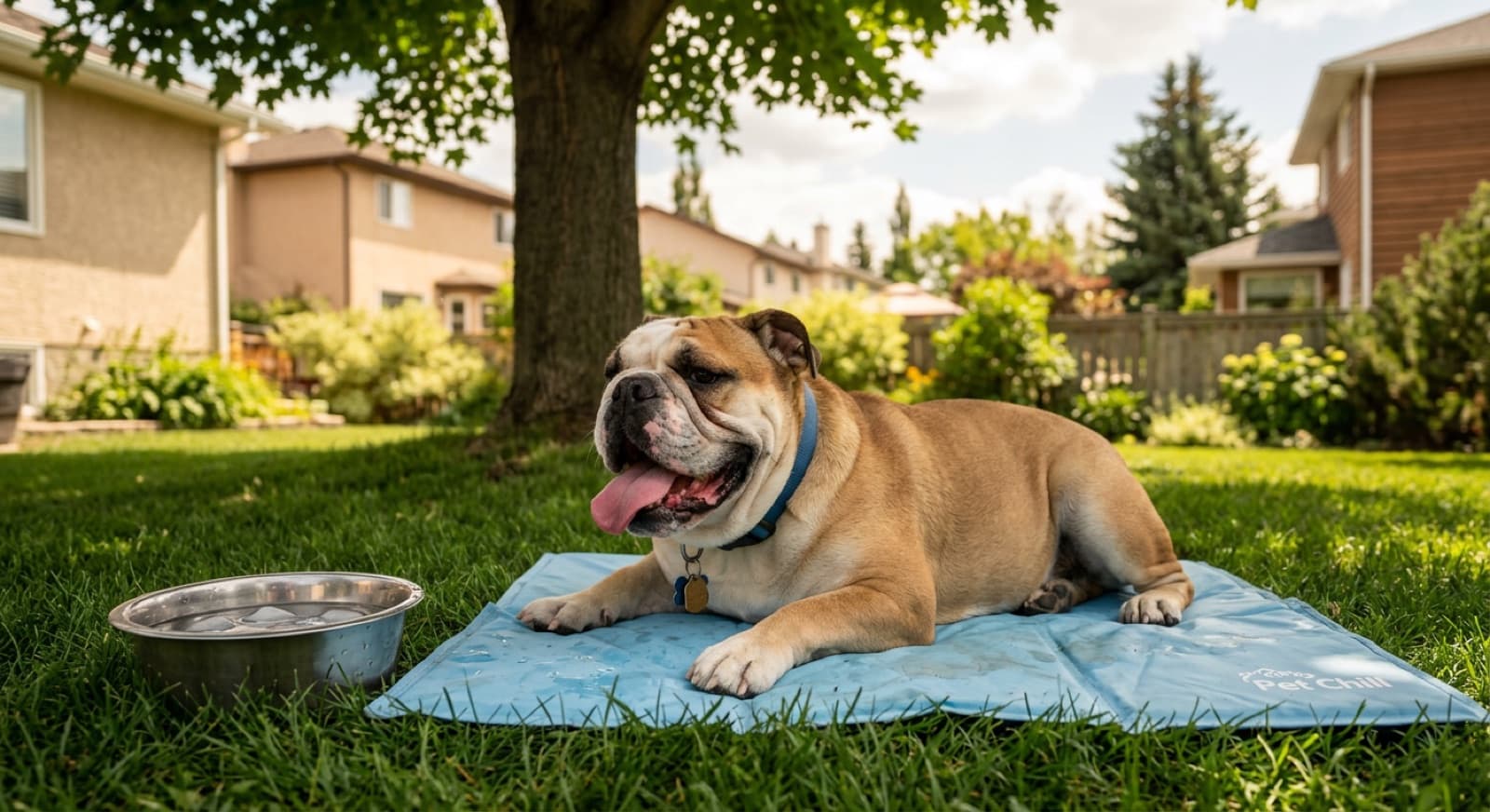
What BOAS actually is: anatomy primer
BOAS stands for Brachycephalic Obstructive Airway Syndrome. The name describes the consequence; the cause is structural. English Bulldogs were bred over generations for a shortened skull, and the soft tissue inside the airway did not shorten proportionally. The result is a permanent partial obstruction that affects breathing at rest and gets worse under any kind of load: exercise, heat, stress, or excitement.
Three primary structural components define BOAS:
- Stenotic nares. Pinched, narrow nostrils restrict the volume of air entering the upper airway with each inhalation. You can usually see this with the naked eye: the nostril openings look like slits rather than open ovals. Severity ranges from mild to severely closed.
- Elongated soft palate. The roof of the mouth (the soft palate, which separates the oral cavity from the nasal cavity at the back of the throat) is longer than it should be. It extends into the airway and partially blocks the opening at the back of the throat. This is the source of most snoring and gagging. Vets diagnose elongation by direct visualisation under sedation.
- Hypoplastic trachea. The windpipe is narrower than normal for body size. Less cross-sectional area means less air moved per breath. Many English Bulldogs have some degree of tracheal narrowing.
Secondary structures that compound the problem: everted laryngeal saccules (tissue at the back of the throat that flips out and further narrows the airway under negative pressure), enlarged tonsils, and laryngeal collapse in advanced cases.
Together these features create a permanent partial airway obstruction. The Royal Veterinary College VetCompass programme (rvc.ac.uk/vetcompass) puts clinical BOAS incidence in English Bulldogs at around 4.2 percent of the population, but that figure tracks dogs with a formal clinical diagnosis. Whole-body plethysmography research published by Liu et al. 2017 in PLOS One measured airway function in apparently healthy English Bulldogs and found that roughly 45 to 50 percent had measurable airway compromise that meets the functional BOAS threshold, even when their owners considered them healthy. In practical terms: most English Bulldogs have some degree of BOAS. The question is severity.
This is the foundation for every summer-safety decision in this guide. Assume your English Bulldog has functional BOAS. Plan walks, household climate, and emergency response around that assumption.
The Calgary summer reality: month by month
The Calgary-specific moat content. Most national pet-care articles assume a moderate climate. Calgary has 25 to 32 degree summer afternoons, chinook-driven 30-degree swings, and 333 sunny days per year. None of that is friendly to a brachycephalic dog.
May. Warming begins. Most days stay below 22, but warm spells reach 25 by month-end. The transition month catches owners off guard because winter habits (long midday walks) suddenly become unsafe. Start the 22-degree walk-ceiling discipline in early May, not in June.
June. Calgary summer arrives. Daily highs commonly 22 to 28. Some days hit 30. The Bow River pathway and Fish Creek Park are still usable in early morning but become unsafe by mid-morning. Pre-cool the home before leaving for work. Begin the summer routine in full.
July. Peak heat. Daily highs 25 to 32. Heat-wave events push temperatures above 32 several times per season. Outdoor walks restricted to before 8 AM and after 8 PM. Some days fail the safety test entirely; indoor enrichment replaces walks.
August. Similar to July. Late August often brings the most aggressive heat days of the year. Smoke from regional wildfires can compound the breathing burden on bad-air days; an English Bulldog with BOAS plus wildfire smoke is a double respiratory load.
September. Cooling begins, but warm chinook events can bring 25 to 28 degree days well into September. Do not relax the routine on the calendar alone; check the forecast.
Indoor reality. Many older Calgary apartments, basement suites, and rental homes do not have central air conditioning. Forced-air heating systems do not reverse to cool. On a 30-degree afternoon, an unconditioned indoor space can hit 28 to 30 degrees by mid-afternoon, which is heat-stroke territory for an English Bulldog at rest. The minimum acceptable setup: a portable AC or window unit in the room where the dog spends time, supplemented by fans, a cooling mat, and a tile or hardwood floor surface (not carpet).
Chinooks. Calgary chinooks swing temperature 25 to 30 degrees in hours. A -5 morning becomes a +25 afternoon. A 12-degree morning becomes 30 by mid-afternoon. A dog's body is built for gradual seasonal adjustment, not several-hour swings. Plan the cool end of the swing for outdoor activity, not the average. Pre-cool the home before the warm phase arrives.
Low humidity caveat. Calgary is genuinely lower-humidity than eastern Canadian summer cities, which is favourable for evaporative cooling in non-brachycephalic dogs. The English Bulldog gets no real benefit from this because their compromised airway already limits how much evaporation can happen at the panting interface. Do not let the dry-heat advantage lull you into a false sense of safety. Air temperature is the dominant variable.
Why panting does not work for English Bulldogs
Dogs cool themselves through panting. The mechanism is evaporative: moisture evaporates from the tongue, soft palate, and upper respiratory tract, and the phase change carries heat away from the body. Effective panting requires unobstructed airflow at high volume.
Brachycephalic anatomy reduces every part of that equation. Stenotic nares restrict inhalation. The elongated soft palate creates turbulent airflow at the back of the throat instead of clean laminar flow. The hypoplastic trachea limits the volume of air moved per breath. The net effect is a panting system running at 30 to 50 percent of normal efficiency, and at the moment the dog needs cooling most (during heat stress), the airway tissue swells slightly under the load, reducing efficiency further.
Two additional anatomical factors compound the problem:
- Body composition. English Bulldogs are heavily muscled with a thick coat and a low body-to-skin-surface ratio (the surface area relative to body mass). This makes passive heat dissipation through the skin less effective than for a leaner, longer-legged breed. The dog has less surface area to radiate heat from, and the panting system is doing most of the work that other breeds spread across panting plus skin radiation.
- Coat insulation. The short, dense coat traps a thin layer of warm air against the skin, which insulates the body. In winter this is useful. In Calgary July it works against the dog. Never shave an English Bulldog (the coat also blocks UV and helps with insulation against extreme heat differentials), but understand that the coat is part of the thermoregulatory burden, not part of the cooling solution.
The practical implication: an English Bulldog will overheat in conditions a non-brachycephalic dog handles comfortably. A Labrador on a 28-degree day with shade and water available is mostly fine. An English Bulldog on the same day is a medical risk. Treating them with the same outdoor expectations leads to heat stroke.
Heat stroke recognition: what to watch for
Heat stroke in dogs is defined by core body temperature, not by external signs. Normal canine body temperature is 38.3 to 39.2 degrees Celsius. Anything above 41 (106 Fahrenheit) is heat stroke. The Cornell Riney Canine Health Center (vet.cornell.edu/riney-canine-health-center) publishes the clinical thresholds clearly, and they are the same thresholds Calgary emergency vets use.
Stages of overheating, with the signs you can recognise at home:
- Early (core temperature about 39 to 40 degrees): excessive panting that does not slow down with rest, drooling, dry or sticky-feeling mouth, reluctance to move, restless or anxious behaviour, seeking out cool surfaces (floor tiles, shaded ground).
- Moderate (about 40 to 41 degrees): rapid heart rate, weakness, mild ataxia (wobbly walking), vomiting, diarrhea, bright red or flushed gum colour, glazed-looking eyes, breathing pattern that is loud and laboured beyond the normal Bulldog baseline.
- Severe (above 41 degrees): collapse, seizures, loss of consciousness, dark red or purplish gum colour, body temperature 41 to 43 degrees, internal organ damage beginning (kidneys, liver, GI tract).
- Critical (above 43 degrees): irreversible organ damage, disseminated intravascular coagulation (DIC), often fatal even with aggressive treatment.
The early stage is where intervention is easy and the outcome is good. The severe stage is where you may already have lost the window. The challenge for English Bulldog owners is that the breed baseline includes a lot of panting, audible breathing, and warm body temperature. Owners get desensitised to the normal sounds and miss the transition into the early heat-stroke stage.
Keep a rectal thermometer in your emergency kit. A digital pediatric or pet-specific rectal thermometer costs $15 to $25 and is the only reliable way to measure core temperature at home. Practice using it once when the dog is calm and healthy so you know how. Petroleum jelly on the tip, gentle insertion, hold for 30 seconds (or until the digital reading stabilises). A reading of 40 or above is a phone call to your vet. A reading of 41 or above is the cooling protocol AND simultaneous transport to a 24-hour emergency vet.
Other recognition cues that should trigger temperature-taking: any collapse, any seizure, any episode where the dog is panting heavily and cannot calm down within 5 to 10 minutes of being moved to air conditioning. Do not wait for the textbook severe signs.
Cooling protocol: what to do if heat stroke is suspected
The cool-not-cold principle is the most important rule in dog first aid. Ice water causes peripheral vasoconstriction and traps heat in the core. Cool water on high-blood-flow areas pulls heat out through evaporation.
The protocol below is consistent with the Cornell Riney Canine Health Center heat-stroke guidance and the position of the American Veterinary Medical Association. Run through it sequentially, but in parallel with calling for help.
- Move to shade or air conditioning immediately. Indoors with the AC on if possible, or the shadiest spot you can find on a hot day. Stop all exercise. Lay the dog on a cool surface like tile or hardwood; carpet traps heat.
- Apply cool (not cold) water to the groin, armpits, neck, and paw pads. These are high-blood-flow areas where evaporative cooling reaches core temperature fastest. Cool means room temperature or slightly cool from the tap, NOT iced.
- DO NOT use ice or ice water. Ice causes peripheral vasoconstriction, which traps heat in the core and slows cooling. Submerging in ice water can also cause shock and over-cooling. This is one of the most persistent old myths in pet first aid; the cool-not-cold principle is the actual veterinary guidance.
- Wet towels on the body, replaced every 2 to 3 minutes. A wet towel cools through evaporation for the first few minutes, then warms up and becomes an insulator. Swap to a fresh wet towel every 2 to 3 minutes for the duration of cooling.
- Fan circulation. Place a fan to blow air across the wet dog. This dramatically increases evaporative cooling. A battery-powered fan in the emergency kit covers the car ride too.
- Offer cool (not iced) drinking water. Small sips only. Do not force-feed water; an unconscious or semi-conscious dog can aspirate. If the dog drinks willingly, fine; if not, do not push.
- Take rectal temperature every 5 minutes. You are watching for the curve.
- Stop cooling at core temperature 39.5 degrees. Over-cooling causes hypothermia and is a real risk. Stop, dry the dog, and continue monitoring. If temperature creeps back up, restart cooling.
- Transport to 24-hour emergency vet while continuing cooling. Do not finish cooling and then drive. Cool while a second person drives, or pre-load the car with AC running on max and a wet-towel setup in the back, then go. Call ahead so the clinic can prepare.
Things to avoid during cooling:
- Ice water submersion (vasoconstriction, shock, over-cooling)
- Forcing the dog to drink large volumes (aspiration risk)
- Wrapping in dry blankets or insulating materials
- Giving any human heat-stroke medication or NSAIDs without a vet directing you
- Waiting to see if the dog improves before going to the vet
Once at the clinic, the vet team has IV fluids, supplemental oxygen, active cooling, anti-emetics, and the ability to monitor kidney and liver function as the body recovers. None of that is replicable at home. The goal of your home cooling is to stabilise the dog enough to get them to the clinic alive. The clinic does the rest.
Calgary 24-hour emergency vet network
Know your route before you need it. Save the numbers in your phone now, not while you are panicking in the kitchen with an overheated dog.
Western Veterinary Specialist and Emergency Centre is the regional referral and 24-hour emergency centre in Calgary. They handle heat-stroke cases, brachycephalic anaesthesia (relevant if BOAS surgery or any urgent procedure is needed), and ICU-level care for severe presentations. They are the default for English Bulldog emergencies in Calgary, and most general practice vets in the city refer there.
VCA Canada West also operates emergency and specialty services in the Calgary area; confirm their current intake hours and specifics by phone before you need them, as service hours and locations can change.
Drive time matters. From most Calgary neighbourhoods, the route to a 24-hour emergency vet is 15 to 30 minutes depending on traffic and time of day. Map the route now in your phone GPS so you are not setting up navigation during an emergency. If you live in a peripheral area (Tuscany, Cranston, Auburn Bay, distant outer suburbs), the drive can be 30 to 45 minutes; plan accordingly and consider the cooling protocol setup for the longer transport window.
When you call ahead, the information the clinic wants is: dog breed and approximate weight, what happened and when, current symptoms, current rectal temperature if you have it, estimated time of arrival. They will often direct you to enter through a specific bay or to call from the parking lot. Follow their instructions.
Cost reality for heat-stroke emergency visits in Calgary: a stabilising visit with IV fluids, oxygen, blood work, and several hours of observation typically runs $1,500 to $3,000. Severe presentations requiring overnight ICU care, organ-function monitoring, and prolonged treatment can run $3,000 to $5,000 or higher. Pet insurance is essentially required for the brachycephalic breeds; buy the policy before the first heat-related vet visit because pre-existing condition exclusions bite hard. See our English Bulldog adoption guide for cost breakdowns and the broader budget context.
Daily summer routine for English Bulldog owners
The routine that keeps an English Bulldog safe through a Calgary summer is not complicated. It just requires discipline. Pick the schedule, post it on the fridge, and run it.
- 6 to 7 AM: morning walk before the sun is high. 15 to 20 minutes maximum on most summer days, less on warm mornings. Watch for early panting that does not settle. Shaded routes along the Bow River pathway or tree-lined sections of Fish Creek Park are cooler than open prairie at Nose Hill Park. Carry water.
- 7 to 8 AM: home, water, breakfast, indoor cool-down. Tile or hardwood floor, fan, AC.
- 9 AM to 7 PM: indoor only. No outdoor activity, no backyard sun-time, no car trips except for vet appointments (and only with AC on full from before the dog enters the car). Indoor enrichment replaces walks: short hallway play, scent games with treats hidden under cups, food puzzles, chew toys. The dog will adapt; mental enrichment substitutes well for physical exercise in this breed.
- Mid-day check: if you are home, look in on the dog. Confirm AC is running, water bowl is full, dog is resting comfortably. If you are at work, a smart thermostat that holds 22 degrees while you are away is the realistic setup.
- 7 to 8 PM: evening walk after the sun has dropped. Check pavement temperature with the 5-second hand rule. If the pavement is too hot to hold your hand on for 5 seconds, it is too hot for paws regardless of air temperature. Many Calgary July pavements still fail this test at 7 PM. Wait until 8 if needed.
- 9 PM onwards: indoor cool-down for sleep. Most English Bulldogs prefer a cool tile floor to a soft bed in summer; do not fight this preference.
Special situations:
- Vet appointments. Schedule for early morning. Pre-cool the car for 5 minutes before loading the dog. Use a cooling vest if the visit is essential and the temperature is borderline.
- Travel and errands. Never leave an English Bulldog in a parked car, even with windows cracked, even for 5 minutes. Calgary car interior temperatures hit 50 to 60 degrees Celsius on a 28-degree day within 10 minutes. This is one of the most common heat-stroke triggers.
- Visitors and social events. Excitement raises body temperature in brachycephalic dogs. A backyard barbecue on a 27-degree day with the dog greeting guests is a heat-stroke setup. Keep the dog inside with AC during summer gatherings.
- Stampede week. Calgary Stampede falls in early July, the peak heat window. Avoid bringing an English Bulldog to outdoor events. Indoor cool-down at home is the right call.
Pre-summer prep for Calgary English Bulldog owners
Start the prep in April. By May the warm days arrive, and by June the routine should be running smoothly.
April:
- Service or replace the AC unit. Window-mount and portable AC units last 5 to 8 years; check function before the heat arrives.
- Buy a backup fan. Box fans, oscillating fans, or stand fans all work; one per major room is the realistic setup.
- Check the rectal thermometer in your emergency kit. Replace batteries.
- Buy or check the cooling vest, cooling mat, and any other heat-mitigation gear.
- Update pet ID tags and microchip registration. Confirm pet insurance is active.
- Save 24-hour vet phone numbers in your phone.
May:
- Pre-summer vet visit. Discuss BOAS severity if it has not been formally assessed. Ask about respiratory function testing if appropriate.
- Discuss BOAS surgery timing if not done. Spring surgery means recovery is complete before peak summer heat.
- Update or refill any prescribed medication.
- Begin the 22-degree walk-ceiling discipline. May warm days catch owners off guard because winter habits feel normal.
- Practice the emergency cooling protocol once with the family or pet sitters so everyone knows the steps under pressure.
Households with multiple dogs of mixed breed: the English Bulldog needs the strict summer schedule even if the other dog is fine with a midday walk. Do not synchronise the brachycephalic dog routine to the more heat-tolerant dog routine. Plan separate walks if needed.
BOAS surgery: what it does and when to do it
BOAS surgery is the medical option for English Bulldogs with significant airway compromise. It does not eliminate brachycephalic risk, but it meaningfully improves margins. After a successful procedure, breathing at rest is quieter, exercise tolerance improves, and the panting system works more effectively for heat dissipation. This translates to a wider safe-temperature window in summer and a generally higher quality of life.
The procedures, typically performed in combination depending on what is affected:
- Stenotic nares correction. Widening the nostrils so more air enters with each breath. Several surgical techniques exist; ask your veterinary surgeon about their preferred method and outcomes.
- Soft palate resection. Shortening the elongated soft palate so it no longer extends into the airway. Often the highest-impact single procedure.
- Laryngeal saccule removal. Removing everted laryngeal saccules that further restrict the airway. Often combined with the other procedures during the same surgery.
- Tonsillectomy. If tonsils are enlarged, removal can be added.
Calgary surgical access. Western Veterinary Specialist and Emergency Centre performs BOAS surgery and has experienced brachycephalic anaesthesia teams (anaesthesia in a brachycephalic dog is itself higher-risk because of the airway anatomy; the surgeon and anaesthesia team experience matter). Many general practice Calgary vets refer to Western Vet for BOAS work. Confirm specifics directly with your vet.
Cost in Calgary runs roughly $3,000 to $6,000 depending on which procedures are combined and the dog severity. Pet insurance coverage varies; pre-approval is worth pursuing before scheduling. Some policies treat BOAS surgery as elective if the dog is asymptomatic; others cover it as medically necessary once severity is documented.
Best timing for surgery. Early intervention at 1 to 2 years old generally gives better lifetime outcomes than waiting. Severity often progresses with age as the dog gains weight and the soft tissue thickens. Spring (March to May) is the preferred surgical window in Calgary because recovery is complete before peak summer heat, and the post-surgery summer is the first one the dog enters with improved airway function.
Recovery. The first 48 to 72 hours are the critical window: monitoring for swelling, regurgitation, aspiration, or airway compromise. Most BOAS surgery patients stay one to two nights in hospital. At home: soft food only for 10 to 14 days, no rigorous exercise for 3 to 4 weeks, harness only (never a collar) on leash for the first month, follow-up appointments at week 2 and week 4. Full recovery is typically 4 to 6 weeks.
Post-surgery, the 22-degree walk ceiling still applies. The dog is still brachycephalic. Surgery improves the margins; it does not eliminate the underlying anatomy. Owners who think of BOAS surgery as a cure are misreading the procedure. Think of it as moving the safety threshold from 20 degrees to 24 degrees on average, not as making the dog a normal-breathing breed.
Insurance and emergency cost reality
Heat-stroke emergency vet visits in Calgary run $1,500 to $5,000 depending on severity and length of stay. A stabilising visit with IV fluids, blood work, oxygen, and several hours of observation is the lower end. ICU-level care with overnight monitoring, organ-function support, and prolonged treatment is the higher end.
BOAS surgery, as covered above, runs $3,000 to $6,000.
Routine annual care for an English Bulldog (vet visits, vaccines, parasite prevention, skin and dental maintenance) runs higher than for a typical breed because of medical complexity, often $1,500 to $3,000 per year before any major procedure.
Pet insurance is functionally required for the brachycephalic breeds, not optional. The key point that catches new owners: pre-existing condition exclusions. Once a dog has been seen for a BOAS-related symptom (audible breathing, exercise intolerance, a single mild heat episode), most insurance companies will either decline new policies for that condition or exclude BOAS-related claims from the new policy. Buy the policy BEFORE the first heat-related vet visit, ideally within the first few weeks of bringing the dog home. Cross-link to our broader cost-of-ownership discussion (when that article is published) for the full lifetime financial picture.
The honest pattern: English Bulldog owners who have insurance from day one have a financial cushion when the inevitable medical bills arrive. Owners who skip insurance because the dog seems healthy in year one face uncovered costs of $3,000 to $10,000 by year three or four. The math favours buying the policy.
The honest framing: heat reality for Calgary English Bulldog owners
This section is the part most national pet-care articles do not say out loud.
English Bulldogs are not suitable for active outdoor lifestyles in Calgary summers. The breed cannot accompany you on a summer hike, a long Bow River pathway walk in July, a backyard barbecue in 28-degree weather, or a road trip to the mountains during a heat wave. If you want a dog that does those things with you, choose a breed without brachycephalic anatomy. American Bulldogs (no brachycephalic risk), Labradors, mixed-breed adoption rescues with longer snouts; any of them is a better fit for an active summer household than an English Bulldog.
Apartment dwellers without air conditioning need to think carefully BEFORE adoption. The summer survival of an English Bulldog in Calgary depends on indoor climate control. A basement suite, an older walk-up apartment, or any rental without functional AC is a heat-stroke risk for the breed. The choice is either invest in a portable AC unit before adopting, or choose a different breed.
Foster home stays during heat waves are a reasonable mitigation. Some rescue networks can coordinate temporary foster placement during extreme heat events; this is the kind of conversation a Calgary rescue group will have honestly with an adopter who runs into trouble. Alberta Bulldog Rescue Society is the Calgary-based breed-specific rescue and the most likely to understand the brachycephalic heat conversation without explanation. Build relationships with local rescues BEFORE you need this help, not during a crisis.
The breed lifespan tells the story. English Bulldogs average 7.39 years (Royal Veterinary College VetCompass 2022 lifespan data) versus 13+ years for many non-brachycephalic breeds. Heat-related cumulative stress is part of why. Owners who follow the 22-degree summer discipline can extend the high-quality years; owners who ignore it shorten an already-short life.
None of this is a reason not to adopt an English Bulldog. The breed is gentle, calm, family-friendly, and rewarding to live with. It is a reason to plan honestly. The owners who succeed with English Bulldogs in Calgary are the ones who built the household summer setup before adopting, not the ones who figured it out during the first July emergency.
For the broader adoption context, including rescue paths, cost math, and surrender patterns, see our English Bulldog adoption guide. For the full medical picture beyond heat and BOAS, see our English Bulldog health issues guide.
Browse adoptable English Bulldogs in Calgary
Most Calgary English Bulldogs in rescue are climate-adapted adults with documented BOAS, hip, or skin history. Foster homes describe each dog's actual heat tolerance, exercise capacity, and any surgical history, which beats breed-reputation alone for matching a Calgary household.
See Available English Bulldogs →Frequently Asked Questions
Can English Bulldogs handle Calgary summers?
Not without structural household changes. Calgary summers regularly hit 25 to 32 degrees Celsius from June through August. English Bulldogs are brachycephalic: stenotic nares, elongated soft palate, often a hypoplastic trachea. Panting is how dogs cool themselves, and brachycephalic anatomy reduces panting efficiency dramatically. A non-brachy dog handles 28 degrees comfortably; an English Bulldog can collapse from heat stroke at the same temperature. The required setup is air conditioning indoors, walks only in early morning and late evening, no outdoor activity 9 AM to 7 PM on warm days, and an emergency cooling protocol ready.
What temperature is too hot for an English Bulldog walk?
Above 22 degrees Celsius ambient temperature is the standard veterinary guidance for brachycephalic breeds. Below 22, walks are generally safe with normal precautions. Between 22 and 25, walks should be 10 to 15 minutes maximum, in shade, with rest stops. Above 25, no outdoor walks. Pavement temperature matters separately: the 5-second rule (if you cannot hold your hand on the pavement for 5 seconds, it is too hot for paws). Calgary asphalt can hit 50 to 60 degrees on a 28-degree day. Most July and August days in Calgary fail the walk-safety test from late morning through early evening.
How do I know if my English Bulldog has BOAS?
Clinical BOAS incidence in English Bulldogs is around 4.2 percent per RVC VetCompass, but functional BOAS (measurable airway compromise without a formal diagnosis) affects roughly 45 to 50 percent of English Bulldogs per Liu 2017 PLOS One whole-body plethysmography research. Owner-recognisable signs: audible breathing at rest, snoring, gagging during or after meals, exercise intolerance, blue-tinged gums during exertion, any collapse episode. A vet can grade severity using respiratory function tests. Assume your English Bulldog has functional BOAS until proven otherwise.
What is the heat stroke threshold for a dog?
Core body temperature above 41 degrees Celsius (106 Fahrenheit). Normal dog body temperature is 38.3 to 39.2. Progression: at 39 to 40 the dog shows early signs (excessive panting, drooling, restless). At 40 to 41 you see weakness, vomiting, diarrhea, bright red gums. Above 41 the dog can collapse, seize, lose consciousness, and develop irreversible organ damage. Above 43 is often fatal. Keep a rectal thermometer in your emergency kit. A core temperature of 41 or higher means cooling protocol AND simultaneous transport to a 24-hour emergency vet.
How do I cool down an overheated English Bulldog?
Move to shade or air conditioning immediately. Apply cool (not cold) water to the groin, armpits, neck, and paw pads. Wet towels on the body, replaced every 2 to 3 minutes. Fan circulation. Stop cooling at core temperature 39.5 degrees Celsius; over-cooling causes hypothermia. Transport to a 24-hour emergency vet while continuing the cooling protocol. Call ahead. In Calgary, Western Veterinary Specialist and Emergency Centre runs full-time emergency intake. Save the number in your phone before summer starts.
Should I use ice water for heat stroke?
No. Ice and ice water cause peripheral vasoconstriction, which traps heat in the body core and slows cooling. This is one of the most persistent old myths in pet first aid. The correct approach is cool (room temperature or slightly cool) water on high-blood-flow areas (groin, armpits, neck, paw pads), wet towels swapped frequently, and fan-driven evaporation. Submerging an overheated dog in ice water can also cause shock from rapid temperature drop, and over-cooling that takes the dog below normal temperature. The Cornell Riney Canine Health Center guidance is explicit on the cool-not-cold principle.
When should I take my English Bulldog to the ER for heat?
Any time you suspect heat stroke, while you are still cooling the dog. Specific triggers: core body temperature 40.5 degrees or higher, collapse or inability to stand, seizure or twitching, vomiting or diarrhea with bloody content, bright red or purple gums, glassy unresponsive eyes, breathing that is loud and laboured beyond normal Bulldog baseline. The vet team has IV fluids, supplemental oxygen, and emergency medication that home cooling cannot replicate. Calgary 24-hour options include Western Veterinary Specialist and Emergency Centre. Plan this route BEFORE you need it.
Do English Bulldogs need air conditioning?
In Calgary, yes, functionally required from May through September. The breed cannot thermoregulate effectively above 22 to 24 degrees, and Calgary indoor summer temperatures without AC regularly hit 26 to 30 during heat waves. Forced-air heating systems do not reverse to cool. The minimum acceptable setup is a portable air conditioner or window unit in the room where the dog spends the most time, supplemented by fans and a cooling mat. Pre-cool the home before leaving for work, and consider a smart thermostat that holds temperature when you are away.
What time of day is safe to walk an English Bulldog in summer?
Early morning before the sun is high and late evening after the sun has dropped. In June, July, and August, that practically means 6 to 8 AM and 8 to 9:30 PM. Even mid-morning is too warm on most summer days. Check ambient temperature AND pavement temperature with the 5-second hand rule. Walks should be short (15 to 20 minutes maximum), low-intensity, and in shaded routes. Bow River pathways and tree-lined sections of Fish Creek Park are cooler than open prairie spaces like the south slope of Nose Hill Park during summer afternoons. Carry water and watch for early distress.
Does BOAS surgery help with heat tolerance?
Yes, meaningfully, though it does not eliminate brachycephalic risk. BOAS surgery typically corrects one or more of the three primary obstructions: widening stenotic nares, resecting the elongated soft palate, and removing everted laryngeal saccules. After surgery, dogs breathe more easily at rest and during light activity, exercise tolerance improves, and panting becomes more effective. However, the dog is still brachycephalic, still has shorter snout-to-airway distance, and still needs the 22-degree summer walk ceiling. Surgery improves margins; it does not eliminate the underlying anatomy. Discuss timing with your vet; early intervention (1 to 2 years old) generally gives better lifetime outcomes.
How long does BOAS surgery recovery take?
Two to four weeks for the soft tissue portion, depending on what was corrected. The first 48 to 72 hours are most critical: monitoring for swelling, airway compromise, regurgitation, or aspiration risk. Most BOAS surgery patients stay one to two nights in hospital for observation. At home: soft food only for 10 to 14 days, no rigorous exercise for 3 to 4 weeks, harness only (never a collar) on leash for the first month, follow-up appointments at week 2 and week 4. Calgary surgical centres typically schedule BOAS surgery in spring (March to May) so recovery is complete before summer heat arrives. Cost in Calgary runs $3,000 to $6,000 depending on which procedures are combined.
Should I get a cooling vest for my English Bulldog?
Yes, as one tool in a layered approach. Evaporative cooling vests (the kind you soak in water) reduce body temperature by 3 to 5 degrees during use, which can buy meaningful margin during a necessary summer outing such as a vet appointment. They are not a substitute for air conditioning, and they are not permission to walk a Bulldog at noon in July. Used correctly: wet, wring out so damp not dripping, put on the dog 5 to 10 minutes before going outside, re-wet every 30 to 60 minutes. Watch for chafing under armpits. Cooling mats for indoor use pair well. The combined kit (vest, mat, fan, water bowl with ice cubes) is the realistic summer setup.
What is in an English Bulldog summer emergency kit?
Build it before May. Contents: digital rectal thermometer with petroleum jelly, two clean microfibre towels, a spray bottle for cool water, a battery-powered fan, a 1-litre water bottle (refilled weekly), the phone numbers of your regular vet AND a 24-hour emergency vet (Western Veterinary Specialist and Emergency Centre is the Calgary referral centre), pet insurance details and policy number, your dog's medical history including any BOAS surgery records, and a printed reminder card with the cooling protocol steps. The kit lives in a known location, accessible to every adult in the household. Practice once: have everyone locate the kit blindfolded.
Are chinooks dangerous for English Bulldogs?
They can be, both in summer and in shoulder seasons. A Calgary chinook can swing temperature 25 to 30 degrees in hours: a -5 morning becomes a +25 afternoon, or a 12-degree morning becomes 30 by mid-afternoon. A dog's body is built for gradual seasonal adjustment, not several-hour swings. For an English Bulldog, the risk is that a planned morning walk during a cool window becomes a heat-stress situation by the time you get home. The protocol: check the forecast hourly during chinook events, plan walks for the cool end of the swing not the average, keep the home pre-cooled if a chinook is forecast for the afternoon. Chinook events extend the brachycephalic heat-risk season at both ends.
English Bulldogs in Calgary
Browse adoptable English Bulldogs and Bulldog mixes from Calgary rescues with foster-documented BOAS severity, heat tolerance, and surgical history.
English Bulldog Health Issues: Breathing, Skin
English Bulldog health issues to plan for: breathing and heat, skin fold infections, cherry eye, hip dysplasia, allergies, heart defects and mast cell tumours.
English Bulldog Cost of Ownership
Full Calgary budget for an English Bulldog: adoption fee, year-one setup, ongoing medical, insurance equation, lifetime totals.
English Bulldog Grooming & Skin Folds
Daily fold protocol, product picks, tail pocket management, when to escalate to veterinary dermatology.
New dog? Start with these care guides
Everything a new adopter needs to set up a safe, happy home.