The short answer
English Springer Spaniels typically weigh 40 to 55 lbs and live 12 to 14 years with proactive care. The breed has several distinct elevated risks. From the top of the list: hip and elbow dysplasia are documented orthopaedic conditions, and ethical breeders screen with OFA or PennHIP. Progressive retinal atrophy (PRA) and retinal dysplasia are inherited eye conditions; PRA is DNA testable. Phosphofructokinase (PFK) deficiency is a DNA-testable metabolic disorder more common in working lines that causes exercise intolerance, jaundice, and dark urine after exertion. Fucosidosis is a rare DNA-testable lysosomal storage disorder ethical breeders screen for. Chronic otitis externa is the everyday reality of the pendulous Springer ear and Calgary humid summers plus pond and river swimming. Atopic dermatitis and primary seborrhoea are documented skin conditions. Idiopathic epilepsy can present in middle age. The historic Springer Rage Syndrome is rare in modern ethically-bred dogs but is worth knowing about. Springers are at elevated risk for haemangiosarcoma and mast-cell tumours in seniors.
This article is informational only and is not veterinary advice. Always consult your Calgary veterinarian for individualised health guidance for your specific dog.
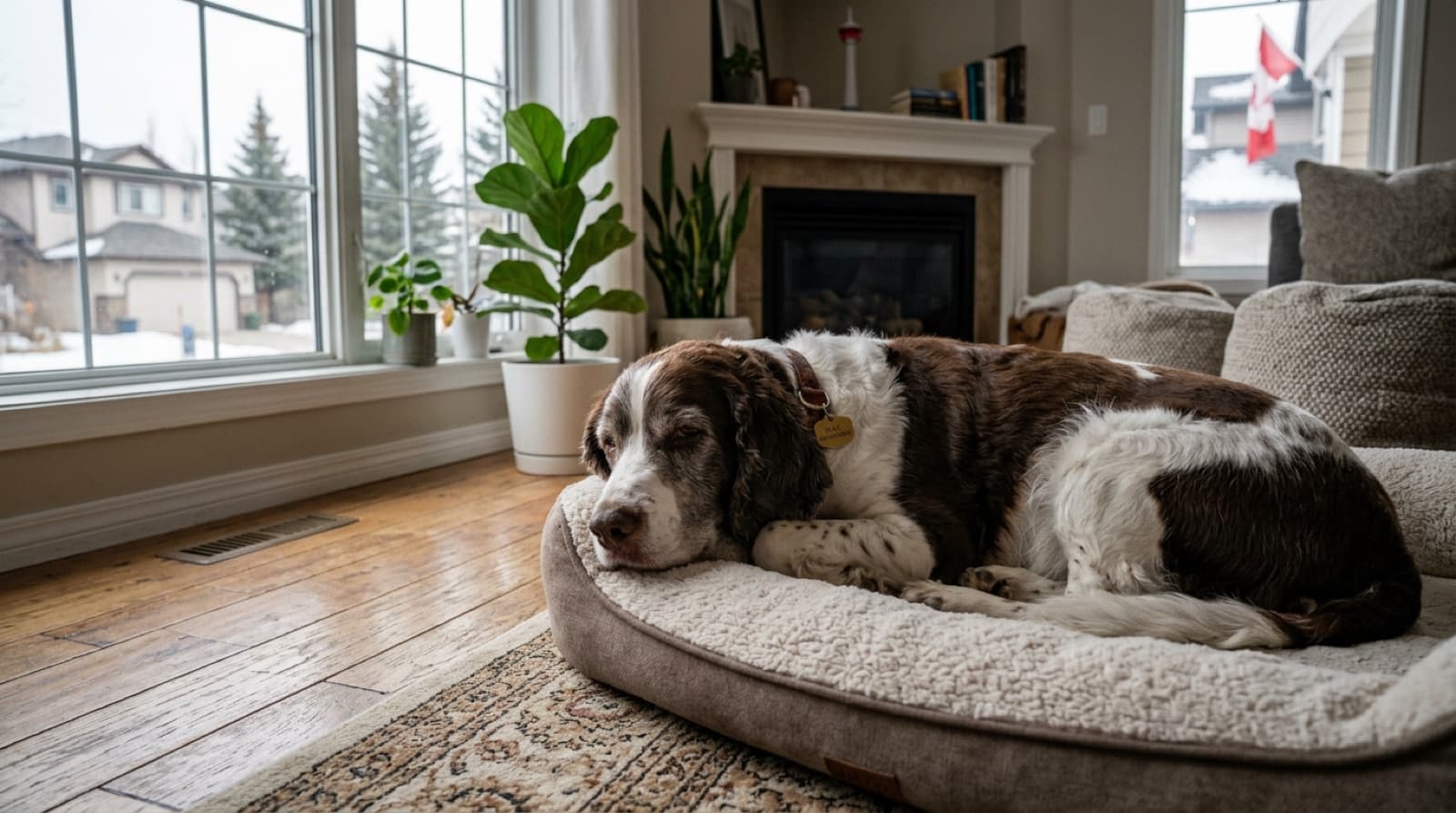
The English Springer Spaniel is a versatile bird-flushing and retrieving breed developed in 19th-century England. The breed split into distinct show and working (field) lines decades ago, and the two lines now look and behave noticeably differently. Working-line Springers are leaner, higher-drive, and bred to hunt; show-line Springers are heavier-boned, longer-coated, and bred for the conformation ring. Both lines share most of the breed's health profile, but a few conditions cluster more in one line than the other. This article walks Calgary owners through the conditions to discuss with your vet at adoption and at every annual exam after that, what to watch for at home, and what belongs in the hands of a veterinarian rather than the internet. Sources include the American Kennel Club, the Orthopedic Foundation for Animals (OFA), the AKC Canine Health Foundation, the Cornell University College of Veterinary Medicine, the American Animal Hospital Association, the Canadian Kennel Club, and the English Springer Spaniel Field Trial Association health pages.
Why Springers have a distinct health profile
Three facts shape almost everything on this page. First, the breed has a relatively narrow gene pool compared with mixed-breed dogs, which concentrates a small number of recessive disorders into the population (PFK deficiency, fucosidosis, PRA). Ethical breeders screen with DNA tests now widely available through commercial labs. Second, the Springer's pendulous furry ear is a textbook anatomical setup for chronic otitis externa, and Calgary's humid summers plus the breed's love of pond and river swimming amplify the risk. Third, the working line and the show line have diverged enough that some risks (PFK in working lines, certain skin conditions in show lines) cluster in one line more than the other.
For a rescue Springer without breeder records (which is most rescue Springers), the practical implication is simple: manage proactively. Build a Calgary vet schedule, plan a week-1 baseline workup, learn the bloat-free but ear-aware Springer routine before you bring the dog home. The rest of this article walks through what to ask the vet about and when.
Hip and elbow dysplasia
Hip dysplasia is documented in English Springer Spaniels and is included in OFA hip dysplasia breed statistics. Ethical breeders evaluate both parents with OFA or PennHIP scoring before breeding. Elbow dysplasia is a separate orthopaedic condition and warrants screening too.
Hip dysplasia is a developmental malformation of the hip joint where the ball and socket do not fit together correctly. Over time, the joint develops painful arthritis. The condition is influenced by genetics, growth rate, body weight, and exercise pattern during growth. Elbow dysplasia refers to a group of developmental abnormalities of the elbow joint that lead to forelimb lameness.
Symptoms to discuss with your Calgary vet:
- Bunny-hopping gait when running, where both rear legs push off together rather than alternating
- Reluctance to climb stairs, jump into the car, or get up onto the couch
- Hindlimb stiffness after rest that improves with movement
- Forelimb lameness, especially after exercise (elbow dysplasia)
- Visible muscle wasting in the hindquarters
- A drop in willingness to run hard on Calgary off-leash trails such as Nose Hill Park, Fish Creek Provincial Park, or Bowmont Park
Diagnosis is by X-ray imaging scored against OFA or PennHIP standards, read by your Calgary vet or a referral radiologist. Management ranges from conservative care (weight control, joint support recommended by your vet, physiotherapy, and pain control your vet selects) through to surgical options for severe cases. Surgical decisions and rehabilitation plans belong with a Calgary specialty centre.
Body weight is the most important owner-controllable factor. An overweight Springer puts more load through hips and elbows than a lean one of the same height. Body condition scoring on the 1 to 9 scale at every Calgary vet visit is more useful than the bathroom scale alone. Springers are working dogs by design and do better lean, particularly through middle age when the temptation to over-feed for the coat starts.
Progressive Retinal Atrophy (PRA, DNA testable)
PRA is an inherited retinal disease that causes gradual vision loss and eventual blindness. The English Springer Spaniel form is DNA testable through commercial veterinary genetics labs. Ethical breeders screen both parents. For a rescue Springer, your Calgary vet can order the test if there is any clinical suspicion.
PRA in Springers is autosomal recessive (two affected copies needed for clinical disease). Affected dogs typically show first signs in middle age, starting with reduced night vision and gradually progressing to complete blindness over months to years.
Early signs to discuss with your Calgary vet:
- Reluctance to navigate in dim light, especially evening walks during Calgary winter darkness
- Hesitation on stairs or curbs
- Bumping into furniture in familiar rooms
- A change in the appearance of the eye (sometimes the tapetum reflects light more strongly as the retina thins)
Diagnosis is by veterinary ophthalmology examination and DNA testing through commercial labs. There is no cure for PRA, but Springers adapt well to gradual vision loss in familiar home environments. Furniture stays put, routines stay consistent, and verbal cues replace visual ones. Specific testing and management belong with your vet team.
Retinal dysplasia
Retinal dysplasia is a developmental abnormality of the retina that has been documented in English Springer Spaniels, with certain lines showing elevated incidence. The condition ranges from minor focal folds (no visual impact) through geographic patches (variable visual impact) to total retinal detachment (significant or complete vision loss). Affected dogs are typically born with the condition; it is not progressive in the way PRA is.
Signs to discuss with your Calgary vet:
- Visual hesitation in a young Springer, especially in dim light or unfamiliar environments
- Bumping into objects on one side (suggesting unilateral impairment)
- An eye that appears different from the other on close inspection
Diagnosis is by veterinary ophthalmology examination, often as part of a CERF or OFA eye certification visit. There is no cure for retinal dysplasia, but the focal forms are often clinically silent. Affected dogs with significant impairment adapt well to a stable home environment. Decisions belong with your vet and a veterinary ophthalmology referral when needed.
Phosphofructokinase (PFK) deficiency (DNA testable)
PFK deficiency is an inherited metabolic disorder more common in working-line English Springer Spaniels. Affected dogs cannot properly metabolise glucose in muscle and red blood cells, which causes episodic exercise intolerance, muscle cramping, jaundice, and dark urine after vigorous exertion. The condition is DNA testable through commercial labs. Any suspected PFK episode is an immediate Calgary vet visit.
PFK deficiency (also called erythrocyte phosphofructokinase deficiency or PFK type VII glycogen storage disease) is an autosomal recessive condition in which a key enzyme of glucose metabolism is missing or defective. Affected Springers cannot break down glucose efficiently during exertion, and they cannot maintain the red blood cell membrane integrity that normal PFK supports. The result is episodic muscle cramping, lethargy, and acute haemolytic crises (red blood cell breakdown) triggered by exercise, stress, hyperventilation, or high body temperature.
Signs that warrant an urgent Calgary vet visit:
- Episodic weakness, lethargy, or muscle cramping after exertion or excitement
- Jaundice (yellowing of the gums, sclera, or skin)
- Dark, cola-coloured, or red urine after exertion (haemoglobinuria)
- Reluctance to exercise that resolves with rest
- Persistent exercise intolerance disproportionate to fitness level
- Episodes triggered by Calgary summer heat, by Stampede excitement, or by strenuous play
Diagnosis is by DNA testing through a commercial veterinary genetics lab combined with bloodwork your vet orders during or after a clinical episode. Management is lifelong avoidance of triggers (vigorous prolonged exercise, overheating, hyperventilation, stress) and is highly individual to the dog. Management decisions, exercise prescription, and any supportive care during a crisis belong entirely with your Calgary veterinary team. This is one of the conditions that makes a working-line Springer's breeder paperwork worth verifying before adoption when records exist.
Fucosidosis (rare, DNA testable)
Fucosidosis is a rare inherited lysosomal storage disorder documented in English Springer Spaniels, in which the enzyme alpha-L-fucosidase is missing. The result is progressive accumulation of fucose-containing compounds in cells throughout the body, with neurological signs appearing in early adulthood and progressing to severe neurological dysfunction. The condition is autosomal recessive and is DNA testable through commercial labs. Ethical breeders screen both parents, and the test result should be in writing for a Springer purchased from a breeder.
Signs to discuss with your Calgary vet (typically appearing 18 months to 4 years):
- Progressive change in temperament, often increasing apathy or unusual behaviour
- Progressive ataxia (unsteady gait)
- Visual deficits
- Loss of learned commands or training
- Progressive weight loss despite normal appetite
Diagnosis is by DNA testing combined with neurological evaluation. There is no cure, and the condition is progressive and ultimately fatal. The good news for the modern adopter is that responsible DNA screening has made fucosidosis rare in well-bred Springers. The risk for an undocumented rescue Springer is very low, but it is the reason the DNA test exists in the standard breeder screening panel.
Idiopathic epilepsy
Idiopathic epilepsy (recurrent seizures with no identifiable underlying structural cause) is documented in English Springer Spaniels. First seizures typically appear between ages 1 and 5. Structural causes (brain tumours, head trauma, toxin exposure, metabolic disease) need to be ruled out first; idiopathic epilepsy is the diagnosis of exclusion.
Signs that warrant a vet visit:
- Generalized convulsions with loss of consciousness
- Cluster seizures (more than one within 24 hours)
- Prolonged seizures (over five minutes) — this is an immediate Calgary 24-hour emergency vet visit
- Pre-seizure (aura) signs: restlessness, hiding, unusual attention-seeking
- Post-seizure (postictal) signs: disorientation, temporary blindness, exhaustion lasting hours
Diagnosis is by clinical history, bloodwork, and sometimes advanced imaging (MRI) ordered through a neurology referral. Management is daily lifelong medication chosen and dosed by your vet, with periodic bloodwork to confirm therapeutic levels. Specific medication and dosing decisions belong entirely with your Calgary veterinary team, often in consultation with a veterinary neurologist at Western Veterinary Specialist Centre or VCA Canada West for refractory cases. If you see a seizure, time it if you can do so safely, video it if possible, and bring the information to your vet visit; the duration and characteristics help your vet team.
Chronic otitis externa (the everyday Springer reality)
The pendulous furry ear that defines the Springer's look is also the breed's most common health complaint. Chronic otitis externa is the single most frequent vet reason a Springer comes through the door, and Calgary's humid summers plus the breed's love of water amplify the risk. Weekly ear checks and post-swim drying are the protective routine.
The Springer's ear flap is heavy, hairy, and covers a relatively narrow ear canal. The combination traps moisture, restricts airflow, and creates a warm dark environment that bacteria and yeast thrive in. Add a swim in the Bow River or the Glenmore Reservoir, a humid Calgary July afternoon, or an allergic skin condition, and chronic otitis externa is the classic Springer story. Most rescue Springers in Calgary arrive with at least some ear history, and a significant fraction need a dermatology workup eventually.
Signs to discuss with your Calgary vet:
- Head shaking
- Scratching at the ear or rubbing the head along furniture or the floor
- A visible discharge or wax buildup in the ear canal
- An unpleasant odour from the ear
- Redness or swelling visible inside the ear flap
- Pain when the ear is gently touched
- A tilted head posture
Diagnosis is by physical exam, ear-canal cytology (looking under the microscope for bacteria, yeast, mites), and sometimes ear-canal culture for resistant cases. Management is vet-selected ear cleaning and treatment that your vet prescribes; never put anything in the ear canal that your vet has not recommended. Recurrent or chronic ear infections (more than two or three episodes a year, or any that resist standard treatment) warrant a veterinary dermatology referral. The underlying driver is usually atopic skin disease or anatomy rather than just a one-time infection, and a dermatologist's plan addresses the root cause. Western Veterinary Specialist Centre and VCA Canada West Veterinary Specialists both offer veterinary dermatology.
Owner prevention routine:
- Weekly ear check at home (lift the flap, look, smell gently, document anything unusual)
- Thorough drying of the ear after every swim or bath
- Keeping the ear fur trimmed (your vet or a grooming professional can advise)
- Vet-selected routine ear cleaning if your Springer is prone to wax buildup
- Prompt vet visit at the first sign of head shaking or scratching, before the infection becomes entrenched
Skin conditions (atopic dermatitis, food allergies, primary seborrhoea)
English Springer Spaniels are at elevated risk for several skin conditions, and skin disease is one of the most common reasons owners see the vet repeatedly through the dog's lifespan. The big three in this breed are atopic dermatitis (environmental allergy), food allergy, and primary seborrhoea (a documented Springer-specific keratinisation disorder).
Atopic dermatitis is an inherited tendency to react to environmental allergens such as pollens, dust mites, and moulds. Classic Springer signs are recurrent paw licking and chewing, face rubbing, recurrent ear infections that come back after every course of antibiotics, and itching around the armpits, groin, and belly. Onset is typically between ages 1 and 3. The condition is lifelong rather than curable. Diagnosis is by ruling out other causes and observing the seasonal or year-round pattern; allergy testing can identify specific triggers. Management is individualized and includes lifestyle modifications, vet-prescribed itch control, and sometimes immunotherapy. The plan belongs with your Calgary vet or a veterinary dermatologist.
Food allergy is less common than atopic dermatitis but does occur in Springers. The clinical picture is similar (itching, ear infections), but food allergies typically have a non-seasonal pattern and can present with gastrointestinal signs (loose stools, frequent bowel movements, gassiness). Diagnosis is by a strict elimination diet trial planned and supervised by your vet — over-the-counter limited-ingredient diets are not the same thing. Hypoallergenic diet selection belongs with your vet team.
Primary seborrhoea is a documented breed-specific keratinisation disorder in English Springer Spaniels. Affected dogs have excessively oily or excessively dry scaly skin, often with a distinctive odour, and the condition typically appears young (under 18 months). Diagnosis is by ruling out other causes and skin biopsy at a veterinary dermatologist. Management is lifelong and individualized; treatment selection belongs entirely with the dermatology team.
What not to do. Do not treat ongoing Springer skin disease with over-the-counter human products, internet remedies, or anti-itch medications you have heard about from another owner. Many of the products discussed casually online are inappropriate or unsafe for dogs, and several of the prescription options that work well in skin disease have specific dose and monitoring requirements that belong with your vet.
Springer Rage Syndrome (rare in modern lines)
Springer Rage Syndrome is a rare neurological condition documented mostly in certain show-line UK pedigrees during the 1970s and 1980s. Modern ethical breeders have worked to screen out the lines historically associated with it, and it is uncommon today. Any unprovoked aggression episode in any Springer is an immediate Calgary vet visit.
Springer Rage Syndrome (sometimes called sudden onset aggression or episodic dyscontrol syndrome) is a rare neurological condition characterised by sudden unprovoked aggression episodes, often with a glazed or dissociated look, no clear warning signs, and rapid return to apparently normal behaviour afterward. The condition was documented during the 1970s and 1980s, largely in certain show-line UK Springer pedigrees, and was historically a topic of significant concern in the breed community. Modern ethical breeders have worked to screen out the affected lines, and the condition is uncommon in well-bred modern Springers.
The practical implication for Calgary adopters is twofold. First, most aggression in a modern Springer has a fear, pain, resource-guarding, or training-history explanation, not a neurological one. A reactive Springer is far more likely to be a fearful Springer than a Rage Syndrome Springer. Second, any unprovoked aggression episode (especially one with a glazed look, no warning signs, and rapid return to normal) is an immediate same-day Calgary vet visit. The differential diagnosis is wide — pain, neurological disease, partial seizures, endocrine disease, brain tumour in an older dog, idiopathic Rage Syndrome in a young show-line Springer with a documented pedigree history — and only a vet can begin the workup. A veterinary behaviourist referral may be part of the diagnostic and management plan; ask your regular vet about access through Western Veterinary Specialist Centre or VCA Canada West.
Cancers (haemangiosarcoma and mast-cell tumours)
Springers are at moderately elevated risk for several cancers as seniors, particularly haemangiosarcoma and mast-cell tumours. Annual senior wellness exams from age 7 onward matter. Sudden collapse in a senior Springer is a same-day Calgary emergency.
Haemangiosarcoma is an aggressive cancer of the blood-vessel lining. The most common presentations are splenic haemangiosarcoma (a tumour on the spleen that can rupture and bleed into the abdomen) and cardiac haemangiosarcoma (a tumour on the heart). Both present as sudden collapse in an apparently healthy senior dog. Early warning signs are often subtle: episodic weakness, pale gums, distended abdomen, exercise intolerance over a short window. Any sudden collapse is a same-day Calgary 24-hour emergency vet event. Diagnosis is by physical exam, bloodwork, abdominal ultrasound, and echocardiography ordered by your vet. Treatment is surgical (splenectomy) and often chemotherapy; specific options and prognosis belong with a Calgary specialty oncology team.
Mast-cell tumours are skin and subcutaneous tumours that can range from low-grade and curable to aggressive and metastatic. The breed sits in a moderately elevated-risk group. Practical home practice: document every new lump on a senior Springer, including approximate size and location, and bring the documentation to every Calgary vet visit. Any new lump in a senior dog warrants a vet conversation; a fine-needle aspirate is a quick diagnostic that your vet can do in clinic. Treatment is typically surgical excision with margins, sometimes with adjuvant chemotherapy for higher-grade tumours; the plan belongs entirely with your veterinary team.
Annual senior wellness exams from age 7 onward, including abdominal palpation and full bloodwork, are the single biggest lever for early cancer detection in Springers. Cancer treatment in Calgary commonly runs $5,000 to $15,000 or more depending on the diagnosis and treatment plan, which is the reason early pet insurance matters for this breed.
Calgary Springer health checklist by life stage
The breed-specific conditions above each have a typical onset window, which gives a reasonable framework for what to ask your Calgary vet about and when. The specific tests, the timing, and any modifications based on your individual dog's history are decisions for your veterinarian.
Puppy (under 12 months):
- Standard vaccination series, parasite prevention, spay or neuter conversation
- Confirm PRA, PFK, and fucosidosis DNA status from breeder paperwork (or testing through your vet)
- Baseline eye exam
- Body condition scoring established as a baseline; food intake planning
- Weekly ear-check routine established from the start
- Early skin and coat baseline (note any flare patterns)
Young adult (1 to 4 years):
- Annual wellness exam with full physical and dental check
- Annual ear-canal exam
- Baseline bloodwork
- Annual eye exam, CERF or OFA Eye Certification where available
- Hip radiograph conversation if any gait irregularity appears
- Skin and allergy conversation; atopic dermatitis often starts in this window
- PFK-aware exercise pattern if working-line Springer with unknown breeder paperwork
Middle-aged (5 to 7 years):
- Annual wellness exam, escalating toward twice-yearly
- Annual full bloodwork
- Annual eye exam (PRA often becomes apparent in this window)
- Annual ear-canal check (chronic otitis often establishes in this window)
- Lump and bump documentation begins
Senior (8+ years):
- Twice-yearly wellness exams
- Full senior bloodwork twice yearly
- Abdominal palpation for splenic masses at every visit
- Annual eye exam
- Cancer screening conversations; new lumps or sudden weakness warrant prompt vet visits
- Joint support and mobility aids: orthopaedic bed, traction rugs on hardwood, ramps for stairs and the car
- Body condition scoring at every visit (lean is gentler on hips, elbows, and the heart)
- Quality-of-life conversations started long before they feel needed
Calgary veterinary access for a Springer
The single most useful thing a new Springer owner can do in the first week is build a Calgary veterinary plan before the dog has a problem. That means a regular vet you trust, a 24-hour emergency clinic identified and saved in your phone, and a short list of specialty referral options for the breed-specific conditions that may come up. Springers in particular tend to get to know their veterinary dermatologist over the years, so picking a practice that is comfortable referring early is worth doing on purpose.
Calgary planning checklist:
- Regular vet: Choose a Calgary clinic with experience in spaniels and sporting breeds. Ask whether the practice routinely manages chronic otitis and atopic skin disease, because these are the everyday reality of Springer ownership. Use the Canadian Veterinary Medical Association directory if you need a starting point.
- 24-hour emergency clinic: Calgary has several distributed across NW, NE, SW, and SE. Identify the closest one to your home, save the address in your phone, and drive the route once in daylight so the path is in your head.
- Specialty referral options: Western Veterinary Specialist Centre and VCA Canada West Veterinary Specialists handle internal medicine, cardiology, ophthalmology, dermatology, neurology, oncology, and orthopaedic surgery. Your regular vet refers when needed.
- Low-cost spay and neuter access: Calgary Pet Wellness and Spay/Neuter Clinic offers lower-cost spay and neuter for adopters on a budget. Confirm services and pricing with the clinic.
- Pet insurance: Enrol while the Springer is young and symptom-free, particularly before any ear or skin diagnosis appears in the chart. Compare Canadian providers on deductible, reimbursement, per-condition limits, and whether hereditary skin and ear conditions are covered.
- Microchip and licence: Calgary requires dog licensing under the Responsible Pet Ownership Bylaw, and microchipping is a standard recommendation.
- Calgary-specific seasonal preparation: Winter paw protection for ice melt, post-swim ear drying through Calgary's summer river and reservoir season, and a thorough coat-dry routine after winter outings.
Pet insurance ROI for a Springer
Pet insurance is a strong consideration for English Springer Spaniels because chronic ear and skin disease alone generate steady monthly vet costs across the breed's lifespan, and the senior cancer risk adds a meaningful tail risk on top. Cancer treatment for a senior Springer (staging, surgery, and oncology care) commonly runs $5,000 to $15,000 or more depending on the diagnosis and treatment plan. Bilateral hip surgery can run into five figures. A serious chronic otitis or atopic dermatitis workup at a veterinary dermatologist can run into the thousands across an initial workup plus ongoing management.
The lever that matters most is enrolling early. Every Canadian provider excludes pre-existing conditions. A Springer enrolled at 8 weeks old with no symptoms qualifies for the broadest coverage; one enrolled at age 4 after a diagnosis of chronic otitis will have that diagnosis excluded from coverage indefinitely. Skin and ear conditions are exactly the kind of diagnoses that, once on the chart, are very hard to insure around. Calgary premiums vary by provider, age, and breed, so request real quotes from several Canadian insurers and compare deductible, reimbursement (typically 70 to 90 percent), and per-condition versus annual limits side by side.
Questions to ask any insurer before enrolling a Springer:
- Are hereditary and congenital conditions covered, or excluded?
- Are bilateral conditions (both ears, both eyes for cataracts, both hips for dysplasia) treated as one claim or two?
- Is there a per-condition lifetime cap or only an annual cap?
- How are pre-existing conditions defined, and what counts as evidence of pre-existence? (This matters most for ear and skin history.)
- Are diagnostics (bloodwork, urinalysis, imaging, dermatology cytology, DNA testing) covered, or only treatments?
- Is dermatologist referral covered?
- Is cancer treatment (surgery, chemotherapy, radiation) covered without sub-limit caps?
Considering an English Springer Spaniel in Calgary?
Health-aware adoption is the single biggest thing you can do for a Springer. Weekly ear checks, an early Calgary vet plan, and pet insurance enrolled before any ear or skin diagnosis turn a 12 to 14 year active companion into the dog the breed is supposed to be. Browse adoptable Springers in Calgary and read the matching breed-fit guides before you bring the dog home.
See Calgary Springers available now →Adopting a rescue Springer with unknown history
Most rescue Springers in Calgary come with limited paperwork. That is normal. The practical implication is that the week-1 vet visit is more important than it would be for a dog with breeder documentation, and the questions you ask the rescue before adopting matter.
What to ask the rescue:
- What is the dog's known history? Any prior owners, any returns, any reason for surrender?
- Any prior ear infections or skin conditions, even if treated and resolved?
- Any episodes of weakness, exercise intolerance, or collapse (which may suggest PFK)?
- Any seizures?
- Any limping, stiffness, or reluctance to exercise?
- Any prior vet records, transferred X-rays, or eye exam results?
- Any unexplained aggression episodes?
- Has the dog been spayed or neutered?
- Any known lumps, current or historical?
- What food has the dog been eating, and at what schedule?
- Is the dog from working-line or show-line ancestry (where known)?
Plan a week-1 Calgary vet workup that covers:
- Thorough physical exam including ear-canal exam and skin check
- Baseline bloodwork: complete blood count, chemistry panel, electrolytes
- Conversation about hip and eye screening at the appropriate age
- Conversation about DNA panel for PRA, PFK, and fucosidosis (especially for working-line Springers)
- Lump and bump baseline documentation
- Pet insurance enrolment before any new diagnoses appear in the chart
Budget framing. Plan for a week-1 vet workup of several hundred dollars. Plan to enrol pet insurance immediately, before any new diagnosis. Plan for a steady ongoing budget for ear and skin care across the dog's lifespan, with occasional dermatology referral fees when an underlying allergy needs a workup. The conditions that matter most in a Springer's lifespan are largely manageable when caught early; the budget for catching them early is the actual lever.
Senior Springer care (8 years and up)
Springers are a working breed at heart, and seniors do best when their owners adjust the routine rather than dropping it. The dog who flushed birds at age 4 still wants to be out and engaged at age 11; the question is how to keep that going safely.
Mobility and orthopaedics:
- Orthopaedic bed with good support; rotate position for dogs with reduced mobility
- Traction rugs on hardwood and tile to prevent slipping
- Ramps for getting into the car and up onto the couch
- Body condition scoring at every visit; lean is gentler on every joint
- Daily moderate exercise rather than weekend-warrior intensity
- Pain management decisions belong with your vet
Cancer monitoring:
- Twice-yearly wellness exams with abdominal palpation
- Full senior bloodwork twice yearly
- Document every new lump (size, location, date noted)
- Sudden collapse, pale gums, or visible weakness is a same-day Calgary 24-hour emergency event
Ear, skin, and dental:
- Weekly ear-canal check continues through the senior years
- Skin lumps documented and brought to every vet visit
- Annual or semi-annual dental check; professional cleaning when your vet recommends
- Oral masses are a common finding in seniors; any new growth in the mouth is a vet visit
Dietary refinement and cognitive support:
- Senior diet conversation with your vet; caloric needs typically drop in seniors
- Cognitive dysfunction signs (disorientation, altered sleep, house-soiling, reduced engagement) are vet conversations
End-of-life framing:
Quality-of-life conversations should start years before they feel needed. Your Calgary vet team has the experience to help you read the trajectory and to discuss palliative options, in-home euthanasia, and aftercare when the time comes. Planning ahead is a kindness to the dog and to yourself.
Anaesthesia considerations
Springers generally tolerate standard anaesthesia protocols well, but the breed's health profile means a few specific pre-operative conversations are worth having with your Calgary veterinary team.
- PFK status matters for any working-line Springer without DNA documentation, because affected dogs may experience haemolytic crises triggered by stress or hyperventilation. A DNA test or pre-operative bloodwork is worth discussing.
- Ear-canal examination at the pre-operative exam is standard in Springers, because an undiagnosed chronic otitis can complicate ear-cleaning or positioning during procedures.
- Cardiac auscultation at the pre-operative exam is standard and especially worthwhile in seniors.
- Skin condition baseline at the pre-operative exam helps your vet plan post-operative wound monitoring, since atopic Springers may lick or chew incisions more.
- Analgesia for orthopaedic procedures. Pain control planning around hip or elbow surgery in seniors is a specialty conversation; orthopaedic surgical centres in Calgary handle this routinely.
Anaesthesia planning, drug selection, monitoring intensity, and any modifications to standard protocols belong entirely with your Calgary veterinary team and any specialty consultants they involve.
The ethical Springer breeder screening checklist
If you are considering an English Springer Spaniel from a breeder, the documentation below should be available in writing for both parents. The English Springer Spaniel Field Trial Association and the Canadian Kennel Club publish parent-club versions of this guidance. Without these documents, walk away.
Required documentation for both parents:
- OFA or PennHIP hip evaluation. OFA scores of Fair, Good, or Excellent are acceptable starting points.
- OFA elbow evaluation. Normal is the target.
- PRA DNA test result. Clear, Carrier, or Affected. Pair Clear-to-Clear or Clear-to-Carrier.
- PFK DNA test result. Clear, Carrier, or Affected (especially essential for working-line Springers).
- Fucosidosis DNA test result. Clear, Carrier, or Affected.
- CERF or OFA annual eye certification.
- Cardiac evaluation. Auscultation at minimum; echocardiogram for older breeding dogs.
- Discussion of skin disease, ear disease, epilepsy, and cancer history in the breeding lines.
- Discussion of any Rage Syndrome history in the pedigree (for show-line dogs especially).
Beyond paperwork. An ethical Springer breeder will want to meet you, ask about your home, ask about your previous dogs and your hunting or sport plans, and answer your questions in detail. They will offer a written contract that requires the dog to come back to them if it ever cannot stay with you. They will offer ongoing support. Puppies will have been socialised to many sights, sounds, surfaces, and handling experiences before they leave.
The walk-away test. If a Springer breeder cannot or will not produce written OFA hip evaluations and PRA, PFK, and fucosidosis DNA results for both parents, walk away. These are the bare minimum. A Springer from a backyard breeder with untested parents carries the full untested breed-risk profile.
Emergency signs that warrant immediate vet attention
These signs are same-day Calgary emergency vet visits. Do not wait, do not Google, do not ask a Facebook group. Drive to your nearest 24-hour clinic and call ahead so they are ready.
Suspected PFK haemolytic crisis:
- Dark, cola-coloured, or red urine after exertion
- Jaundice (yellowing of gums, sclera, or skin)
- Sudden weakness or collapse after exercise
- Pale gums
Sudden collapse in a senior Springer (suspect haemangiosarcoma):
- Apparent fainting or collapse with rapid recovery, especially in a senior Springer
- Pale gums
- Distended abdomen
- Profound weakness
Seizures:
- Any generalized convulsion with loss of consciousness
- Cluster seizures (more than one within 24 hours) or prolonged seizures (over five minutes) are particular emergencies
- Time the seizure if you can do so safely; the duration helps your vet team
Eye emergencies:
- Sudden cloudiness, blue-grey corneal change, or a film over the eye
- Persistent squinting, especially with redness or swelling
- A visibly enlarged or painful eye
- Sudden vision loss in an apparently healthy dog
Sudden unprovoked aggression:
- Aggression with a glazed or dissociated look
- No identifiable trigger and rapid return to normal afterward
- Same-day Calgary vet visit to rule out medical causes
Frequently Asked Questions
What is the typical lifespan of an English Springer Spaniel?↓
Is PRA in English Springer Spaniels DNA testable?↓
Does hip screening really matter for an English Springer Spaniel?↓
How do I prevent ear infections in an English Springer Spaniel?↓
What should I ask a Springer rescue about a dog's health history?↓
When should I enrol an English Springer Spaniel in pet insurance?↓
Is Springer Rage Syndrome still a modern risk?↓
How often should an English Springer Spaniel have an eye exam?↓
How often should an adult Springer see the vet?↓
When should I escalate to a Calgary specialty vet?↓
How does ethical breeder line-screening work for Springers?↓
What does atopic dermatitis look like in a Springer, and when should I worry?↓
Continue reading
English Springer Spaniels in Calgary
Browse adoptable Springers in Calgary right now, with live rescue listings and breed-fit context for each dog.
English Springer Spaniel adoption Calgary
The full Calgary Springer adoption guide: rescue sources, real costs, surrender patterns, and the breed-vs-buy conversation.
Working-line vs show-line Springer
How the two Springer lines differ in build, drive, coat, and health profile, and which one fits a Calgary home.
Golden Retrievers in Calgary
If you are weighing a Springer against another friendly sporting breed, the Golden Retriever guide covers the same adoption questions.
New dog? Start with these care guides
Everything a new adopter needs to set up a safe, happy home.