The short answer
Working-line (field-bred) English Springer Spaniels need 90+ minutes of structured daily exercise and behave like high-drive sporting dogs. Show-line (bench-bred) Springers need 60 to 75 minutes a day and behave like moderate-energy family companions. Both lines are friendly, biddable, and biologically the same breed under CKC and AKC rules, but the day-to-day reality of owning one is genuinely different. Ask your Calgary rescue or breeder which line a dog comes from before you commit. Matching the line to your household is the single biggest predictor of long-term satisfaction.
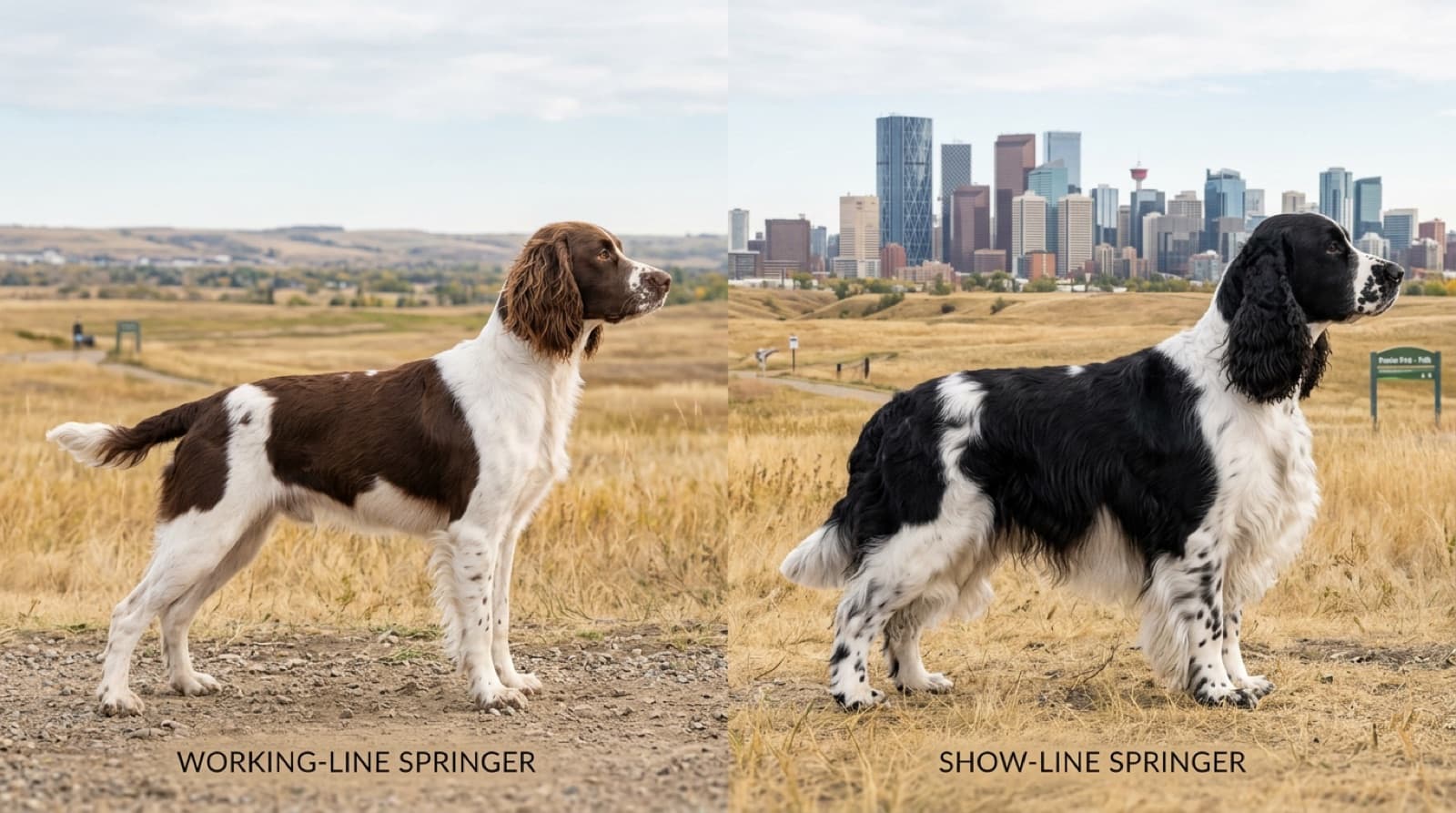
The historical split: how one breed became two
The English Springer Spaniel was a single working breed through most of its history. Field spaniels and cocker spaniels were sorted out into separate breeds in the late 1800s, and the Springer settled in as a flushing dog used to push upland birds out of cover for hunters with shotguns. For decades, every Springer was bred for hunting work.
The split happened in the mid-20th century. As dog shows grew in popularity, conformation breeders in the UK and US began selecting Springers for appearance: heavier bone, longer ear leather, fuller coat, more compact build. Field breeders kept selecting for performance: leaner athletes, lighter feathering, sustained running stamina, sharper scenting and retrieve instinct. Over 50 to 70 years of separate selection, the two populations diverged enough that an experienced Springer person can tell them apart on sight.
Both the Canadian Kennel Club and the American Kennel Club still register both lines as one breed under a single conformation standard. Neither kennel club has formally split them. In practice, ethical breeders specialise. A field breeder produces working-line dogs and titles them in hunt tests and field trials. A show breeder produces show-line dogs and titles them in conformation. Cross-breeding between the two lines is uncommon among serious breeders, and pet-bred Springers (the kind most likely to land in Calgary rescue) often carry mixed pedigrees with show-line conformation and varying levels of working-line drive.
The result is that English Springer Spaniel is, functionally, one breed name covering two different dogs. The Calgary adopter who understands this picks better.
Visual differences: how to tell them apart
The line shows in the body. Once you have seen a few of each, the visual split is usually clear within seconds.
| Trait | Working / Field Line | Show / Bench Line |
|---|---|---|
| Build | Lean, lighter-boned, athletic | Heavier-boned, compact, blocky |
| Weight (adult) | 35 to 45 lbs | 45 to 55 lbs |
| Ear length | Shorter, sits closer to head | Longer, often past the nose |
| Feathering (legs, chest, tail) | Light, easy-care | Full, requires regular grooming |
| Coat colour patterns | Often more white with smaller liver or black patches | More even patches, often heavier marking |
| Gait | Quick, ground-covering, low to ground | Showier, higher head carriage, more lift |
| Tail carriage | Active, often docked shorter, sweeps low | Higher set, often docked at show standard length |
Docking practices vary. Tail docking is illegal in some Canadian provinces and discouraged by the Canadian Veterinary Medical Association. Many Calgary Springers carry undocked tails regardless of line. Do not use docking as a primary line indicator.
For a rescue Springer of unknown origin, the best single visual cue is the combination of bone weight and ear length. A lean Springer with shorter ears is almost certainly working line or a working-leaning cross. A heavier dog with long ears that brush past the nose tip is almost certainly show line. The middle of the bell curve, where most pet-bred crosses live, is harder to call from looks alone.
Energy and exercise: the practical difference
Energy is where the two lines diverge most visibly in daily life. The minutes-per-day numbers below assume a healthy adult dog in moderate Calgary weather. Puppies, seniors, and dogs in winter need adjusted plans.
Working line: 90+ minutes per day of structured exercise. Off-leash running on safe terrain, fetch in long repeated sets, swimming, hunt-style retrieve drills with dummies in long grass, or bike-joring along the Bow River pathway. A leashed neighbourhood walk does not count toward this target. Working-line Springers without sustained outdoor running default to indoor destruction within weeks. The breed was selected for an ability to flush birds for 4 to 6 hours at a stretch; a 60-minute leashed walk does not begin to match that biology.
Show line: 60 to 75 minutes per day of moderate exercise. A long off-leash romp at Bowmont or Edworthy in the morning plus a couple of shorter neighbourhood walks usually satisfies a show-line Springer. Most show-line dogs settle into family life with manageable exercise demand and a clear off-switch indoors. They still need real outdoor time, but they do not require the field-style structured outlet the working line does.
What counts for both lines:
- Off-leash running at Calgary off-leash parks (Nose Hill, Bowmont, Fish Creek, Edworthy, Sandy Beach, Tom Campbell's Hill).
- Swimming at Sandy Beach or the Elbow River off-leash access points in summer.
- Retrieve games with a Chuckit or training bumper.
- Structured nose-work and scent-hide games (matches the breed's scenting drive).
For working-line dogs specifically, add hunt-test prep or NAVHDA Natural Ability entry. The North American Versatile Hunting Dog Association runs Natural Ability tests starting at 9 to 16 months of age. Two NAVHDA chapters operate in Alberta and run spring and fall tests. Even Calgary owners who never plan to hunt benefit from running Natural Ability with a working-line Springer because the structured outlet matches the breed's biological needs.
Calgary winter complicates both lines. Springers have moderate double coats and tolerate cold better than short-coated breeds, but deep cold below -20 Celsius still requires shortened outdoor sessions plus indoor enrichment. Pup City Pup Academy and Raising Canine both run winter-friendly group classes that absorb some of the indoor exercise load through January and February.
Trainability: similar foundation, different ceiling
Both lines are biddable, intelligent, and food-motivated. The Springer is a force-free trainer's favourite for a reason: dogs of both lines offer behaviours readily, learn fast, and bond strongly to a consistent handler. The differences show up at the upper end of training, not at the basics.
Working line trainability: Higher ceiling, higher drive, faster to plateau on basic commands and faster to want more challenge. A working-line Springer that gets stuck on the same five sits all year stops engaging. These dogs reward owners who keep adding complexity: scent discrimination, blind retrieves, sustained heel work in distraction, NAVHDA Utility prep. They also have stronger prey drive, which means recall around Calgary park wildlife (rabbits, ground-nesting birds, squirrels, deer) takes a longer, more structured long-line protocol than the show line typically needs.
Show line trainability: Excellent at standard family-companion expectations. Sit, down, stay, polite leash, recall at moderate distraction, crate skills, settle-on-mat. These build up over a normal puppy-class-plus-intermediate sequence and stick. Show-line Springers usually develop reliable recall faster than working-line dogs because the prey drive is milder. They also tend to settle into a calmer indoor off-switch with less explicit training.
For both lines, force-free protocols work exceptionally well. Avoid balanced trainers who lead with prong collars or e-collar corrections for either line; the breed responds far better to high-rate food reinforcement and clear marker-cue work. Calgary force-free trainers (Raising Canine, Pup City Pup Academy) run continuous group classes that work well for the breed through adolescence.
The American Veterinary Society of Animal Behaviour has a clear position statement on punishment-based training that is worth reading before adding any aversive tool to a Springer's training plan.
Temperament: the personality split
Both lines share the friendly, people-oriented, soft-tempered Springer baseline. Springers are velcro dogs in both lines; they bond hard to their primary handler and prefer to be in the same room. The differences show up in intensity, focus, and prey response.
Working line temperament: More intense, more focused, more prey-driven. A working-line Springer locks on to a scent or movement faster and harder. Around children, working-line dogs are usually still affectionate and tolerant, but they have less patience for chaotic toddler energy and benefit from clear management. Some working-line pedigrees, particularly older UK lines, carry a tendency toward fear-based reactivity (spook tendency) when poorly socialized; modern breeders screen carefully against this and the trait is uncommon in current dogs.
Show line temperament: Calmer, more family-bonded, milder prey response. Show-line Springers are typically the better fit for households with young kids, multiple cats, or chaotic schedules. They still flush a rabbit if one bolts in front of them, but the recovery is faster and the chase commitment is lower. Show-line dogs are also more tolerant of being left alone for moderate work-day stretches when properly conditioned.
One temperament factor worth naming honestly: full ear feathering can hide subtle ear-pinning and stress signals. A heavily feathered show-line Springer is harder to read at first glance than a working-line dog with shorter ears. New owners benefit from spending time learning what the dog's base relaxed expression looks like so that stress signals (whale-eye, lip licking, soft ear pin) are visible despite the coat.
For both lines, early socialization between 8 and 16 weeks is critical. The Springer is friendly by default, but a Springer puppy that misses socialization windows can develop adult reactivity that is hard to unwind. Calgary puppy classes through Raising Canine, Pup City Pup Academy, or your veterinary clinic's recommended trainer are worth the investment.
Grooming: the coat workload difference
Coat is the most predictable line-difference. Working-line Springers are an easier grooming commitment by a meaningful margin.
Working line grooming routine:
- Weekly home brushing with a slicker brush and a comb through the lighter chest, leg, and ear feathering.
- Bath every 4 to 6 weeks or after muddy off-leash sessions.
- Ear cleaning every 1 to 2 weeks (Springer ear conformation traps moisture regardless of line; both lines need consistent ear care).
- Nail trim every 3 to 4 weeks.
- Professional grooming optional; many working-line owners maintain coats entirely at home.
Show line grooming routine:
- Twice-weekly home brushing through fuller chest, belly, leg, and tail feathering.
- Bath every 3 to 4 weeks.
- Ear cleaning every 1 to 2 weeks; ears require extra attention because longer leather traps more moisture.
- Nail trim every 3 to 4 weeks.
- Professional grooming every 6 to 8 weeks at $75 to $110 per session in Calgary. The pro handles deep coat conditioning, sanitary trim, ear-feather tidy, and feet feathering.
Annual grooming cost difference: a working-line Springer maintained at home runs roughly $50 to $150 per year in shampoo, brushes, and ear cleaner. A show-line Springer with regular professional grooming runs $600 to $900 per year on the grooming side. The difference is meaningful in a multi-year budget.
Both lines shed moderately. Springers blow coat twice a year (spring and fall), and the shed weeks require daily brushing for both lines. Springer hair is fine and sticks to fabric; expect to vacuum more often than a typical dog household and accept that black work pants will collect Springer hair year-round.
Calgary fit: matching the line to the household
The household-fit decision is the practical heart of this guide. Both lines can succeed in Calgary; the question is which fits your specific household.
Working line fits best in:
- Active outdoor Calgary households with at least one daily off-leash session.
- Hunting or hunt-test households (upland bird hunters in Alberta, NAVHDA chapter members).
- Households with a fenced yard near a major off-leash park (NW for Nose Hill/Bowmont, SW for Sandy Beach/Edworthy, S for Fish Creek).
- Owners experienced with sporting breeds and comfortable with high-drive dogs.
- Households without very young children (under 5), or families with structured management for kid-dog interactions.
Show line fits best in:
- Most Calgary family households with kids of any age.
- Suburban or urban households with regular off-leash access plus daily walks.
- Apartments with a committed exercise routine (60 to 75 minutes daily plus enrichment).
- First-time dog owners who chose a Springer for the friendly companion temperament.
- Households with cats or other small pets (milder prey drive than working line).
Neither line fits well in:
- Households where the dog will be alone 9+ hours a day on weekdays with no daycare. Both lines are velcro dogs and develop separation anxiety in extended isolation.
- Households unwilling to commit to weekly grooming (show line) or daily off-leash exercise (working line).
- Households expecting a low-maintenance dog. Springers, both lines, are higher-maintenance than the friendly reputation suggests at first read.
Most Calgary Springer adopters do well with the show line. Working-line Springers are the right dog for a smaller, more specific audience.
Springer Rage Syndrome: rare but worth knowing about
Any unexplained aggression, sudden personality change, or seizure-like episode in a Springer requires immediate veterinary evaluation. This is a veterinary diagnosis question, not an internet diagnosis question. Calgary veterinary behaviourists can assess whether the pattern is medical, behavioural, or both.
Springer Rage Syndrome is a rare neurological condition documented primarily in old show-line UK pedigrees from the 1970s and 1980s. Affected dogs show sudden, unprovoked aggression episodes that the dog appears unaware of afterward, sometimes linked to seizure-like activity. The most commonly cited research is from work done at Cambridge veterinary school in the 1980s.
Modern ethical breeders screen their lines and the condition is uncommon in current pedigrees. Most Calgary adopters will never encounter it. The reason it earns a mention in this guide is that the syndrome was concentrated in show-line UK pedigrees specifically, which makes it a line-relevant topic rather than a generic Springer warning.
What to watch for:
- Sudden aggression episodes with no clear trigger.
- The dog appearing disoriented or unaware after the episode.
- Episodes that look more like a neurological event than a reactive event (fixed stare, sudden onset, post-episode confusion).
- Any combination of behavioural changes with possible seizure activity (eye flickering, brief absences, drooling).
If your Springer shows any of this, book a veterinary behaviour consult immediately. Calgary veterinary behaviourists at Western Veterinary Specialist Centre or VCA Canada West can evaluate the pattern, rule out medical causes (epilepsy, thyroid issues, brain tumours), and design a management or treatment plan if needed. Do not attempt to manage suspected rage syndrome through training alone. Discuss any medication path with your vet; this is not a do-it-yourself area.
The vast majority of Calgary Springers, both working and show line, never show anything like this. Most Springer aggression that owners worry about turns out to be ordinary fear-based reactivity that responds well to standard behaviour modification. The rage syndrome conversation is included here because it is a real (if rare) condition that has a documented line association, and because owners who hear the term from internet sources deserve a calm, accurate context.
Browse adoptable English Springer Spaniels in Calgary
Calgary rescues see both lines, with show-line and pet-bred Springers most common. Once you know which line fits your household, the rescue conversation becomes much clearer.
See Available Springers →How to identify the line of a rescue Springer
Most Calgary rescue Springers arrive without a registered pedigree. Working out the line from available clues takes a combination of visual assessment, surrender-story context, and observed behaviour.
Visual cues (most reliable single signal): Bone weight, ear length relative to muzzle, and feathering volume. A lean dog with shorter ears that sit at or above the muzzle level is almost certainly working line or working-leaning. A heavier dog with long ears that brush past the nose and full leg and chest feathering is almost certainly show line.
Surrender-story context: Ask the rescue what they know about origin. A surrender from a hunting household, a hunt-test community, or a Saskatchewan or Manitoba farm is usually working line. A surrender from a Calgary suburban pet home is usually show line or pet-bred cross. A surrender from a backyard breeder or puppy mill is usually pet-bred and unpredictable.
Observed behaviour during meet-and-greet: A working-line dog typically shows more focused intensity on smells, faster scenting transitions, and a more sustained interest in toys that move. A show-line dog typically shows more handler engagement, softer prey response, and a calmer baseline. Neither pattern is universal, but the tendency is real.
Pedigree paperwork: If the rescue has any paperwork, look for titles. Working pedigrees show hunt-test titles (NAVHDA NA, UPT, UT; AKC JH, SH, MH; field-champion titles). Show pedigrees show conformation titles (CKC CH, AKC CH, GCH, BIS). Most pet-bred Springers have neither.
For an adopted dog where the line is unclear, the safer assumption is to plan for working-line exercise needs and downgrade if the dog turns out to be calmer than expected. An under-exercised working-line Springer goes wrong fast. An over-exercised show-line Springer just gets a nice long romp.
The decision framework: which line for which household
The framework most Calgary rescue volunteers use when matching a Springer to a household reads like this:
- How much daily exercise can the household realistically deliver, year-round? If the honest answer is 60 to 75 minutes including off-leash access, point them at show-line dogs. If the honest answer is 90+ minutes including structured off-leash and field-style enrichment, working-line dogs are on the table.
- What is the household composition? Young children under 5, multiple cats, chaotic schedules favour show-line. Older kids, no small pets, structured routines work for either line.
- Where do they live and what is the off-leash access? Suburban house near Nose Hill, Bowmont, or Fish Creek with a fenced yard opens up working-line options. Inner-city apartment with limited fenced access narrows to show-line.
- What is the owner's dog-experience level? First-time dog owners default to show-line. Owners with sporting-breed experience (GSP, Vizsla, retriever, setter) can handle working-line.
- Are they willing to commit to the grooming? Show-line means weekly home brushing plus pro grooming every 6 to 8 weeks. Working-line is much lighter. Some Calgary households self-select out of show-line on the grooming question alone.
- Hunt-test or sport ambitions? A household that wants to run Natural Ability, dock diving, or upland hunting is a working-line household. A household that wants a friendly family companion is a show-line household.
For Calgary rescues with mixed-pedigree dogs, the energy and drive of the specific dog matters more than the abstract line label. A rescue volunteer who has lived with the dog for two weeks in foster has a better read on what the dog actually needs than the pedigree paperwork (or lack of it) suggests.
Both lines are wonderful dogs in the right households. The Calgary adopters who do best with Springers spend their first conversation with the rescue on line and energy questions, not on coat colour or name.
Frequently Asked Questions
How can I tell if a Springer is working line or show line?
Working-line (field-bred) Springers tend to be leaner, lighter-boned, with shorter ears, less feathering on the legs and chest, and a more athletic gait. Show-line (bench-bred) Springers are heavier-boned, with longer ears that often reach past the nose, fuller feathering, and a more compact, blocky build. Pedigree paperwork is the most reliable signal: a working pedigree shows hunt-test or field-trial titles (NAVHDA, AKC field champion, Canadian field titles); a show pedigree shows conformation championships (CH, GCH, Best in Show). For a rescue Springer with unknown pedigree, ask the rescue what they know about origin, surrender reason, and previous lifestyle. A surrender from a hunting household is usually working line; a surrender from a pet home with no field background is usually show line or a pet-bred cross.
Are working and show line Springers the same breed officially?
Yes. Both the Canadian Kennel Club and the American Kennel Club register both lines as English Springer Spaniel and use a single breed standard. The standard does not formally split working from show. In practice, breeders have specialised for decades, and the two populations have diverged enough that experienced Springer people can usually tell them apart on sight. The English Springer Spaniel Club of Canada and the English Springer Spaniel Field Trial Association both acknowledge the split informally, and most ethical breeders breed within a line rather than crossing.
Which line is better for a first-time dog owner?
Show line, in most cases. The show-bred Springer is calmer, has lower prey drive, and runs at a moderate-companion energy level that suits first-time owners with a daily-walk routine. The working line is a high-drive sporting dog that needs experienced handling, a recall plan, and 90+ minutes of structured exercise daily. A first-time owner who falls in love with the working-line look without understanding the energy demand is the most common Springer surrender pattern Calgary rescues see. Match the line to the household before falling in love with a specific dog.
Can a working-line Springer live in a Calgary apartment?
It is possible but hard. The working line was bred to range ahead of a hunter and flush birds for hours at a stretch. Apartment living without a fenced yard requires two structured daily outings of 45+ minutes each, weekday daycare, and aggressive indoor enrichment. Most Calgary working-line Springers thrive in suburban houses with backyards near Nose Hill, Bowmont, Fish Creek, or Edworthy. A show-line Springer adapts to apartment life much more easily on 60 to 75 minutes of daily exercise plus a couple of shorter walks.
Can a show-line Springer hunt or run hunt tests?
Yes, with caveats. Show-line Springers retain natural retrieve and scenting instinct and can enter NAVHDA Natural Ability or AKC hunt tests at entry levels. They will not match the drive, range, or stamina of a working-line dog at higher test levels (Utility, Master Hunter). For a Calgary family wanting a dog that can do casual upland walks and a few weekend hunt-test entries, a show-line Springer is a reasonable fit. For serious field competition or a full season of upland hunting, a working-line dog is the right choice.
How different is the grooming workload between the two lines?
Meaningfully different. Working-line Springers have lighter feathering on the chest, legs, ears, and tail, and most owners get away with a weekly home brushing and a bath every 4 to 6 weeks. Show-line Springers have fuller feathering, longer ear leather that traps moisture and ear-canal debris, and most need weekly home brushing plus a professional grooming every 6 to 8 weeks ($75 to $110 per session in Calgary). Ear cleaning every 1 to 2 weeks is required for both lines because Springer ear conformation traps moisture regardless of feathering volume. Talk to your vet if you see persistent ear odour, head shaking, or scratching.
What is Springer Rage Syndrome and should I be worried?
Springer Rage Syndrome is a rare neurological condition documented primarily in old show-line UK pedigrees from the 1970s and 1980s. Affected dogs show sudden, unprovoked aggression episodes that the dog appears unaware of afterward, sometimes linked to seizure-like activity. Modern ethical breeders screen their lines and the condition is uncommon in current pedigrees. If your Springer shows any unexplained aggression, sudden personality changes, or behaviour that looks neurological rather than reactive, book a veterinary behaviour consult immediately. Do not try to manage this without professional help. Calgary veterinary behaviourists can evaluate whether the pattern is medical, behavioural, or both. This is a veterinary diagnosis question, not an internet diagnosis question.
Can the two lines be crossed?
They can be, and pet-bred crosses are common. A working-show cross sometimes produces a moderate-energy dog that looks somewhere between the two lines. Pet breeders without pedigree records often produce dogs of mixed origin without realising it. The trade-off is unpredictability: the puppy may inherit the working-line drive in a show-line body, or vice versa. For Calgary adopters from rescue, most surrendered Springers are pet-bred crosses with some working-line influence. Working with the rescue to understand the dog’s actual energy and drive matters more than the pedigree label.
Which line is more common in Calgary rescues?
Pet-bred and show-line Springers dominate Calgary surrenders. True working-line dogs from hunt-test breeders rarely reach rescue because hunting communities tend to rehome within the network. The Springers that arrive at AARCS, Pawsitive Match, or other Calgary rescues are typically pet-bred dogs with show-line conformation and varying levels of working-line drive. This is part of why the line conversation matters: a Springer surrendered for being "too much dog" in a pet home may have more working-line influence than the family realised.
Will the two lines diverge into separate breeds eventually?
In the UK, the working and show populations have diverged so far that some breeders informally treat them as separate. Formal separation would require kennel club action that neither the CKC nor AKC has signalled. For practical purposes, Calgary adopters should treat the two lines as functionally different dogs sharing one breed name, and pick the line that fits the household. The breed-club acknowledgement of the informal split is enough to guide adoption decisions today.
Adoptable Springers in Calgary
Live listings of English Springer Spaniels from the Calgary rescue network, updated regularly.
Springer Adoption Calgary
Rescue sources, real adoption costs, surrender patterns, and breeder verification for Calgary Springer adopters.
English Springer Spaniel Health Issues
English Springer Spaniel health issues to plan for: ear infections, PRA and glaucoma, PFK deficiency, epilepsy and hip dysplasia, and what to ask your vet.
Golden Retrievers in Calgary
Another friendly active family breed. Useful comparison if you are weighing a Springer against a retriever for your household.
New dog? Start with these care guides
Everything a new adopter needs to set up a safe, happy home.