The honest version most websites will not give you
Greyhounds are gentle, calm, and famously easy. They are also sighthounds bred for centuries to chase small running animals to the death. Both things are true at once. The result is a breed where individual variation in prey drive is the single biggest factor in family fit. Some Greyhounds can share a couch with a kitten; some will kill a cat through a window screen if given the chance. The reputation does not predict the dog. Only the rescue's assessment of that specific Greyhound does. This guide replaces wishful thinking with the real protocol: the five levels of cat compatibility, why “cat-tested” is a screening bar not a forecast, sleep startle around toddlers, the small dog risk most articles ignore, and the Calgary rescue policies that exist because too many placements failed.
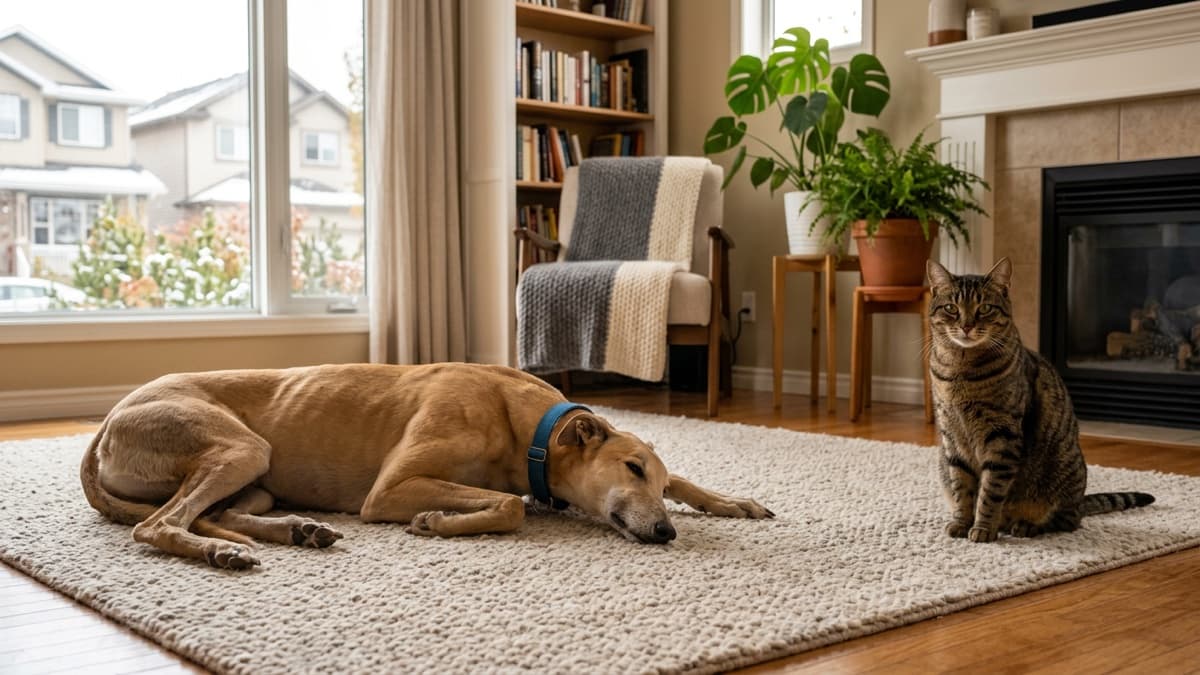
Prey Drive: The Centerpiece You Cannot Skip
Greyhounds were bred to chase. Hares, foxes, small game. That instinct lives at different intensities in every dog you meet, from nearly absent to extremely strong. Honest framing:
- Wide individual variation. Littermates can sit at opposite ends of the spectrum. Breed reputation does not predict the dog.
- Track training amplifies it. Retired racers spent the start of their lives chasing a mechanical lure. The chase reflex is rehearsed thousands of times.
- Sight triggers more than smell. A still cat may be fine. A running cat may flip the same dog into chase mode within a heartbeat.
- Never assume safety based on calm appearance. A Greyhound can lounge calmly beside a cat for weeks and then chase one outside through a window.
The rescue's assessment of the individual dog is the only reliable signal. The Northwest Canadian Greyhound League (NCGL) is the regional gold standard for this and labels every dog on a clear compatibility scale.
The 5 Levels of Cat Compatibility in Greyhounds
NCGL and other Greyhound-specific rescues use a spectrum like this when describing how a dog responds to cats. Learn the language; it will help you read foster reports correctly.
1. Cat-safe
Calm and uninterested around any cat. Soft body language, no fixation, no chase response even when the cat moves. Rare. Can live with cats with normal household routines and standard introduction.
2. Cat-workable
Fine with calm cats they live with, especially after a slow introduction. May still trigger on a running cat outside or a strange cat in the yard. Suitable for cat homes with permanent supervision and baby-gate management when nobody is home.
3. Cat-curious
Interested in cats but manageable with training. Will stare, follow with eyes, sometimes step toward the cat. Settles with consistent redirection. Possible in a cat home with experienced handlers, ongoing training, and high vigilance for at least the first six months.
4. Cat-tolerant
Can share space with a cat only under constant supervision and strict routine. Without management, the chase response surfaces. Most rescues will not place these dogs with cats; if they do, it is foster-to-adopt only with experienced multi-pet handlers.
5. Cat-aggressive (cat-unsafe)
Fixates, stalks, lunges, will attempt to catch and kill. No amount of training fixes this. The rescue will not place with cats, indoor or outdoor, and will screen out applications from cat-owning homes. Honest disclosure protects the cat and the dog.
When a Calgary rescue lists a Greyhound as cat-safe or cat-workable, that label is the result of structured testing and foster observation. It is earned. Trust it.
What “Cat-Tested” Actually Means
A cat test is a screening bar, not a forecast. NCGL cat-tests rigorously, sometimes across multiple sessions. A typical test looks like this:
- Setting. Indoor, controlled, the rescue's home environment. Calm, confident resident cat. Greyhound on leash.
- Duration. A few minutes to half an hour. Sometimes repeated days later to confirm the response.
- Pass criteria. No fixation, no lunging, no whining at the cat, no sustained chase impulse. Soft body, relaxed tail, can disengage on cue.
- Fail criteria. Hard stare, locked body, leash tension toward the cat, vocalization, repeated forward movement.
What the test tells you: this dog cleared the screening bar that high-prey-drive Greyhounds do not clear. What it does not tell you:
- How the dog will behave with your specific cat over months in your home.
- How the dog will react to a strange outdoor cat or a fast-moving kitten.
- Whether the dog will stay safe if a routine changes (new baby, new schedule, illness).
Run a multi-week home introduction even with a cat-tested dog. The test gets you to the start line. The protocol gets you to safe cohabitation.
Greyhounds with Kids: Compatibility by Age
| Kid age | Greyhound compatibility | Primary risk |
|---|---|---|
| 0 to 2 years (babies) | Most Calgary rescues will not place a retired racer here. Long-term pet Greyhounds with kid history are case-by-case. | Sleep startle. Baby on the floor near a resting dog is the highest-risk scenario. |
| 3 to 7 years (toddlers/preschool) | Most Calgary Greyhound rescues require kids 8+ for placement. Some make exceptions for proven dogs with foster verification. | Sleep startle plus unpredictable child behaviour around a resting dog. |
| 8 to 12 years | Common placement age. School-age kids who follow the rules pair well with the breed's gentle, low-arousal nature. | Light. Active supervision and clear rules. Kid trained on dog body language. |
| 13 to 17 years (teens) | Excellent fit. Greyhounds are quiet, affectionate, and content alongside calm teens. | Light. Teen can handle daily walks with adult backstop. |
| 18+ (adults only) | Most rescue placements. Newly-retired racers especially. | Standard adult dog management. |
The single most-important rule: never leave a Greyhound unsupervised with any toddler, regardless of how gentle the dog seems. Sleep startle is the specific breed risk, and toddlers are the specific trigger group.
Sleep Startle: The Breed-Specific Risk You Must Plan For
Greyhounds sleep with their eyes open. They can look awake when they are deeply asleep. They came from a kennel-life environment where many dogs slept side by side, learning to defend their tiny patch of space with a snap before fully waking. The carryover into a pet home is real. Sometimes called sleep aggression or “alligator-rolling,” the pattern looks like this:
- The trigger. The dog is asleep on a bed or couch. Someone touches it, leans on it, or falls onto it.
- The response. A reflexive snap or air-snap before the dog is fully conscious.
- Recovery. Within seconds the dog is calm and apologetic. The dog did not choose to do it; it was a kennel-life reflex.
- Risk group. Toddlers and young kids who do not understand to leave a sleeping dog alone. Adults who lean over a sleeping dog without speaking first.
This is the biggest reason most Calgary Greyhound rescues require kids 8+. It is not aggression. It is a wiring issue that the family has to manage with rules and environment. Management plan:
- Bed in a quiet adult zone. Not in the toddler's play area, not in a high-traffic hallway. A dedicated dog bed or crate the kids cannot reach.
- Strict “sleeping dog is off-limits” rule. Every kid old enough to walk learns this rule before they touch the dog.
- Wake from a distance. Adults call the dog's name before touching. Always.
- No sharing beds or couches with kids under 8. The risk is not worth the snuggle.
Greyhounds with Small Dogs: The Hidden Risk
Most articles cover cats and skip this. Small dogs are arguably the higher-risk household variable. Why:
- Toy breeds trigger chase response. A Chihuahua, Yorkie, Pomeranian, Maltese, or Min Pin running across a yard looks like prey to a Greyhound who has never lived with small dogs. Calm cohabitation indoors does not guarantee outdoor safety.
- Size disparity is severe. A 70 pound Greyhound and a 7 pound Yorkie. Any impulse-grab or correction-bite can be fatal.
- Breed reputation does not predict. Some retired racers live happily with small dogs they meet as adults. Many cannot.
- Greyhound plus Yorkie household is high risk. Greyhound-specific rescues will not place if the small dog is under 10 pounds without rigorous foster verification.
Ask the rescue directly: has this dog been small-dog tested, what was observed, and is there a foster who can speak to it? Honest answers matter more than generalizations.
Greyhounds with Other Dogs and Multi-Greyhound Homes
A few patterns to know:
1. Leash reactivity is common, not aggression
Retired racers often pull and vocalize at other dogs on leash. The pattern is residue from kennel arousal at the track, where excited dogs anticipated racing. Force-free counter-conditioning, distance work, and focus games reduce it over weeks to months. The same dog is often calm off-leash with the right friends.
2. Greyhound plus Greyhound usually works
Greyhounds tolerate each other well. They grew up in packs of similar dogs. Two Greyhounds in one home is one of the easier multi-dog configurations, often easier than a Greyhound plus a different breed of similar size.
3. Mixed-breed pairings vary
Greyhound plus Labrador, Greyhound plus Golden, Greyhound plus mid-size mutt: usually fine with normal introduction. Greyhound plus high-arousal breed (Husky, Malinois, Border Collie) can be friction. Greyhound plus small dog: see the section above.
4. Resident-dog confidence matters
A confident resident dog of the right size sets the tone faster than a nervous one. If your current dog is shy or insecure, plan a slower introduction with neutral-territory walks first.
Multi-Week Cat Introduction Protocol
Standard rescue-recommended protocol. Plan for 4 to 10 weeks. Slow is fast: the homes that rush are the ones that fail.
1. Full separation + scent swap
Different rooms, closed doors. Feed on opposite sides of the same door so each animal links the other's scent to food. Rotate bedding and toys so each carries the other's scent.
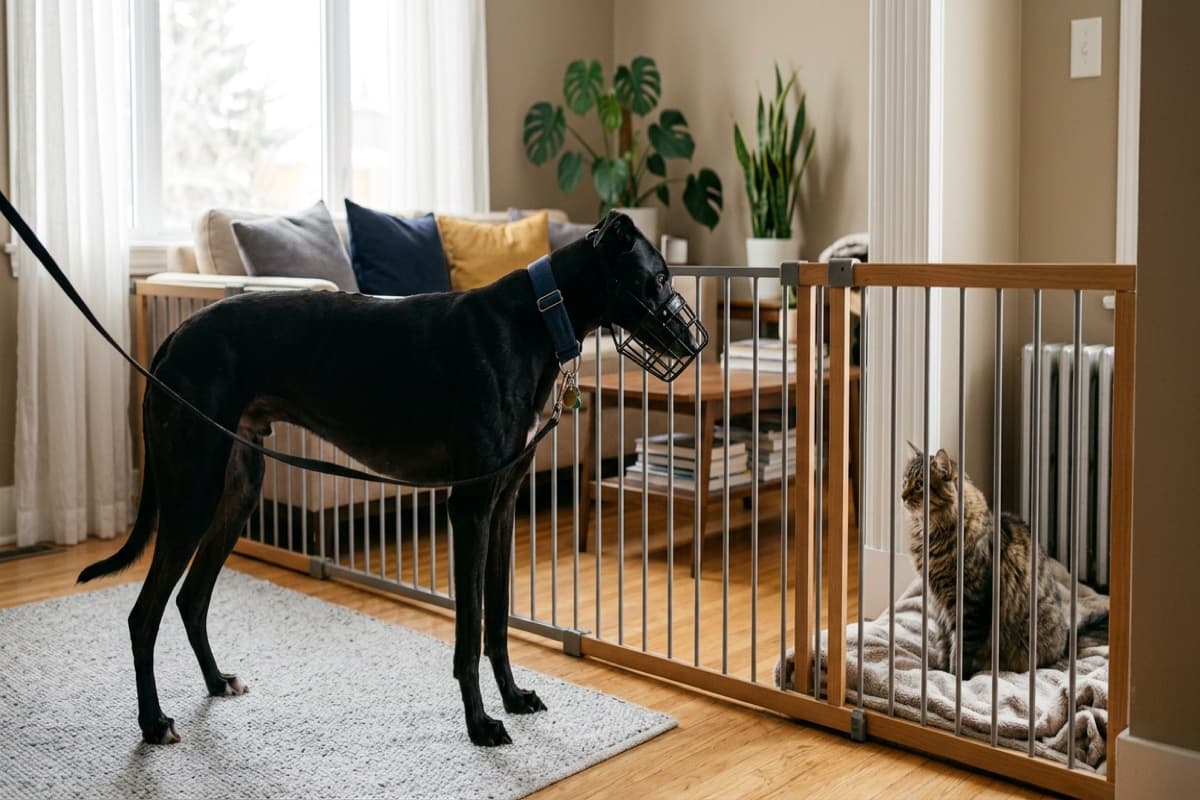
2. Visual contact through gates
Baby gate or screen door. Both can see but cannot touch. The cat has reliable escape routes (cat tree, high shelves). Reward the dog for calm, no-fixation behaviour with treats and praise.
3. Leashed parallel time
Dog on leash, cat free to approach or leave. Start with 5 minute sessions, end on calm. Build duration only if both animals stay relaxed. If the dog fixates or hard-stares, back up a step.
4. Longer leashed and dragline
Build to 30 minute sessions. Drop the leash but keep a dragline attached so you can grab control instantly. Cat should still have escape routes always available.
5. Supervised off-leash
Both free in shared rooms with handler directly present. Watch for pattern shifts; some Greyhounds settle further over time, some get more curious as they learn the cat's movements.
6. Gradual freedom, permanent management
Most Greyhound-cat households reach calm cohabitation by month 2 or 3. Most still use baby-gate separation when the family is out of the house. This is responsible long-term multi-pet life, not failure.
Most Calgary Greyhound placements into cat homes use foster-to-adopt. The dog spends 2 to 4 weeks in a home that mirrors yours before the adoption finalizes. If the introduction goes wrong, the dog returns to the rescue without a failed adoption on its record.
Dog-Respect Rules for Kids in a Greyhound Home
Every kid old enough to interact with the dog needs to know these rules. Adults teach them, reinforce them, and model them.
1. Never wake a sleeping dog
This is the cardinal rule with Greyhounds. Sleep startle is real. If the dog is on its bed, the couch, or anywhere with eyes closed (or open), it is off-limits. Adults call the dog's name from a distance before touching.
2. The dog bed is a sanctuary
No climbing onto the dog bed, no putting toys on it, no playing near it while the dog is resting. The bed exists so the dog has a guaranteed safe space when overwhelmed.
3. No hugging, no face contact, no leaning
Greyhounds tolerate plenty from their adults but rarely enjoy hugs from kids. No throwing arms around the dog, no kissing the dog on the face, no putting a face up to the dog when it is resting.
4. Never take food, toys, or chews
Kids do not approach the dog while it is eating or chewing. Resource guarding is uncommon in Greyhounds but real in some dogs. Do not test for it.
5. No riding, climbing, or rough handling
Greyhound bodies are lean and bony with thin skin. Even gentle wrestling can hurt them, and rough handling teaches the dog that kids are unpleasant.
6. Read body language together
Teach older kids the early warning signals: lip lick, head turn, freeze, whale eye. The dog rarely “snaps with no warning.” Kids who read the signals stay safe.
Bringing a Baby Home to a Resident Greyhound
Most resident dogs of any breed can adjust to a new baby with planning. With a Greyhound, the specific risk to plan around is sleep startle. Four-step protocol:
- Step 1. Scent introduction. Bring a blanket from the hospital home before the baby arrives. Let the dog smell it for several days. Pair the scent with calm praise and treats.
- Step 2. Classical conditioning. When the baby comes home, the dog gets good things every time the baby is present. Treats, calm attention, special chews. The dog learns baby = good.
- Step 3. Move the dog bed to a quiet adult zone. Not in the nursery, not in the toddler play area. A spot the crawling baby cannot reach. Sleep startle plus crawling baby is the worst-case scenario you must prevent.
- Step 4. Never unsupervised, never on shared furniture with the baby. A 70 pound Greyhound stepping off a couch onto a baby is a body-mass risk on top of the startle risk. Treat the couch and the dog bed as separate zones from the baby's space.
If your dog shows tension, withdrawal, or unusual stress when the baby arrives, contact a certified behaviour consultant immediately. The Pet Professional Guild lists Calgary-area force-free consultants who handle sighthounds well.
Browse adoptable Greyhounds in Calgary
NCGL is the regional Greyhound specialist and lists every dog with kid-tested, cat-tested, and small-dog notes. AARCS, BARCS, and Pawsitive Match occasionally have Greyhounds and Greyhound-mixes.
See Available Greyhounds →When NOT to Bring a Greyhound Home
If any of these describe your household right now, the right answer is to wait or look at a different breed:
- Toddler home expecting to share a bed or couch. Sleep startle plus toddlers on furniture is the single highest-risk scenario for this breed.
- Home with a cat and unwillingness to manage permanently. Even a cat-workable Greyhound needs baby-gate management when the family is out. If that sounds unsustainable, choose a low-prey-drive breed.
- Home with a small dog under 15 pounds. Many Greyhound rescues will not place. The size disparity makes a single impulse moment fatal.
- Renters in properties without secure fencing. Greyhounds are sprint specialists who cannot be off-leash in unfenced spaces. A privacy-fenced yard or reliable access to one is non-negotiable.
- Families who want a hiking partner who can do long off-leash trails. Greyhounds need on-leash or fenced exercise. They are sprinters, not endurance recall dogs.
- Owners who travel often and use casual daycare. Many daycares are not Greyhound-experienced. Thin skin and chase impulses around small dogs make group play tricky.
- Households not ready for a quiet, low-energy adult dog. Greyhounds are not playful in the Lab sense. If you wanted a dog who fetches and roughhouses, this is not the breed.
Frequently Asked Questions
Are Greyhounds good with cats?
Some are, some are not. Prey drive varies widely between dogs. Trust the rescue's individual assessment. A cat-safe Greyhound integrates well; a cat-aggressive Greyhound is not safe with cats at any age. NCGL labels every dog on a clear compatibility spectrum.
What does cat-tested actually mean?
The rescue exposed the dog to a calm indoor cat in a controlled setting and watched body language. A pass means no fixation or chase impulse in that window. It does not guarantee long-term safety with your specific cat. Run a full multi-week home introduction regardless.
Are Greyhounds good with kids?
Generally yes with school-age and older kids who respect the dog's space. Most Calgary rescues require kids 8+ for retired racer placement. Toddlers are a higher-risk group because of sleep startle, not aggression.
What is sleep startle?
A breed-typical defensive reaction when a sleeping Greyhound is touched or disturbed. The dog snaps or air-snaps before fully waking. It is a kennel-life reflex, not aggression. Manage with strict rules, a quiet bed location, and waking from a distance with the dog's name.
Can Greyhounds live with small dogs?
Sometimes. Toy breeds (Chihuahua, Yorkie, Pomeranian) can trigger a chase response. Size disparity makes any impulse moment severe. Many Greyhound rescues will not place with dogs under 15 pounds. Ask the rescue directly about small-dog testing before applying.
Why are Greyhounds leash reactive?
Carryover from kennel arousal at the track. Force-free counter-conditioning and distance work reduce it over weeks to months. The same dog is usually calm off-leash in fenced spaces with the right friends.
Bringing a baby home to a Greyhound?
Scent introduction, classical conditioning, move the dog bed away from baby zones, never share furniture with a baby on it. Sleep startle plus crawling baby is the specific risk to prevent.
Which Calgary rescues place Greyhounds?
The Northwest Canadian Greyhound League (NCGL) is the regional specialist. AARCS, BARCS, and Pawsitive Match occasionally have Greyhounds. Most placements use foster-to-adopt, kids 8+ minimum, with rigorous cat and small-dog testing.
More Greyhound guides
Greyhound Adoption Calgary →
Where to adopt, why puppies are rare, off-leash reality, and the Italian Greyhound distinction.
Is a Greyhound Right for You? →
Honest fit check covering lifestyle, fencing, climate, and the breed's couch-potato reality.
Off-Leash and Recall →
Why most Greyhounds never get reliable recall, and the fenced-yard alternative.
Temperament and Quirks →
Sleep startle, kennel-life carryover, and the gentle low-arousal default.
Greyhound Training Calgary →
Force-free training, leash reactivity work, and what retired racers already know.
First Weeks with a Retired Racer →
The decompression timeline from kennel life to home life. Day 1 to month 3.
Greyhound Health and Vet Guide →
Anesthesia sensitivity, dental care, and the bloodwork quirks every Calgary vet should know.
Feeding and Digestion →
Sensitive stomachs, food transitions, and the bloat-risk feeding routine.
New dog? Start with these care guides
Everything a new adopter needs to set up a safe, happy home.