The honest version
Greyhounds are smart but stubborn. They are trainable with force-free positive reinforcement and almost untrainable with anything else. Prong collars, e-collars, choke chains, leash pops, and alpha rolls backfire badly on a thin-skinned, sensitive breed. The dog shuts down, avoids eye contact, stops offering behaviour, and loses trust. Most ex-racers arrive already housebroken from kennel routine and walk well on lead. What they have never seen is a flight of stairs, a glass patio door, a mirror, or a reflection in a dark window at night. The first weeks home are part training and part introducing a kennel dog to house life. This guide covers what works, what damages greyhounds, and the Calgary trainers worth your time.
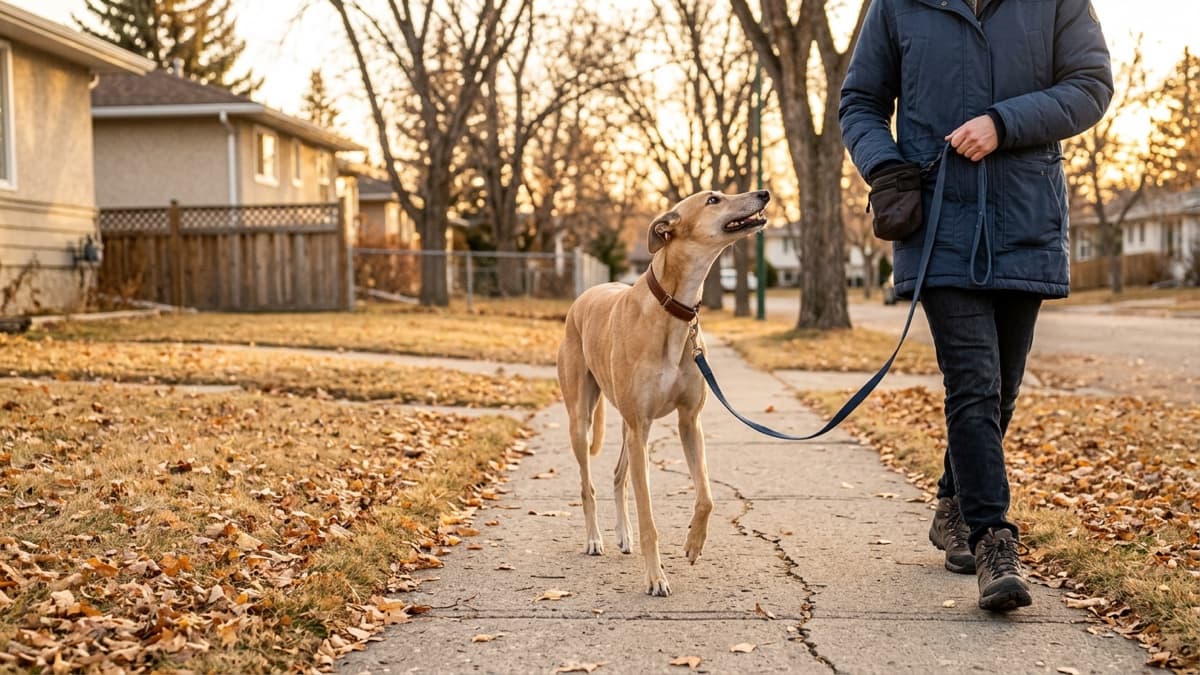
Are They Easy or Hard to Train?
Neither. Greyhounds are different. The breed was selected for generations to chase prey on sight and to run faster than anything else. They were not selected to take direction from a person at a distance. Hounds in general (sighthounds and scenthounds) are independent decision-makers. That is a feature for hunting and a quirk for pet life.
What this means in practice: greyhounds will learn anything you teach with the right approach, but they will not perform for you the way a Border Collie or Golden Retriever performs for their handler. They work for clear rewards, not for praise alone. They tune out cues they have learned to ignore. They prioritize sleep, food, and prey over obedience drills.
Plan for short, frequent training sessions. Pay generously. Build a routine the dog can predict. Avoid pressure. Most owners get reliable house manners within the first month and decent obedience around the home within 3 to 6 months. Off-leash recall is the long project and never reaches dog-park reliability.
Why Force-Free Is the Only Method That Works
Greyhounds are physically and emotionally thin-skinned. Their skin is literally thinner than most breeds (vets call them “paper-skinned”) and their nervous system matches. Aversive training tools cause real damage:
- Prong collars can puncture the thin neck skin and cause neck trauma. The breed's long delicate neck is physically vulnerable.
- E-collars destroy the trust foundation greyhounds need. A startled greyhound bolts; an e-shock during a bolt creates an even more reactive dog.
- Choke chains on a long thin neck cause windpipe damage. Avoid entirely.
- Leash pops and yelling produce shut-down behaviour, not learning. The dog goes quiet, avoids eye contact, stops offering behaviours.
- Alpha rolls and dominance theory are debunked across every modern veterinary behaviour body. With a sensitive breed they actively create fear-based reactivity.
Force-free positive reinforcement works the opposite way. Reward the dog for what you want with high-value treats (chicken, cheese, hot dog, freeze-dried liver). Remove reinforcement from what you do not want by turning away, ending the session, or managing the environment so the unwanted behaviour cannot practice. Greyhounds respond fast to food and slow to pressure. The math is one-way.
If any trainer in Calgary recommends a prong, e-collar, or choke chain on a greyhound, leave the session.
Basic Commands: Priority Order
1. Name recognition
The foundation. Many ex-racers have a track name they barely respond to. Say the dog's new name, wait for any head turn or eye contact, mark and reward immediately. Practice 20 to 30 reps a day for the first week. Name recognition is the cue every other cue rests on.
2. Sit (yes, greyhounds can sit)
Most greyhounds do not sit naturally because their muscle and skeletal build favours standing or lying down. Sit is still teachable. Use a treat lure above the head, mark the moment the rear touches the ground even briefly, reward. Train on a padded surface. Never push on the rear. Some greyhounds prefer down over sit; that is fine. Down is a more comfortable default for the breed.
3. Come (recall, fenced areas only)
Train recall in your living room first. Then yard. Then long-line in a fenced park. Pay every recall with chicken or cheese. Never punish a slow return. Recall in greyhounds is a fun and safety tool inside fences, not a permission slip for off-leash walks. See the recall section below.
4. Stay
Most greyhounds default to lying down on their bed, which makes stay easy. Build duration in 5-second steps to 2 minutes, then 5, then 10. Add distance second, distractions last. Useful at the front door, vet office, and during meal prep.
5. Leave it
Critical safety cue. Greyhounds notice movement before sound. A squirrel, a chicken bone on the sidewalk, a moving cat. Train with two treats in two hands. Closed hand with low-value treat, open hand with high-value treat. The dog learns leaving the closed hand gets the better reward. Build to dropped food on the floor, then real-world distractions.
6. Down
Often easier than sit for a greyhound. Lure from a stand or sit to the floor with a treat. Many greyhounds offer down voluntarily because it is comfortable. Pair with a mat and you have a settle cue, the most useful command for a long-bodied dog who needs to learn where to park during dinner or guest visits.
Browse adoptable greyhounds in Calgary
Adult ex-racers come with basic kennel manners and a calm baseline. Foster temperament reports flag prey drive and sensitivity levels.
See Available Greyhounds →House-Training an Ex-Racer
Most ex-racers arrive already housebroken in the kennel sense. They learned to hold and to relieve themselves on a turn-out schedule at the track. The thing they have not learned is that the entire house is now “inside” and that “outside” means any door.
Plan for 1 to 2 weeks of teaching outside = bathroom. Take the dog out:
- First thing in the morning
- After every meal
- After every nap (greyhounds nap a lot, 16 to 20 hours a day)
- After play sessions
- Every 2 to 3 hours the first week
- Right before bed
Reward outdoor bathroom heavily the moment the dog finishes. Treats, praise, the whole party. Ignore indoor accidents in week 1, clean with enzyme cleaner, reset the schedule. Do not punish or scold. Punishment teaches the dog to hide bathroom behaviour, which is the opposite of what you want.
By week 2 or 3 most ex-racers have the routine. If accidents persist past 4 weeks, see a vet to rule out a UTI or stress incontinence and review crate/turn-out timing.
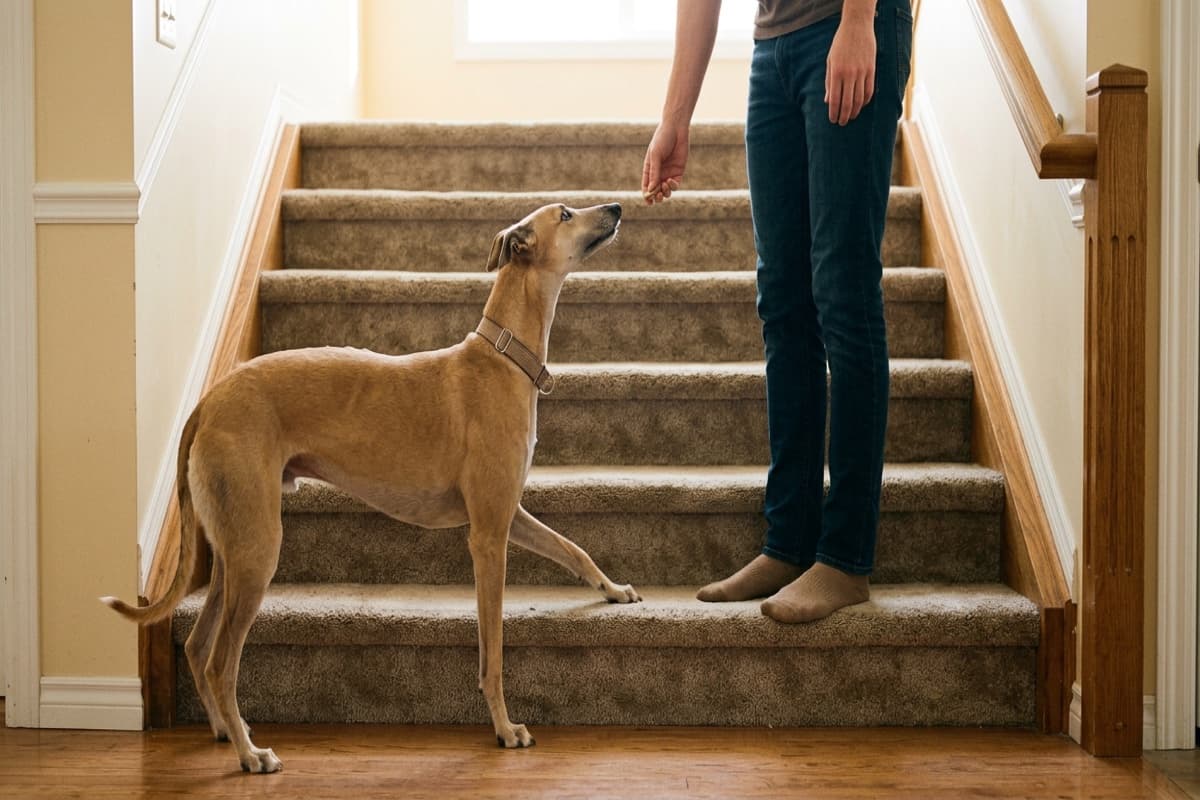
Stairs, Glass Doors, Mirrors, Reflections
Ex-racing kennels are usually single-level concrete with metal kennel runs and minimal household features. The first time a retired greyhound encounters house life, normal stuff looks alien.
Stairs
Many ex-racers have never seen stairs. The first encounter can look impossible. Use a ramp the first weeks if you have one or carry the dog if size permits. To teach stairs, start with 1 or 2 steps. Place treats on each step. Let the dog work at their own pace. Never drag or push. Most greyhounds learn full staircases within 2 to 6 weeks. Carpet feels safer than hardwood. Open-back stairs are the hardest. Add a non-slip runner.
Glass doors
Greyhounds have never seen glass. They walk into patio doors and sliding doors at full speed. Tape paper at nose level on the glass for the first few days. The dog learns the door is solid. Most catch on within a week. Some need longer. Open the door physically to let the dog through the first few times.
Mirrors
A greyhound seeing a mirror dog for the first time can be funny or stressful depending on the dog. Most ignore mirrors within a few days. If your dog gets stuck staring or reacting, cover the mirror for a week and reintroduce gradually.
Reflections in dark windows
At night, your windows reflect the room back at the dog. Many ex-racers spook at the reflected dog and lose sleep. Add a nightlight, close the blinds at dusk, or use frosted window film. Cheap fix, big quality-of-life improvement.
Leash Pulling and Loose-Leash Walking
Most retired racers walk well on lead because they were lead-trained from a young age at the track. Pulling usually comes from one of three sources:
- Excitement in the first weeks home. Calms down within a month.
- Prey sighting. A squirrel, rabbit, or cat triggers a forward lunge. Manage with route choice and high-value treats.
- Insufficient sniff time. A greyhound on a structured heel for 30 minutes pulls toward bushes. Add sniff breaks.
A front-clip Y-front harness fixes 90 percent of greyhound pulling. The harness redirects forward momentum to the side and disrupts the pull without applying pressure to the neck. Never use a prong, choke, or e-collar. The breed's long thin neck is physically vulnerable and the temperament is wrong for aversive equipment.
Reward the dog for walking near you with frequent small treats. Stop walking when the leash tightens. Resume when it loosens. Slow process, real results in 2 to 3 months. Calgary winter walks on icy sidewalks are easier with traction booties for the dog and ice grips on your own boots. Wind chill below minus 15 means a coat for the dog; greyhounds have minimal body fat and thin coats.
Recall: The Reality
Greyhound recall is never reliable enough for off-leash safety in open areas. This is the single most important sentence in this guide. Greyhounds reach 70 km/h in seconds and a moving prey item triggers a chase response that overrides any training. Open prairie, off-leash trails, river paths, and unfenced parks are not safe for a greyhound off lead, ever.
That said, recall is still worth training for three reasons:
- Inside fenced off-leash parks so you can call your dog back to leash up at the end of the session.
- In emergencies if a door gets left open or a leash drops, you have a chance instead of zero chance.
- For mental enrichment. Recall games inside a fenced yard are good brain work.
Train recall the same way you would for any breed: indoors first, then yard, then 15 to 30 foot long-line, then fenced parks. Pay every recall with chicken or cheese. Never call your greyhound off a scent or sighting without paying more than the prey is worth. Never punish a slow return.
Sue Higgins Off-Leash Park in southeast Calgary has perimeter fencing and works well for greyhound run sessions. NCGL, the national greyhound adoption network, recommends greyhounds remain on lead outside fully fenced spaces for life. Listen to them.
Crate or No Crate?
Most retired racers do not need a crate at home. They came from kennel-free home life in foster care or transition kennels with open runs. Once house manners are established, greyhounds tend to choose a couch or dog bed and stay there. The breed sleeps 16 to 20 hours a day and prefers soft surfaces over crates.
Some greyhounds prefer a crate as a den, especially during the first weeks home when everything else is new. If your dog seeks out small spaces or hides under tables, an open crate with the door removed gives them a den they can choose. Add a thick bed or blanket because the breed has no body fat to pad them.
Crate training a greyhound is the same as any breed: positive associations, feed meals inside, build up to closed-door brief periods, never use the crate as punishment. Max recommended crate time is 6 to 8 hours for an adult. If you need longer absences, set up a dog-proofed room instead.
Common greyhound training problems
Sleep startle. Some greyhounds startle and snap when woken suddenly. Not aggression. A leftover from kennel sleep patterns. Use a verbal cue (the dog's name) before touching a sleeping greyhound. Teach kids the same rule.
Counter-surfing. Long-bodied dogs reach kitchen counters easily. Clear counters during the training period. Teach “off,” reward floor-paws. Manage the environment while you train the alternative.
Resource guarding food or toys. Kennel-raised dogs may guard food bowls. Feed in a quiet space, do not reach into the bowl, trade up for high-value items. If guarding is severe, call a force-free behaviour consultant (CDBC, CSAT credentials).
Prey drive toward small dogs and cats. Some greyhounds chase anything small that moves. Many are cat-safe. Test before adopting (NCGL does temperament-test cat compatibility). On walks, manage with route choice and leave-it cue.
Separation anxiety. Ex-racers may have lived in groups and find solo life new. Build alone-time gradually from week 1. Pair short absences with frozen Kongs. Most adjust within 1 to 3 months.
Calgary Force-Free Trainers
Dogma Training
Multiple Calgary locations including Inglewood. Puppy classes, group obedience, private sessions, day training, behaviour modification. Strong reputation for sensitive breeds including greyhounds and other sighthounds.
ImPAWSible Possible
Northwest Calgary. Strong reactive-dog and sensitive-breed programs. Good for separation anxiety and resource guarding cases.
Calgary K-9 Force-Free
Force-free companion training. Strong with quiet, sensitive breeds. Good fit for first-time greyhound owners learning the basics.
Sit Happens Calgary
Group classes and private sessions. Patient instructors comfortable with breeds that need slow ramp-up.
Raising Fido
Owner-operated. Private and group classes. Individual attention works well for sensitive ex-racers.
Class costs in Calgary: 200 to 450 dollars for a 6-week group class. 80 to 200 dollars per hour for private sessions. Most trainers offer a free or low-cost intro consult.
AVOID: trainers using e-collars, prong collars, choke chains, dominance theory, or who describe themselves as “balanced.” Force-free credential signals: CCPDT, KPA-CTP, CDBC, PMCT.
Greyhound-specific resources: NCGL publishes training guides specifically for retired racers, including the first-weeks-home protocol and the sleep-startle awareness brief.
Frequently Asked Questions
Are greyhounds easy or hard to train?
Neither. Greyhounds are different. They were bred to chase prey, not to obey cues. They learn anything you teach with patience and high-value rewards but ignore cues they have learned mean nothing. House manners come fast, off-leash reliability never gets there.
Can greyhounds sit?
Yes. Most do not sit naturally because of their muscle and skeletal build, but the cue is teachable with treat lures and patience. Many greyhounds prefer down over sit. Down is a comfortable default for the breed.
Why force-free for greyhounds?
Greyhounds are thin-skinned and emotionally sensitive. Prong collars, e-collars, choke chains, and yelling produce shut-down behaviour and damage trust. The breed's long delicate neck is also physically vulnerable to aversive collars. Only force-free positive reinforcement works.
Can greyhounds be off leash?
No, never in open areas. They reach 70 km/h in seconds and a moving prey item overrides recall training. Off leash only in fully fenced spaces. NCGL recommends on-lead-for-life outside fences.
Are ex-racers house-trained?
Mostly yes, from kennel routine. Plan for 1 to 2 weeks of teaching outside = bathroom in a home environment. Take out every 2 to 3 hours, after meals, after naps, and reward outdoor bathroom heavily.
Why is my greyhound afraid of stairs?
Normal. Most ex-racers have never seen stairs. Use a ramp the first weeks, then teach 1 or 2 steps at a time with treats. Most learn within 2 to 6 weeks. Carpeted stairs feel safer than hardwood.
How do I stop leash pulling?
A front-clip Y-front harness fixes 90 percent of greyhound pulling. Never use prong, choke, or e-collars on the breed's thin neck. Reward walking near you, stop when the leash tightens, resume when it loosens.
Calgary force-free trainers?
Dogma, ImPAWSible Possible, Calgary K-9, Sit Happens, Raising Fido. Class costs 200 to 450 dollars for 6-week group, 80 to 200 dollars per hour private. Avoid “balanced” trainers.
More greyhound guides
Greyhound Adoption Calgary →
The full Calgary adoption playbook: NCGL, ex-racer pipeline, costs, what to expect.
Greyhound Off-Leash & Recall →
Why off-leash never works in open areas, fenced park options, the long-line protocol.
Ex-Racer First Weeks Home →
Decompression, kennel-to-house transition, the 3-3-3 rule applied to ex-racers.
Greyhound Temperament & Quirks →
Sleep startle, roaching, the 45-mph couch potato, what the breed is actually like.
Greyhound Separation Anxiety →
Kennel-to-solo transition, alone-time math, the prevention protocol.
Greyhounds with Kids & Cats →
Cat-safe testing, kid compatibility, multi-pet households.
Is a Greyhound Right for You? →
Honest truths and self-assessment for the breed.
Greyhound Health & Vet Guide →
Breed-specific health quirks, anesthesia sensitivity, Calgary vets familiar with sighthounds.
New dog? Start with these care guides
Everything a new adopter needs to set up a safe, happy home.