The honest version
Greyhounds look like an easy big breed. Adults are 55 to 80 lbs, quiet indoors, sleep 18 to 20 hours a day, and rarely bark. The catch is the specific needs that overwhelm new adopters. Greyhounds cannot be off-leash outside a fully fenced area because prey drive plus 45 mph sprint speed makes recall unreliable forever. They have almost no body fat and a thin coat, so a Calgary winter requires a real coat below -5C. They velcro to one person and the partner bonding gap is real for couples. Post-adoption anxiety hits most owners in weeks 2-6 and feels like buyer's remorse. It almost always lifts by month 3. Greyhounds are wonderful for apartment dwellers, retirees, single adopters, and anyone wanting a calm large breed. They are a poor fit for active outdoor families, toddler households, frequent travellers, and homes with cats or small dogs that have not been thoroughly tested through the rescue. This article catches the honest mismatches before you adopt.
10 Honest Questions to Ask Yourself Before Adopting a Greyhound
1. Can I accept the never-off-leash rule?
A Greyhound spots a rabbit, squirrel, or deer at 200 metres and is gone before you can react. Top speed is 45 mph. Recall is unreliable once prey drive engages. The Calgary plan is leashed walks plus fenced off-leash areas only. Nose Hill, Bowmont, and Sue Higgins are unsafe for Greyhounds because of wildlife. If you want a hiking buddy you can let off-leash on the trail, pick a different breed.
2. Do I want a calm indoor companion more than an outdoor athlete?
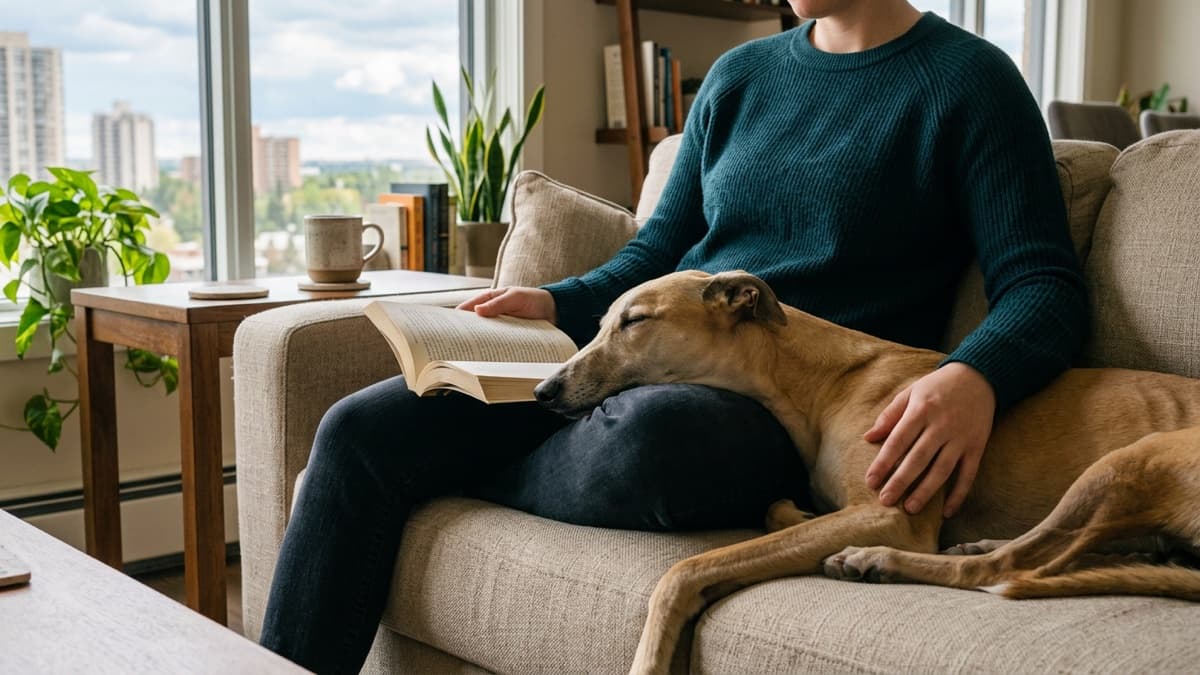
Greyhounds nap 18 to 20 hours a day. Two leash walks of 20 to 30 minutes plus a couple of zoomies in a fenced field cover the daily needs. They are not jogging dogs. They sprint and stop. If you want a daily 10 km running partner, pick a Lab mix, Vizsla, or Aussie. If you want a 4 lb-pillow large dog that fits a quiet apartment, Greyhounds win.
3. Am I home most of the day, or do I have a real plan for alone-time?
Greyhounds velcro hard and develop separation anxiety more often than most large breeds. Retirees, work-from-home owners, and part-time workers are the easiest fit. Full-time office workers need a plan: daycare a couple of days a week, a midday walker, and gradual alone-time conditioning from day one. Without a plan, panting, whining, and destruction are common in the first 90 days.
4. Do I have an adult-only home, or kids 10 and older?
Greyhounds are not aggressive but they are tall, thin-skinned, and bruise easily. Toddlers grabbing, falling on, or hugging a Greyhound can startle the dog and cause space-guarding. Most retired racers come from track kennels and have never lived with small children. Calmer older kids (10+) who respect boundaries do fine. Toddler households should consider a sturdier breed.
5. Do I have cats or small dogs the rescue has not pre-tested?
Greyhounds are sighthounds bred to chase. Some are cat-safe. Many are not. The rescue tests each dog with a cat in a controlled setting before placement. Never bring a Greyhound home to your cat without rescue cat-testing first. Same logic applies to small dogs under 15 lbs. NCGL and Pawsitive Match label cat-tested and small-dog-tested Greyhounds clearly.
6. Will I commit to force-free, positive-only training?
Greyhounds shut down with harsh methods. Yelling, leash pops, e-collars, and alpha rolling all damage the bond and can cause learned helplessness. Force-free training with treats, gentle handling, and patient repetition is the only method that builds a stable Greyhound. Calgary force-free trainers Doggie Tales, Sit Happens, and Above and Beyond all handle hounds well. Old-school dominance advice ruins the breed.
7. Can I budget for a 10 to 14 year large-breed lifetime?
Greyhounds live 10 to 14 years, longer than most large breeds. Food, vet care, dental cleanings, pet insurance, and end-of-life care for a 70 lb dog over 12 years runs $20,000 to $40,000. Calgary adoption fees through NCGL and other rescues run $300 to $500. Greyhounds have breed-specific quirks: thin skin tears easily, dental issues are common, and they cannot tolerate most flea medications. Pet insurance is highly recommended.
8. Do I have a real plan for Calgary winters?
Greyhounds have almost no body fat (4 to 8 percent vs 15 to 20 for most breeds) and a thin single-layer coat. They lose body heat fast. The Calgary plan: a proper insulated winter coat below -5C, booties below -10C, and outdoor time capped at 15 to 20 minutes in extreme cold. Many Calgary Greyhound owners use pajamas indoors during deep-freeze weeks. The breed cannot tolerate Canadian winter without gear.
9. Am I ready for the first 90 days to be the hardest?
Retired racers transition from kennel life to home life and need 3 to 6 months to fully settle. Sleep starts back, housetraining setbacks happen, separation anxiety builds, and post-adoption anxiety hits most owners in weeks 2-6. By month 3 most of it resolves. By month 6 you have the calm couch companion the breed is famous for. Plan for the rough middle, not just the easy end state.
10. Will I lean on NCGL and the wider community?
The Northwest Canadian Greyhound League (NCGL), the NCGL Facebook community, the Reddit r/Greyhounds community, and Calgary-area meetups are the strongest breed support network in Alberta. New owners who post questions, attend meetups, and stay connected adapt faster. Owners who try to go it alone struggle more. Joining the community is not optional, it is part of how the breed works.
Who Greyhounds Are a GREAT Fit For
Apartment and condo dwellers
Calm, quiet, clean, and rarely bark. A 70 lb Greyhound fits a Beltline, Bridgeland, or Mission condo better than a hyperactive 30 lb dog. No yard needed. Two leash walks a day plus zoomies at a fenced field cover the exercise needs. Many Calgary condo boards allow Greyhounds even where other large breeds are restricted because of the breed's quiet reputation.
Lower-activity owners and retirees
Two 20 to 30 minute leash walks a day plus a couple of zoomies is the full exercise plan. No hour-long runs, no daily off-leash hikes, no high-stakes mental enrichment. Retirees who walk twice a day and want a quiet companion get the best of the breed. Several Calgary-area Greyhound adopters in their 60s and 70s describe the breed as the easiest large dog they have ever owned.
Single adopters
Velcro bonding is wonderful when you live alone. The dog follows you room to room, sleeps next to your bed, and is a constant calm presence. Single adopters do not have the partner bonding gap problem couples face and the breed often suits the lifestyle perfectly.
Homes wanting a calm large breed
If you want a big dog but cannot handle Lab energy, Vizsla intensity, or Husky stubbornness, Greyhounds are one of the few large breeds that genuinely match a quiet home. The combination of 70 lb size, sleek elegance, and low daily energy is rare and uniquely Greyhound.
Owners who will join NCGL
The community support is exceptional. New owners who plug in adapt faster, struggle less, and stay in the breed longer. Read our Greyhound adoption Calgary guide for the full NCGL and rescue network details.
Who Greyhounds Are NOT a Fit For
Active outdoor families wanting an off-leash hiking buddy
Greyhounds cannot be off-leash outside a fully fenced area. The never-off-leash rule is forever. If your weekends are in Kananaskis, Banff, or the foothills with a dog ranging ahead on trail, pick a Lab mix, Aussie, or Border Collie mix instead. Greyhounds on a 10 metre long line do exist but the trail experience is fundamentally different.
Families with toddlers
Tall, thin-skinned, bruises easily, and many retired racers have never lived with small children. Toddlers grabbing, falling on, or hugging a Greyhound can startle the dog and trigger space-guarding. Older kids 10+ who respect boundaries usually do well. Toddler households should pick a sturdier family breed.
Owners who travel often
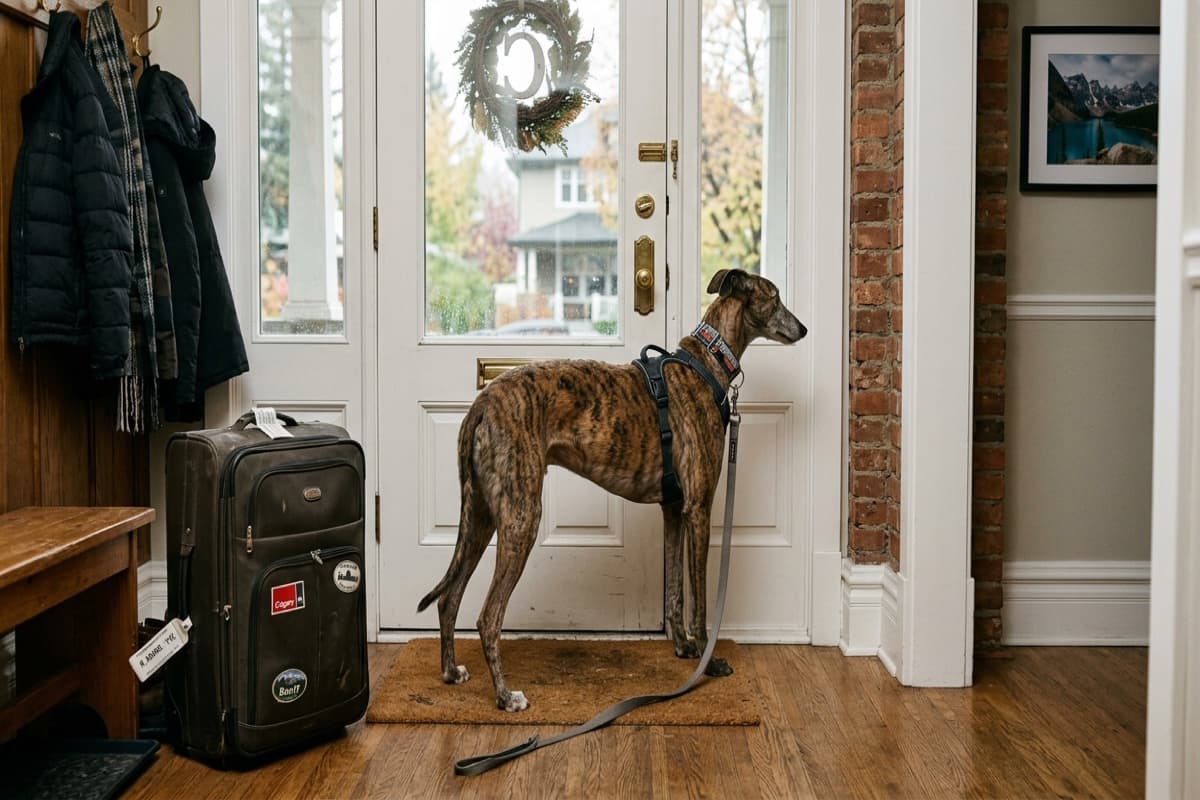
Velcro bonding plus separation anxiety risk make frequent boarding hard. Greyhounds need a hound-experienced sitter, not a kennel. Owners gone more than 2 to 3 nights a month need a dedicated trusted sitter relationship. If you travel for work weekly, the breed is rough.
Cat households without thorough cat-testing
Some Greyhounds are cat-safe. Many are not. Sighthound prey drive plus a fast indoor cat can end badly. Always adopt a Greyhound that the rescue has cat-tested with their own cats in a controlled setting. NCGL and Pawsitive Match label cat-safe Greyhounds clearly. Never assume.
Homes with small dogs
Same logic as cats. Some Greyhounds are fine with small dogs. Many are not. Always pre-test through the rescue with the specific small dog you live with. Outdoor encounters with strange small dogs on walks need careful management on leash. Do not assume the breed is small-dog-safe by default.
Owners wanting a jogging or biking partner
Greyhounds are sprinters, not endurance dogs. They cannot keep a steady 8 km/h jogging pace for 30 minutes. A 1 to 2 km easy jog is the upper limit. If you want a dog to run, bike, or roller-blade beside, pick a Lab, Vizsla, or Aussie.
Foster-to-adopt is the safest test of fit
Calgary-area Greyhound placement through NCGL and partner rescues includes a 2 to 4 week foster trial. You meet the velcro reality, the post-adoption anxiety wave, the never-off-leash workflow, and the Calgary winter coat needs in real life. If the trial fits, you adopt. If not, the dog returns to foster with no fee lost. This is by far the best way to know.
See Available Greyhounds →“I Love My Greyhound but I'm Struggling” (This Is Normal)
Post-adoption anxiety hits most Greyhound adopters in weeks 2-6. The dog is unfamiliar, the routine is upended, sleep is broken, and the responsibility feels heavier than expected. The honeymoon ends, the work begins, and the brain says “maybe I made a mistake.”
This is completely normal and very common. NCGL Facebook threads, Reddit r/Greyhounds posts, and Calgary meetup conversations are full of new adopters describing the same wave. The pattern is almost universal for retired racers transitioning to home life.
What helps:
- Talk to the rescue. They have heard it 1,000 times and have specific advice for your dog.
- Post in the NCGL Facebook community. Owners answer within hours and share their own struggles.
- Book a session with a Calgary force-free trainer (Doggie Tales, Sit Happens, Above and Beyond).
- Stick to the routine. Same walk times, same meal times, same bedtime. Predictability calms anxious dogs and anxious owners.
- Wait. The 90-day rule is real for Greyhounds. Most of the rough feeling lifts by month 3.
The struggle is normal. Most owners come out the other side bonded for life. The breed earns the “Greyhound grief” reputation precisely because the bond runs so deep once it forms.
Should I Rehome My Greyhound?
Last resort. Most Greyhound struggles resolve with time, a force-free trainer, and NCGL community support. The first 90 days are the hardest for almost every adopter. Separation anxiety, housetraining setbacks, partner bonding gaps, and post-adoption anxiety all tend to resolve by month 3.
If after 90 days of real work the fit is genuinely wrong (safety issue with kids, irreconcilable separation anxiety despite professional help, household change like a move or new baby), the original rescue takes the dog back. That is the contract. Greyhound rescues do not abandon their dogs.
Do not list a Greyhound on Kijiji, Facebook Marketplace, or rehome privately. The breed needs hound-experienced placement, cat-tested matching, and a proper home check. The rescue network handles that correctly. Private rehoming puts the dog at risk.
Contact your original rescue first. Be honest about the struggle. They have placed thousands of Greyhounds and want this one to land well, not bounce.
My Partner Is Not Bonding with the Greyhound
Common, and usually time plus presence fixes it. Many Greyhounds pick one person and warm to others over months. The bonded partner is usually whoever spent the most one-on-one time with the dog in the first week.
What helps the non-bonded partner catch up:
- Take over the feeding for 4 to 8 weeks. Two meals a day from the same hand builds association fast.
- Do the morning and evening walks. Leash time is bonding time.
- Be the treat-giver during training. High-value treats from a specific person build attachment.
- Avoid forcing affection. Sit on the floor at the dog's level and let the Greyhound come to you.
- Have the bonded partner step back during introductions. The dog needs space to choose the non-bonded human.
By month 3 to 6 most Greyhounds settle into liking both adults in the home. One often remains the obvious favourite, but the other becomes a real bond partner too.
Some Greyhounds stay single-person no matter what you try. That is a known breed pattern. Plan for the possibility but expect improvement with consistent effort.
The “Second Greyhound” Question
Some velcro Greyhounds settle dramatically once a second hound joins the home. The two dogs keep each other company, sleep together, and the separation anxiety eases. Many NCGL owners describe getting a second Greyhound as the single best thing they did for the first one.
Other Greyhounds form a bonded pair that panics together when both are left alone. Instead of one anxious dog, you have two. Some pairs also fight if temperaments do not match, and returning the second dog is hard once it has been in the home.
The right call depends on the specific dog. Talk to the rescue first. NCGL has placed thousands of pairs and knows which Greyhounds benefit from a second hound and which need solo placement.
Never adopt a second Greyhound impulsively as an anxiety fix. If the first dog still has unresolved separation anxiety, work that out first with a force-free trainer and structured alone-time conditioning. Read our Greyhound separation anxiety Calgary guide for the full plan.
Greyhound Grief: Plan for the Emotional Reality
Greyhound owners describe loss of their dog as exceptionally hard. The breed bonds deeply, lives in close physical contact (often sleeping in the bed), and the calm quiet presence becomes woven into daily life. When a Greyhound passes, the absence is loud.
This is not unique to the breed but Greyhound communities are unusually open about it. Read the NCGL Facebook community and you will find threads of long-term owners describing grief that lasted years and shaped every future adoption.
Plan for the emotional reality. Greyhounds live 10 to 14 years. Adopting at age 3 means a 10-year companion. Adopting a senior Greyhound (8+) means 3 to 6 years and the grief comes sooner. Both choices are valid.
Many Greyhound owners adopt a second one before the first passes, both to ease the inevitable loss and because the breed becomes a permanent part of life. This is the “greysession” pattern NCGL members talk about.
The 45 mph Couch Potato Reality
Confirmed. Greyhounds sprint hard for 30 to 60 seconds and then nap for hours. Top speed is 45 mph, faster than any other breed in common ownership. The same dog will run flat-out around a fenced field for two minutes then sleep on the couch for 18 hours.
Daily exercise is light by large-breed standards. Two leash walks of 20 to 30 minutes each, plus a couple of zoomies in a secure yard or fenced off-leash area, covers the full exercise needs. Greyhounds are not jogging dogs and not endurance hikers. They sprint and stop.
Indoors they are notorious couch and bed dwellers. Most adopters report the dog claiming the softest surface in the home within the first 24 hours. Many Calgary Greyhound owners buy a dedicated dog bed and find the dog ignores it in favour of the couch anyway.
The Calgary Winter Coat Reality
Greyhounds have almost no body fat (4 to 8 percent vs 15 to 20 for most breeds) and a thin single-layer coat. They lose body heat fast. Calgary winters at -25C to -35C are genuinely hard on the breed without proper gear.
The Calgary plan:
- Insulated winter coat from -5C and below. Voyagers K9 Apparel and Chilly Dogs both make Greyhound-cut coats sold by Calgary pet stores.
- Booties from -10C and below. Calgary sidewalk salt cracks thin Greyhound paw pads.
- Outdoor time capped at 15 to 20 minutes in extreme cold (below -25C).
- Indoor pajamas or fleece during deep-freeze weeks if your home runs cool. Many Calgary Greyhound owners use these.
- Heated dog beds and extra blankets in winter. Greyhounds seek out heat constantly.
This is real cost and real effort. The thin coat is non-negotiable. Owners who skip the winter gear find their dog miserable by January. For the full winter playbook read our retired racing Greyhound first weeks Calgary guide.
The Never-Off-Leash Truth
A Greyhound spots a rabbit, squirrel, deer, or small dog at 200 metres and is gone before the owner can react. Top speed is 45 mph. They do not respond to recall once locked onto prey because the chase drive is hardwired through generations of racing selection.
Even Greyhounds with reliable recall in calm settings will bolt if a deer crosses 100 metres ahead. The dog can clear a kilometre in under a minute. Recovery is hard, often dangerous (traffic, getting lost, hypothermia in winter), and sometimes fatal.
Calgary off-leash parks like Nose Hill, Bowmont, and Sue Higgins are particularly risky because of constant deer, rabbits, and coyotes. Use fully fenced off-leash areas only. Calgary has a few (check current dog park listings) and many NCGL members rent or share fenced fields for zoomies.
A 10 metre long line is the compromise for trails. The dog gets some freedom, you keep the safety. Accept this rule or do not adopt a Greyhound. Read our Greyhound off-leash and recall Calgary guide for the full safety plan.
NCGL and the Community Support Network
The Northwest Canadian Greyhound League (NCGL) is the Alberta-based Greyhound rescue network. The NCGL Facebook community is the most active breed-specific community in Alberta. Calgary-area meetups happen seasonally.
Reddit r/Greyhounds has 100,000+ members and is one of the most useful breed-specific subreddits anywhere. New adopters who post questions get answers within hours from owners with decades of experience.
Why this matters: Greyhounds are unusual enough that general dog training advice often does not apply. The community knows the breed-specific quirks (the kennel-bred housetraining curve, the cat-testing process, the thin-skin tear risk, the Trazodone sensitivity, the right winter coat brands). New owners who plug in adapt faster.
Join the NCGL Facebook community before you adopt. Read 100 recent threads. You will know more about Greyhound ownership than most first-week adopters do, and the support network will be in place from day one.
Foster-to-Adopt: The Best Way to Test Fit
NCGL and partner rescues place Greyhounds through 2 to 4 week foster trials before formal adoption. You pay nothing during the trial. The rescue provides food, vet care, and gear. You provide the home.
In two weeks you learn whether velcro bonding fits your life, whether the never-off-leash rule is workable, whether your cats and small dogs (if any) are safe with this specific Greyhound, and whether the daily rhythm matches your work-from-home or office schedule. You also catch the early wave of post-adoption anxiety with full rescue support behind you.
If it works, you adopt. If not, the dog returns to foster. This is by far the safest test of breed fit. Kijiji and most “Greyhound for sale Calgary” listings are not vetted, often not cat-tested, and have no return option. The rescue route protects both you and the dog.
Frequently Asked Questions
Are Greyhounds good for first-time dog owners?
Yes for many first-timers, with caveats. Greyhounds are calm, quiet, clean, and rarely bark. They sleep 18 to 20 hours a day. The catch is the never-off-leash rule, the velcro bond, the post-adoption anxiety most owners feel in weeks 2-6, and the thin coat that needs winter coverage in Calgary. A patient first-timer who walks twice a day on leash, accepts months of bonding, and joins NCGL for community support does very well.
Is the 45 mph couch potato thing actually true?
Yes. Greyhounds sprint hard for 30 to 60 seconds then nap for hours. Two 20 to 30 minute leash walks plus a couple of zoomies in a fenced field cover the daily exercise needs. The breed is one of the lowest-energy adult large dogs in common ownership despite looking like a racing athlete.
Why can Greyhounds never be off-leash?
Sighthound prey drive plus 45 mph sprint speed. A Greyhound spots a rabbit or deer at 200 metres and is gone before recall registers. Even well-trained Greyhounds bolt when prey crosses. Calgary off-leash parks are unsafe because of wildlife. Use fully fenced off-leash areas only, or stay on a long line. Non-negotiable for the breed.
I love my Greyhound but I am struggling. Is this normal?
Completely normal. Post-adoption anxiety hits most Greyhound adopters in weeks 2-6. NCGL and Reddit r/Greyhounds threads are full of the same wave. It almost always lifts by month 3 as the dog settles and you find rhythm. Reach out to your rescue, post in the NCGL Facebook community, or talk to a force-free trainer. The struggle is normal and common.
Should I rehome my Greyhound?
Last resort. Most struggles resolve with time, a force-free trainer, and NCGL community support. The first 90 days are the hardest. Separation anxiety, housetraining setbacks, and post-adoption anxiety almost all resolve by month 3. If after 90 days the fit is genuinely wrong, the original rescue takes the dog back. Do not list a Greyhound on Kijiji or rehome privately.
My partner is not bonding with the Greyhound. What now?
Usually time and presence fix this. Have the non-bonded partner do the feeding, walking, and treat-giving for 4 to 8 weeks. Avoid forcing affection. By month 3 to 6 most Greyhounds warm to both adults in the home, even if one remains the obvious favourite. Some Greyhounds stay single-person no matter what you try, but expect improvement with consistent effort.
Should I get a second Greyhound for separation anxiety?
Sometimes helps, sometimes doubles the problem. A second Greyhound can ease velcro-driven separation anxiety. It can also create a bonded pair that panics together when both are left alone. The right call depends on the specific dog. Talk to the rescue first. NCGL knows which Greyhounds benefit from a pair and which need solo placement. Never adopt a second one impulsively as an anxiety fix.
Who should NOT get a Greyhound?
Active outdoor families wanting an off-leash hiking buddy. Families with toddlers. Owners who travel often without a hound-experienced sitter. Cat households without thorough rescue cat-testing. Homes with untested small dogs. Owners who cannot accept the never-off-leash rule outside fenced areas. Anyone wanting a jogging or biking partner beyond 1 to 2 km.
Related Greyhound guides
Greyhound Adoption Calgary →
Where to find a rescue Greyhound in Calgary, NCGL and partner rescues, real adoption costs, and what to expect from the foster trial process.
Greyhound Off-Leash and Recall Calgary →
Why Greyhounds cannot be off-leash, the long-line workflow, Calgary fenced field options, and the prey drive truth behind the rule.
Greyhound with Kids and Cats Calgary →
The honest reality of Greyhounds with toddlers, older kids, cats, and small dogs. Cat-testing process and household introduction plan.
Greyhound Temperament and Quirks Calgary →
Velcro bonding, sleep startle, kennel-bred habits, roaching, statue-mode, and the full set of breed-specific quirks new owners ask about.
Greyhound Separation Anxiety Calgary →
Why velcro Greyhounds develop separation anxiety, alone-time conditioning from day one, daycare options, and when a second dog helps.
Greyhound Training Calgary →
Force-free training for retired racers, leash skills, stair training, household manners, and the Calgary trainers who know the breed.
Retired Racing Greyhound First Weeks Calgary →
Day-by-day plan for the first 30 days, kennel-to-home transition, sleep startle prevention, and the 3-3-3 rule for retired racers.
Greyhound Health and Vet Guide Calgary →
Greyhound-specific medication sensitivities, thin-skin tear care, dental issues, bloodwork quirks, and Calgary vets who know the breed.
New dog? Start with these care guides
Everything a new adopter needs to set up a safe, happy home.