The honest version
Greyhounds are paradox dogs. They are built for 45 mph sprints and they sleep 18 to 22 hours a day. The “45 mph couch potato” label is genuine, not a marketing line. Adult Greyhounds need two 20-minute leash walks and occasional fenced-area zoomies, and most are content. They almost never bark. They lean their full body weight against you for affection. They stare without blinking. They follow you everywhere, including the bathroom. They sleep on their backs with their legs in the air. They are gentle, sensitive, quirky, and deeply weird in a way that becomes obvious in the first month and never stops being charming. Most “bad Greyhound” stories trace back to sleep startle (a manageable breed quirk, not aggression), high prey drive (predictable from racing background), or separation anxiety (preventable with good first-weeks planning).
The 45 mph Couch Potato Is Real
Reddit Greyhound owners consistently describe their dogs as lazier than almost any other large breed. The numbers back it up. Adult Greyhounds sleep or lounge 18 to 22 hours a day. They are sprinters, not endurance dogs. The breed evolved to chase fast prey in short bursts and then conserve energy for hours afterward. Modern retired racers carry the same wiring.
For Calgary owners this means lower daily exercise than people expect. Two 20-minute leash walks a day is often plenty for an adult Greyhound. Add a sprint opportunity once or twice a week in a fully fenced space (a friend's backyard, a fenced ball diamond off-hours, or a securely fenced dog park) and the dog is set. Most retired racers will not run themselves at off-leash parks like Nose Hill or Sue Higgins, and they should not be off leash in unfenced areas regardless. Recall is not reliable in sighthounds when prey appears.
Inside the house the dog will mostly be horizontal. Greyhounds do not pace, they do not patrol, they do not demand attention every hour. They find a soft spot and stay there. New owners coming from a Labrador or a Border Collie are often surprised by how little the dog moves. It is not depression and it is not boredom. It is the breed.
The Quiet Breed
Greyhounds are one of the quietest breeds in the rescue world. Most do not bark at doorbells, mail carriers, footsteps in the hallway, or dogs passing the patio door. Some never bark in their entire life. The retired-racer kennel environment discouraged barking and selected for quiet dogs, and the breed standard reinforces it.
You may hear other sounds. A small woof at something unusual. A long sigh when the dog settles for the night. A theatrical groan when you ask the dog to move off the couch. Chattering teeth when excited about dinner or a walk. None of these are bark equivalents and none are loud.
This makes Greyhounds excellent Calgary apartment and townhouse dogs. Noise complaints are a real concern in condo buildings, and the breed produces almost none. If you live in a building with thin walls, a Greyhound is one of the safest large-dog choices on the rescue market.
Roaching: The Iconic Sleep Position
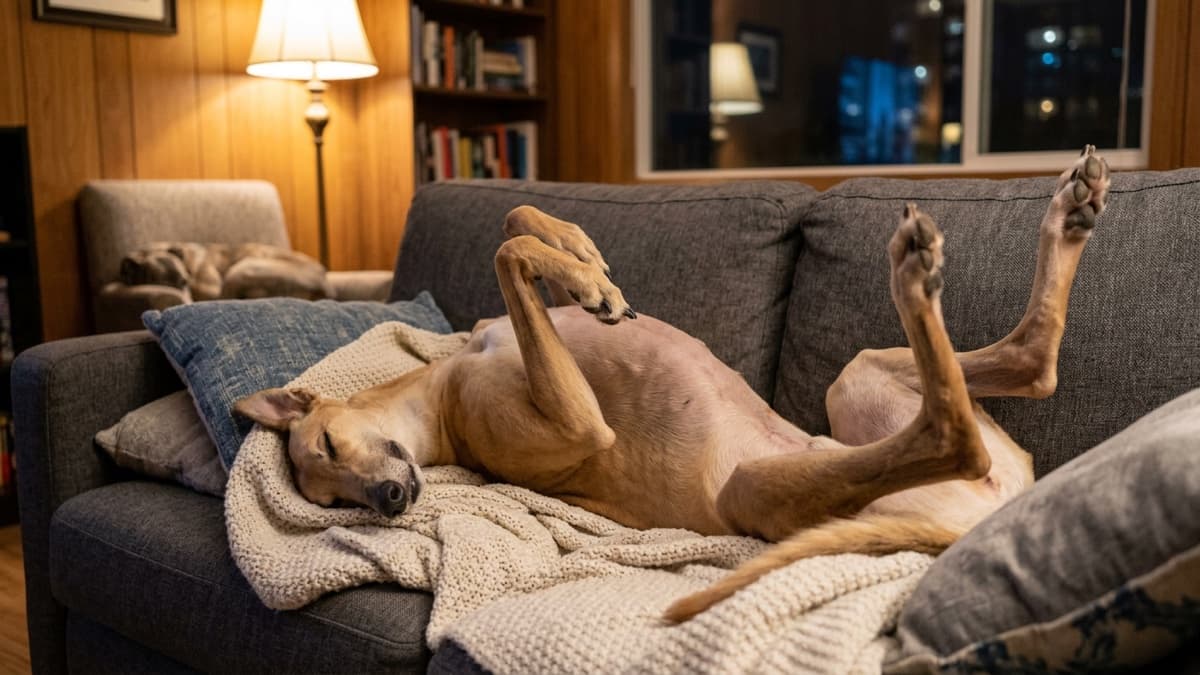
Roaching is the most photographed Greyhound quirk. The dog lies on its back, legs in the air, belly fully exposed, often with the spine twisted in a way that looks structurally impossible. The pose says one thing: total trust. The dog feels safe enough to expose the most vulnerable part of its body and pass out.
Retired racers usually do not roach for the first few weeks or even months in a new home. The pose appears once the dog has decompressed and decided the home is permanent. When you see your retired racer roach for the first time, it is a milestone. The dog has settled in.
Roaching happens on the couch, on a thick orthopedic bed, in a sunbeam, and occasionally in the middle of the kitchen floor. The breed is not picky about location once the dog is comfortable. Most owners take dozens of photos. They never stop being funny.
Leaning, Staring, and the Greyhound Greeting
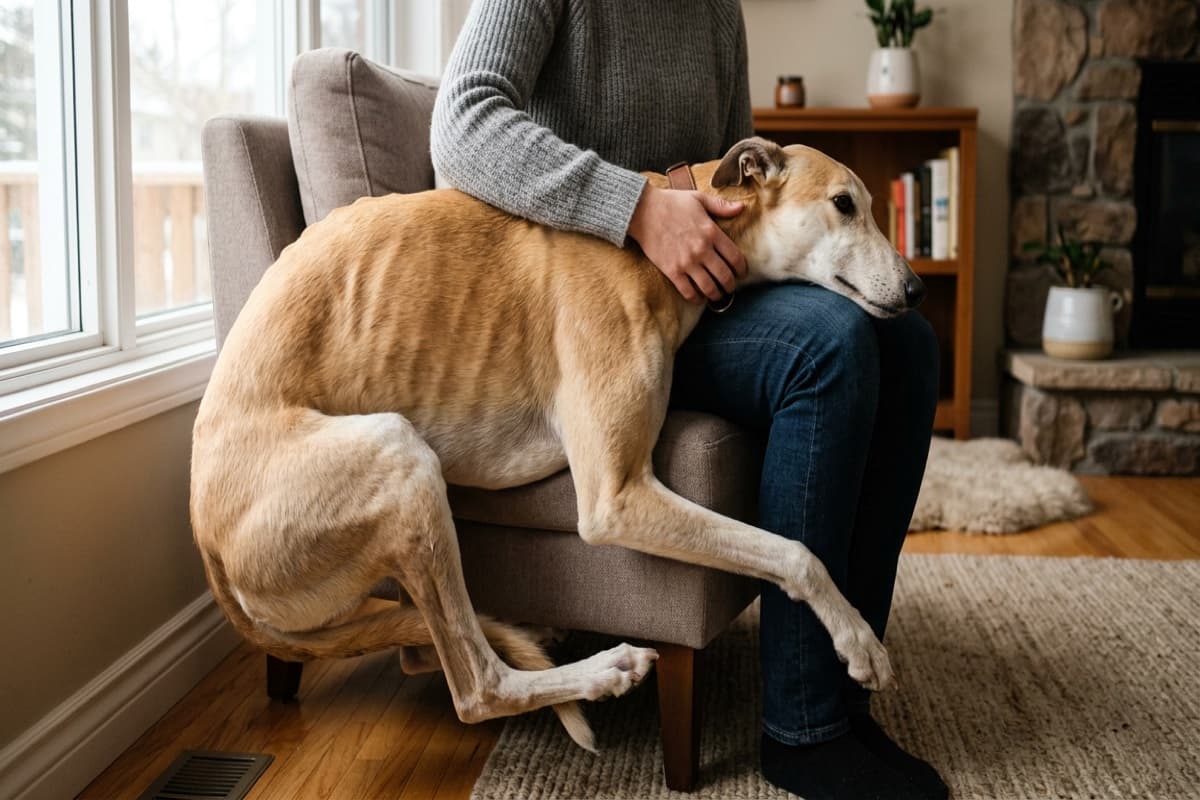
Greyhounds have their own affection language. New owners often misread it because the gestures look intense or strange. Three behaviours are universal in the breed.
The lean
A Greyhound walks up, turns sideways, and rests its full body weight against your legs. This is the breed greeting and the breed equivalent of a hug. Do not lock your knees. A 65 lb Greyhound at full lean can knock over a small adult. Bend slightly, accept the lean, and rest a hand on the shoulder. Many dogs hold the lean for several minutes, especially with their primary person.
The stare
An intense, unblinking gaze from a few feet away. Adopters find this unnerving at first because it looks like the dog is sizing them up. It is not. Sighthounds are wired to observe and the stare is the breed paying attention. Common around dinner time, before walks, or when the dog wants something. Stare back gently. Most will eventually break contact and come lean against you instead.
Chattering teeth
Rapid teeth chatter that sounds like the dog is cold. It is excitement or anticipation. Happens at dinner time, when the leash comes out, or when a favourite person walks in. Harmless and adorable. Some Greyhounds chatter constantly and some never do. Either is normal.
The Greyhound smile
Some Greyhounds lift their upper lip in a submissive grin when greeting people they love. Teeth show, eyes soften, body wags. New owners sometimes panic and read aggression. It is the opposite. This is a submissive, friendly display unique to certain breeds. If the body is loose and the eyes are soft, it is a smile, not a snarl.
Velcro Shadow Behaviour
Retired racers follow their person everywhere. Kitchen, bedroom, bathroom, basement, garage. The dog stays within sight at all times. This is the velcro pattern and it is common in the breed because of how racing kennels work.
Racing Greyhounds spent their entire careers in group housing, surrounded by other dogs and handlers 24 hours a day. They were never alone. Being alone is genuinely foreign to a retired racer, and being suddenly alone in a quiet Calgary apartment is one of the most stressful transitions in the breed.
The velcro behaviour usually softens after 6 to 12 months as the dog learns the home is permanent. Most owners find it endearing. The risk is that velcro can slide into separation anxiety if the owner is away long hours. Prevent it from day one by feeding meals in a separate room, building a positive bed or crate space, and practising short alone-time intervals starting the first week. Our Greyhound separation anxiety guide covers the full prevention plan.
Zoomies in Fenced Areas
Watch a Greyhound run once and you understand why people fall in love with the breed. Full-speed zoomies last 30 to 60 seconds. The dog accelerates from a standstill to genuine sprint speed in three strides, banks turns with the ease of a motorcycle, and stops as suddenly as it started. It is beautiful to watch and it is the dog using exactly the body it was built for.
Schedule zoomies in safe spaces. Fully fenced areas only. A 6-foot perimeter fence is the minimum because Greyhounds can clear shorter fences from a standing jump. Good Calgary options include rented private backyards (try the Sniffspot app for fenced bookable yards), fenced ball diamonds during quiet hours, and securely fenced sections of off-leash parks during low-traffic times.
Do not run a Greyhound off leash in unfenced areas regardless of how well-trained the dog seems. Recall is not reliable in sighthounds when prey appears, and a Greyhound at full sprint is doing 40 mph. The dog will be a kilometre away before you finish calling. Our Greyhound off-leash and recall guide covers the rules in detail.
Sleep Startle: A Real Breed Quirk
Sleep startle is the single most important quirk for new Greyhound owners to understand. Greyhounds sleep with their eyes partly open and they can react defensively if touched while asleep or half-asleep. A startled dog may snap, sometimes hard enough to break skin, before it has fully woken up and registered what happened.
This is not aggression. It is a breed-typical reflex from generations of kennel life where being touched while asleep often meant another dog was crowding the space. Most retired racers will outgrow some of the sensitivity in a stable home, but the reflex never fully disappears in many dogs.
The rules are simple and they prevent every sleep-startle incident:
- Wake by voice, not touch. Stand a few feet away. Say the dog's name. Wait for the dog to open its eyes and lift its head before approaching.
- Beds in low-traffic locations. Not in hallways, not in doorways, not where someone might step over the dog at night.
- Children sit, dogs come to them. No reaching over a sleeping Greyhound. No climbing on the bed. No surprise hugs.
- Other pets respect the bed. A sleeping Greyhound should not have a cat walk over it or a small dog jump on it.
- Guests are briefed. Tell anyone visiting that the dog is not to be petted while sleeping.
With these rules in place, sleep startle never becomes a problem. Skip the rules and you risk a serious bite that was completely preventable.
Resource Guarding in Retired Racers
Some retired racers learned to guard food, toys, or bed space in the kennel environment. Resources were limited and competition was constant, so a dog that protected its bowl ate more. The pattern carries into adoptive homes for a minority of retired racers.
Signs of resource guarding include freezing over a food bowl, growling when a person or other dog approaches a chew, snapping when reached for a toy, and stiffening when someone walks past the bed. The behaviour is not aggression in the broad sense. It is anxiety about losing something valuable.
Resource guarding is training-fixable. The standard force-free approach: feed in a quiet space without crowding, never reach into the food bowl while the dog is eating, trade up for high-value chews (offer a better treat in exchange for the guarded item, do not just take it), and let the dog finish meals undisturbed. A force-free Calgary trainer can build a structured plan within two or three sessions for most cases. Do not punish growling. The growl is the warning before the bite. Suppress the growl and you get the bite with no warning. Our retired racer first-weeks guide covers resource guarding alongside the other early-adjustment issues.
Bonding: Deeply Attached, Slow to Warm
Greyhounds bond deeply to one or two people, usually the ones who feed them, walk them, and share the couch. The bond is genuine and long. Once a Greyhound chooses, the dog is committed. Many retired racers form intense attachments to a primary person within the first month of adoption.
With strangers the breed is reserved but not fearful. A Greyhound meeting a new person will usually approach slowly, sniff, lean for a moment, and then retreat to its bed. They are polite, not effusive. The breed does not jump on guests, lick faces, or demand attention from new people. Owners who want a friendly social butterfly are sometimes disappointed by how disinterested the dog seems in their friends.
Give Greyhounds time to warm up to new people and the relationship deepens over weeks and months. Most retired racers eventually treat regular visitors (family, close friends, dog walkers) as part of the inner circle. Strangers stay strangers.
Stress Signs Every Owner Should Recognize
Greyhounds are stoic. They hide discomfort better than most breeds, which makes early stress detection a skill worth learning. Watch for these signals.
Whale eye
The whites of the eyes show as the dog turns its head away while watching something. A clear sign of discomfort and a request for space.
Lip licking and yawning
Outside of meal time or post-nap, repeated lip licks and yawns are anxiety markers. Often appear before a freeze or a refusal.
Freezing
The dog stops moving, ears back, tail low or tucked. A Greyhound that freezes is overwhelmed. Remove the trigger, give space, and reset before continuing.
Tucked tail and lowered head
Sustained tail tuck and a low head carriage indicate prolonged stress. Common on walks where the dog has been overwhelmed by traffic, dogs, or new environments.
Catching stress early prevents bigger problems later. A Greyhound that is allowed to retreat at the whale-eye stage rarely escalates to a growl or snap. A Greyhound that is pushed through stress signals learns to skip the warnings.
Ready for the couch-potato life?
Calgary has retired racing Greyhounds in adoption rotation through Greyt Companion Rescue, GRA Canada, and AARCS. Adult Greyhounds from foster homes come with documented temperament notes: cat-tested or not, small-dog-tested or not, sleep startle observations, and home-decompression status.
See Available Greyhounds →Frequently Asked Questions
Are Greyhounds really as lazy as people say?
Yes. The 45 mph couch potato label is genuine. Adult Greyhounds sleep or lounge 18 to 22 hours a day. Most are content with two 20-minute leash walks and occasional fenced-area zoomies. Reddit Greyhound owners describe them as lower exercise than a Labrador or Border Collie. They are sprinters, not endurance dogs. New owners are often surprised by how little the dog moves around the house.
Do Greyhounds bark?
Most do not. Greyhounds are one of the quietest breeds. Many never bark at strangers, doorbells, or delivery vans. Some never bark in their entire life. You may hear sighs, groans, and excited teeth chatter, but doorbell-style barking is rare. This makes Greyhounds excellent Calgary apartment and townhouse dogs.
What does roaching mean?
It is the iconic Greyhound sleep position. The dog lies on its back with legs in the air and belly exposed. It is a sign of total trust and comfort. Retired racers usually do not roach until they have decompressed and decided the home is permanent. The first roach is a major milestone.
Why does my Greyhound lean on me?
Greyhound leaning is the breed greeting. The dog rests its full body weight against your legs as a form of affection. Do not lock your knees. A 65 lb Greyhound at full lean can knock over a small adult. Bend slightly and accept the lean. Many dogs hold it for several minutes with their primary person.
Why does my Greyhound stare at me?
The Greyhound stare is intense and unblinking but it is not threatening. Sighthounds are wired to observe. The stare is the dog paying attention, usually around meal time or before walks. Stare back gently. Most will eventually break contact and come lean against you instead.
Why does my Greyhound follow me everywhere?
Velcro shadow behaviour is common in retired racers. Racing Greyhounds lived in group kennels and were never alone. Being alone is foreign and stressful. The behaviour softens after 6 to 12 months as the dog learns the home is permanent. Prevent it from sliding into separation anxiety by practising short alone-time intervals from the first week.
Is sleep startle dangerous?
It is breed-typical, not aggression, and it is manageable with simple rules. Greyhounds can snap defensively if touched while asleep. Wake with your voice from a few feet away, never by reaching over the body. Keep beds out of high-traffic areas. Brief children and guests that sleeping Greyhounds are off limits. With these rules in place, sleep startle never escalates.
Are Greyhounds good with strangers and other dogs?
Reserved with strangers, often great with other large dogs. Greyhounds take time to warm up to new people but are polite, not fearful. With other Greyhounds, deep friendship is normal. With small fluffy dogs and cats, results are case by case because some retired racers have high prey drive from racing. Reputable rescues cat-test and small-dog-test their dogs before adoption.
More Greyhound guides
Is a Greyhound Right for You? →
Honest Calgary self-assessment. Lifestyle, budget, climate, off-leash limits, and the questions every adopter needs to answer.
Retired Racing Greyhound: First Weeks →
Decompression timeline, stair training, glass doors, kennel-to-home transition, and the resource-guarding watch list.
Greyhound Off-Leash and Recall →
Why sighthound recall is different, fenced zoomie options in Calgary, and the rules that keep retired racers alive.
Greyhound Separation Anxiety →
Why kennel-life velcro can slide into panic, the prevention plan for the first month, and force-free treatment if it has already started.
Greyhounds With Kids and Cats →
Prey-drive testing, household rules, kid-safe sleeping arrangements, and how to read whether your retired racer will live safely with a cat.
Greyhound Training in Calgary →
House training a kennel-raised dog, leash skills, settle cues, and the force-free Calgary trainers who specialize in sighthounds.
New dog? Start with these care guides
Everything a new adopter needs to set up a safe, happy home.