The short answer
Yes for active outdoor Calgary households, no for sedentary homes, apartment-only living, or full-time office workers without a daycare plan. Three factors decide it. One: can you provide 90-plus minutes of structured exercise every day including Calgary winter mornings? Two: can you tolerate a velcro dog that wants to be in your shadow constantly, and avoid the slide into separation anxiety? Three: do you have a cold-weather plan with a fitted winter coat, booties, and indoor enrichment from November through March? If all three fit, the GSP is one of the most rewarding versatile hunting breeds you can adopt. If even one is shaky, our resources hub covers steadier options.
Honest Pros: Why Calgary Households Love the GSP
Athletic outdoor companion built for Calgary
The GSP was developed in 19th-century Germany as a versatile hunting dog that could point, retrieve, track, and work in water. The breed standard at the American Kennel Club describes a working athlete built for stamina and speed. In Calgary, that translates into a hiking, biking, running, and skiing partner with no upper ceiling on outdoor activity. Owners who already enjoy the Bow River pathways, Nose Hill, Bowmont, or Kananaskis trails describe the GSP as the dog that finally fit their lifestyle rather than the dog they had to manufacture activity for.
Eager to please and biddable
GSPs are one of the more biddable versatile hunting breeds. They want to work with their handler and respond beautifully to positive-reinforcement training. Calgary force-free trainers like Raising Canine and Pup City Pup Academy run group classes well-suited to the breed. Marker training, recall drills, and structured nose-work all play to the GSPs strengths. The eager temperament makes the breed coachable around children and other pets faster than guardian or independent working breeds, provided the handler stays consistent.
Intelligent and quick to learn
The breed is intelligent enough to pick up complex hunt-test exercises, off-leash directional commands, and trick chains. Calgary GSPs do well in structured activities like obedience, rally obedience, scent work, dock-diving, and field trials. The intelligence is a double-edged sword: a GSP that learns the routine learns the cheat too. Counter-surfing, opening cupboards, and figuring out how to escape a poorly latched gate are common stories. Channel the intelligence into structured work and the dog thrives; leave it idle and the dog invents its own job.
Low-grooming maintenance
The short single coat is one of the lowest-maintenance coats in the sporting group. Weekly brushing with a rubber curry brush keeps shedding under control. No professional grooming required; the breed needs a bath every few months and routine nail trims. Annual grooming budget is roughly $100 to $200, mostly nails and ears. Compared to a Labradoodle wool coat at $600 to $1,200 a year, or a Husky double-coat blow at two weeks per year, the GSP grooming load is genuinely low. The trade-off is the cold-tolerance limit (see cons below).
Family-bonded and affectionate
GSPs are deeply family-bonded. They want to be in the same room as their people, often touching them. The breed is sometimes called velcro because of this trait. For Calgary households where someone is home most of the time, or where the dog joins outdoor activities, the velcro temperament reads as a feature rather than a bug. The dog wants to be included in family routines, kids backyard play, weekend hikes, and evening couch time. Most Calgary GSPs do well with kids 5 and up who understand respectful handling.
Swim-loving for Calgary summer water access
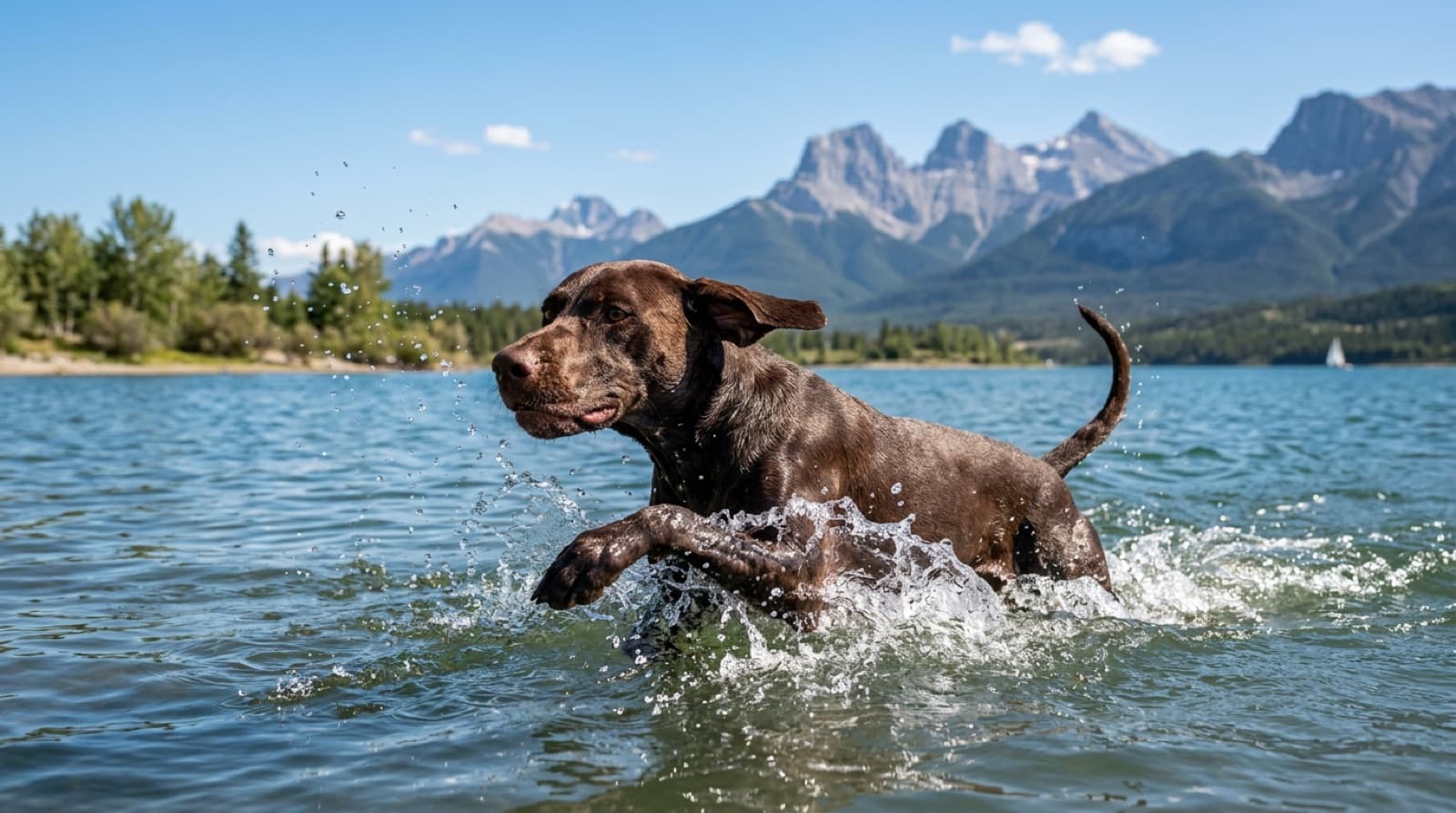
GSPs are strong, willing swimmers. The breed was developed to work in water for waterfowl retrieval. Calgary summer access to the Bow River pathways at Edworthy and Bowness, Sandy Beach on the Elbow River, and Glenmore Reservoir suits the breed beautifully. A daily summer swim covers a chunk of the breeds working-drive need without effort. Owners with summer water habits often describe the swim sessions as the easiest part of GSP ownership. The water love does not extend to cold-water sessions below about 15C; pick warmer afternoons.
Hunt-test and NAVHDA community
The North American Versatile Hunting Dog Association (navhda.org) runs hunt tests for versatile breeds including the GSP. Alberta has active NAVHDA chapters, which gives GSP owners access to a hunting and working-dog community even if they never hunt. Hunt tests, training days, and breed-club events fill the structured-outlet need that the breed craves. Even non-hunting Calgary GSP owners benefit from joining a chapter for the training infrastructure and the community of owners who understand the breed.
Realistic 12 to 14 year lifespan
GSPs typically live 12 to 14 years in good health. The breed stays lean and athletic into its senior years if exercised consistently. Owners who do the hip, elbow, eye, and cardiac screening homework and manage senior weight often see the full span. The lifespan is realistic for families planning a decade-plus commitment without the heartbreak of giant-breed timelines. Senior GSPs slow somewhat but never become couch dogs; they still need structured daily activity.
Honest Cons: The Calgary Insider Angle
The exercise demand will break under-committed households
Ninety minutes is the floor, not the ceiling. The Calgary GSPs we see in rescue overwhelmingly come from households that under-estimated the exercise need. The destruction stories are predictable: chewed baseboards, eaten sofa cushions, dug-up backyards, counter-surfed dinners, frustration-barking neighbours. Within six months of inadequate exercise, the dog is either surrendered or the household is exhausted. The right outlet is real: off-leash running at Nose Hill, fetch with a flirt pole, bike runs along the Bow River pathway, swim sessions in summer, structured nose-work or field work year-round. A brisk on-leash walk does not meet the breeds needs.
Velcro behaviour can tip into separation anxiety
The velcro temperament that endears the GSP to its family becomes a problem when the dog is left alone. Mild velcro reads as a dog that follows you to the bathroom; severe velcro reads as panting, drooling, destruction, and frustration-vocalising the moment the door closes. Calgary GSP separation anxiety cases are common in households where the dog moved from constant company (paternity leave, summer break, retirement) to suddenly alone (return to work, school year). Prevention starts at adoption: short alone-time training from day one, crate or pen acclimation, and a structured exit-and-return routine. Calgary force-free trainers and veterinary behaviourists can help if the anxiety is already established.
Prey drive complicates walks and off-leash work
The breed was developed to find, point, and retrieve game. The prey drive does not switch off in a residential context. Squirrels, rabbits, magpies, ground squirrels, and occasionally cats and small dogs all trigger the chase instinct. On-leash, this means a sudden 50-lb lunge that can pull a small handler off balance; a front-clip harness like a Ruffwear Front Range or PetSafe Easy Walk helps. Off-leash, this means recall has to compete with a moving rabbit, which is hard. The right path is months of long-line recall work, graduated distractions, and honest acceptance that some GSPs will never be fully reliable off-leash near wildlife.
Winter cold intolerance is real
The short single coat is the GSPs Calgary weakness. The breed has minimal undercoat insulation and prefers cool weather, not cold. Above zero Celsius, the dog is happy. From zero to minus 10C, most GSPs do fine with brisk exercise. From minus 10C to minus 20C, a fitted insulated coat (Ruffwear Powder Hound, Hurtta Extreme Warmer, or similar) is required for outdoor sessions over 20 minutes. Below minus 20C, sessions shrink to potty breaks plus indoor enrichment. Booties protect paw pads on salted sidewalks and from ice cuts. Owners who treat winter as a six-month break from exercise see destructive boredom by December. The right plan is shorter, more frequent outdoor sessions plus structured indoor work.
Off-leash recall requires significant investment
Recall against a moving rabbit is hard. The right path is long-line work (15 to 30 metres of biothane), recall drills in low-distraction environments first, and graduated exposure to higher-distraction settings before any genuine off-leash freedom. The investment is months, not weeks, and even a well-trained GSP may have a moment where the prey drive wins. Calgary off-leash zones like Nose Hill, Bowmont, and Sue Higgins Park are usable for proofed adult GSPs, but the recall must be tested in stages. Adult rescues sometimes come with documented recall ability; ask the foster directly before relying on it.
Counter-surfing and sofa-eating when bored
An under-stimulated GSP is creatively destructive. Counter-surfing for food, opening cupboards, eating sofa cushions, chewing baseboards, and digging the yard are all classic boredom outlets. The intelligence that makes the breed trainable also makes it inventive. The solution is meeting the exercise floor, providing daily mental work (nose-work, training sessions, food puzzles), and crate or pen management when alone. Households that try to manage a GSP through corrections rather than meeting the underlying need lose that battle.
Bouncy adolescence from 8 to 24 months
The adolescent GSP from roughly 8 to 24 months is a different dog than the calmer adult. Adolescent GSPs test boundaries, push recall, jump on people, knock kids over, and channel an underdeveloped working drive into chaos. The right response is force-free consistency, more exercise, more structured training, and patience. Corrections-based methods like e-collars, leash pops, and alpha rolls damage the eager-to-please temperament and are unnecessary given how willing the dog already is. Calgary GSPs surrendered in adolescence overwhelmingly come from owners who tried to outlast the phase without enough structure. The phase passes; the dog on the other side is the breed at its best.
GSP vs Vizsla vs Weimaraner vs Pointer vs Labrador
All five breeds have a sporting heritage and varying degrees of family-pet success. The honest comparison for Calgary households:
| Breed | Exercise floor | Velcro level | When it fits |
|---|---|---|---|
| GSP | 90 to 120 min | High | Active outdoor Calgary households new to pointers |
| Vizsla | 90 to 120 min | Extreme | Households home most of the day, softer temperament fit |
| Weimaraner | 120-plus min | High | Experienced pointer households, larger and stronger dog |
| English Pointer | 90 to 120 min | Moderate | Field-trial or hunting households, less family-bonded |
| Labrador | 60 to 90 min | Moderate | Lower exercise ceiling, better Calgary winter coat, more forgiving first dog |
For most Calgary households new to versatile hunting breeds, the GSP is the most forgiving entry point. The Vizsla suits households where someone is home most of the day. The Weimaraner suits experienced pointer households. The English Pointer suits hunting-focused homes. The Labrador is the steadier, more forgiving first dog for families uncertain about the exercise floor.
The Calgary Lifestyle Math
Calgary is mostly friendly to GSP ownership for the right household. The honest picture:
- Yard size: A fenced yard is strongly preferred. The yard does not replace exercise; it gives the dog room to decompress, sniff, and patrol between outings. Households without a yard can succeed but the exercise commitment scales up significantly.
- Off-leash access: Calgary off-leash zones like Nose Hill, Bowmont, Sue Higgins Park, and Sandy Beach work for proofed adult GSPs. Drive time to the closest off-leash zone matters because the breed needs off-leash exercise most days, not just weekends.
- Weather extremes: Calgary summers are warm enough that long mid-day runs can overheat a GSP; shift to early morning or evening. Calgary winters demand a fitted coat below minus 10C and booties on salted sidewalks. Chinook days are the easiest weather for the breed.
- Urban vs suburban: Suburban Calgary with a fenced yard and short drive to off-leash access is the easiest fit. Urban condo living is harder. Acreage outside the city is paradise but most Calgary GSP owners live in standard suburban homes and manage.
- NAVHDA hunt-test community: Alberta NAVHDA chapters (navhda.org) run training days and tests within driving distance of Calgary. Joining a chapter gives access to a community of owners who understand the breed, plus structured training infrastructure even for non-hunters.
- Bylaw 3M2006 compatibility: Calgary Responsible Pet Ownership Bylaw 3M2006 governs noise complaints. GSPs are not chronic barkers in well-exercised homes; frustration vocalising in under-exercised dogs can become a problem. Meeting the exercise floor prevents it.
- Specialty vet access: Western Veterinary Specialist Centre handles complex cardiac, eye, and orthopedic referrals, which matters for the breeds hip, elbow, eye, and cardiac risk profile. VCA Canada West also offers internal medicine and cardiology referrals.
- Rescue availability: GSPs appear regularly in Calgary rescue from lifestyle changes and exercise-floor mismatches. Calgary Humane Society, AARCS, and occasionally breed-specific networks list adoptable GSPs. Expanding the search to Edmonton or Saskatchewan widens the pool for breed-specific rescues.
Browse adoptable German Shorthaired Pointers in Calgary
Calgary GSP availability is meaningful and turnover is regular. Reputable rescues list adults with documented temperament, energy level, kid tolerance, and recall ability. Foster-trial programs of 2 to 4 weeks give you a real-world test of the daily exercise floor, the velcro behaviour, and the winter management plan before committing. For a breed this defined by the exercise floor and the velcro temperament, a foster trial is the safest way to know the fit.
See Available GSPs →You Should NOT Get a GSP If...
Honest disqualifiers. If any of these describe your household, the GSP is the wrong fit right now. That is useful information, not a judgment.
You walk 20 to 30 minutes a day and that is your activity ceiling
A GSP needs 90-plus minutes of structured exercise daily. Sedentary households produce destructive GSPs within six months. The exercise floor is not negotiable.
You live in a small apartment with no plan for two long outings daily
Apartment GSP ownership is workable but the exercise commitment is even higher than for yard owners. Most Calgary apartment-only households underestimate this and surrender within 18 months.
You work 8 to 10 hours outside the home with no daycare or walker plan
A velcro breed left alone all day is the highest-risk separation-anxiety profile. Calgary daycares like Pup City Doggy Daycare and Paws Dog Daycare suit the breed; a reliable midday walker is the next-best option. No plan equals serious problems.
You treat Calgary winter as a six-month exercise pause
The short coat needs a winter management plan with a fitted coat, booties, and indoor enrichment from November through March. Owners who hibernate see destructive boredom by December.
You have a household cat or small dog and have not honestly assessed prey drive
The breed prey drive can extend to cats and small dogs. Some GSPs live peacefully with cats; others stalk and chase. Adult rescue with documented compatibility is the right path; gambling on a puppy is not.
You want a calm, low-maintenance family dog
The GSP is not that dog. The grooming is low-maintenance; nothing else about the breed is. Households wanting a calmer family companion should consider an older adult Labrador or a Golden Retriever rescue.
You are not committed to force-free training
The eager-to-please temperament responds beautifully to positive reinforcement and is damaged by corrections-based methods (e-collars, leash pops, alpha rolls). If your training philosophy is correction-based, the breed will suffer and the relationship will not work.
10-Question Self-Assessment
Answer honestly. If you answer “no” or “not sure” to more than two, the GSP is probably not the right fit right now. That is useful information, not a judgment.
1. Will I genuinely provide 90-plus minutes of structured exercise every day?
A brisk on-leash walk does not count. The output needs to be off-leash running, fetch with a flirt pole, bike runs, swim sessions, or structured nose-work. Calgary winter mornings are still exercise days. Honest self-knowledge here matters more than any other answer.
2. Does my household spend most weekends outdoors year-round?
GSPs thrive when they join your active outdoor life rather than when you manufacture activity for them. Households that already hike, bike, ski, paddle, or run on weekends slot the breed in beautifully.
3. Do I live in a detached home with a yard, or an apartment with realistic outdoor turnover?
A fenced yard is strongly preferred. Apartment ownership is workable but the exercise commitment scales up. Most Calgary apartment-only households underestimate this.
4. Am I willing to invest in a fitted winter coat, booties, and an indoor enrichment plan from November through March?
The short coat needs winter management. Booties protect paw pads on salted sidewalks. Indoor nose-work, obedience drills, and treadmill conditioning fill the cold-day gap. Owners who hibernate see destructive boredom by December.
5. Can I avoid 8-plus hours of isolation, or do I have a daycare or midday walker plan?
A velcro breed left alone all day develops separation anxiety. Calgary daycares like Pup City Doggy Daycare and Paws Dog Daycare suit the breed. A reliable midday walker is the next-best option.
6. Am I ready for a dog that wants to be in my shadow constantly?
The velcro temperament is the breed default. The dog follows you to the bathroom, sleeps beside you, joins every household activity. For some this is the appeal; for others it is too much. Be honest about the fit.
7. Am I comfortable managing high prey drive on walks and off-leash?
Squirrels, rabbits, magpies, and sometimes cats and small dogs trigger the chase instinct. On-leash this means a sudden 50-lb lunge; off-leash this means recall has to compete with a moving rabbit. The prey drive does not switch off.
8. Am I committed to force-free training with patient long-line recall work?
The breed responds to positive reinforcement and is damaged by corrections. Calgary force-free trainers like Raising Canine and Pup City Pup Academy run group classes well-suited to GSPs. Recall takes months of long-line work, not a quick course.
9. If I have a cat or small dog, have I honestly assessed the GSP prey-drive risk?
Adult rescue with documented cat or small-dog compatibility is the right path. Puppy adoption is a gamble. Some GSPs live peacefully with cats their entire lives; others never accept them.
10. If I have kids, am I aware of the toddler-collision risk from a 60-lb bouncy adolescent?
GSPs are family-bonded and affectionate but bouncy and strong. School-age kids generally do well; toddler-aged households can succeed with structured greetings and constant supervision. Mini variants are not an option (the breed is one size).
Frequently Asked Questions
Is a German Shorthaired Pointer good for first-time owners?
Only with a realistic exercise plan and a force-free training commitment. GSPs are biddable, eager to please, and intelligent, which makes the training side approachable for beginners. The harder parts are the 90-plus minute daily exercise floor, the velcro temperament that can tip into separation anxiety, the prey drive that complicates off-leash work, and the short coat that needs winter management in Calgary. First-time owners who succeed are already active outdoors year-round and pick an adult rescue with a documented temperament rather than an 8-week puppy. Calgary force-free trainers like Raising Canine and Pup City Pup Academy run group classes well-suited to the breed.
Can a GSP live in an apartment?
Mostly no. The 90-plus minute daily exercise floor and the velcro temperament make apartment life a stretch for most households. The breed is a hunting dog bred to range across fields all day; a small footprint with limited outdoor turnover sets the dog up for destruction and frustration vocalising. Calgary Beltline or Mission condo owners considering a GSP should be honest about whether they will deliver two long off-leash sessions every day regardless of weather. Most do not. A detached home with a fenced yard plus off-leash access fits the breed better. There are GSP owners in Calgary apartments, but they are the exception and the exercise commitment is even higher than for yard owners.
How much exercise does a GSP need every day?
Ninety minutes is the floor; two hours of structured exercise is closer to ideal for most adolescent and young-adult GSPs. The output needs to be real: a brisk on-leash walk does not meet the breeds needs. Off-leash running, fetch with a flirt pole, swim sessions, bike runs, and structured nose-work or field work are the building blocks. Calgary owners who succeed combine a 60-minute morning off-leash run with an evening training session, scent game, or swim. The exercise floor drops slightly for senior GSPs but the breed never becomes a low-energy companion. Under-exercised GSPs counter-surf, chew baseboards, eat sofas, and frustration-vocalise.
Are GSPs good with kids?
Generally yes for school-age kids, with caution around toddlers. GSPs are family-bonded and affectionate, often called velcro dogs because they want to be in your shadow. The catch is size and enthusiasm: a 55 to 70 lb adult GSP at full speed can knock a small child over from sheer momentum, not aggression. Calgary GSP households with kids 5 and up tend to do well, especially when the kids participate in walks and training. Toddler-aged households can succeed but need to coach the dog around respectful greetings and never leave the two unsupervised. The eager-to-please temperament makes the breed coachable around children faster than guardian breeds or independent working breeds.
Are GSPs good with cats and small dogs?
Mixed and case by case. The breed was developed to find, point, and retrieve game, which means a high prey drive that can extend to cats and small dogs. Some GSPs raised with cats from puppyhood live with them peacefully their entire lives. Others stalk and chase indoors. Adult rescues solve the guesswork by showing you documented cat compatibility before adoption; ask the foster directly. Small dogs in the home or at off-leash parks can trigger chase behaviour even in cat-tolerant GSPs because the size, speed, and movement profile is closer to natural prey. Calgary multi-pet households should be honest about the risk and structure introductions slowly using the Rule of 3s.
How does a GSP handle Calgary winters?
Less well than most Calgary breeds. The short single coat offers limited cold protection. Below minus 10C, most GSPs need a fitted insulated coat and booties; below minus 20C, outdoor sessions shrink to short potty breaks plus indoor enrichment. The breeds preference for vigorous outdoor exercise collides with a coat that does not match Calgary January. Owners who succeed invest in a winter coat (Ruffwear, Hurtta, or similar), booties for salted sidewalks, and a structured indoor enrichment plan from November through March. Nose-work classes, scent games, indoor obedience, and treadmill conditioning fill the gap. Owners who treat winter as a six-month break from exercise see destructive boredom by December.
How hard is off-leash recall for a GSP?
Achievable but slow, and it requires significant investment. The breeds prey drive means a moving rabbit or squirrel can override even a well-trained recall. The right path is months of long-line work (15 to 30 metres of biothane), recall drills in low-distraction environments first, and graduated exposure to higher-distraction settings before any genuine off-leash freedom. Calgary off-leash zones like Nose Hill, Bowmont, and Sue Higgins Park are usable for well-trained adult GSPs, but the recall must be tested in stages. Adult rescues sometimes come with documented recall ability; ask the foster directly. Owners who release a GSP off-leash too early lose the dog to a scent or a small animal sooner or later.
Should I adopt a rescue GSP or buy from a breeder?
For most Calgary first-time GSP owners, an adult rescue is the safer choice. GSP puppies are uncommon in Alberta rescue but adults appear regularly from lifestyle changes, divorce, or owners who underestimated the exercise floor. Reputable rescue GSPs arrive temperament-evaluated, with documented kid and pet compatibility, and past the chaotic 8 to 24 month adolescent phase. Calgary Humane Society, AARCS, and occasionally breed-specific rescues like German Shorthaired Pointer Rescue of Ontario list adoptable GSPs. Reputable breeders test for hip dysplasia (OFA), elbow dysplasia, cardiac, and progressive retinal atrophy; expect a 12 to 18 month waitlist and $2,500 to $4,500. Avoid Calgary Kijiji and Facebook Marketplace listings without health screening.
What is the typical GSP lifespan and ongoing commitment?
Twelve to fourteen years of high-activity ownership. GSPs age relatively gracefully because they stay lean and athletic if exercised consistently. The commitment math: roughly 5,000 hours of off-leash, walks, runs, and training across the dogs lifetime, plus daily velcro company, plus the winter management plan. Households planning the breed should be confident their next decade-plus includes the time and energy. Senior GSPs (8 plus years) slow somewhat but never become couch dogs; they still need structured daily activity. Pet insurance taken before any pre-existing condition is documented is high value because of the hip, elbow, eye, and cardiac risk profile.
What are the most common Calgary GSP ownership mistakes?
Under-estimating the exercise floor is the biggest one. Owners who picture a GSP as a friendly family dog without the working-drive layer often surrender within the first 18 months. Other common mistakes: skipping force-free training and using corrections-based methods (which damage the eager-to-please temperament), treating Calgary winter as a hibernation period, leaving the dog 8 to 10 hours alone with no enrichment, releasing off-leash too early before recall is proofed, and assuming the prey drive will not extend to the household cat. The breed rewards an active, structured, force-free household and punishes a sedentary or inconsistent one.
How is a GSP different from a Vizsla or Weimaraner?
All three are versatile hunting dogs with similar exercise needs, but the temperaments differ. GSPs sit in the middle: athletic, biddable, family-bonded, with a higher prey-drive ceiling than the Vizsla. Vizslas are slightly softer, more sensitive, and more sharply velcro (often called the worst velcro breed). Weimaraners are larger, stronger, and harder for first-time owners to manage; the prey drive runs higher and the working-drive ceiling sits above the GSP. For active Calgary households new to pointers, the GSP is often the most forgiving entry. For households wanting a softer companion who still hunts, the Vizsla fits better. For experienced pointer households comfortable with a stronger dog, the Weimaraner has its appeal.
Is a GSP a good Calgary first dog?
Only for very specific households. The right profile is an active outdoor couple or family already running, hiking, biking, or skiing daily, with a force-free training mindset and a realistic winter plan. The wrong profile is a sedentary household, an apartment dweller without a yard, or someone who works 10-hour office days with no daycare plan. GSPs are not a forgiving first breed for households learning what dog ownership requires. For active first-time owners with the right profile, an adult rescue with a documented temperament makes the breed work. For uncertain first-time owners, our resources hub covers steadier options.
Sources and further reading
- North American Versatile Hunting Dog Association (navhda.org): hunt-test structure, training resources, and Alberta chapter contacts for GSP owners and prospective owners.
- American Kennel Club (akc.org): breed standard, working history, temperament profile, and lifespan documentation for the German Shorthaired Pointer.
- Canadian Kennel Club (ckc.ca): Canadian breed standard and registered breeder directory for the GSP.
- Calgary Humane Society (calgaryhumane.ca): local adoption process, surrender support, and breed listings when GSP inventory exists.
- Calgary Responsible Pet Ownership Bylaw 3M2006: governing legislation for licensing, leash, and noise enforcement in Calgary.
This article is informational only and not a substitute for veterinary, behavioural, or insurance advice. Consult a Calgary veterinarian, a force-free trainer, and your own grooming salon for personalised guidance.
Related GSP guides
German Shorthaired Pointers for Adoption in Calgary →
Live listing of available GSPs and recognisable mixes across Calgary rescues when inventory exists.
GSP Adoption Calgary →
Where to find a rescue GSP in Calgary, real adoption costs vs breeder pricing, surrender patterns, and what reputable rescues assess.
GSP Exercise and Training →
Calgary-specific deep dive on the 90-plus minute exercise floor, off-leash recall, long-line work, NAVHDA hunt-test structure, and winter conditioning.
GSP Health Issues →
Calgary-specific breakdown of hip and elbow dysplasia, cardiac, progressive retinal atrophy, bloat risk, and pet insurance ROI for the breed.
New dog? Start with these care guides
Everything a new adopter needs to set up a safe, happy home.