The short answer
Labradoodles typically weigh 30 to 90 lbs depending on the Poodle parent size and live 10 to 14 years. The breed inherits the full health profile of both parent breeds, not just one. From the Labrador side: hip and elbow dysplasia, exercise-induced collapse (EIC), progressive retinal atrophy, bloat/GDV in Standard sizes, and food-motivated obesity. From the Poodle side: Addison's disease, sebaceous adenitis, epilepsy, von Willebrand disease, and additional hip dysplasia risk. Research does not support the marketing claim that designer crosses are reliably healthier than purebreds. The protective lever is both parents being DNA tested and orthopaedically screened.
Informational only, not medical advice. Consult your veterinarian for any health concerns specific to your dog.
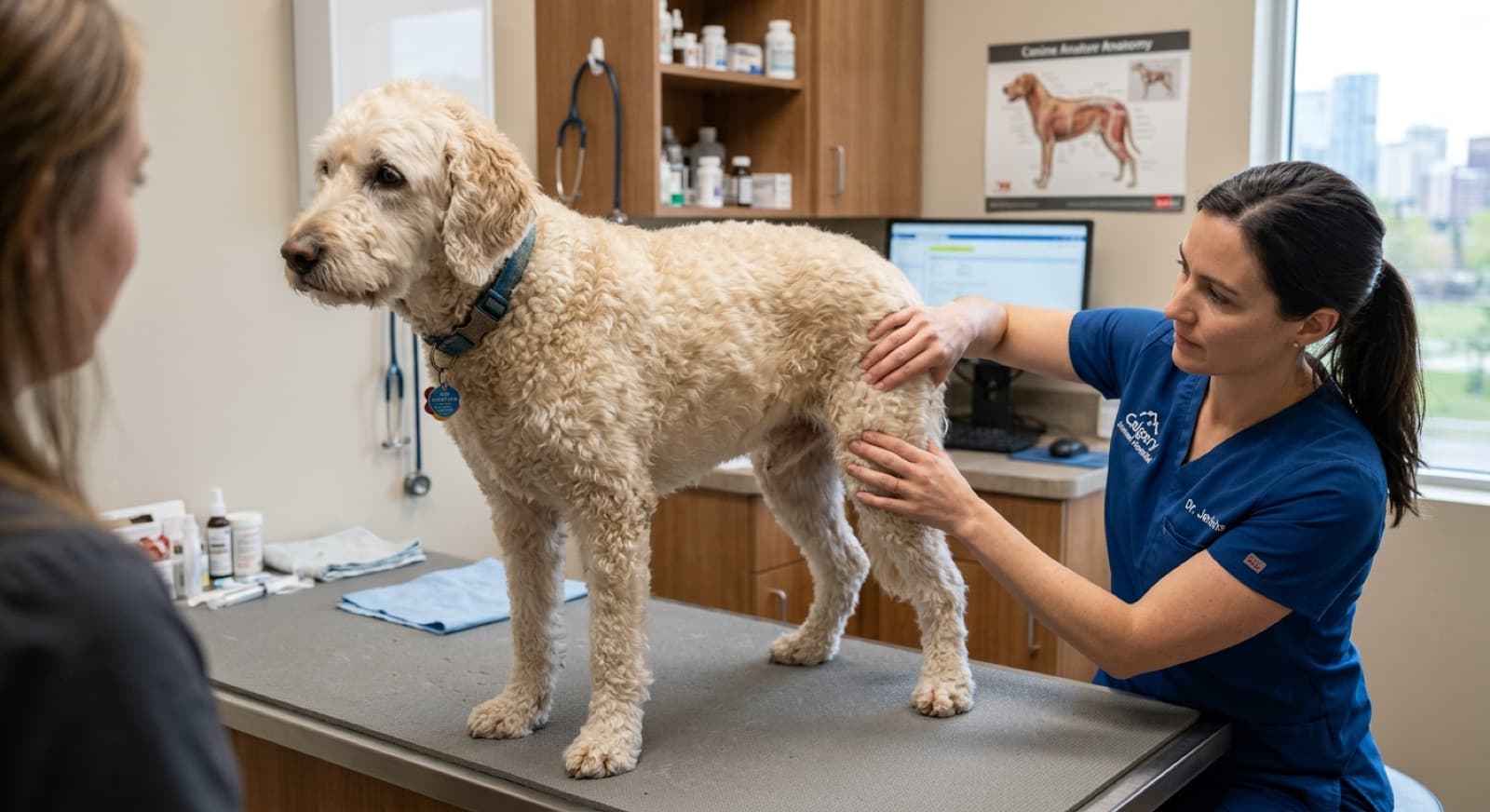
Labradoodles are a designer cross between a Labrador Retriever and a Standard, Miniature, or Toy Poodle. They were originally bred in Australia in the late 1980s as potential service dogs combining the Lab's trainability with the Poodle's lower-shedding coat. The breed has exploded in popularity since, and most Calgary Labradoodles today come from backyard or commercial breeders rather than the carefully health-tested programs the original developers intended. The result is a dog whose health profile is the sum of both parent breeds, not a magical halfway point. This article walks Calgary owners through what to ask your vet about at adoption and at every annual exam after that, what to watch for at home, and what belongs in the hands of a veterinarian rather than the internet. Sources include the American Kennel Club, the Poodle Club of America Health Foundation, the Orthopedic Foundation for Animals (OFA), the AKC Canine Health Foundation, and the parent organizations of the Australian Labradoodle (WALA and ALAA).
The hybrid vigour myth in designer crosses
Designer-cross marketing leans heavily on the idea that mixing two breeds produces a healthier dog through “hybrid vigour.” The research does not consistently support this claim for Labradoodles. A first-generation Labradoodle inherits half its genes from each parent breed, which means it can carry health risks from either side. Stacked risks can compound rather than cancel out.
Hybrid vigour (heterosis) is a real biological phenomenon, but it applies most strongly when two unrelated populations are crossed and the offspring show traits that exceed either parent. In dogs, the practical reality is more complicated. Many of the conditions that affect Labradors (hip dysplasia, EIC, PRA-prcd) and Poodles (Addison's, sebaceous adenitis, vWD) are autosomal recessive, which means they only appear when a dog inherits two affected copies. A Lab who is a PRA-prcd carrier bred to a Poodle who is also a PRA-prcd carrier (PRA-prcd is found in both breeds) can produce affected puppies, just as in a purebred-to-purebred breeding.
In other words: hybrid vigour does not protect against shared recessive mutations. Both parent breeds share several DNA-testable conditions (PRA-prcd notably), so the Lab and Poodle parents must each be tested. The same logic applies to orthopaedic screening: both breeds carry hip dysplasia risk, so both parents need OFA or PennHIP hip evaluations.
The honest framing for Calgary adopters is this: a Labradoodle from two carefully screened, DNA-tested, orthopaedically evaluated parents has a meaningfully better health outlook than one from untested parents. A Labradoodle from a backyard breeder who skipped screening has at least the same risk profile as a purebred from that same level of breeder, and possibly higher because two distinct breed risk lists now apply. The screening, not the cross, is what matters.
Health risks inherited from the Labrador side
Labrador Retrievers are one of the most-studied breeds in veterinary genetics. The OFA, the Labrador Retriever Club, and major canine health research organizations publish breed-specific health guidance. The Lab parent of a Labradoodle contributes the conditions below.
Hip dysplasia (both parent breeds)
Hip dysplasia is documented in both Labrador Retrievers and Standard Poodles, and is included in OFA hip dysplasia breed statistics for both. Both parents of a Labradoodle should have OFA or PennHIP hip evaluations on file.
Hip dysplasia is a developmental malformation of the hip joint where the ball and socket do not fit together correctly. Over time, the joint develops painful arthritis. The condition is influenced by genetics, growth rate, body weight, and exercise pattern during growth. Labradoodles, like both parent breeds, are at meaningful risk.
Symptoms to discuss with your Calgary vet:
- Bunny-hopping gait when running, where both rear legs push off together rather than alternating
- Reluctance to climb stairs, jump into the car, or get up onto the couch
- Hindlimb stiffness after rest that improves with movement
- Visible muscle wasting in the hindquarters
- A drop in willingness to walk far on Calgary off-leash trails such as Nose Hill Park or Fish Creek Provincial Park
Diagnosis is by X-ray imaging scored against OFA or PennHIP standards, read by your Calgary vet or referral radiologist. Management ranges from conservative care (weight control, joint support recommended by your vet, physiotherapy, and pain control your vet selects) through to surgical options for severe cases. Calgary owners facing bilateral hip dysplasia surgery should expect a serious cost commitment; surgical decisions and rehabilitation plans belong with the specialty team at a centre such as Western Veterinary Specialist Centre or VCA Canada West Veterinary Specialists.
Body weight is the most important owner-controllable factor. An overweight Labradoodle puts more load through hips and elbows than a lean one of the same height. Body condition scoring on the 1 to 9 scale at every Calgary vet visit is more useful than the bathroom scale alone. Lean Labradoodles do better on every orthopaedic measure across their lifespan.
Elbow dysplasia (Lab side)
Elbow dysplasia is a separate inherited orthopaedic condition prevalent in Labrador Retrievers. It refers to a group of developmental abnormalities of the elbow joint that lead to lameness in the forelimbs. The Lab parent of a Labradoodle should have an OFA elbow evaluation in addition to the hip evaluation.
Symptoms to discuss with your Calgary vet:
- Forelimb lameness, especially after exercise
- Stiffness in the front legs after rest
- Reluctance to bear weight evenly on the front legs
- Visible swelling of the elbow joint
- An outward or inward rotation of the front paw when standing
Diagnosis is by X-ray imaging at your Calgary vet, sometimes with referral to a veterinary radiologist for OFA scoring. Management options range from conservative care to surgical intervention; decisions belong with a Calgary specialty surgical team.
Exercise-induced collapse (EIC, Lab side)
Exercise-induced collapse (EIC) is an inherited neuromuscular condition in Labrador Retrievers in which affected dogs become weak or collapse during intense exercise. A DNA test for the DNM1 mutation has been available for years. The Lab parent of a Labradoodle should be EIC tested. Collapse during exercise in a young Labradoodle is a same-day Calgary vet conversation.
EIC typically appears between 5 months and 3 years of age. Affected dogs are clinically normal at rest and during light exercise but develop weakness, wobbly gait, and sometimes collapse during prolonged intense activity (most often around 5 to 15 minutes into vigorous exercise, especially when excited). Episodes usually resolve within 5 to 25 minutes of rest. The condition is autosomal recessive (two affected copies needed for clinical disease).
Signs to discuss with your Calgary vet:
- Wobbling, weakness, or staggering during fetch sessions, agility, or extended off-leash running
- Hindlimb collapse in particular (rear legs giving out first)
- Episodes triggered by high excitement combined with hard exercise
- Normal mental alertness during the episode (the dog is aware but cannot move normally)
- Full recovery within 5 to 25 minutes of rest
Diagnosis is by DNA testing through commercial veterinary genetics labs combined with clinical history; your Calgary vet orders and interprets the test. Management for affected dogs is exercise restriction: avoiding the specific high-intensity, high-excitement triggers that cause episodes. Most affected dogs can live full, happy lives at lower exercise intensities. Specific exercise prescriptions belong with your vet, not the internet.
For a Labradoodle from unknown lineage (most Calgary rescue Labradoodles), DNA testing through your vet is reasonable if there has been any history of weakness or collapse. For a Labradoodle from a breeder, the Lab parent's EIC test result should be in writing.
Progressive Retinal Atrophy (PRA-prcd, both parent breeds)
PRA-prcd (progressive rod-cone degeneration) is an inherited retinal disease documented in BOTH Labradors and Poodles. It causes gradual vision loss and eventual blindness. DNA testing is available, and because both parent breeds carry the mutation, BOTH parents of a Labradoodle should be DNA tested.
PRA-prcd is autosomal recessive. Affected dogs typically show first signs in middle age (around 3 to 6 years), starting with reduced night vision and gradually progressing to complete blindness over months to years. Because the mutation appears in both parent breeds, a Labradoodle from two untested carriers can be affected just as readily as a purebred from two untested carriers.
Early signs to discuss with your Calgary vet:
- Reluctance to navigate in dim light, especially evening walks during Calgary winter darkness
- Hesitation on stairs or curbs
- Bumping into furniture in rooms the dog should know
- A change in the appearance of the eye (sometimes the tapetum reflects light more strongly as the retina thins)
Diagnosis is by veterinary ophthalmology examination and DNA testing through commercial labs. Your Calgary vet decides which test and how to interpret it. There is no cure for PRA, but Labradoodles adapt remarkably well to gradual vision loss in familiar home environments. Furniture stays put, routines stay consistent, and verbal cues replace visual ones.
Bloat / GDV (Standard Labradoodles especially)
Gastric dilatation-volvulus (GDV), commonly called bloat, is a life-threatening same-day emergency in which the stomach distends with gas and may twist. Larger Standard Labradoodles with deep chests are at meaningful risk. Prophylactic gastropexy is worth discussing with your Calgary vet. Suspected bloat is an immediate 24-hour Calgary emergency vet trip.
Bloat is one of the leading causes of death in deep-chested medium and large breeds, including Labradors and Standard Poodles, with both parent breeds' risk profile passing through to Standard Labradoodles. Miniature and Toy Labradoodles (under approximately 30 lbs with shallower chests) carry lower risk. The condition can progress from initial signs to shock and death within hours; speed of recognition and response is what saves the dog.
Emergency signs that warrant an immediate 24-hour Calgary vet visit:
- A visibly distended or bloated abdomen, especially behind the ribs
- Unproductive retching: the dog tries to vomit but nothing comes up
- Restlessness, pacing, inability to settle
- Excessive drooling
- Pale gums, weakness, or collapse
- Rapid shallow breathing
Prophylactic gastropexy is a surgical procedure in which the stomach is tacked to the body wall, dramatically reducing the risk of the stomach twisting. It is often performed at the time of spay or neuter in at-risk breeds, with minimal additional cost or recovery. For Standard Labradoodles over approximately 50 lbs, this is a worthwhile conversation with your Calgary vet. Surgical decisions and timing belong with your vet team.
Risk-reduction strategies that your vet may discuss include feeding two or three smaller meals rather than one large meal, avoiding vigorous exercise immediately before or after eating, and avoiding raised food bowls (the evidence around elevated bowls is mixed, but some studies suggest they may increase risk; defer to your vet's current recommendation).
Obesity tendency (Lab side)
Labradors are famous for their food motivation. Research has identified a deletion in the POMC gene that affects appetite regulation and is found at high frequency in Labrador Retrievers. The result is a breed that is hard-wired to seek food and prone to obesity. The Lab parent contributes that genetic predisposition to a Labradoodle. Calgary Labradoodle owners should expect to manage food intake actively across the dog's lifespan.
Obesity in a Labradoodle worsens every other condition on this page. It accelerates hip and elbow dysplasia, increases anaesthesia risk, contributes to skin and ear disease, and shortens lifespan. Body condition scoring at every Calgary vet visit, accurate food measurement at home, treat budgeting, and reasonable daily exercise are the levers within owner control. Specific feeding plans (caloric intake, food choice, treat substitutions) belong with your vet.
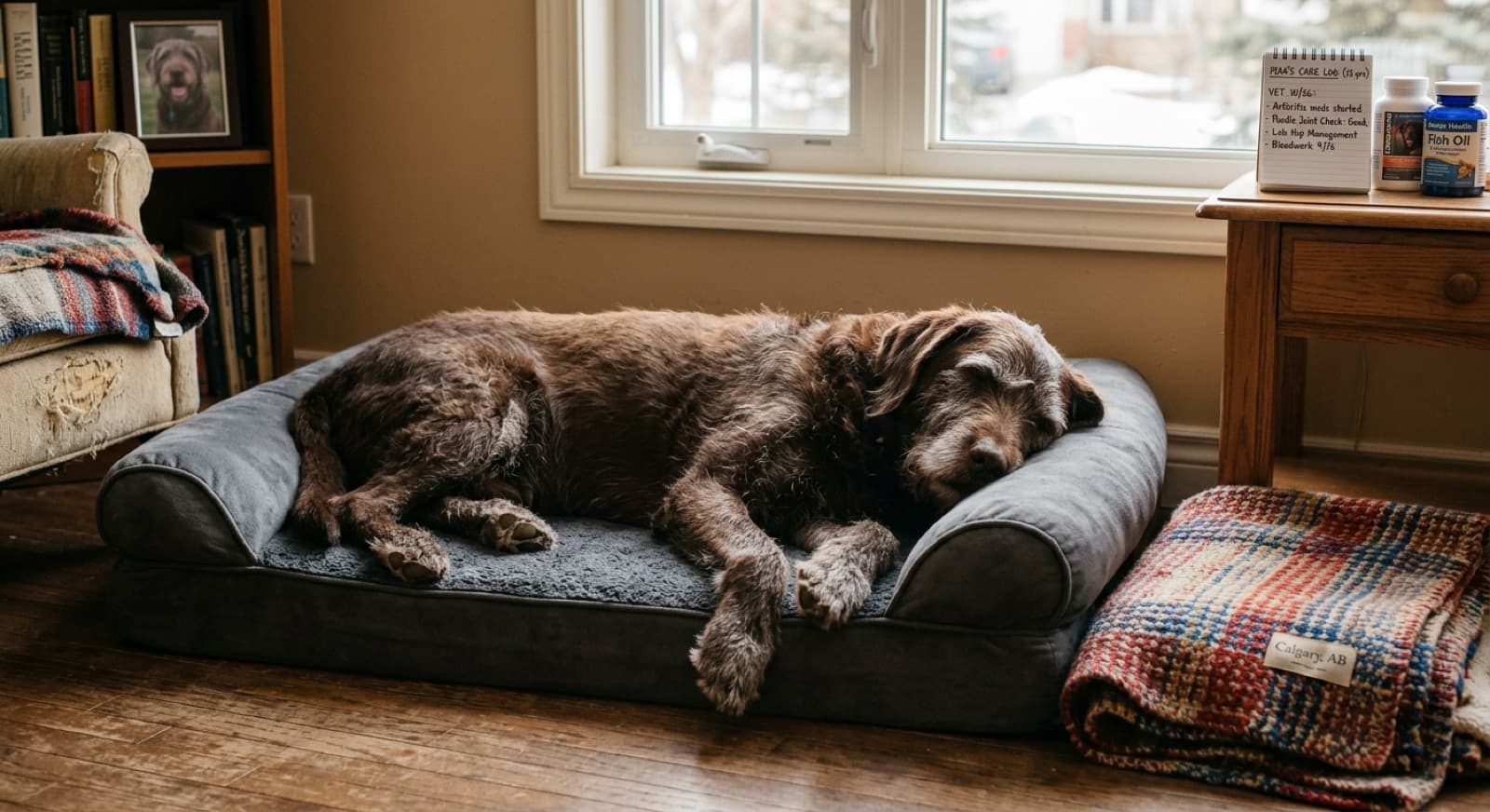
Health risks inherited from the Poodle side
Standard Poodles carry a distinct health risk profile. The Poodle Club of America Health Foundation and the OFA both publish breed-specific guidance. The Poodle parent of a Labradoodle contributes the conditions below.
Addison's disease / hypoadrenocorticism (Poodle side)
The Standard Poodle is among the breeds reported with elevated Addison's disease prevalence, and the predisposition can carry through to a Labradoodle. Addison's is an autoimmune condition where the adrenal glands stop producing adequate cortisol. The American College of Veterinary Internal Medicine publishes professional guidance. Lifelong but manageable when caught.
Canine Addison's disease (hypoadrenocorticism) is most commonly diagnosed in young to middle-aged adult dogs. Symptoms can be vague and episodic, which is why Addison's is sometimes called the great pretender: lethargy on one day, vomiting on another, weight loss noticed over weeks, and dogs who seem fine between episodes. An Addisonian crisis (severe collapse, profound weakness, dangerously low blood pressure, sometimes shock) is a same-day Calgary emergency vet event.
Symptoms to discuss with your Calgary vet:
- Episodic lethargy, often described as waxing and waning energy
- Vomiting and diarrhoea, sometimes recurrent
- Weight loss despite a normal appetite
- Weakness, sometimes collapse during stress
- Increased thirst and urination in some dogs
- Reduced appetite, food refusal
- Shaking or muscle tremors
- Slow heart rate on physical examination
Diagnosis is by bloodwork (electrolyte abnormalities, particularly sodium and potassium) followed by an ACTH stimulation test, ordered and interpreted by your vet. The ACTH stim test is the definitive diagnostic. Management is lifelong daily medication chosen and adjusted by your veterinarian, with regular bloodwork rechecks to monitor electrolytes and overall control. Many dogs with Addison's live full, active lives when the condition is well managed. Specific medications, dosing, and monitoring schedules belong entirely with your vet team; never adjust Addison's medication based on internet sources.
Lifetime cost framing. A well-managed Addison's dog with regular bloodwork and lifelong daily medication commonly runs around $1,000 to $2,000 per year in management costs in Calgary. Owners with pet insurance enrolled before any symptoms appeared have meaningful coverage. Insurance enrolled after diagnosis excludes Addison's as a pre-existing condition.
Emergency Calgary access for an Addisonian crisis. If your Labradoodle collapses or becomes severely weak, drive immediately to your nearest 24-hour clinic and call ahead. Calgary 24-hour emergency facilities include Western Veterinary Specialist and Emergency Centre, VCA Canada West Veterinary Specialists, the McKnight 24-Hour Veterinary Hospital, and the CARE Centre. An Addisonian crisis is treatable when caught early; delay is the enemy.
Sebaceous adenitis (Poodle side)
Sebaceous adenitis is an autoimmune skin condition in which the dog's own immune system attacks the sebaceous (oil) glands in the skin. It is documented in Standard Poodles and can appear in Labradoodles inheriting from a Standard Poodle parent. Signs typically appear in young to middle-aged adults.
Symptoms to discuss with your Calgary vet:
- Excessive scaling and dandruff, particularly along the back and head
- Hair loss in patches, often symmetric
- A dull, coarse, or matted coat
- A musty odour
- Skin lesions or visible inflammation
- Secondary bacterial or fungal infections
Diagnosis is by skin biopsy at your Calgary vet, sometimes with referral to a veterinary dermatologist. Management is lifelong and individualized: topical oil treatments, medicated shampoos, and immune-modulating medications chosen by your vet or dermatologist. There is no cure, but most dogs do well with consistent care. Treatment selection belongs entirely with the veterinary team; over-the-counter human products and home remedies are not a substitute.
Idiopathic epilepsy (Poodle side)
Idiopathic epilepsy is a seizure disorder of unknown specific cause that is documented in Standard Poodles. Seizures typically begin in young to middle-aged adults, often between 1 and 5 years of age. A Labradoodle inheriting from a Standard Poodle parent with epilepsy in the line carries elevated risk.
Signs to discuss with your Calgary vet (any first seizure warrants same-day vet contact):
- Generalized convulsions with loss of consciousness
- Stiffening, paddling of the legs, or rhythmic muscle jerking
- Drooling, urination, or defaecation during the seizure
- Disorientation, restlessness, or temporary blindness after the seizure
- Focal seizures (twitching of one body part, unusual repetitive behaviour)
Diagnosis is by ruling out other causes of seizures (toxin exposure, metabolic disease, brain tumour) through bloodwork, neurological examination, and sometimes advanced imaging at a Calgary specialty centre. Management of confirmed idiopathic epilepsy is lifelong anti-seizure medication chosen and adjusted by your vet, often with input from a veterinary neurologist. Specific drugs, dosing, and monitoring belong with the veterinary team. Most dogs achieve adequate seizure control with appropriate medication.
Von Willebrand disease (Poodle side, DNA testable)
Von Willebrand disease (vWD) is an inherited bleeding disorder caused by a deficiency in von Willebrand factor, a protein involved in blood clotting. Standard Poodles are among the breeds for which the vWD mutation has been documented and is DNA testable. A Labradoodle inheriting from an untested Standard Poodle parent can be at elevated risk.
vWD is typically silent until the dog has surgery, a significant injury, or other event that requires normal clotting. Affected dogs may experience prolonged bleeding from minor wounds, excessive bleeding after surgery, nosebleeds, or bloody urine or stool. Diagnosis is by DNA testing and additional clotting tests ordered by your vet.
The practical implication for Calgary Labradoodle owners is the same as for many DNA-testable conditions: ask the breeder for written vWD test results for the Standard Poodle parent. For a Labradoodle from unknown lineage, vWD testing is worth a conversation with your vet before any planned surgery, especially spay or neuter.
Other eye conditions (both parent breeds)
Beyond PRA-prcd, hereditary cataracts and glaucoma are documented in both Labradors and Poodles. Annual eye examinations through your vet or a referral ophthalmologist, with results recorded in the OFA Eye Certification Registry where available, are reasonable for Labradoodles, especially after age 5.
Hereditary cataracts are opacities in the lens that progress over months or years. They can develop in young adults or seniors. Diagnosis is by your vet or a referral ophthalmologist. Surgical correction is available at Calgary specialty centres when appropriate, and outcomes are generally good in otherwise healthy dogs.
Glaucoma is less common in Labradoodles than in some breeds but is always a same-day Calgary emergency when it occurs. Emergency signs include a red eye, squinting, cloudy cornea, a visibly enlarged eyeball, or the dog pulling away when the head is touched near the eye. Any new acute eye change is a same-day vet trip rather than a wait-until-Monday situation.
Calgary owners can access veterinary ophthalmology through specialty practices such as VCA Canada West Veterinary Specialists and Western Veterinary Specialist Centre. Your regular Calgary vet decides whether referral is appropriate and when.
Anaesthesia profile
Neither parent breed (Labrador Retriever nor Poodle) carries the MDR1 gene mutation that affects anaesthesia and certain medication safety in Australian Shepherds, Collies, and related herding breeds. Labradoodles generally tolerate standard anaesthesia protocols well.
Reasonable pre-operative steps before any elective procedure in a Labradoodle include:
- Standard pre-operative bloodwork
- A thorough cardiac auscultation
- Adrenal function discussion, particularly if any Addison's-suggestive symptoms have been noted
- For Standard Labradoodles: a gastropexy conversation if the dog is being spayed or neutered
- Standard hydration, fasting, and recovery monitoring protocols
Anaesthesia planning, drug selection, monitoring intensity, and any modifications to standard protocols belong entirely with your Calgary veterinary team and any specialty cardiology or internal medicine consultants they involve. The general message for owners: Labradoodles are not anaesthesia-fragile in the way MDR1-affected breeds are, but standard preoperative care still applies.
The ethical Labradoodle breeder screening checklist
If you are considering a Labradoodle from a breeder, the documentation below should be available in writing for BOTH parents (the Lab AND the Standard Poodle). Without these, walk away. The Worldwide Australian Labradoodle Association (WALA) and the Australian Labradoodle Association of America (ALAA) publish parent-club versions of this guidance.
Required documentation for the Labrador parent:
- OFA or PennHIP hip evaluation. OFA scores of Fair, Good, or Excellent are acceptable starting points.
- OFA elbow evaluation. Normal is the target.
- EIC DNA test result. Clear, Carrier, or Affected. Carrier-to-Carrier breedings should not be done.
- PRA-prcd DNA test result. Clear, Carrier, or Affected.
- CERF or OFA annual eye certification. Annual exams by a veterinary ophthalmologist.
Required documentation for the Standard Poodle parent:
- OFA or PennHIP hip evaluation. Standard Poodles carry hip dysplasia risk too.
- von Willebrand disease (vWD) DNA test result. Clear, Carrier, or Affected.
- PRA-prcd DNA test result. Clear, Carrier, or Affected. Pair Clear-to-Clear or Clear-to-Carrier with the Lab parent.
- CERF or OFA annual eye certification.
- Discussion of Addison's disease history in the breeding lines. Addison's does not have a single DNA test, but ethical breeders are transparent about adult-onset conditions in their lines.
- Discussion of sebaceous adenitis and epilepsy history in the breeding lines.
Beyond paperwork. An ethical Labradoodle breeder will want to meet you, ask about your home, ask about your previous dogs, and answer your questions in detail. They will offer a written contract that requires the dog to come back to them if it ever cannot stay with you. They will offer ongoing support. Puppies will have been socialized to many sights, sounds, surfaces, and handling experiences before they leave.
The walk-away test. If a Labradoodle breeder cannot or will not produce written OFA hip evaluations for BOTH parents and EIC DNA results for the Lab parent, walk away. These are the bare minimum. A Labradoodle from a backyard breeder with two untested parents carries the full untested risk profile of both breeds.
Calgary veterinary access for a Labradoodle
The single most useful thing a new Labradoodle owner can do in the first week is build a Calgary veterinary plan before the dog has a problem. That means a regular vet you trust, a 24-hour emergency clinic identified and saved in your phone, and a short list of specialty referral options for the breed-specific conditions that may come up.
Calgary planning checklist:
- Regular vet: Choose a Calgary clinic with experience in medium to large active breeds and with general designer-cross breed health profiles. Ask whether the practice has worked with Labradoodles and is familiar with breed-predisposed conditions including Addison's, EIC, and bloat. Use the Canadian Veterinary Medical Association directory if you need a starting point.
- 24-hour emergency clinic: Calgary has several distributed across NW, NE, SW, and SE. Identify the closest one to your home, save the address in your phone, and drive the route once in daylight so the path is in your head. Calgary 24-hour facilities include McKnight 24-Hour Veterinary Hospital, Western Veterinary Specialist and Emergency Centre, VCA Canada West Veterinary Specialists, and the CARE Centre.
- Specialty referral options: Calgary specialty centres including Western Veterinary Specialist Centre and VCA Canada West Veterinary Specialists handle internal medicine, cardiology, ophthalmology, dermatology, neurology, and orthopaedic surgery. You do not need to choose one in advance, but knowing they exist and that your regular vet can refer is useful.
- Pet insurance: Enrol while the Labradoodle is young and symptom-free. Compare Canadian providers on deductible, reimbursement, per-condition limits, and whether hereditary and bilateral conditions like hip dysplasia and cataracts are covered.
- Microchip and licence: Calgary requires dog licensing under the Responsible Pet Ownership Bylaw, and microchipping is a standard recommendation.
- Calgary-specific seasonal preparation: Winter paw protection for ice melt on Calgary sidewalks, lean body condition (especially important for hip and elbow health on slippery winter footing), and a Calgary-aware allergy management plan if your Labradoodle develops atopic signs from cottonwood pollen or grass.
Pet insurance ROI for a Labradoodle
Pet insurance is generally a strong consideration for Labradoodles because the stacked Lab + Poodle health profile includes several conditions whose lifetime management cost can run into thousands of dollars. Bilateral hip dysplasia surgery can run $8,000 to $15,000 in Calgary if both hips need intervention. Lifetime Addison's management commonly runs around $1,000 to $2,000 per year. Bloat emergency surgery can run several thousand dollars. Cataract surgery, dermatology workup for sebaceous adenitis, and seizure management for epilepsy all add up. Any single one can change the household budget calculation; combinations of two or three across a 10 to 14 year lifespan are not unusual for a Labradoodle from untested parents.
The lever that matters most is enrolling early. Every Canadian provider excludes pre-existing conditions. A Labradoodle enrolled at 8 weeks old with no symptoms qualifies for the broadest coverage; one enrolled at age 5 after a diagnosis of Addison's will have Addison's excluded from coverage indefinitely. Calgary premiums vary by provider, age, and breed, so request real quotes from several Canadian insurers and compare deductible, reimbursement (typically 70 to 90 percent), and per-condition versus annual limits side by side.
Questions to ask any insurer before enrolling a Labradoodle:
- Are hereditary and congenital conditions covered, or excluded?
- Are bilateral conditions (both eyes for cataracts, both hips for dysplasia) treated as one claim or two?
- Is there a per-condition lifetime cap or only an annual cap?
- How are pre-existing conditions defined, and what counts as evidence of pre-existence?
- Are diagnostics (bloodwork, urinalysis, imaging, echocardiography, DNA testing) covered, or only treatments?
- Is prophylactic gastropexy covered?
Labradoodle screening schedule by life stage
The breed-specific conditions above each have a typical onset window, which gives a reasonable framework for what to ask your Calgary vet about and when. The specific tests, the timing, and any modifications based on your individual dog's history are decisions for your veterinarian.
Puppy (under 12 months):
- Standard vaccination series, parasite prevention, neuter or spay conversation
- For Standard Labradoodles: gastropexy conversation at time of spay or neuter
- Confirm EIC, PRA-prcd, and vWD DNA status (from breeder paperwork or testing through your vet)
- Cardiac auscultation at every visit
- Body condition scoring established as a baseline; food intake and treat budget planning
- Watch closely for any neurological signs (epilepsy can present in young adults) or any exercise-related collapse (EIC)
Young adult (1 to 4 years):
- Annual wellness exam with full physical and dental check
- Annual cardiac auscultation
- Baseline bloodwork including electrolytes (early Addison's detection)
- Annual eye exam, OFA Eye Certification where available
- Hip radiograph conversation if any gait irregularity appears
- Skin and coat assessment for early signs of sebaceous adenitis
Middle-aged (5 to 8 years):
- Annual or twice-yearly wellness exams
- Annual full bloodwork including electrolytes and thyroid panel
- Addison's discussion if any episodic symptoms appear (ACTH stim test ordered by your vet if indicated)
- Annual eye exam (PRA-prcd often becomes apparent in this window)
- Cardiac auscultation; further imaging if any new murmur is detected
Senior (8+ years):
- Twice-yearly wellness exams
- Full senior bloodwork twice yearly, including electrolytes
- Annual eye exam (cataracts and glaucoma can develop in seniors)
- Cancer screening conversations; new lumps or lameness warrant prompt vet visits
- Joint support and mobility aids: orthopaedic bed, traction rugs on hardwood, ramps for stairs and the car
- Body condition scoring at every visit (obesity remains a hip and elbow accelerator)
- Quality-of-life conversations started long before they feel needed
Emergency signs that warrant immediate vet attention
These signs are same-day Calgary emergency vet visits. Do not wait, do not Google, do not ask the rescue's Facebook group. Drive to your nearest 24-hour clinic and call ahead so they are ready.
Suspected bloat / GDV (Standard Labradoodles especially):
- A visibly distended or bloated abdomen
- Unproductive retching (trying to vomit but nothing comes up)
- Restlessness, pacing, inability to settle
- Excessive drooling, pale gums, weakness, or collapse
- This is an immediate drive-to-the-emergency-vet event; speed matters more than anything else
Collapse during exercise (suspect EIC):
- Wobbly gait, weakness, or hindlimb collapse during vigorous exercise
- Episode typically 5 to 15 minutes into intense activity
- Most resolve within 5 to 25 minutes of rest, but the first episode warrants vet evaluation
Possible Addisonian crisis:
- Sudden collapse or inability to stand
- Profound weakness, especially in a stressful situation
- Severe lethargy combined with vomiting and diarrhoea
- Pale gums or visible weakness
Seizures (suspect epilepsy on first event):
- Generalized convulsions with loss of consciousness
- Cluster seizures (more than one within 24 hours) or prolonged seizures (over 5 minutes) are particular emergencies
- Time the seizure if you can do so safely; the duration helps your vet team
Eye emergencies:
- Sudden cloudiness, blue-grey corneal change, or a film over the eye
- Persistent squinting, especially with redness or swelling
- A visibly enlarged or painful eye (possible glaucoma)
- Sudden vision loss in an apparently healthy dog
Excessive bleeding (suspect vWD):
- Prolonged bleeding from a minor wound
- Persistent nosebleed
- Bloody urine or stool
- Excessive bruising
- Any unexpected bleeding after a planned procedure
Considering a Labradoodle in Calgary?
The stacked Lab + Poodle health profile is the conversation every Labradoodle adopter should have with their vet at the first visit, not the third. Browse adoptable Labradoodles in Calgary and read the matching breed-fit guides before you bring the dog home.
See Calgary Labradoodles available now →Frequently Asked Questions
Are Labradoodles healthier than purebreds?↓
What is EIC and should my Labradoodle be tested?↓
Do Labradoodles get bloat?↓
Should I get pet insurance for a Labradoodle?↓
Do Labradoodles inherit hip dysplasia from both parents?↓
What is Addison's disease and are Labradoodles prone to it?↓
What eye conditions affect Labradoodles?↓
Do Labradoodles have anaesthesia sensitivities?↓
What is sebaceous adenitis and how does it affect Labradoodles?↓
What health tests should a Labradoodle breeder provide?↓
Continue reading
Labradoodle adoption Calgary
The full Calgary Labradoodle adoption guide: rescues, costs, why Labradoodles end up in rescue, and the ethical-breeder vs rescue conversation.
Is a Labradoodle right for you?
Honest Calgary self-assessment: exercise needs, grooming commitment, climate fit, and who the breed is really for.
Labradoodle generations and coat guide
F1, F1b, F2, multigen: what generation and coat type mean for shedding, allergies, and grooming in Calgary.
Portuguese Water Dog health issues
Companion YMYL guide to PWD health: GM1, JDCM, Addison's, hips, eyes, and the ethical-breeder DNA checklist.
New dog? Start with these care guides
Everything a new adopter needs to set up a safe, happy home.