The honest version
With Cane Corsos, sex genuinely affects temperament, size, and training experience in ways that go beyond individual personality. Males run 99 to 110 lbs versus 88 to 99 lbs for females, with a 10 to 15 lb gap that shows up on every leash walk. Males mature mentally until age 3. Females finish around 2. Males show protectiveness more demonstratively. Females tend to be quieter but more handler-focused. Same-sex aggression is a real concern in this breed, especially intact-male-to-intact-male, which matters for any multi-dog Calgary household. Modern giant-breed vet guidance has shifted spay and neuter timing from 6 to 9 months to 18 to 24 months for better orthopedic health. Females live slightly longer (9 to 12 years vs 9 to 11 for males). Neither sex is a first-time large-dog breed. If you must choose, females are usually the easier introduction for experienced Calgary owners.
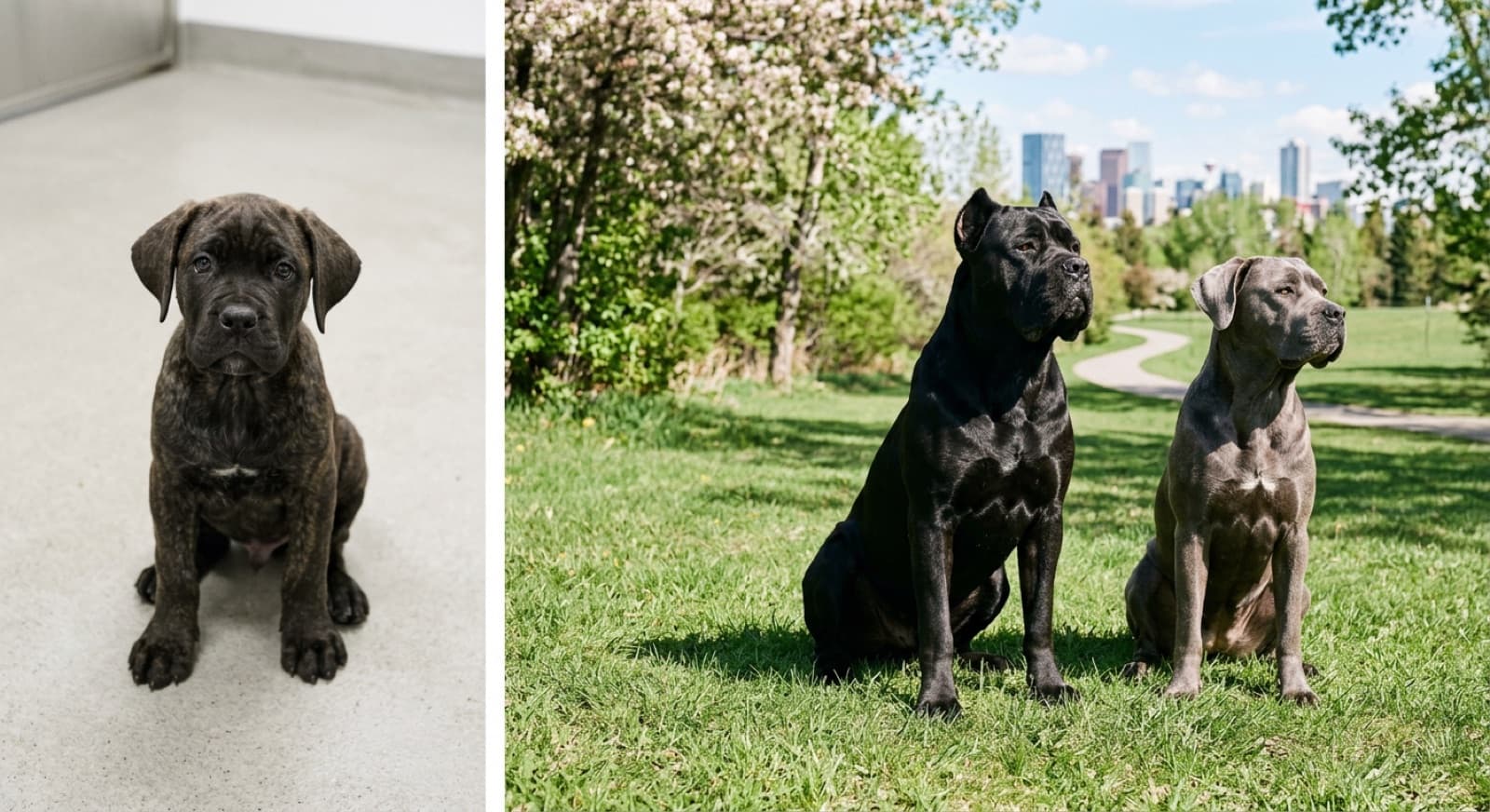
Why sex matters more in Cane Corsos
In most breeds, sex differences are real but mild. A male Labrador and a female Labrador are functionally similar dogs. With Cane Corsos, the pattern is different. The size gap is meaningful. The maturation timeline is meaningfully different. The protectiveness expression is different. Same-sex aggression is a documented breed trait. Long-time Corso owners on Reddit and breed forums consistently report that sex choice changed their experience in ways they did not anticipate going in.
None of this is a hard rule. Individual personality always matters. A confident female can outweigh a soft male in training challenge, and a calm intact male can integrate into a multi-dog home that a reactive female could not. But the breed-level patterns are real enough that Calgary adopters should understand them before choosing.
Size comparison
| Trait | Male Cane Corso | Female Cane Corso |
|---|---|---|
| Adult weight | 99 to 110 lbs | 88 to 99 lbs |
| Shoulder height | 25 to 28 inches | 23 to 26 inches |
| Head and jaw | Larger, blockier, more pronounced jowls | Slightly more refined, narrower muzzle |
| Muscle mass | Heavier, more visible bulk | Leaner, more athletic build |
| Mental maturation | ~3 years to adult brain | ~2 years to adult brain |
| Lifespan | 9 to 11 years | 9 to 12 years |
| Leash management | Stronger pulling, harder physical control | Easier on leash on average |
| Monthly food cost | $140 to $190 | $120 to $170 |
Weights and heights reflect FCI and CKC breed standards. Calgary food cost is based on premium giant-breed kibble at 2026 retail pricing. Individual dogs vary within these ranges.
Temperament differences
Males: bigger, bolder, slower to mature
Male Cane Corsos are generally more confident, more demonstrative with their protectiveness, and slower to mature mentally. They often bark or vocalize first when something seems off and present a larger, more imposing physical block to anyone the dog is suspicious of. Adolescence runs longer (often 18 months to 3 years) and impulse control develops slowly. Males pull harder on leash, push through doorways more aggressively, and need consistent boundary-setting through their second and third year. The reward is a confident, stable adult dog. The cost is a longer training runway.
Females: smaller, sharper, more handler-focused
Female Cane Corsos are often described as more subtle in their protectiveness. Instead of barking and rushing forward like a male, a female is more likely to go quiet, fix on the perceived threat, and watch. Owners sometimes call it “snake-like”: slower, more deliberate, harder to read. Females tend to bond intensely with one or two people in the household and orient toward their handler. They mature faster, are often more biddable in training, and pull less on leash. They can also be moodier if intact (heat cycles affect behaviour) and are more sensitive to harsh corrections.
What this looks like day to day
A male Corso meeting a stranger at the door is more likely to bark, posture, and need a verbal correction. A female is more likely to stand still, eyes locked, body lowered slightly. Both behaviours require management. The male is louder. The female is harder to read. Neither pattern is “safer”: they are different presentations of the same underlying breed-typical guardian instinct.
Aggression patterns by sex
Same-sex aggression: real and breed-typical
Same-sex aggression is a documented Cane Corso trait. The highest-risk pairing is two intact males in the same household. Conflict can develop slowly over months as the younger dog matures, then escalate quickly to serious fights. Two intact females can also clash, often around resources or status. Mixed-sex pairs (one male, one female) are the easiest combination and rarely show this pattern. Spay and neuter substantially reduce same-sex aggression but do not eliminate it. Calgary multi-dog households considering a Corso should default to opposite-sex pairings and spay or neuter at least one dog.
Owner-directed aggression: rare in either sex
Aggression directed at the owner is uncommon in well-bred, well-socialized Cane Corsos of either sex. When it does appear, it almost always traces to harsh or punishment-based training that triggered defensive responses, or to medical pain that the owner missed. Sex does not meaningfully predict owner-directed aggression. Training method does. Reward-based handling is the standard for the breed, not because Corsos are soft, but because punishment-trained Corsos become dangerous.
Stranger-reactive: males louder, females quieter
Both sexes alert to strangers approaching the home or family. Males tend to vocalize first with deep barking, posturing, and pushing forward. Females are often more silent: watching, lowering, waiting. The female pattern is harder for visitors and Calgary tradespeople to read because there is less warning. A silent fixed stare from a 90 lb dog can escalate without the audible warning that a male typically provides. Both patterns require management, structured introductions, and clear handler control.
Training differences
The biggest training difference between male and female Cane Corsos is timeline. Females mature mentally around 2 years. Males take closer to 3. That extra year matters. A 2-year-old male Corso is physically adult (often over 100 lbs) but mentally still adolescent — testing boundaries, slow to settle, prone to impulse decisions. The owner needs to manage a full-grown dog with a teenager brain for an additional 12 months.
Females tend to be more biddable on average. They orient toward their handler more naturally, focus better in training sessions, and pick up new commands faster. The trade-off is sensitivity. A correction tone that a male shrugs off can shut a female down for a full session. Females often respond better to softer, reward-heavy training. Males often need clearer, firmer (not harsher) structure and consistent repetition.
Both sexes need professional training, preferably starting before 16 weeks and continuing through adolescence. Calgary trainers experienced with guardian breeds (not all are) are the right fit. Group obedience classes work for foundational skills but most Corsos benefit from one-on-one work for impulse control, leash manners, and handler focus.
Health considerations by sex
Shared concerns (both sexes)
Dilated cardiomyopathy (DCM) is the leading cause of death in Cane Corsos and affects both sexes. Annual cardiac screening starting at age 3 is standard for the breed. Hip and elbow dysplasia are common, and OFA or PennHIP scoring of parents is non-negotiable for breeder purchases. Gastric dilatation-volvulus (bloat) is a life-threatening emergency in any deep-chested giant breed. Both sexes carry the risk. Calgary owners should know the symptoms and have a 24-hour emergency vet identified before a crisis.
Male-specific risks
Intact males develop prostate issues at higher rates, particularly past age 6. Neutering eliminates most prostate disease risk but introduces other trade-offs (joint and ligament). Males also have higher orthopedic injury rates across the breed, partly because of the larger frame and partly because intact males roam, fight, and push limits more than females. Cruciate ligament tears in particular are more common in males.
Female-specific risks
Intact females past their second heat cycle have a sharply elevated risk of pyometra (a life-threatening uterine infection) and mammary cancer. Pyometra typically presents in females 5+ years old, requires emergency surgery, and Calgary specialist treatment runs $4,000 to $8,000. Mammary cancer risk rises with each unspayed heat cycle. Spaying before the second heat cuts mammary cancer risk by roughly 75%. Spaying after the second heat still helps but the protective effect is smaller.
Spay and neuter timing for giant breeds
Old guidance for Cane Corsos was spay or neuter at 6 to 9 months. That advice came from small and medium-breed research and was applied to giant breeds without solid evidence. Modern giant-breed orthopedic research has shifted the recommendation.
Current best-practice guidance for giant breeds is 18 to 24 months, after the growth plates have closed. Sex hormones drive proper bone, joint, and muscle development through adolescence. Removing them early in a giant breed is linked to higher rates of cruciate ligament tears, hip dysplasia, and certain cancers. Waiting until skeletal maturity produces a structurally sounder adult dog.
The trade-offs of waiting are real. Intact males mark, roam, and mount more. Intact females have two heat cycles per year with management challenges and pyometra and mammary cancer risk after the second heat. Multi-dog households face same-sex aggression risk that spay or neuter would reduce. The decision is individual and Calgary guardian-breed-experienced vets are increasingly walking through it case by case rather than defaulting to a fixed age.
Talk to a Calgary vet who has handled multiple Cane Corsos or other Mastiff-type dogs. The blanket “fix by 6 months” rule is no longer the standard for this breed.
Lifespan
Female Cane Corsos live slightly longer than males on average. Females typically reach 9 to 12 years. Males typically reach 9 to 11. The 1-year gap is consistent with the general pattern that female dogs outlive males, especially in giant breeds where lifespan is shorter overall.
The single biggest factor in either sex is weight management. An overweight Corso develops joint disease, DCM compounded by cardiac stress, and earlier mobility loss. Keeping a Corso lean (ribs easily felt, clear waist, no fat pad on the lower back) adds years. Annual cardiac screening from age 3 catches DCM early enough to manage with medication. Both interventions matter more than sex.
Browse adoptable Cane Corsos in Calgary
Live listings from 15+ Calgary rescues, refreshed regularly. Both male and female Cane Corsos plus Mastiff and guardian-breed mixes. Foster reports usually include sex, spay or neuter status, kid history, multi-dog history, and same-sex behaviour notes.
See Available Cane Corsos →Calgary rescue availability
Both sexes appear in Calgary rescue. Males show up slightly more often, usually surrendered between 12 and 24 months when owners underestimate adolescence, leash management, or same-sex conflict with an existing dog. Female surrenders tend to be older, often retired breeding females from less-reputable operations, available at 4 to 7 years old. These older females can be excellent companion dogs for experienced owners who can skip the adolescent training arc entirely.
Adoption fees through Calgary Humane Society, AARCS, BARCS, Pawsitive Match, and other general rescues run $300 to $700 regardless of sex. Foster reports usually include sex, spay or neuter status, kid history, cat history, multi-dog history, and same-sex behaviour notes. That information is often more useful than what a breeder puppy comes with. Cane Corso rescue intake in Alberta runs 15 to 30 dogs per year across all general rescues combined.
Cost differences
Total cost of ownership is similar between sexes. The one consistent gap is food: females eat about 10 to 15% less than males because they carry less body weight. On premium giant-breed kibble at 2026 Calgary retail pricing, that works out to a $10 to $20 monthly savings, or $120 to $240 per year. Over a 10-year lifespan, the food cost difference is $1,200 to $2,400.
Vet costs are broadly similar. Spay surgery costs more than neuter in Calgary (roughly $700 to $1,200 vs $500 to $900 at standard clinics) but the difference is one-time. Insurance premiums are typically a few dollars per month higher for males because of higher orthopedic injury rates, but the gap is small. Training costs, food bowl, beds, harnesses, and crates are similar.
Which one is right for your Calgary household?
Choose a male if…
- You have prior experience with large guardian breeds and are comfortable with a 3-year maturation arc.
- You want a more demonstrative protector who barks, postures, and gives clear warning behaviour.
- You are physically capable of handling 100+ lbs on leash through adolescence.
- You do not currently own another intact male dog and do not plan to.
- You are committed to professional training from 12 weeks through 24+ months.
Choose a female if…
- You have some large-dog experience but this is your first guardian breed.
- You want a slightly smaller, more handler-focused dog.
- You prefer a quieter, more subtle guardian style.
- You can read body language and respond to silent fixed-stare alerting.
- You have an existing male dog in the household.
- You can commit to spay timing planning (before or after second heat) with a giant-breed-experienced vet.
Reconsider a Cane Corso entirely if…
- This is your first large dog (regardless of sex).
- You already have an intact dog of either sex.
- You cannot physically manage 100 lbs of muscle on leash during adolescence.
- You are unable to commit to 18 to 24 months of consistent professional training.
- You expect a calm couch dog right out of puppyhood. The calm adult comes later, after the training investment.
Frequently Asked Questions
Does sex really matter more in Cane Corsos than other breeds?
Yes. Reddit Corso owners consistently report sex affects temperament, size, and training experience more in this breed than in most. Males average 10 to 15 lbs heavier, mature more slowly (3 years vs 2), and show protectiveness more demonstratively. Females are more handler-focused, mature faster, and can be more biddable but also more sensitive to harsh handling. Same-sex aggression risk is real in this breed.
How much bigger are male Cane Corsos than females?
Males weigh 99 to 110 lbs and stand 25 to 28 inches at the shoulder. Females weigh 88 to 99 lbs and stand 23 to 26 inches. Males also carry noticeably more muscle and have a larger, blockier head with more pronounced jowls. The size gap is bigger than in most breeds and shows up on every leash walk.
Is same-sex aggression real in Cane Corsos?
Yes. It is a documented breed trait. The highest-risk pairing is two intact males. Two intact females can also clash. Mixed-sex pairs are generally easier. Spay and neuter reduce risk but do not eliminate it. Any Calgary multi-dog household considering a Corso should default to opposite-sex pairings.
Are female Cane Corsos easier to train?
On average, yes. Females mature faster, focus on their handler more naturally, and pick up commands quicker. The trade-off is sensitivity. Females can be more affected by harsh corrections. Both sexes need reward-based training and consistent handlers. Neither sex is appropriate for first-time large-dog owners.
When should I spay or neuter my Cane Corso?
Old guidance was 6 to 9 months. Modern giant-breed orthopedic research has shifted the recommendation to 18 to 24 months, after growth plates close. Early spay and neuter in giant breeds is linked to higher rates of cruciate tears, hip dysplasia, and certain cancers. Discuss timing with a Calgary giant-breed-experienced vet.
Do female Cane Corsos live longer than males?
Slightly. Females average 9 to 12 years. Males average 9 to 11. Both sexes share the same major health concerns: DCM, hip and elbow dysplasia, and bloat. Lifespan depends more on weight management and early DCM screening than on sex.
Which sex is better for a first-time Cane Corso owner?
Honestly, neither. Corsos are not a first-time large-dog breed. If a household is set on the breed and is experienced with other large dogs, females are usually the easier introduction: smaller, faster-maturing, more handler-focused, less leash pulling. A spayed female from a reputable Calgary rescue is the safest entry point.
Are male or female Cane Corsos more available in Calgary rescue?
Both appear. Males show up slightly more often, usually surrendered between 12 and 24 months when owners underestimate adolescence. Females in rescue are often older retired breeding females. Adoption fees through general Calgary rescues run $300 to $700 for either sex. Foster reports usually include same-sex behaviour notes.
More Cane Corso guides
Cane Corso Adoption Calgary →
Where to find a rescue Cane Corso in Calgary, real costs, sex availability, and how guardian-breed adoption screening works.
Is a Cane Corso Right for You? →
Honest self-assessment for Calgary households considering a Corso. Experience required, household fit, and lifestyle reality.
Cane Corso Temperament & Aggression →
Honest read on Corso temperament, aggression patterns, what triggers reactivity, and how Calgary owners manage it.
Cane Corso Training Calgary →
Training timeline through adolescence, Calgary guardian-breed trainers, and what 18 to 24 months of work looks like.
Cane Corso Health Issues →
DCM, hip and elbow dysplasia, bloat, and breed-specific health concerns every Calgary Corso owner should know.
Cane Corso Cost of Ownership →
Annual and lifetime cost of a Cane Corso in Calgary, including DCM and orthopedic scenarios and pet insurance.
Cane Corso with Kids & Cats →
Honest read on Corsos with children, cats, and other dogs. Supervision, introductions, and household management.
Buy or Adopt a Cane Corso →
Calgary breeder pricing vs adoption fees, how to vet a guardian-breed breeder, and what cheap puppy listings actually mean.
New dog? Start with these care guides
Everything a new adopter needs to set up a safe, happy home.