The short answer
Plan for a professional groom every 6 to 8 weeks ($60 to $110 typical, $80 to $130 if hand stripped), daily 5 to 10 minute home brushing focused on beard, eyebrows, and leg furnishings, and a clear decision early on hand stripping versus clipping. Hand stripping keeps the salt-and-pepper colour bright and the wiry texture intact. Clipping is easier and cheaper but the coat softens and fades over time. Total annual cost runs $500 to $900 for a healthy Schnauzer with no chronic skin issues.
This article is informational only and does not replace veterinary advice. Skin conditions, allergy diagnosis, and medication choices are veterinary work. Consult your Calgary veterinarian for individualised guidance for your dog.
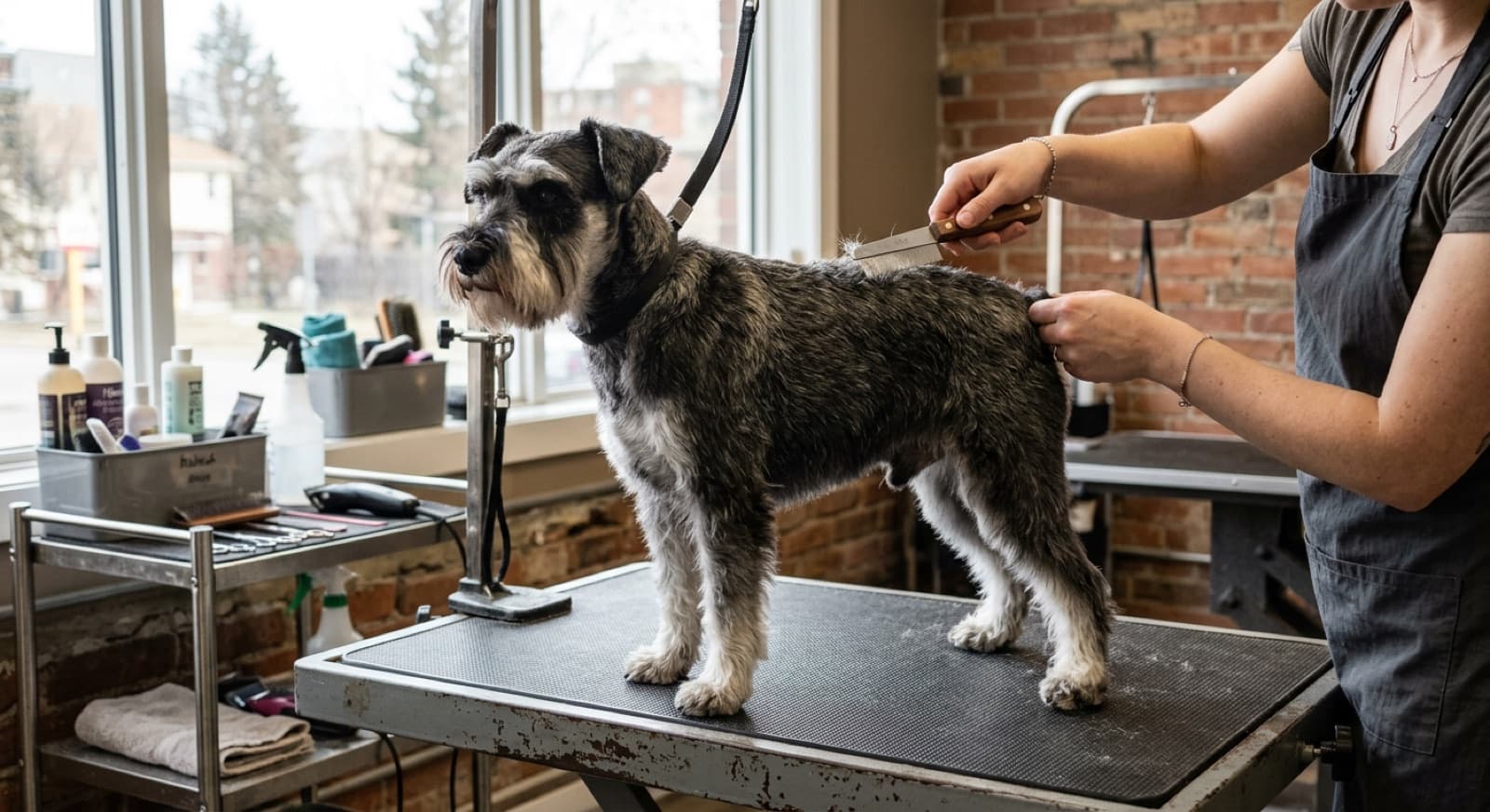
Why the Mini Schnauzer coat is unique
The Miniature Schnauzer was developed in Germany in the late 19th century as a small farm dog, ratter, and household companion, scaled down from the Standard Schnauzer. Like its larger ancestor, the breed carries a working terrier double coat: a harsh wiry outer guard layer over a soft dense undercoat. The wire texture is not cosmetic. It was bred to shed dirt, resist moisture, and protect the dog from rats and brush on a farm.
The breed colour standard recognises three: salt-and-pepper (the most common), pure black, and black-and-silver. Salt-and-pepper is a banded hair pattern (each individual hair has alternating dark and light segments) that gives the breed its distinctive grizzled look. This is one of the reasons hand stripping matters for colour preservation. The banded pigment lives along the length of the harsh outer hair; clip the hair and you cut through the bands, exposing the duller base colour and fading the visual contrast.
The coat structure produces three high-maintenance zones unique to the breed:
- The beard. Long coarse hair on the muzzle. Functional for the breed's original ratting work; high maintenance for modern owners because it catches food, water, mud, snow, dust, and saliva.
- The eyebrows. Long hair over the eyes that gives the breed its expressive look. Needs trimming so it does not fall into the eye.
- The leg furnishings. Long softer hair on the lower legs and underbelly. Mats fast if not brushed.
None of this is a reason to avoid the breed. It is a reason to know the workload before adopting. The Schnauzer look is the breed's defining feature, and the daily routine is part of the package.
Hand stripping versus clipping
This is the defining grooming decision for any Mini Schnauzer owner. Both are valid. They produce different coats, different costs, and different long term outcomes. The American Miniature Schnauzer Club grooming standards reference hand stripping as the breed standard for show, though the choice for a pet is personal.
Hand stripping. The groomer pulls out the dead outer guard hairs by hand or with a stripping knife. The new harsh wire coat grows in cleanly underneath. The breed coat texture stays intact. The salt-and-pepper colour stays vivid because the banded outer hairs cycle naturally. The skin breathes better because the natural shedding cycle is preserved. Calgary salons charge $80 to $130 per hand strip session on a 6 to 8 week cycle. Hand stripping is the breed standard answer for a Schnauzer with healthy skin and a reasonable temperament for the work.
Clipping. The groomer uses electric clippers to shave the outer coat off at a chosen length. Easier on the dog who dislikes pulling. Faster session, lower cost ($60 to $95 a Calgary session). The trade off is that the coat softens over time as the harsh outer hairs no longer cycle naturally. The salt-and-pepper colour fades toward grey or beige because clipping cuts through the banded pigment in the outer hair. Some dogs also shed more dander after a transition to clipping. Other groomers prefer clipping for dogs with chronic skin issues because the pulling involved in stripping can flare sensitive skin.
How to choose:
- Healthy skin, tolerates handling, owner wants breed standard look: hand strip.
- Healthy skin, dog dislikes pulling, owner wants lower cost: clip.
- Diagnosed skin condition, vet has weighed in: follow your vet and groomer's combined recommendation; either can work.
- Senior Schnauzer with skin getting more fragile: clip is usually kinder.
- Show coat ambitions: hand strip exclusively.
Both choices are defensible. The wrong answer is doing nothing for 6 months and ending up at a $120 to $160 shave down because the beard and furnishings matted out. Pick a path, stick with the 6 to 8 week cadence, and adjust over the first year as you learn your dog.
The daily home routine
Five to ten minutes a day is the sustainable minimum for most adult Mini Schnauzers. The beard, eyebrows, leg furnishings, and tail are the focus zones because that is where mats form fastest. The basic sequence:
- Slicker brush, line brushing on the body. Part the coat with one hand and brush the section underneath. Move from the skin outward in short strokes. Work from chest to hips, then down each leg. This is the difference between brushing the top of the coat (which feels productive but does not prevent mats) and brushing near the skin (which is where mats form).
- Beard brush plus wipe. Brush through the beard with a smaller slicker or boar bristle brush to clear food debris. Wipe with a damp cloth or beard wipe. Dry thoroughly. Wet beard left on the dog breeds bacteria and skin irritation.
- Eyebrow check. Brush eyebrows forward over the eyes and check whether any hair is touching the eye corner. If so, trim back at an angle with curved blunt-tipped scissors. Do this every 2 to 3 weeks at home; your groomer can also handle it at every salon visit.
- Leg furnishing pass. Slicker the lower legs and underbelly hair, then metal comb through to verify the coat is clear. These are the second most common mat zone after the beard.
- Metal comb check overall. A fine to wide metal comb tells you whether the coat is clear at skin level. If the comb glides through, you are done. If it catches, go back with the slicker.
- Reward. Treat at the end every time. Most Schnauzers tolerate the routine well if it starts early and stays gentle.
The Calgary at home kit (generic categories, your groomer or vet picks the specific brands for your dog):
- Medium slicker brush ($25 to $40)
- Smaller slicker or boar bristle brush for the beard ($10 to $20)
- Metal greyhound comb, fine and wide ($15 to $25)
- Curved blunt-tipped scissors for eyebrows ($15 to $30)
- Stripping knife if you plan to learn home stripping ($20 to $50)
- Detangling spray ($10 to $20)
- Gentle hypoallergenic shampoo (groomer or vet recommendation)
- Beard wipes or a soft washcloth ($10 to $20)
- Ear cleaning solution (vet recommended only)
- Nail clipper or grinder ($20 to $50)
Total kit cost runs $130 to $250 once and lasts for years. Specific brands are a groomer and vet conversation; the structure above is the kit you need to assemble.
The beard reality
If there is one part of Mini Schnauzer ownership that catches new owners off guard, it is the beard. The breed signature is also the breed's highest maintenance feature, and the difference between a clean dog and a smelly one comes down to beard hygiene.
What the beard catches. Every meal leaves food residue. Every water bowl visit leaves the beard soaked. Every walk picks up dust, dirt, mud, snow, ice, leaves, and grass. The beard is a wick that pulls everything off the ground up toward the muzzle and face.
Wash cadence. Two to three times a week with mild shampoo or daily damp cloth wipes is the practical baseline. Messy eaters and aggressive water drinkers usually need a daily wash. The full beard shampoo wash takes about 90 seconds and does not require bathing the whole dog.
Dry thoroughly. This matters more than the washing. Wet beard left to sit on the dog produces bacterial growth, skin irritation, and a sour smell. Towel dry firmly after every wash. Some owners use a low setting hair dryer on the beard; others find a thorough towel and air dry sufficient.
Beard staining. Brownish or rust staining around the muzzle is common in lighter coloured Schnauzers. The cause is usually saliva oxidation combined with food residue. Daily wiping prevents most of it. Once staining has set in, it grows out with the coat over weeks; do not use bleach, peroxide, or unverified online whitening products near the eyes or mouth.
Beard length. Calgary winter (especially below minus 25 Celsius) freezes a long beard solid on walks. Most Calgary Schnauzer owners keep the beard at a moderate length year round and ask the groomer to trim it shorter heading into the deep winter months. A frozen beard is uncomfortable and can crack at the skin contact point.
Eye proximity. The beard sits close to the eyes, and a wet beard wicking moisture upward is one of the most common causes of tear staining in the breed. Drying the beard thoroughly after every wash, and trimming eyebrows so they do not fall into the eye, prevents most tear staining. Persistent staining despite the basics warrants a vet visit to rule out tear duct issues or eye structure problems.
Calgary salon grooming and cut styles
A standard Calgary Mini Schnauzer groom takes 90 minutes to 2 hours and includes bath, blow dry, hand strip or clip body, scissor head into the rounded Schnauzer crown shape, beard and eyebrow shape, ear care, nail care, and a sanitary trim. Pricing typically runs $60 to $110 for a clip and $80 to $130 for a hand strip.
Common Calgary cut styles:
- Show cut. Full hand strip preservation. The harsh wire outer coat is maintained on the body, with full leg furnishings, full beard and eyebrows, and the breed standard head shape. This is what you see in the breed ring.
- Pet cut (clipped). Clipped body at 0.5 to 1 inch length. Leg furnishings, beard, and eyebrows scissored to a tidy length. Practical, easier to maintain at home, and the most common Calgary choice.
- Pet cut (hand stripped). Like the pet cut but with the body hand stripped instead of clipped. Preserves the wire texture and salt-and-pepper colour. The middle ground between show cut and clipped pet cut.
- Calgary winter cut. Slightly longer body (1 to 1.5 inches) for insulation. Beard trimmed shorter than usual to prevent freezing. Leg furnishings full length for paw warmth on cold walks.
- Summer trim. Shorter body (0.5 to 0.75 inches) for cooling. Beard and leg furnishings tidied to a manageable length. Some owners ask for a full puppy cut style in deep summer that takes the whole coat down to a uniform short length; this is a heat management choice rather than a breed standard look.
Discuss seasonal style with your Calgary groomer at the first visit of each season. The flexibility to adjust between winter and summer is one of the practical advantages of working with a breed-experienced groomer.
Ear care, eye care, and pricked ear advantage
Ears. Mini Schnauzer ears stand pricked rather than droopy. Airflow into the canal is excellent and base ear infection risk is lower than droop-eared breeds. Lift the flap and look inside once a week. Healthy Schnauzer ears stay pale pink with minimal wax and no smell. If you see redness, swelling, dark discharge, or smell a yeasty or foul odour, book a vet visit rather than clean at home. Some Schnauzers have hair growing inside the ear canal that benefits from gentle plucking by a groomer at every visit; ask your groomer if this applies to your dog.
Eyes. The proximity of the beard and eyebrows to the eyes makes daily eye area care a Mini Schnauzer specific habit. Wipe the eye area with a damp cloth daily to clear any debris or tear residue. Trim eyebrows back from the eye every 2 to 3 weeks so the hair does not touch the eye corner. Tear staining around the eyes is common and usually preventable through these two habits. Persistent staining despite the basics warrants a vet visit to rule out tear duct obstruction or eye structure issues. The Cornell Riney Canine Health Center maintains owner-facing material on eye health concerns worth reading for any small breed owner.
Tear staining management. Start with the easy fixes (eyebrow trim, daily eye wipe, dry beard). If staining continues, book a vet visit. Do not use peroxide, lemon juice, or unverified online tear stain products near the eye. Ask your vet for a veterinary-approved tear stain solution if topical care is needed. The American Animal Hospital Association publishes general guidance on eye care for small breed dogs.
Calgary climate strategies
The Mini Schnauzer wiry double coat handles Calgary winter better than most owners expect, and a few specific habits make the seasonal transitions easier.
Deep winter (November through March). Keep the body coat slightly longer (1 to 1.5 inches) for insulation. Hand stripped Schnauzers retain their full coat function. Clipped Schnauzers should be left at 1 to 1.5 inches rather than a close clip. Trim the beard shorter than usual because a long beard freezes solid below minus 25 Celsius (a real concern in Calgary January and February). Most healthy adult Schnauzers handle walks down to about minus 15 Celsius without a jacket; below that, a fitted winter coat helps, especially for seniors. Paw pad hair traps ice and salt; ask your groomer to keep it trimmed short at every winter groom.
Summer (May through September). A slightly shorter clip (0.5 to 0.75 inches) keeps the dog cool. Resist the urge to shave fully; the coat provides some sun protection and a complete shave exposes the skin to sunburn risk on bright prairie days. Hot pavement burns paw pads. The 7 second rule (place the back of your hand on the pavement for 7 seconds; if you cannot keep it there, it is too hot for paws) is a reasonable test. Walk early morning or late evening on hot days. Bow River pathways and Edworthy Park grass trails are kinder to paws than pavement on summer afternoons.
Shoulder seasons (April and October). Chinook activity peaks. Layer for variability. Carry a removable jacket on walks. Towel dry thoroughly after any wet outing because the alternating wet and dry of chinook melt cycles tangles the leg furnishings and beard and can irritate sensitive skin.
Salt and ice melt. Calgary sidewalks get heavy salt and ice melt application from November through March. Rinse paws with lukewarm water after walks, keep paw pad hair trimmed short, and watch for cracking or redness between the toes. Some Schnauzers tolerate boots well; many do not, and a paw rinse routine is usually the easier compromise.
Schnauzer comedo syndrome and other skin concerns
Unusual bumps along the back, persistent itch, recurrent skin or ear infections, or any new lesion warrant a vet visit rather than home treatment. Mini Schnauzers carry breed-specific skin risk; specialist involvement often shortens the path to a working management plan.
Schnauzer comedo syndrome. A breed-specific skin condition that produces small dark bumps or blackhead-like lesions along the back, typically following the line of the spine. The bumps are clogged hair follicles. The condition is genetic, not infectious, and not caused by poor hygiene. Most cases are mild and managed with regular gentle bathing, vet recommended medicated shampoo, and occasional vet follow up. Severe cases can develop secondary bacterial infections and may need more involved veterinary management. The American College of Veterinary Dermatology recognises the condition as a breed-associated dermatosis.
Warning signs that warrant a vet visit:
- Small dark bumps along the back, especially following the spine
- Blackhead-like lesions that increase in number over weeks
- Hair loss or thinning over the affected area
- Redness, swelling, or pus from any of the bumps (suggests secondary infection)
- The dog scratching or chewing at the back persistently
Other Mini Schnauzer skin concerns. Atopic dermatitis (allergic skin disease) is less prominent in the breed than in Westies but does occur. Watch for itchy paws, recurrent ear infections, face rubbing, and belly redness as early signs. Hyperlipidemia (high blood fat levels) is also more common in Mini Schnauzers than most breeds and can contribute to skin and pancreatitis issues; your vet may recommend periodic blood work as part of routine care.
Calgary specialty options if needed:
- Western Veterinary Specialist Centre. Multi-specialty hospital with dermatology services available by referral.
- VCA Canada West Veterinary Specialists. Specialty hospital with dermatology referral capacity in the Calgary area.
- Calgary Pet Wellness and Spay or Neuter Clinic. Lower cost general practice option for routine skin exams and follow up, with referral up if specialist input is needed.
Pet insurance enrolled before any skin diagnosis covers most chronic skin spend. Insurance enrolled after diagnosis excludes the condition as pre-existing. See the Mini Schnauzer health issues guide for the full pet insurance ROI breakdown for the breed.
Browse adoptable Mini Schnauzers in Calgary
The iconic Schnauzer look (beard, eyebrows, leg furnishings) is also a daily commitment. Most Calgary Mini Schnauzers in rescue are between 2 and 8 years old, which means the adult coat is established and any skin history is on record with the rescue. That visibility lets you plan grooming for a known dog rather than guessing how a puppy will develop. If the workload outlined above feels manageable, the rescue network can match you with a Schnauzer whose care needs fit your household.
See Available Mini Schnauzers →The cost of grooming neglect
Most Calgary Mini Schnauzer owners learn the maintenance math the hard way at their second or third groom appointment. They skipped beard care during a busy stretch, brought the dog in expecting a routine $80 visit, and got told the dog had to be shaved down because the beard or leg furnishings matted too deeply to safely brush out.
The cost picture, neglect versus routine:
- Routine clip or strip every 6 to 8 weeks: $60 to $130 a session, $500 to $900 a year.
- Shave down after matting: $120 to $160 for the reset visit, plus 2 to 3 months of regrowth where the coat is too short to be the breed look. The salt-and-pepper colour also takes longer to recover after a shave because the new growth is initially shorter and duller before the banded pigment establishes.
- Chronic beard skin infection: $200 to $400 a vet visit, often several visits if neglected long enough for bacterial growth to establish. Preventable with routine beard hygiene.
- Tear staining once established: growth-out takes 4 to 8 weeks once eyebrow trim and daily eye wipe are in place. Preventable with daily basics.
- Groomer aversive dog: harder to quantify but real. Schnauzers who have a difficult shave down session sometimes develop anxiety around future grooming visits, which compounds the workload at every appointment thereafter.
The fix is prevention. Daily 5 to 10 minute brushing focused on beard, eyebrows, and leg furnishings; weekly slicker line brushing on the body; and a 6 to 8 week professional cadence locked in. The Schnauzers who do best at the groomer are the dogs who do not need anything dramatic done because the owner kept the coat clear at home.
The puppy to adult coat transition
The Mini Schnauzer coat changes meaningfully between roughly 6 and 14 months. The soft puppy coat sheds out and the harsh adult double coat replaces it. During this window, two coats live on the dog at once, and the matting risk is at its lifetime peak.
The brushing cadence through the transition:
- Months 1 to 5: 3 to 4 light brushings a week. The puppy coat is soft and short, so the goal is habit building and conditioning the puppy to enjoy the routine. Introduce the beard wipe and eyebrow brush early as positive experiences.
- Months 6 to 14: daily brushing, 5 to 10 minutes. This is non negotiable. The harsh adult coat is coming in underneath the puppy coat and the two layers tangle fast. Most owners who end up at an interim shave down at 10 to 12 months missed the daily routine somewhere in this window.
- Months 14+: settle into the daily sustainable adult cadence, with extra attention during the spring and fall coat blow.
Professional grooming through the transition:
- First puppy groom: around 12 to 16 weeks after the full vaccination series. A gentle introduction visit with a light tidy, bath, and blow dry. No major clipping or stripping. The goal is positive first experience and the first proper Schnauzer shape on the head and face.
- 4 to 6 months: first full Schnauzer groom shape with proper beard, eyebrows, and rounded crown emerging. The body is still mostly clipped because the adult coat is not in yet.
- 6 to 14 months: grooms every 6 weeks. Building tolerance to the full routine. The first hand strip is usually around 9 to 12 months when the adult coat has come in enough to grip.
- 14 months+: settle into the every 6 to 8 week routine that holds for the rest of the dog's life.
The coat change is also when the hand strip versus clip decision becomes concrete rather than theoretical. Talk to your groomer at the first hand strip attempt about whether your specific dog's coat texture and temperament are well suited to stripping or whether clipping makes more sense.
Frequently Asked Questions
How often does a Mini Schnauzer need professional grooming in Calgary?
Every 6 to 8 weeks is the standard cadence whether you hand strip or clip. Calgary salons charge $60 to $95 for a routine clip and $80 to $130 for a hand strip session. Owners with strong at home brushing habits can sometimes stretch to 8 to 10 weeks, but past that the beard and leg furnishings usually matt and the visit turns into a longer reset session. Most Calgary Schnauzer owners settle into a 7 week cycle within the first year of ownership. Talk to your groomer about a cadence that works for your dog and your home routine.
Should I hand strip or clip my Mini Schnauzer?
Hand stripping preserves the harsh wiry outer coat the breed was developed for. The texture stays coarse, the salt-and-pepper colour stays vivid, and the coat sheds less. Clipping shaves the outer coat off with electric clippers. It is faster, easier on a dog who dislikes pulling, cheaper ($60 to $95 versus $80 to $130 a session), and works fine cosmetically. The trade off is that clipped coats soften over time, the colour fades toward grey or beige, and the skin can produce more dander as the natural shedding cycle changes. For a Schnauzer with healthy skin and a tolerant temperament, hand stripping is the breed standard answer. For a Schnauzer who hates pulling or an owner on a tighter budget, clipping is reasonable. Both are defensible. The wrong answer is doing nothing for 6 months and ending up at a shave down.
How much daily home brushing does a Mini Schnauzer actually need?
Five to ten minutes a day for most adults. The beard, eyebrows, leg furnishings (the long hair on the underbelly and lower legs), and tail are the focus zones because that is where mats form fastest. The basic sequence is a slicker brush followed by a metal comb pass to check the coat is clear at skin level. Skipping a day is fine. Skipping a week risks small mats. Skipping a month risks a reset visit. The breed signature look (beard plus furnishings) is exactly the part of the coat that demands the daily attention.
How often should I wash my Schnauzer's beard?
Two to three times a week with a damp cloth or mild dog shampoo for most Calgary Schnauzers. Owners whose dogs are messy eaters or who drink water aggressively often go daily. The beard catches food, water, mud, snow, and dust on every walk and meal. Wet beard left to sit breeds bacteria and irritates the skin underneath. Wipe the beard after every meal as a habit, and do a fuller wash every few days. Dry the beard thoroughly afterward because trapped moisture is the bigger problem than the dirt itself.
Can I trim my Schnauzer's eyebrows at home?
Yes, and most owners learn this skill within the first few months. Curved blunt-tipped scissors are the safe tool. The goal is to keep the eyebrow hair from falling into the eye and irritating it, not to remove the eyebrow shape. Brush the eyebrow forward over the eye, identify any hair that touches the corner of the eye, and trim that back at an angle away from the centre. Doing this every 2 to 3 weeks between professional grooms prevents eye irritation, tear staining, and the dog pawing at the face. Keep your hand steady, work in good light, and stop the moment the dog moves. If you are uncomfortable with scissors near the eye, your groomer can do it at every visit.
What is the difference between a summer cut and a winter cut?
In Calgary winter, leave the body coat slightly longer (about 1 to 1.5 inches) for insulation, and keep the beard trimmed shorter than usual because a long beard freezes solid below minus 25 Celsius. In summer, a shorter clip (about 0.5 to 0.75 inches on the body) keeps the dog cooler, especially on hot pavement walks. The leg furnishings and beard length can flex with the season too. Hand stripped coats keep their function in both seasons; clipped coats need length adjustments more deliberately. Discuss seasonal style with your Calgary groomer at the first visit of each season.
What does a year of Mini Schnauzer grooming cost in Calgary?
For a healthy adult Schnauzer with no chronic skin issues, plan for $500 to $900 in professional grooming (7 to 8 visits at $60 to $130 each depending on hand strip versus clip), plus $80 to $200 for at home brushes, combs, shampoo, and beard wipes, plus $200 to $400 for the annual vet exam. Total $780 to $1,500 a year. Add $300 to $800 if your dog develops comedo syndrome or another skin condition requiring ongoing vet management. Pet insurance taken out before any skin diagnosis covers most of the chronic skin spend; insurance taken out after diagnosis excludes the pre-existing condition.
Can I learn to hand strip my Mini Schnauzer myself?
Some owners do. The upfront equipment cost is modest (a stripping knife runs $20 to $50, a stripping stone another $15 to $25). The realistic learning curve is 1 to 2 years before your at home strip looks as good as a professional groom. Most Calgary owners do partial work at home (beard wipes, eyebrow trims, between visit maintenance) and leave the full strip to a salon. If you want to learn properly, ask your groomer if they will teach you during a session; many are open to walking an owner through the technique. The other option is to clip at home, which is easier to learn but moves you off the hand strip path long term.
Why is my Schnauzer getting tear staining?
Tear staining in Mini Schnauzers usually comes from one of three sources: long eyebrow or face hair touching the eye and triggering tearing, beard moisture wicking up to the eye area, or an underlying eye issue like blocked tear ducts or mild irritation. Start with the easy fixes. Trim eyebrows back so no hair touches the eye, wipe the eye area daily with a damp cloth, and keep the beard dry. If staining continues despite these basics, book a vet visit to rule out tear duct or eye structure issues. Do not use peroxide, lemon juice, or unverified online tear stain products near the eye. Ask your vet for a veterinary-approved tear stain solution if topical care is needed.
How do I pick a Calgary groomer for my Mini Schnauzer?
Look for a groomer with terrier or breed standard experience specifically, not a generalist who clips every breed the same way. Ask whether they hand strip Schnauzers, what their typical strip and clip session looks like, how they shape the head (the rounded crown and angled eyebrow are breed defining), and how they handle the beard. A good groomer will examine the coat and skin at every visit and flag changes you might miss at home. Ask for before and after photos of Schnauzers they have worked on. Calgary force free trainers like Raising Canine and Pup City Pup Academy often share groomer referrals through their client networks. Most owners settle on a groomer after one or two trial visits.
How often should I check my Schnauzer's ears?
Lift the ear flap and look inside once a week, and clean only if your vet has shown you the routine for your dog. Mini Schnauzer ears stand pricked rather than droopy, so airflow into the canal is much better than breeds like Cocker Spaniels and the base ear infection risk is lower. The flip side is that ear hair grows inside the canal in this breed and some owners find their dog benefits from gentle plucking by a groomer. If you see redness, swelling, dark discharge, or smell a yeasty or foul odour, book a vet visit rather than clean at home. Healthy Schnauzer ears stay pale pink with minimal wax and no smell.
What are the warning signs of Schnauzer comedo syndrome?
Schnauzer comedo syndrome is a breed-specific skin condition that produces small dark bumps or blackhead-like lesions along the back, usually following the spine. The bumps are clogged hair follicles and the condition is genetic, not infectious. Most cases are mild and managed with regular gentle bathing, vet recommended medicated shampoo, and occasional vet visits for follow up. Severe cases can develop secondary infections and need more involved veterinary management. The condition is not a grooming failure or a hygiene problem; it is breed genetics. If you notice unusual bumps along the back, book a vet visit for a proper diagnosis rather than self-treating. Western Veterinary Specialist Centre and VCA Canada West Veterinary Specialists both offer dermatology services in the Calgary area if specialist input is needed.
Adoptable Mini Schnauzers in Calgary
Live listings of Miniature Schnauzers from the Calgary rescue network, updated regularly.
Mini Schnauzer Adoption Calgary
The Calgary Mini Schnauzer adoption hub. Rescue sources, real costs, surrender patterns, and breeder verification.
Is a Mini Schnauzer Right for You?
Lifestyle fit, terrier temperament, Calgary climate match, and the grooming workload reality.
Mini Schnauzer Health Issues Calgary
Inherited conditions, comedo syndrome, Calgary specialty vet contacts, and pet insurance ROI for the breed.
New dog? Start with these care guides
Everything a new adopter needs to set up a safe, happy home.